Mainframe

Ugg, COBOL is so horrible.

September 23, 2019 Mainframe , , ,

If you don’t know COBOL (and I clearly don’t know it well enough), you probably won’t spot that there’s a syntax error here:

       IDENTIFICATION DIVISION.
       PROGRAM-ID. BLAH.
       ENVIRONMENT DIVISION.
       CONFIGURATION SECTION.
       DATA DIVISION.
       WORKING-STORAGE SECTION.
       LINKAGE SECTION.

       PROCEDURE DIVISION.

           DISPLAY 'BLAH.' UPON CONSOLE.

           STOP-RUN.

The C equivalent to this program is:

#include <stdio.h>
int main(){
  printf("BLAH.\n");
}

but it is meant to have an exit(0), so we want:

#include <stdio.h>
int main(){
  printf("BLAH.\n");
  return 0;
}

Translating that back into COBOL, we need the STOP-RUN statement to say STOP RUN (no dash).  With the -, this gets interpreted as a paragraph label (i.e. STOP-RUN delimits a new function) with no statements in it. What I did was something akin to:

#include <stdio.h>
void STOPRUN(){
}
int main(){
  printf("BLAH.\n");
  STOPRUN();
}

The final program doesn’t have the required ‘return 0’ or ‘exit(0)’ and blows up with a “No stop run nor go back” error condition.  Logically, what I really wanted was:


       IDENTIFICATION DIVISION.
       PROGRAM-ID. BLAH.
       ENVIRONMENT DIVISION.
       CONFIGURATION SECTION.
       DATA DIVISION.
       WORKING-STORAGE SECTION.
       LINKAGE SECTION.

       PROCEDURE DIVISION.

           DISPLAY 'BLAH.' UPON CONSOLE

           STOP RUN

           .


This time I’ve left off the period that I had after CONSOLE (which was superfluous and should really only be used at the end of the paragraph (end of “function”)), and also fixes the STOP-RUN -> STOP RUN typo.

This is not the first time I’ve gotten mixed up on when to use DASHES or not.  For example, even above, I’d not expect a programmer to know or remember that you need to know to use dashes for WORKING-STORAGE and PROGRAM-ID but not for PROCEDURE DIVISION, nor some of the other space delimited fields.

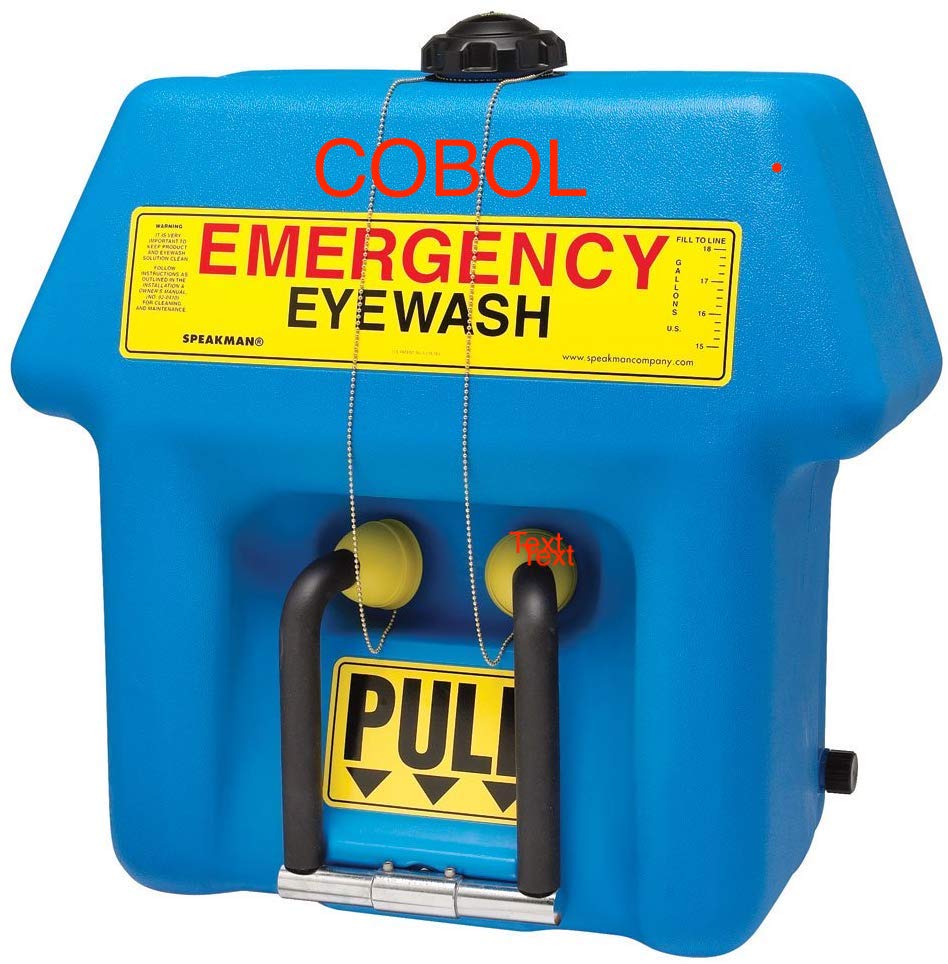
My eyes are burning, and I left my COBOL programmer safety gear at home.
Getting closer to a JCL one liner equivalent to Unix head -1.

June 14, 2019 Mainframe , , , , , , , ,

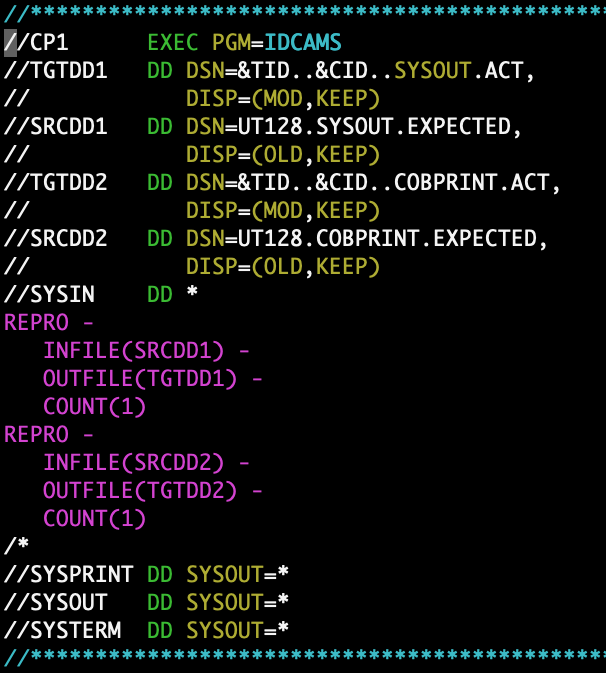
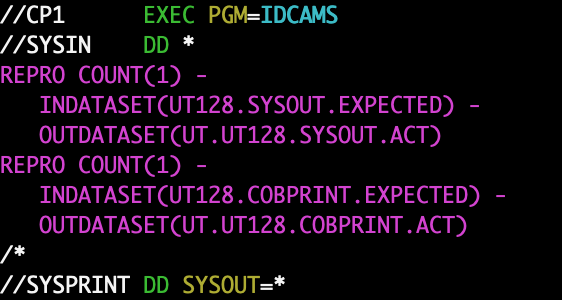
I was somewhat bemused by how much JCL it took to do the equivalent of a couple ‘head -1’ commands.  It was pointed out to me that INDATASET, OUTDATASET can be used to eliminate all the DD lines, and that all but the SYSPRINT DDs for IDCAMS were not actually required.  This allows the JCL for these pair of ‘head -1’ commands to be shortened to:

The REPRO lines still have to be split up because of the annoying punch-card derived 72 column restrictions of JCL. Note that to use OUTDATASET in this way, I had to sacrifice the JCL shell variable expansion that I had been using. To retain my shell variables (SET TID=UT; SET CID=UT128) I still need DDNAME statements to do the shell expansion in JCL proper, since that doesn’t occur in the SYSIN specification.  Translated to Unix, we must think of this sort of SYSIN “file” as being single and not double quoted (unlike a Unix <<EOF…EOF inline file where shell script are expanded).  The JCL is left reduced to:

Note that since I opted to retain the DDNAME statements, the REPRO lines are now short enough to each fit on a single line.

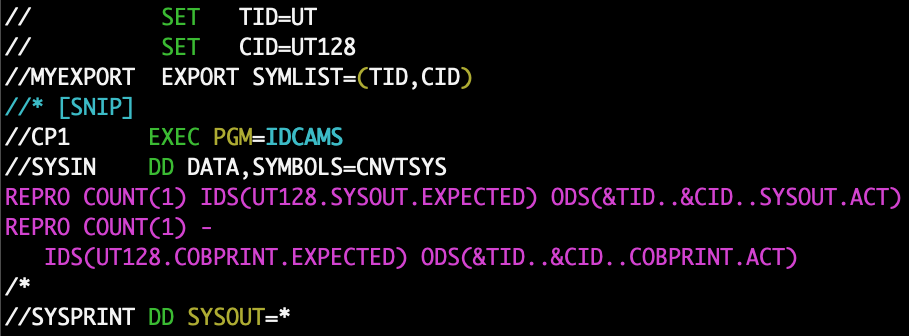
It turns out that there’s also a way to do variable expansion within the SYSIN, essentially treating something like a Unix double quoted script variable.  You need to explicitly export the symbols in the JCL prologue using EXPORT SYMLIST, and then import them in the SYSIN specification using SYMBOLS=CNVTSYS

I’ve switched to IDS and ODS to make the lines shorter, which makes it possible for one of the REPRO lines to be a one liner (with 6 lines of helper code).  The final JCL line count weighs in at 8:2 vs. Unix, but is not as bad as the original JCL I constructed (22 lines.)

JCL equivalent of head -1.

June 12, 2019 Mainframe , , , ,

Suppose you wanted to do the equivalent of the following Unix shell code on the mainframe in JCL:

head -1 < UT128.SYSOUT.EXPECTED > $TID.$CID.SYSOUT.ACT
head -1 < UT128.COBPRINT.EXPECTED > $TID.$CID.COBPRINT.ACT

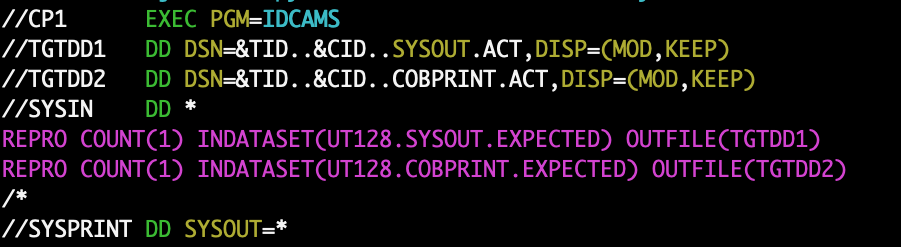
Here’s the JCL equivalent of this pair of one-liners:

There are probably shorter ways to do this, but the naive way weighs in at 22:2 lines for JCL:Unix — damn!

I can’t help but to add a punny comment that knowing JCL must have once been really good JOB security.

A library discard: ANSI COBOL WITH STRUCTURED PROGRAMMING

February 14, 2019 Mainframe ,

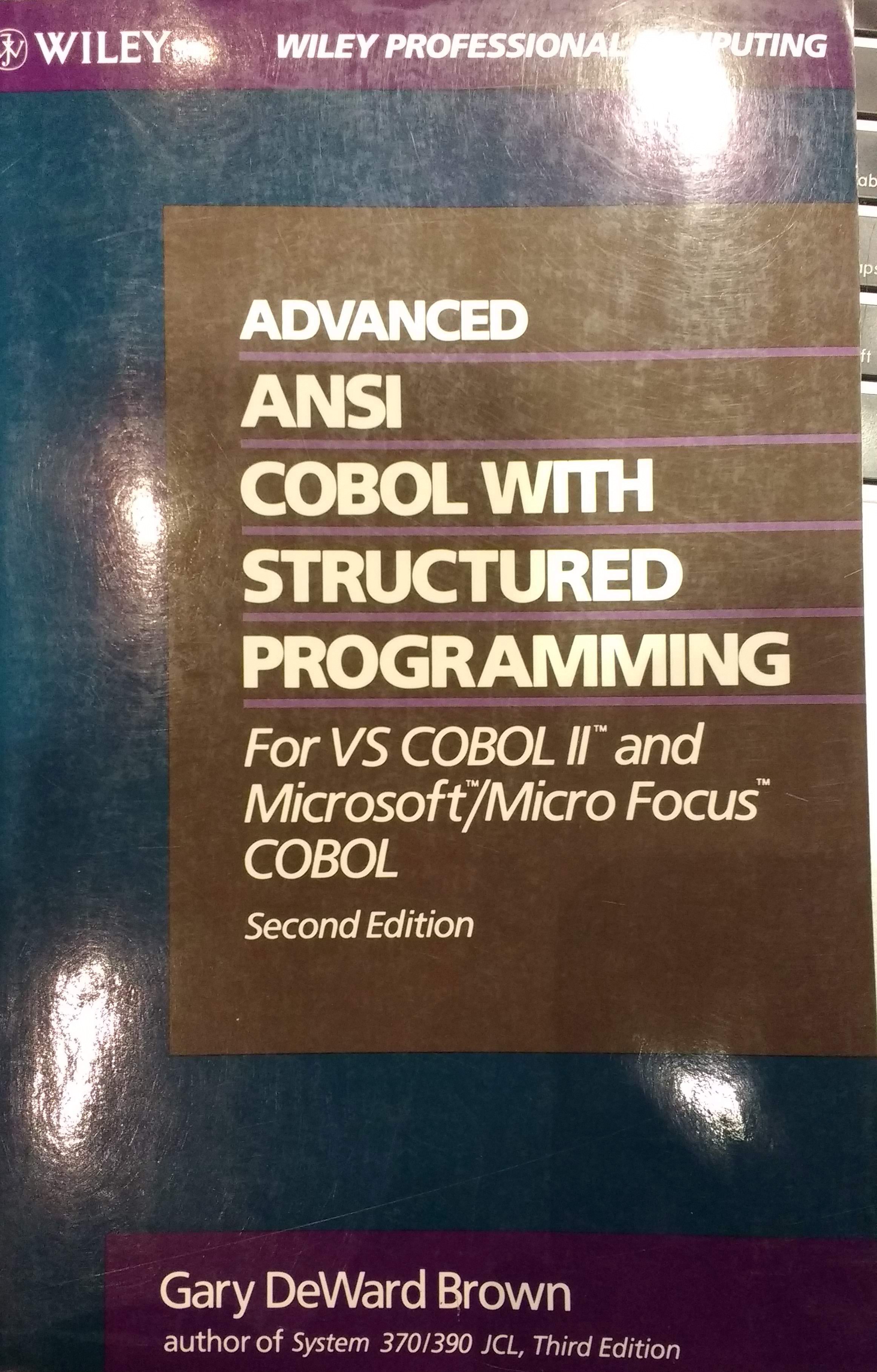
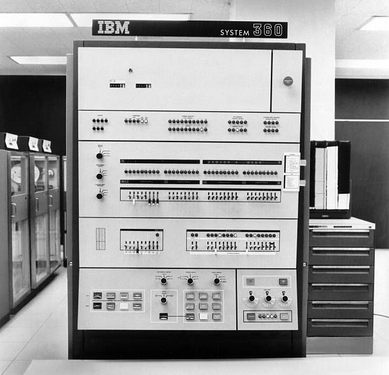
Look what I found for $2 at the public library in the no-longer-circulating discard bin

Can you believe that a book like this wasn’t flying off the shelves and ended up in the for sale box?!

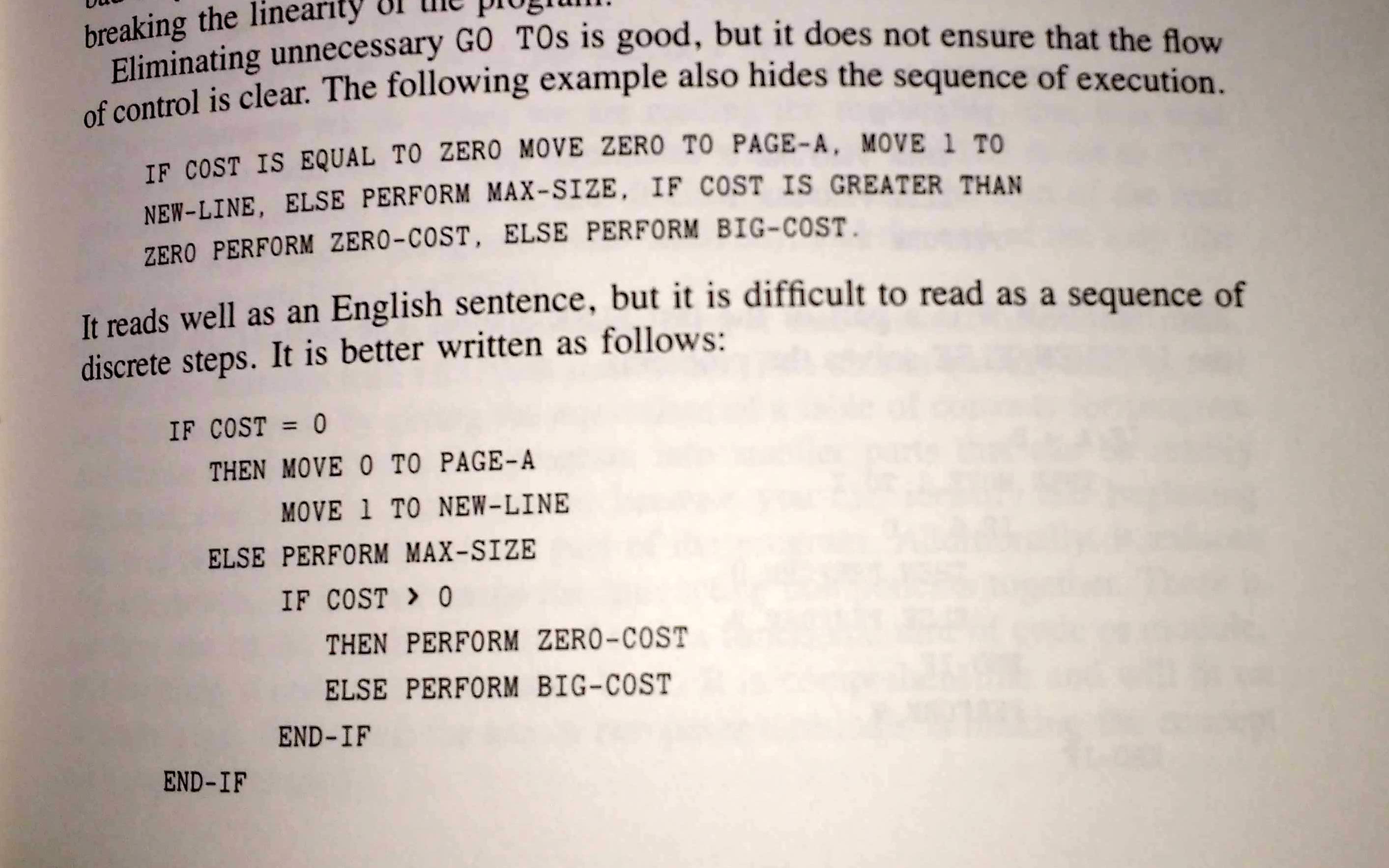
So far I quite like it, as it has a number of examples of bad COBOL style, and what you should do instead.  Example:

Ways to make COBOL source code burn your eyes less are much appreciated.  The first sample above definitely mandates a trip to the eye wash station.

Mainframe development: a story, chapter 1.

April 19, 2018 Mainframe , , , , , , , , , , , , ,

Once upon a time, in a land far from any modern developers, were languages named COBOL and PL/I, which generated programs that were consumed by a beast known as Mainframe. Developers for those languages compiled and linked their applications huddled around strange luminous green screens and piles of hole filled papers while chanting vaguely latin sounding incantations like “Om-padre-JCL-beget-loadmodule-pee-dee-ess.”

In these ancient times, version control tools like git were not available. There was no notion of makefiles, so compilation and link was a batch process, with no dependency tracking, and no parallelism. Developers used printf-style debugging, logging trace information to files.  In order to keep the uninitiated from talking to the Mainframe, files were called datasets.  In order to use graphical editors, developers had to repeatedly feed their source to the Mainframe using a slave named ftp, while praying that the evil demon EBCDIC-conversion didn’t mangle their work. The next day, they could go back and see if Mainframe accepted their offering.

[TO BE CONTINUED.]

Incidentally, as of a couple days ago, I’ve now been working for LzLabs for 2 years.  My work is not yet released, nor announced, so I can’t discuss it here yet, but it can be summarized as really awesome.  I’m still having lots of fun with my development work, even if I have to talk in languages that the beast understands.