electric field

Green’s function for the spacetime gradient (and solution of Maxwell’s equation)

October 28, 2025 math and physics play , , , , , , , , , , , , , , , , ,

[Click here for a PDF version of this post]

Motivation

I’ve been assembling a table of all the Green’s functions that can be used in electrodynamics. There’s one set of those Green’s functions left to fill in, the Green’s functions for the spacetime gradient:
\begin{equation}\label{eqn:spacetimeGradientGreens:20}
\lr{\spacegrad + \inv{c}\PD{t}{}} G(\Bx, \Bx’, t, t’) = \delta(\Bx – \Bx’)\delta(t – t’).
\end{equation}
I’d like to compute the retarded and advanced Green’s function for this operator for the 1D, 2D and 3D cases.

In [2] I use the retarded time Green’s function for the spacetime gradient to derive the Jefimenkos equations. However, in retrospect my handling of that material is sloppy. The starting point is the retarded wave equation Green’s function, but I didn’t even derive it, instead just lazily pointing to other authors that did.
I don’t actually ever state the spacetime gradient Green’s function, instead just using a sequence of intermediate results of that would be derivation. Even worse, all of that is scattered roughshod across both chapter II and III, as well as the appendix.

The idea.

Suppose that we know the Green’s functions for the wave equation
\begin{equation}\label{eqn:spacetimeGradientGreens:40}
\lr{\spacegrad^2 – \inv{c^2}\frac{\partial^2}{\partial t^2}} G_r(\Bx, \Bx’, t, t’) = \delta(\Bx – \Bx’)\delta(t – t’).
\end{equation}
\begin{equation}\label{eqn:spacetimeGradientGreens:60}
\lr{\spacegrad + \inv{c}\frac{\partial}{\partial t}} \lr{\spacegrad – \inv{c}\frac{\partial}{\partial t}} G_r(\Bx, \Bx’, t, t’) = \delta(\Bx – \Bx’)\delta(t – t’).
\end{equation}
This means that the Green’s function for the spacetime gradient, a multivector valued entity, satisfying \ref{eqn:spacetimeGradientGreens:20}, is
\begin{equation}\label{eqn:spacetimeGradientGreens:80}
G(\Bx, \Bx’, t, t’) = \lr{\spacegrad – \inv{c}\frac{\partial}{\partial t}} G_r(\Bx, \Bx’, t, t’).
\end{equation}
So if we have a Green’s function for the wave equation, it’s just a matter of taking derivatives to figure out the Green’s function for the spacetime gradient.

Why do we care? Recall that the multivector form of Maxwell’s equations is just
\begin{equation}\label{eqn:spacetimeGradientGreens:100}
\lr{\spacegrad + \inv{c}\frac{\partial}{\partial t}} F = J,
\end{equation}
so, if we know the Green’s function for this non-homogeneous problem, we may simply invert this equation for \( F \) with a convolution. This is how we can obtain the Jefimenkos equations in one fell swoop.

Now let’s evaluate these derivatives.

3D case.

Retarded case.

I’m going to start with the 3D retarded case, since I know the answer for that, and at least nominally, have all the composite parts of that derivation at hand. Then we can move on and compute the same for the advanced case, and then the 2D and 1D variants for fun. It’s not clear to me that we necessarily care about the 1D and 2D cases. I can imagine that there are circumstances where weird geometries or constraints force 1D and 2D solutions, but perhaps the 1D and 2D solutions will be academic and not practical.

Recall that the 3D retarded Green’s function for the wave equation was found to be
\begin{equation}\label{eqn:spacetimeGradientGreens:120}
G_r = -\inv{4 \pi r} \delta\lr{ t – t’ – r/c },
\end{equation}
where \( \Br = \Bx – \Bx’, r = \Abs{\Br} \).

Lemma 1.1: Gradient of \(\Abs{\Bx – \Bx’} \).

The gradient of the scalar \( r = \Abs{\Bx – \Bx’} \) is
\begin{equation*}
\spacegrad \Abs{\Bx – \Bx’} = \frac{\Br}{r}.
\end{equation*}
This will be written as \( \spacegrad r = \rcap \), with \( \rcap = \Br/r \).

Start proof:

\begin{equation}\label{eqn:spacetimeGradientGreens:140}
\begin{aligned}
\spacegrad \Abs{\Bx – \Bx’}
&=
\sum_m \Be_m \partial_m \sqrt{ \sum_n (x_n – x_n’)^2 } \\
&=
\sum_m \Be_m \inv{2} 2 \frac{x_m – x_m’}{r} \\
&=
\sum_m \Be_m \inv{2} 2 \frac{x_m – x_m’}{r} \\
&= \frac{\Br}{r}.
\end{aligned}
\end{equation}

End proof.

This means, suppressing the arguments of the delta function, that
\begin{equation}\label{eqn:spacetimeGradientGreens:160}
\begin{aligned}
\lr{ \spacegrad -(1/c) \partial_t } G_r
&= -\inv{4 \pi} \lr{
(\spacegrad r) \frac{\partial_r \delta}{r} + (\spacegrad r) \lr{ -\frac{1}{r^2}}\delta
– \inv{c r} \partial_t \delta
} \\
&= -\inv{4 \pi} \lr{ \frac{\rcap}{r} \partial_r \delta -\frac{\rcap}{r^2} \delta – \inv{c r} \partial_t \delta} \\
&= -\inv{4 \pi r} \lr{ \rcap \partial_r \delta – \frac{\rcap}{r} \delta – \inv{c} \partial_t \delta} \\
\end{aligned}
\end{equation}

Lemma 1.2: Derivatives of the delta function.

The derivative of the delta function (with respect to a non-integration variable parameter \( u \)) is
\begin{equation*}
\frac{d}{du} \delta( a u + b – t’ ) = a \delta( a u + b – t’ ) \frac{d}{dt’},
\end{equation*}
where \( t’ \) is the integration parameter for the delta function.

Observe that this is different than the usual identity
\begin{equation}\label{eqn:spacetimeGradientGreens:200}
\frac{d}{dt’} \delta(t’) = -\delta(t’) \frac{d}{dt’}.
\end{equation}

Start proof:

As usual, we figure out the meaning of these delta function derivatives by their action on a test function in a convolution.
\begin{equation}\label{eqn:spacetimeGradientGreens:220}
\int_{-\infty}^\infty \frac{d}{du} \delta( a u + b – t’ ) f(t’) dt’.
\end{equation}

Let’s start with a change of variables \( z = a u + b – t’ \), for which we find
\begin{equation}\label{eqn:spacetimeGradientGreens:240}
\begin{aligned}
t’ &= a u + b – z \\
dz &= – dt’ \\
\frac{d}{du} &= \frac{dz}{du} \frac{d}{dz} = a \frac{d}{dz}.
\end{aligned}
\end{equation}

Substitution back into \ref{eqn:spacetimeGradientGreens:220} gives
\begin{equation}\label{eqn:spacetimeGradientGreens:260}
\begin{aligned}
\int_{-\infty}^\infty \frac{d}{du} \delta( a u + b – t’ ) f(t’) dt’
&=
a \int_{\infty}^{-\infty} \lr{ \frac{d}{dz} \delta( z ) } f( a u + b – z ) (-dz) \\
&=
a \int_{-\infty}^{\infty} \lr{ \frac{d}{dz} \delta( z ) } f( a u + b – z ) dz \\
&=
\evalrange{a \delta(z) f( a u + b – z)}{-\infty}{\infty} \\
&\qquad –
a \int_{-\infty}^{\infty} \delta( z ) \frac{d}{dz} f( a u + b – z ) dz \\
&=
– \evalbar{ a \frac{d}{dz} f( a u + b – z ) }{z = 0} \\
&=
– \evalbar{ a \frac{d}{d(au + b – t’)} f( t’ ) }{t’ = a u + b} \\
&=
+ \evalbar{ a \frac{d}{d(t’ -(au + b))} f( t’ ) }{t’ = a u + b} \\
&=
\evalbar{ a \frac{dt’}{d(t’ – (a u + b))} \frac{d}{dt’} f( t’ ) }{t’ = a u + b} \\
&=
\evalbar{ a \frac{d}{dt’} f( t’ ) }{t’ = a u + b} \\
&=
\int_{-\infty}^\infty a \delta(a u + b – t’) \frac{df(t’)}{dt’} dt’.
\end{aligned}
\end{equation}

End proof.

In particular, this means that
\begin{equation}\label{eqn:spacetimeGradientGreens:280}
\begin{aligned}
\partial_r \delta(t – t’ – r/c) &= -\frac{1}{c} \delta(t – t’ – r/c) \PD{t’}{} \\
\partial_t \delta(t – t’ – r/c) &= \delta(t – t’ – r/c) \PD{t’}{} \\
\end{aligned}
\end{equation}

Application to \ref{eqn:spacetimeGradientGreens:160} gives
\begin{equation}\label{eqn:spacetimeGradientGreens:300}
\begin{aligned}
\lr{ \spacegrad -(1/c) \partial_t } G_r
&=
\inv{4 \pi r} \delta(t – t’ – r/c)
\lr{
\frac{\rcap}{r}
+
\lr{ \rcap + 1} \inv{c} \PD{t’}{}
} \\
\end{aligned}
\end{equation}
With \( t_r = t – r/c \), \ref{eqn:spacetimeGradientGreens:80} is found to be
\begin{equation}\label{eqn:spacetimeGradientGreens:320}
G(\Bx, \Bx’, t, t’) = \inv{4 \pi r} \delta(t_r – t’)
\lr{
\frac{\rcap}{r}
+
\lr{ \rcap + 1} \inv{c} \PD{t_r}{}
}
\end{equation}

Advanced case.

The advanced Green’s function for the wave equation is
\begin{equation}\label{eqn:spacetimeGradientGreens:340}
G_a(\Bx, \Bx’, t, t’) = -\inv{4 \pi r} \delta\lr{ t’ – t – r/c },
\end{equation}
so with \( t_a = t + r/c \), we must evaluate the delta function derivatives
\begin{equation}\label{eqn:spacetimeGradientGreens:360}
\begin{aligned}
\partial_r \delta\lr{ t’ – t – r/c } &= -\inv{c} \delta\lr{ t’ – t_a } \frac{d}{dt_a} \\
\partial_t \delta\lr{ t’ – t – r/c } &= – \delta\lr{ t’ – t_a } \frac{d}{dt_a}.
\end{aligned}
\end{equation}
So the Green’s function for the space time gradient is
\begin{equation}\label{eqn:spacetimeGradientGreens:380}
\begin{aligned}
G(\Bx, \Bx’, t, t’)
&= -\inv{4 \pi r} \lr{ \rcap \partial_r \delta – \frac{\rcap}{r} \delta – \inv{c} \partial_t \delta} \\
&= \inv{4 \pi r} \delta\lr{t’ – t_a} \lr{ \frac{\rcap}{r} + \lr{ \rcap – 1} \inv{c} \frac{d}{d t_a}}.
\end{aligned}
\end{equation}

Application: Maxwell’s equation.

Let’s use this to solve Maxwell’s equation. Finding a specific solution is now trivial. The retarded solution is
\begin{equation}\label{eqn:spacetimeGradientGreens:400}
\begin{aligned}
F(\Bx, t)
&= \int dV’ dt’ \gpgrade{
G(\Bx, \Bx’, t, t’) J(\Bx’, t’)
}{1,2} \\
&= \inv{ 4 \pi } \int d^3 \Bx’ dt’
\delta(t_r – t’)
\gpgrade{
\inv{r}
\lr{
\frac{\rcap}{r}
+
\lr{ \rcap + 1} \inv{c} \PD{t_r}{}
}
J(\Bx’, t’)
}{1,2} \\
&=
\inv{ 4 \pi } \int d^3 \Bx’
\gpgrade{
\inv{r}
\lr{
\frac{\rcap}{r} J(\Bx’, t_r)
+
\lr{ \rcap + 1} \inv{c} J'(\Bx’, t_r)
}
}{1,2},
\end{aligned}
\end{equation}
where \( J'(\Bx’, t_r) = \PDi{t_r}{J(\Bx’, t_r)} \).
Similarly, the advanced solution is
\begin{equation}\label{eqn:spacetimeGradientGreens:520}
F(\Bx, t) =
\inv{ 4 \pi } \int d^3 \Bx’
\gpgrade{
\inv{r}
\lr{
\frac{\rcap}{r} J(\Bx’, t_a)
+
\lr{ \rcap – 1} \inv{c} J'(\Bx’, t_a)
}
}{1,2},
\end{equation}
where derivatives are with respect to \( t_a \). In general, we are free to form a superposition of both the retarded and advanced solutions, as well as any solution of the homogeneous equation for charge and current free space \( \lr{ \spacegrad + (1/c) \partial_t } F = 0 \).

There’s a lot of abstraction baked into these solutions. One is the multivector charge and current density \( J \)
\begin{equation}\label{eqn:spacetimeGradientGreens:420}
J = \eta \lr{ c \rho – \BJ } + I \lr{ c \rho_\txtm – \BM },
\end{equation}
where \( \rho_\txtm, \BM \) are the fictitious magnetic sources that are used in engineering antenna and microwave circuit theory. We can ignore those if we choose. We also have the abstraction of the multivector field \( F = \BE + I \eta \BH = \BE + I c \BB \) itself on LHS.

Let’s unpack this solution into it’s constituent electric and magnetic field components, to see if the result looks more familiar. First note that
\begin{equation}\label{eqn:spacetimeGradientGreens:440}
\begin{aligned}
\gpgrade{\rcap J}{1}
&=
\gpgrade{
\rcap \eta \lr{ c \rho – \BJ } + \rcap I \lr{ c \rho_\txtm – \BM }
}{1} \\
&=
\eta c \rho \rcap
– I \rcap \wedge \BM \\
&=
\frac{\rho}{\epsilon} \rcap
+ \rcap \cross \BM,
\end{aligned}
\end{equation}
and
\begin{equation}\label{eqn:spacetimeGradientGreens:460}
\begin{aligned}
\gpgrade{\rcap J}{2}
&=
\gpgrade{
\rcap \eta \lr{ c \rho – \BJ } + \rcap I \lr{ c \rho_\txtm – \BM }
}{2} \\
&=
I \lr{
– \eta \rcap \cross \BJ
+ \rcap c \rho_\txtm
} \\
&=
I \eta \lr{
\BJ \cross \rcap
+ \rcap \frac{\rho_\txtm}{\mu}
}
\end{aligned}
\end{equation}
Selecting the vector and bivector components of the field \( F = \BE + I \eta \BH \), we have
\begin{equation}\label{eqn:spacetimeGradientGreens:480}
\BE(\Bx, t)
=
\inv{4 \pi \epsilon}
\int d^3 \Bx’
\lr{
\frac{\rho}{r^2} \rcap
+ \frac{\rho’}{c r} \rcap
+ \epsilon \frac{\rcap}{r^2} \cross \BM
+ \frac{\epsilon \rcap}{c r} \cross \BM’
\mp \frac{1}{c^2 r} \BJ’
}
\end{equation}
and
\begin{equation}\label{eqn:spacetimeGradientGreens:500}
\BH(\Bx, t)
=
\inv{4 \pi \mu}
\int d^3 \Bx’
\lr{
\frac{\rho_\txtm}{r^2} \rcap
+ \frac{\rho_\txtm}{c r} \rcap
+ \mu \BJ \cross \frac{\rcap}{r^2}
+ \mu \BJ’ \cross \frac{\rcap}{c r}
\mp \inv{c^2 r} \BM’
},
\end{equation}
where the negative sign is for the retarded solution, with times and derivatives with respect to the retarded time \( t_r = t – \Abs{\Bx – \Bx’}/c \), and the positive case for the advanced solutions where times are evaluated at the advanced time \( t_a = t + \Abs{\Bx – \Bx’}/c \).
For the retarded case, if we zero the fictitious sources, setting \( \rho_\txtm = 0, \BM = 0 \), these are Jefimenko’s equations, as seen in [1]. Griffiths derives them by first solving for the potential functions that solve the 2nd order scalar wave equation problem, and then computing all the derivatives.

1D case.

The Green’s function for the 1D spacetime gradient is easy to compute
\begin{equation}\label{eqn:spacetimeGradientGreens:540}
\begin{aligned}
G
&= -\frac{c}{2} \lr{ \spacegrad – \inv{c} \partial_t } \Theta(\pm (t – t’) – r/c) \\
&=
-\frac{c}{2} \lr{
-\inv{c} \rcap – \inv{c} (\pm 1)
}
\delta(\pm (t – t’) – r/c) \\
&=
\inv{2} \lr{ \rcap \pm 1 } \delta(\pm (t – t’) – r/c).
\end{aligned}
\end{equation}

2D case.

The Green’s function for the 2D spacetime gradient is
\begin{equation}\label{eqn:spacetimeGradientGreens:560}
G = -\inv{2 \pi}
\lr{ \spacegrad – \inv{c} \partial_t }
\frac{\Theta(\pm (t – t’) – r/c) }{
\sqrt{\lr{ \tau^2 – r^2/c^2 }}
}.
\end{equation}

The derivatives of the step are
\begin{equation}\label{eqn:spacetimeGradientGreens:580}
\begin{aligned}
\lr{ \spacegrad – \inv{c} \partial_t } \Theta(\pm (t – t’) – r/c)
&=
\lr{
-\inv{c} \rcap -\inv{c} (\pm 1)
}
\delta(\pm (t – t’) – r/c) \\
&=
-\inv{c} \lr{ \rcap \pm 1 }
\delta(\pm \tau – r/c).
\end{aligned}
\end{equation}
and the derivatives of the denominator is
\begin{equation}\label{eqn:spacetimeGradientGreens:600}
\begin{aligned}
\lr{ \spacegrad – \inv{c} \partial_t }
\lr{(t – t’)^2 – r^2/c^2}^{-1/2}
&=
-\inv{2}(2) \lr{ -\inv{c^2} r \rcap -\inv{c} (t – t’) }
\lr{(t – t’)^2 – r^2/c^2}^{-3/2} \\
&=
\inv{c^2} \lr{ \Br + c \tau }
\lr{\tau^2 – r^2/c^2}^{-3/2}.
\end{aligned}
\end{equation}
so
\begin{equation}\label{eqn:spacetimeGradientGreens:620}
G(r, \tau) =
\frac{
\lr{\tau^2 – r^2/c^2}^{-3/2}
}{2 \pi c^2}
\lr{
c \lr{ \rcap \pm 1 }
\lr{\tau^2 – r^2/c^2}
\delta(\pm \tau – r/c)
-\lr{ \Br + c \tau }
\Theta(\pm \tau – r/c)
}.
\end{equation}

References

[1] David Jeffrey Griffiths and Reed College. Introduction to electrodynamics. Prentice hall Upper Saddle River, NJ, 3rd edition, 1999.

[2] Peeter Joot. Geometric Algebra for Electrical Engineers. Kindle Direct Publishing, Toronto, 2019.

Transverse electric and magnetic field relations.

August 10, 2025 math and physics play , , , , , , , , , , , , , , ,

[Click here for a PDF version of this post]

I found a sign error in my book. Here’s I’ll re-derive all the results for myself here in a standalone fashion, also verifying signs as I go.

Setup

Suppose that a field is propagating in a medium along the z-axis. We may represent that field as the real part of
\begin{equation}\label{eqn:transverseField:20}
F = F(x,y) e^{j(\omega t – k z)}.
\end{equation}
This is a doubly complex relationship, as we have a scalar complex imaginary \( j \), as well as the spatial imaginary \(I = \Be_1 \Be_2 \Be_3 \) that is part of the multivector field itself
\begin{equation}\label{eqn:transverseField:40}
F = \BE + I \eta \BH.
\end{equation}

Let’s call
\begin{equation}\label{eqn:transverseField:60}
F_z = \lr{ \BE \cdot \Be_3} \Be_3 + I \eta \lr{ \BH \cdot \Be_3 } \Be_3,
\end{equation}
the propagation component of the field and \( F_t = F – F_z \) the transverse component of the field. We can write these in a more symmetric fashion by expanding the dot products and regrouping
\begin{equation}\label{eqn:transverseField:80}
\begin{aligned}
F_z
&= \lr{ \BE \cdot \Be_3} \Be_3 + I \eta \lr{ \BH \cdot \Be_3 } \Be_3 \\
&= \inv{2} \lr{ \BE \Be_3 + \Be_3 \BE } \Be_3 + \frac{I \eta}{2} \lr{ \BH \Be_3 + \Be_3 \BH} \Be_3 \\
&= \inv{2} \lr{ \BE + \Be_3 \BE \Be_3 } + \frac{I \eta}{2} \lr{ \BH + \Be_3 \BH \Be_3} \Be_3 \\
&= \inv{2} \lr{ F + \Be_3 F \Be_3 }.
\end{aligned}
\end{equation}
By subtraction, we also have
\begin{equation}\label{eqn:transverseField:100}
F_t = \inv{2} \lr{ F – \Be_3 F \Be_3 }.
\end{equation}

Relating the transverse and propagation direction fields

The multivector form of Maxwell’s equation, for source free conditions, is
\begin{equation}\label{eqn:transverseField:120}
0 = \lr{ \spacegrad + \inv{c} \partial_t } F.
\end{equation}
We split the gradient into a propagation direction component and a transverse component \( \spacegrad_t \)
\begin{equation}\label{eqn:transverseField:140}
\spacegrad = \spacegrad_t + \Be_3 \partial_z,
\end{equation}
so
\begin{equation}\label{eqn:transverseField:160}
\begin{aligned}
0
&= \lr{ \spacegrad_t + \Be_3 \partial_z + \inv{c} \partial_t } F \\
&= \lr{ \spacegrad_t + \Be_3 \partial_z + \inv{c} \partial_t } F(x,y) e^{j(\omega t – k z) } \\
&= \lr{ \spacegrad_t – j\Be_3 k + j\frac{\omega}{c} } F(x,y) e^{j(\omega t – k z) },
\end{aligned}
\end{equation}
or
\begin{equation}\label{eqn:transverseField:180}
-j \lr{ \frac{\omega}{c} – k \Be_3 } F = \spacegrad_t F.
\end{equation}

Observe that
\begin{equation}\label{eqn:transverseField:200}
-j \lr{ \frac{\omega}{c} – k \Be_3 } \Be_3 F \Be_3 = -\spacegrad_t \Be_3 F \Be_3,
\end{equation}
which means that
\begin{equation}\label{eqn:transverseField:220}
-j \lr{ \frac{\omega}{c} – k \Be_3 } \inv{2} \lr{ F \pm \Be_3 F \Be_3 } = \spacegrad_t \inv{2} \lr{ F \mp \Be_3 F \Be_3 },
\end{equation}
or
\begin{equation}\label{eqn:transverseField:240}
\begin{aligned}
-j \lr{ \frac{\omega}{c} – k \Be_3 } F_z &= \spacegrad_t F_t \\
-j \lr{ \frac{\omega}{c} – k \Be_3 } F_t &= \spacegrad_t F_z.
\end{aligned}
\end{equation}

Provided \( \omega^2 \ne k^2 c^2 \), this can be inverted, meaning that \( F_t \) fully specifies \( F_z \) if known, as well as the opposite.

That inversion provides the propagation direction field in terms of the transverse
\begin{equation}\label{eqn:transverseField:260a}
F_z = j \frac{ \frac{\omega}{c} + k \Be_3 }{ \omega^2 \mu \epsilon – k^2 } \spacegrad_t F_t,
\end{equation}
and the transverse field in terms of the propagation direction field
\begin{equation}\label{eqn:transverseField:260b}
F_t = j \frac{ \frac{\omega}{c} + k \Be_3 }{ \omega^2 \mu \epsilon – k^2 } \spacegrad_t F_z.
\end{equation}

Transverse field in terms of propagation

Let’s expand \ref{eqn:transverseField:260b} in terms of component electric and magnetic fields. First note that
\begin{equation}\label{eqn:transverseField:280}
\begin{aligned}
\spacegrad_t F_z
&= \spacegrad_t \Be_3 \lr{ E_z + I \eta H_z } \\
&= -\Be_3 \spacegrad_t \lr{ E_z + I \eta H_z }.
\end{aligned}
\end{equation}
so
\begin{equation}\label{eqn:transverseField:300}
F_t = -j \frac{ \frac{\omega}{c} \Be_3 + k }{ \omega^2 \mu \epsilon – k^2 } \spacegrad_t \lr{ E_z + I \eta H_z }.
\end{equation}
This may now be split into electric and magnetic fields, but first note that the multivector operator
\begin{equation}\label{eqn:transverseField:320}
\begin{aligned}
\Be_3 \spacegrad_t
&=
\Be_3 \cdot \spacegrad_t + \Be_3 \wedge \spacegrad_t \\
&=
\Be_3 \wedge \spacegrad_t,
\end{aligned}
\end{equation}
has only a bivector component.

For the transverse electric field component, we have
\begin{equation}\label{eqn:transverseField:340}
\begin{aligned}
\gpgradeone{ \lr{ \frac{\omega}{c} \Be_3 + k } \spacegrad_t \lr{ E_z + I \eta H_z } }
&=
k \spacegrad_t E_z + \frac{\omega}{c} \Be_3 \wedge \spacegrad_t \lr{ I \eta H_z } \\
&=
k \spacegrad_t E_z – \frac{\eta \omega}{c} \Be_3 \cross \spacegrad_t H_z.
\end{aligned}
\end{equation}
and for the magnetic field component
\begin{equation}\label{eqn:transverseField:360}
\begin{aligned}
\gpgradetwo{ \lr{ \frac{\omega}{c} \Be_3 + k } \spacegrad_t \lr{ E_z + I \eta H_z } }
=
\frac{\omega}{c} \Be_3 \wedge \spacegrad_t E_z + I \eta k \spacegrad_t H_z
\end{aligned}
\end{equation}

This means that
\begin{equation}\label{eqn:transverseField:380}
\begin{aligned}
\BE_t &= \frac{j}{\omega^2 \mu \epsilon – k^2 } \lr{ -k \spacegrad_t E_z + \frac{\eta \omega}{c} \Be_3 \cross \spacegrad_t H_z } \\
\eta I \BH_t &= -\frac{j}{\omega^2 \mu \epsilon – k^2 } \lr{ \frac{\omega}{c} \Be_3 \wedge \spacegrad_t E_z + I \eta k \spacegrad_t H_z }
\end{aligned}
\end{equation}

Cancelling out the \( \eta I \) factors in the magnetic field component, and substituting \( \eta/c = \mu, 1/(c\eta) = \epsilon \), leaves us with
\begin{equation}\label{eqn:transverseField:400}
\begin{aligned}
\BE_t &= \frac{j}{\omega^2 \mu \epsilon – k^2 } \lr{ -k \spacegrad_t E_z + \mu \omega \Be_3 \cross \spacegrad_t H_z } \\
\BH_t &= -\frac{j}{\omega^2 \mu \epsilon – k^2 } \lr{ \epsilon \omega \Be_3 \cross \spacegrad_t E_z + k \spacegrad_t H_z }.
\end{aligned}
\end{equation}

Propagation field in terms of transverse.

Now let’s invert \ref{eqn:transverseField:260a}. We seek the grade selections
\begin{equation}\label{eqn:transverseField:420}
\gpgrade{ \lr{ \frac{\omega}{c} + k \Be_3 } \spacegrad_t F_t }{1,2}
\end{equation}

Performing each of these four grade selections in turn, for the \( \spacegrad_t F_t \) products we have
\begin{equation}\label{eqn:transverseField:440}
\begin{aligned}
\gpgradeone{ \spacegrad_t F_t }
&=
\gpgradeone{ \spacegrad_t \lr{ \BE_t + I \eta \BH_t } } \\
&=
\eta \gpgradeone{ I \spacegrad_t \BH_t } \\
&=
\eta I \lr{ \spacegrad_t \wedge \BH_t } \\
&=
-\eta \lr{ \spacegrad_t \cross \BH_t }.
\end{aligned}
\end{equation}
Because \( \spacegrad_t \BE_t \) has only 0,2 grades, so the grade-one selection was zero, leaving us with only \( \BH_t \) dependence.

For the grade two selection of the same, we have
\begin{equation}\label{eqn:transverseField:460}
\begin{aligned}
\gpgradetwo{ \spacegrad_t F_t }
&=
\gpgradetwo{ \spacegrad_t \lr{ \BE_t + I \eta \BH_t } } \\
&=
\spacegrad_t \wedge \BE_t \\
&=
I \lr{ \spacegrad_t \cross \BE_t }.
\end{aligned}
\end{equation}
This time we note that the vector-bivector product \( \spacegrad_t (I \BH_t) \) has only 1,3 grades, and is killed by the grade-2 selection.

For the \( \Be_3 \spacegrad_t F_t \) products, we have
\begin{equation}\label{eqn:transverseField:480}
\begin{aligned}
\gpgradeone{ \Be_3 \spacegrad_t F_t }
&=
\gpgradeone{ \Be_3 \spacegrad_t \lr{ \BE_t + I \eta \BH_t } } \\
&=
\gpgradeone{ \lr{ \Be_3 \cdot \spacegrad_t + \Be_3 \wedge \spacegrad_t } \BE_t }
+
\eta \gpgradeone{ I \Be_3 \lr{ \spacegrad_t \cdot \BH_t + \spacegrad_t \wedge \BH_t } } \\
&=
\gpgradeone{ I \lr{ \Be_3 \cross \spacegrad_t } \BE_t } \\
&=
-\lr{ \Be_3 \cross \spacegrad_t } \cross \BE_t.
\end{aligned}
\end{equation}
Observe that we’ve made use of \( \Be_3 \cdot \spacegrad_t = 0 \), regardless of what it operates on. For the \( \BH_t \) dependence, we had a bivector-scalar product \( (I \Be_3) (\spacegrad_t \cdot \BH_t) \), and a bivector-bivector product \( (I \Be_3) (\spacegrad_t \wedge \BH_t) \), neither of which have any vector grades.

Finally
\begin{equation}\label{eqn:transverseField:500}
\begin{aligned}
\gpgradetwo{ \Be_3 \spacegrad_t F_t }
&=
\eta \gpgradetwo{ I \Be_3 \spacegrad_t \BH_t } \\
&=
-\eta \gpgradetwo{ \lr{\Be_3 \cross \spacegrad_t} \BH_t } \\
&=
-\eta I \lr{\Be_3 \cross \spacegrad_t} \cross \BH_t.
\end{aligned}
\end{equation}
Here we’ve discarded the \( \BE_t \) dependent terms, since the bivector-vector product \( \lr{ \Be_3 \wedge \spacegrad_t } \BE_t \) has only grades 1,3, and we seek grade 2 only.

Putting all the pieces together, noting that \( \eta/c = \mu \) and \( 1/(c \eta) = \epsilon \), we have
we have
\begin{equation}\label{eqn:transverseField:520}
\BE_z = -\frac{j}{\omega^2 \mu \epsilon – k^2 } \lr{ \omega \mu \lr{ \spacegrad_t \cross \BH_t } + k \lr{ \Be_3 \cross \spacegrad_t } \cross \BE_t },
\end{equation}
and
\begin{equation}\label{eqn:transverseField:540}
\BH_z = \frac{j}{\omega^2 \mu \epsilon – k^2 } \lr{ \omega \epsilon \lr{ \spacegrad_t \cross \BE_t } – k \lr{\Be_3 \cross \spacegrad_t} \cross \BH_t }.
\end{equation}

Electric fields for ring and disk charge distributions (along the central axis.)

February 5, 2025 math and physics play , , , , , , , ,

[Click here for a PDF version of this post]

Motivation: explain field formulas in an engineering problem set.

The following equations were given in a problem set for the magnitude of the electric field strength at a point \( z \) due to symmetric ring and disk charge distributions respectively:
\begin{equation}\label{eqn:ringAndDiskField:20}
E = \frac{q z}{4 \pi \epsilon_0 \lr{ z^2 + R^2 }^{3/2} },
\end{equation}
\begin{equation}\label{eqn:ringAndDiskField:40}
E = \frac{\sigma}{2 \epsilon_0} \lr{ 1 – \frac{ z }{\sqrt{ z^2 + R^2 }} }.
\end{equation}

While these were given as black box results to use in a few superposition problems, there isn’t actually any magic required to find these, provided one knows how to perform some line and area integrals.

Electric field due to charge distributions.

Assuming that we are talking about stationary charges, we have only an electric field. Recall that the field, measured at a point \( \Bx \) for a single stationary point situated at point \( \Bx’ \) is
\begin{equation}\label{eqn:ringAndDiskField:60}
\BE(\Bx) = \inv{4 \pi \epsilon_0} \frac{ q \lr{ \Bx – \Bx’ }}{\Norm{\Bx – \Bx’}^3 }.
\end{equation}
If we want to find the field due to charges \( q_k \) at points \( \Bx_k \), then we just sum over all those charges
\begin{equation}\label{eqn:ringAndDiskField:80}
\BE(\Bx) = \inv{4 \pi \epsilon_0} \sum_k \frac{ q_k \lr{ \Bx – \Bx_k }}{\Norm{\Bx – \Bx_k}^3 }.
\end{equation}
This sum can be extended to a continuous charge density. If \( \rho(\Bx) \) represents the charge per unit volume situated at point \( \Bx \), then the field due to that continuous charge density is
\begin{equation}\label{eqn:ringAndDiskField:100}
\BE(\Bx) = \inv{4 \pi \epsilon_0} \int dV’ \frac{ \rho(\Bx’) \lr{ \Bx – \Bx’ }}{\Norm{\Bx – \Bx’}^3 }.
\end{equation}
Similarly, if \( \sigma(\Bx) \) represents the charge per unit area for at point \( \Bx \), then the field due to that continuous surface charge density is
\begin{equation}\label{eqn:ringAndDiskField:120}
\BE(\Bx) = \inv{4 \pi \epsilon_0} \int dA’ \frac{ \sigma(\Bx’) \lr{ \Bx – \Bx’ }}{\Norm{\Bx – \Bx’}^3 }.
\end{equation}
Finally, if \( \lambda(\Bx) \) represents the charge per unit length situated at point \( \Bx \), then the field due to that continuous linear charge density is
\begin{equation}\label{eqn:ringAndDiskField:140}
\BE(\Bx) = \inv{4 \pi \epsilon_0} \int dl’ \frac{ \lambda(\Bx’) \lr{ \Bx – \Bx’ }}{\Norm{\Bx – \Bx’}^3 }.
\end{equation}
At least theoretically, given any set of charge distributions, it’s just a matter of integration to find the corresponding electric field at any point. It happens that these integrals can be tricky, but we can get lucky when the charge configurations have special symmetries, as in the problem set formulas.

Ring charge distribution.

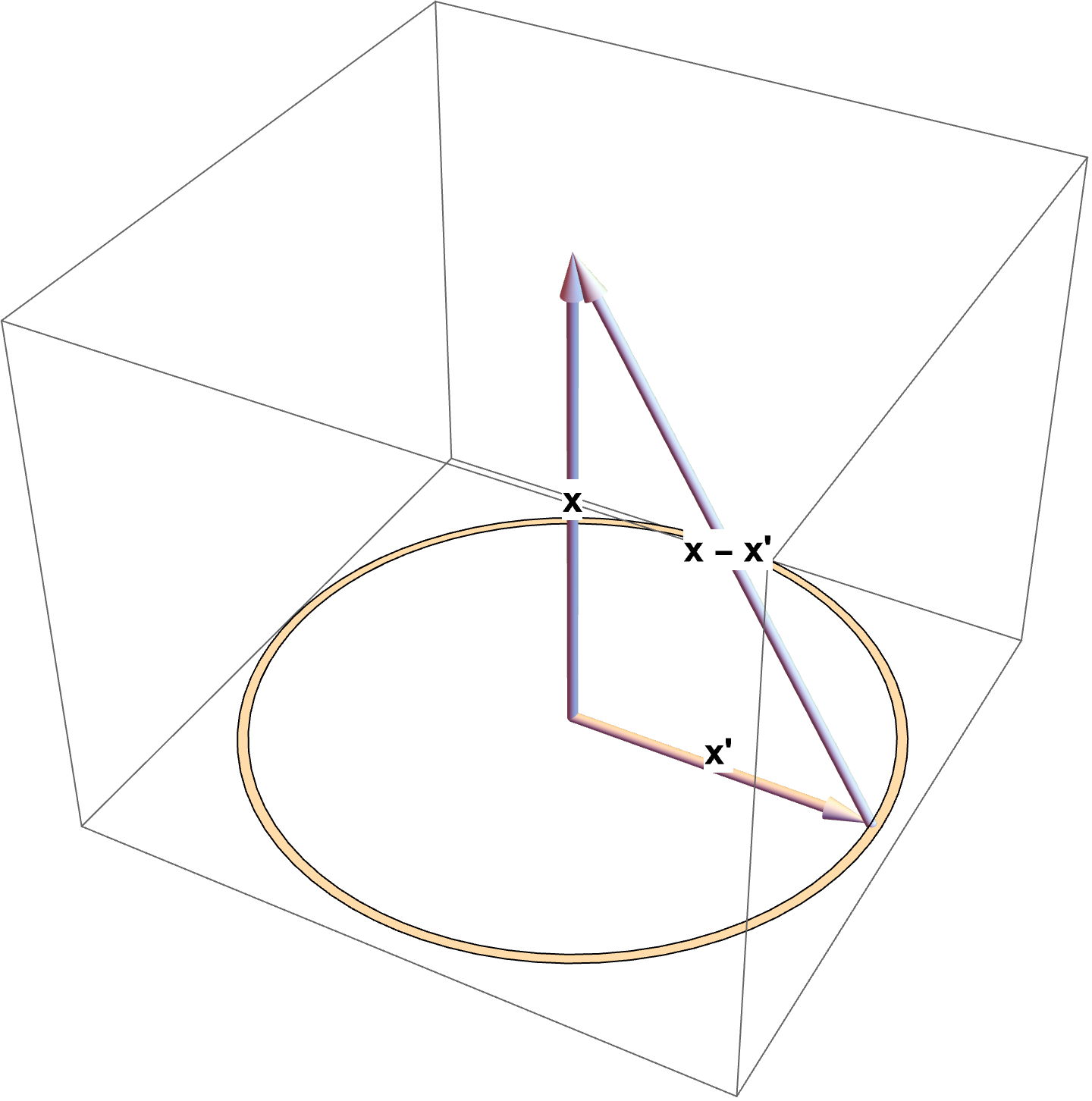
Let’s compute the electric field at a point along the axis of a ring charge distribution. I’ll use \( \setlr{ \Be_1, \Be_2, \Be_3 } \) to represent the standard basis direction vectors. We are considering the geometry of fig. 1.

fig. 1. Circular ring charge distribution.

The point on the central axis can be written as
\begin{equation}\label{eqn:ringAndDiskField:160}
\Bx = z \Be_3,
\end{equation}
and the points on the ring are
\begin{equation}\label{eqn:ringAndDiskField:180}
\Bx'(\theta) = R \lr{ \Be_1 \cos\theta + \Be_2 \sin\theta },
\end{equation}
then
\begin{equation}\label{eqn:ringAndDiskField:200}
\Bx – \Bx’ = z \Be_3 – R \lr{ \Be_1 \cos\theta + \Be_2 \sin\theta },
\end{equation}
and
\begin{equation}\label{eqn:ringAndDiskField:220}
\Norm{\Bx – \Bx’}^2 = z^2 + R^2.
\end{equation}
Since \( R d\theta \) is the length of a segment of the ring, the charge on that segment is \( R d\theta \lambda \), and the field is
\begin{equation}\label{eqn:ringAndDiskField:240}
\begin{aligned}
\BE(\Bx)
&= \inv{4 \pi \epsilon_0} \int_{\theta =0}^{2 \pi} R d\theta \lambda \frac{z \Be_3 – R \lr{ \Be_1 \cos\theta + \Be_2 \sin\theta }}{\lr{ z^2 + R^2 }^{3/2} } \\
&= \inv{4 \pi \epsilon_0} \frac{2 \pi R z \Be_3 }{ \lr{ z^2 + R^2 }^{3/2} }.
\end{aligned}
\end{equation}
Observe that the integral of the \( \sin\theta \) and \( \cos\theta \) components are zero, since we are integrating over a full period. Finally, since the total charge is \( q = 2 \pi R \lambda \), we have
\begin{equation}\label{eqn:ringAndDiskField:260}
\BE(0, 0, z) = \inv{4 \pi \epsilon_0} \frac{q z \Be_3 }{ \lr{ z^2 + R^2 }^{3/2} }.
\end{equation}
This recovers the equation from the problem set, with the only difference being the explicit inclusion of the direction vector, which was implied in the problem statement.

Field of a disk.

The setup above can be used to state the integral to solve for the field of a disk. The area of a segment of the disk is \( r dr d\theta \), so the charge of that fragment is \( r dr d\theta \sigma \), so the field is
\begin{equation}\label{eqn:ringAndDiskField:280}
\begin{aligned}
\BE(\Bx)
&= \inv{4 \pi \epsilon_0} \int_{r = 0}^R \int_{\theta =0}^{2 \pi} r dr d\theta \sigma \frac{z \Be_3 – r \lr{ \Be_1 \cos\theta + \Be_2 \sin\theta }}{\lr{ z^2 + r^2 }^{3/2} } \\
&= \frac{\sigma z \Be_3}{2 \epsilon_0} \int_{r = 0}^R dr \frac{r}{\lr{ z^2 + r^2 }^{3/2} }.
\end{aligned}
\end{equation}
As before, when evaluating the \( \theta \) integral, the sinusoidal components are killed. Since \( \int_0^{2 \pi} d\theta = 2 \pi \), we have a nice cancellation of \( 2 \pi \) downstairs.
Finally, provided \( z \ne 0 \),
\begin{equation}\label{eqn:ringAndDiskField:300}
\int_{r = 0}^R dr \frac{r}{\lr{ z^2 + r^2 }^{3/2} } = \inv{\Abs{z}} – \inv{\sqrt{ z^2 + R^2 }},
\end{equation}
so the electric field is
\begin{equation}\label{eqn:ringAndDiskField:320}
\BE(0, 0, z) = \frac{ \sigma }{2 \epsilon_0 } \lr{ \mathrm{sgn}(z) – \frac{z}{\sqrt{z^2 + R^2}} },
\end{equation}
where \( \mathrm{sgn}(z) \) is the sign of \( z \). We see that the equation provided in the problem set is actually only true for \( z > 0 \), and needs a sign correction otherwise.

Potentials in geometric algebra.

December 2, 2023 math and physics play , , , , , , , , , , , , , , , , , , , ,

[Click here for a PDF version of this post]

Conventional formulation.

The idea behind introducing the scalar potential \( \phi \) and vector potential \( \BA \) is that we can impose a constraint on the form of our observable fields \( \BE, \BB \), (or \( \BD, \BH \)), that reduces the complexity and coupling of Maxwell’s equations. These potentials are not unique, but the types of allowed variations in those potentials (gauge transformations) do not change the observable fields.

The basic idea is that we are looking for representations of the fields that automatically satisfy the pair of source free Maxwell’s equations
\begin{equation}\label{eqn:gapotentials:40}
\begin{aligned}
\spacegrad \cdot \BB &= 0 \\
c \partial_0 \BB + \spacegrad \cross \BE &= 0,
\end{aligned}
\end{equation}
so that the problem is reduced to solving just the remaining source dependent Maxwell’s equations.

The conventional way of constructing these potentials makes use of the identities
\begin{equation}\label{eqn:gapotentials:60}
\begin{aligned}
\spacegrad \cdot \lr{ \spacegrad \cross \Bf } &= 0 \\
\spacegrad \cross \lr{ \spacegrad \chi } &= 0,
\end{aligned}
\end{equation}
where \( \Bf \) is a vector, and \( \chi \) is a scalar. This approach is straightforward. Instead of replicating it, here are a few well known references where such a treatment can be found

  1. section 18-6 potentials and the wave equation in [2] (available online),
  2. section 10.1 The potential formulation in [3], and
  3. section 6.4 Vector and Scalar Potentials, in [4],

Multivector potentials in geometric algebra.

The multivector form of Maxwell’s equation is
\begin{equation}\label{eqn:gapotentials:820}
\lr{ \spacegrad + \partial_0 } F = J,
\end{equation}
where \( \partial_0 = (1/c)\partial/\partial t \), the electromagnetic field \( F = \BE + I c \BB = \BE + I \eta H \) has grades(1,2), and a multivector charge and current density \( J \). Grades(0,1) of the current are the charge and current densities respectively, and if desired, the grade(2,3) portion of the current has the fictitious magnetic charge and current densities (used in microwave and antenna engineering.)

It’s best to consider the case of electric sources, separately from the case of (fictitious) magnetic sources, and then use superposition to construct a potential representation that includes both.

We require a tool, that generalizes the \(\mathbb{R}^3\) cross product curl identities above.

Lemma 1.1: Curl of curl.

Let \( A \in \bigwedge^k \) be a blade of grade \( k \). Then
\begin{equation*}
\nabla \wedge \nabla \wedge A = 0.
\end{equation*}

Observe that for scalar \( A \), this reduces to
\begin{equation}\label{eqn:gapotentials:1740}
\nabla \wedge \nabla A = 0.
\end{equation}
We’ve recently proved this, so we won’t do it again now.

Now we are ready to figure out the structure of the potentials.

Case I. No (fictitious) magnetic sources.

Without magnetic sources, Maxwell’s equation is
\begin{equation}\label{eqn:gapotentials:840}
\lr{ \spacegrad + \partial_0 } F = \gpgrade{J}{0,1},
\end{equation}
This can be split into two equations, one that has just the sources, and one that is source free
\begin{equation}\label{eqn:gapotentials:860}
\gpgrade{ \lr{ \spacegrad + \partial_0 } F }{0,1} = \gpgrade{J}{0,1},
\end{equation}
\begin{equation}\label{eqn:gapotentials:880}
\gpgrade{ \lr{ \spacegrad + \partial_0 } F }{2,3} = 0.
\end{equation}
If you are clever, or have the benefit of having worked out the answer already, you can look directly at \ref{eqn:gapotentials:880} and guess the multivector form for the potential. Hint: you want something closely related to \( F = \lr{ \spacegrad – \partial_0 } A \), where \( A \) has grades(0,1).

If you aren’t that clever, or don’t have a time machine that let’s you look that clever, you’ll have to work it out systematically like the rest of us. We can start by breaking down \( F \) into it’s constituent observer dependent fields. That means that we want to find values for \( \BE, \BH \) that satisfy
\begin{equation}\label{eqn:gapotentials:900}
\gpgrade{ \lr{ \spacegrad + \partial_0 } \lr{ \BE + I \eta \BH } }{2,3} = 0.
\end{equation}
Expanding the multivector factors gives us
\begin{equation}\label{eqn:gapotentials:920}
\begin{aligned}
\gpgrade{ \lr{ \spacegrad + \partial_0 } \lr{ \BE + I \eta \BH } }{2,3}
&=\gpgradetwo{\spacegrad \BE} + \gpgradethree{I \eta \spacegrad \BH} + I \eta \partial 0 \BH \\
&=
\spacegrad \wedge \BE
+ \spacegrad \wedge \lr{ I \eta \BH }
+ I \eta \partial_0 \BH.
\end{aligned}
\end{equation}
Splitting this into one equation for each grade, leaves us with
\begin{equation}\label{eqn:gapotentials:940}
0 = \spacegrad \wedge \BE + I \eta \partial_0 \BH
\end{equation}
\begin{equation}\label{eqn:gapotentials:960}
0 = \spacegrad \wedge \lr{ I \eta \BH }.
\end{equation}
Observe that we could have also written \ref{eqn:gapotentials:960} as \( 0 = I \eta \lr{ \spacegrad \cdot \BH } \), which is the starting point of the conventional non-GA approach.
It’s clear that we want to write \( I \eta \BH = I c \BB \) as a (bivector) curl, and let
\begin{equation}\label{eqn:gapotentials:980}
I \eta \BH = c \spacegrad \wedge \BA.
\end{equation}
It’s a bit sneaky to toss that factor of \( c \) in here, but that’s done to make the units of \( \BA \) turn out in a way that matches the conventional vector potential. If it makes you feel better, you can think of this as an undetermined constant multiplicative undetermined factor that will be used to adjust the dimensions of \( \BA \) down the line.

Having made that choice, \ref{eqn:gapotentials:960} is automatically satisfied, and \ref{eqn:gapotentials:940} is reduced to
\begin{equation}\label{eqn:gapotentials:1000}
\begin{aligned}
0
&= \spacegrad \wedge \BE + I \eta \partial_0 \BH \\
&= \spacegrad \wedge \BE + \partial_0 \spacegrad \wedge \lr{ c \BA } \\
&= \spacegrad \wedge \lr{ \BE + c \partial_0 \BA }.
\end{aligned}
\end{equation}
We can now let
\begin{equation}\label{eqn:gapotentials:1020}
\BE + \partial_0 c \BA = -\spacegrad \phi.
\end{equation}
Again, we had the option of including an arbitrary multiplicative constant, but this time, we managed to find the right switch for our time machine, and look ahead to see that we want that constant to be \( -1 \) in order to have agreement with the conventional result.

We are left with a potential construction for our individual field components
\begin{equation}\label{eqn:gapotentials:1040}
\begin{aligned}
\BE &= -\spacegrad \phi – c \partial_0 \BA \\
I \eta \BH &= c \spacegrad \wedge \BA,
\end{aligned}
\end{equation}
or
\begin{equation}\label{eqn:gapotentials:1060}
F = -\spacegrad \phi – c \partial_0 \BA + c \spacegrad \wedge \BA.
\end{equation}
This automatically satisfies the grades of Maxwell’s equation that are source free, leaving us to solve just
\begin{equation}\label{eqn:gapotentials:1080}
\gpgrade{ \lr{ \spacegrad + \partial_0 } F }{0,1} = \gpgrade{J}{0,1}.
\end{equation}

Multivector potential.

It’s natural to wonder if there is a more structured form for \( F \) than \ref{eqn:gapotentials:1060}, just as we found a GA structure for Maxwell’s equation that eliminated the crazy mix of divs and curls that we had in the original Gibbs representation. Let’s find that structure. To do so, we can enclose \( F \) in a no-op grade selection operation
\begin{equation}\label{eqn:gapotentials:1100}
\begin{aligned}
F
&= \gpgrade{ -\spacegrad \phi – c \partial_0 \BA + c \spacegrad \wedge \BA }{1,2} \\
&= \gpgrade{ -\spacegrad \phi – c \partial_0 \BA + c \spacegrad \BA }{1,2} \\
&= \gpgrade{ \spacegrad \lr{ -\phi + c \BA } – c \partial_0 \BA + \lr{ \partial_0 \phi – \partial_0 \phi } }{1,2} \\
&= \gpgrade{ \lr{ \spacegrad – \partial_0 } \lr{ -\phi + c \BA } }{1,2}.
\end{aligned}
\end{equation}

We can now introduce a multivector potential, and express the remaining non-zero grades of Maxwell’s equation in terms of this potential
\begin{equation}\label{eqn:gapotentials:1120}
\begin{aligned}
A &= -\phi + c \BA \\
F &= \gpgrade{ \lr{ \spacegrad – \partial_0 } A }{1,2} \\
\gpgrade{J}{0,1} &= \gpgrade{ \lr{ \spacegrad + \partial_0 } F }{0,1}.
\end{aligned}
\end{equation}

Lorentz gauge.

The grade selection in our representation of \( F \) is a bit annoying, and can be eliminated if we impose additional constraints on the potential. We can write
\begin{equation}\label{eqn:gapotentials:1140}
F =
\lr{ \spacegrad – \partial_0 } A

\gpgrade{ \lr{ \spacegrad – \partial_0 } A }{0,3},
\end{equation}
and then ask what conditions are required for this grade(0,3) selection to be zero. In terms of our constituent potentials, that is
\begin{equation}\label{eqn:gapotentials:1160}
\begin{aligned}
0 &=
\gpgrade{ \lr{ \spacegrad – \partial_0 } A }{0,3} \\
&=
\gpgrade{ \lr{ \spacegrad – \partial_0 } \lr{ -\phi + c \BA } }{0,3} \\
&=
c \spacegrad \cdot \BA + \partial_0 \phi,
\end{aligned}
\end{equation}
This is the Lorentz gauge condition, recognized a bit more easily if written out in terms of the time partials explicitly
\begin{equation}\label{eqn:gapotentials:1180}
\inv{c^2} \PD{t}{\phi} + \spacegrad \cdot \BA = 0.
\end{equation}

We can now write Maxwell’s equations, in the potential formulation, as
\begin{equation}\label{eqn:gapotentials:1200}
\begin{aligned}
A &= -\phi + c \BA \\
F &= \lr{ \spacegrad – \partial_0 } A \\
0 &= \inv{c} \gpgrade{ \lr{ \spacegrad – \partial_0 } A }{0,3} = \inv{c^2} \PD{t}{\phi} + \spacegrad \cdot \BA \\
\gpgrade{J}{0,1} &= \gpgrade{ \lr{ \spacegrad + \partial_0 } F }{0,1} = \lr{ \spacegrad^2 – \partial_{00} } A.
\end{aligned}
\end{equation}
This is quite nice. We have a one to one decoupled relationship between the potential and the current, and are free to use the well known techniques for solving the wave equation (using convolution and a superposition of advanced and retarded Green’s functions for the wave equation operator.)

Gauge transformation.

There’s one more thing that we should look at before moving on to the magnetic sources case, and that’s the question of gauge freedom. We’ve said that the potentials are not unique, but this non-uniqueness has a very specific form.

Since we’ve constructed \( F \) with a grade selection as
\begin{equation}\label{eqn:gapotentials:1220}
F = \gpgrade{ \lr{ \spacegrad – \partial_0 } A }{1,2},
\end{equation}
so it’s clear that any transformation
\begin{equation}\label{eqn:gapotentials:1240}
A \rightarrow A + \lr{ \spacegrad + \partial_0 } \psi_{0,3},
\end{equation}
where \( \psi_{0,3} \) is any multivector with grades(0,3) components, will leave \( F \) invariant. That is
\begin{equation}\label{eqn:gapotentials:1260}
\begin{aligned}
A &= -\phi + c \BA \\
&\rightarrow
-\phi + c \BA + \lr{ \spacegrad + \partial_0 } \psi_{0,3} \\
&=
-\phi + c \BA + \lr{ \spacegrad + \partial_0 } \lr{ c \psi + I \bar{\psi} } \\
&=
\lr{ -\phi + c \partial_0 \psi }
+ c \lr{ \BA + \spacegrad \psi }
+ I \spacegrad \bar{\psi}
+ I \partial_0 \bar{\psi}.
\end{aligned}
\end{equation}
We see that the contributions of \( \bar{\psi} \) result in grade(2,3) terms, which are not of interest, and we find that a paired transformation of the potentials
\begin{equation}\label{eqn:gapotentials:1280}
\begin{aligned}
\phi &\rightarrow \phi – \PD{t}{\psi} \\
\BA &\rightarrow \BA + \spacegrad \psi,
\end{aligned}
\end{equation}
called a gauge transformation, leaves the field \( F \) unchanged. This can be expressed slightly more compactly as
\begin{equation}\label{eqn:gapotentials:1300}
A \rightarrow A + \lr{ \spacegrad + \partial_0 } c \psi,
\end{equation}
where, once again, the multiplicative constant \( c \) is included so for consistency with the conventional expression for potential gauge transformation.

Case II. With (fictitious) magnetic sources.

With magnetic sources, Maxwell’s equation is
\begin{equation}\label{eqn:gapotentials:1500}
\lr{ \spacegrad + \partial_0 } F = \gpgrade{J}{2,3}.
\end{equation}
We put this in dual form
\begin{equation}\label{eqn:gapotentials:1520}
\lr{ \spacegrad + \partial_0 } I F = I \gpgrade{J}{2,3},
\end{equation}
which now has the sources all with grades (0,1) as we just analyzed. The dual vector \( I F \), like \( F \), has only grade(1,2) components.

Expanding the source free Maxwell’s equations in terms of \( \BE, \BH \), we have
\begin{equation}\label{eqn:gapotentials:1340}
\begin{aligned}
0
&= \gpgrade{ \lr{ \spacegrad + \partial_0 } I F}{2,3} \\
&= \gpgrade{ \lr{ \spacegrad + \partial_0 } \lr{I \BE – \eta \BH } }{2,3} \\
&= \gpgrade{ I \spacegrad \BE – \eta \spacegrad \BH + I \partial_0 \BE – \eta \partial_0 \BH }{2,3} \\
&= \spacegrad \wedge \lr{ I \BE } – \eta \spacegrad \wedge \BH + I \partial_0 \BE,
\end{aligned}
\end{equation}
or, by grade
\begin{equation}\label{eqn:gapotentials:1360}
0 = \spacegrad \wedge \lr{ I \BE },
\end{equation}
\begin{equation}\label{eqn:gapotentials:1361}
0 = – \eta \spacegrad \wedge \BH + I \partial_0 \BE.
\end{equation}
We see that the dual electric field needs to be a curl to satisfy \ref{eqn:gapotentials:1360}
\begin{equation}\label{eqn:gapotentials:1400}
I \BE = -\eta \spacegrad \wedge c \BF,
\end{equation}
and after substitution into \ref{eqn:gapotentials:1361} we are left with
\begin{equation}\label{eqn:gapotentials:1540}
\begin{aligned}
0
&= – \eta \spacegrad \wedge \BH + \partial_0 \lr{ – \eta \spacegrad \wedge c \BF } \\
&= \eta \spacegrad \wedge \lr{ -\BH – \partial_0 c \BF } \\
\end{aligned}
\end{equation}
We set
\begin{equation}\label{eqn:gapotentials:1420}
-\BH – \partial_0 c \BF = \spacegrad \phi_m,
\end{equation}
Our fields are
\begin{equation}\label{eqn:gapotentials:1440}
\begin{aligned}
\BE &= – \inv{\epsilon} \spacegrad \cross \BF \\
\BH &= -\spacegrad \phi_m – \PD{t}{\BF}.
\end{aligned}
\end{equation}
This has the structure that matches the potential conventions from antenna theory, for example as stated in [1].

Multivector potential.

As with the electrical sources, we expect that we can write this as something like
\begin{equation}\label{eqn:gapotentials:1460}
F = \gpgrade{ \lr{ \spacegrad – \partial_0 } I A }{1,2}.
\end{equation}
Let’s verify that this is the case.
\begin{equation}\label{eqn:gapotentials:1480}
\begin{aligned}
F
&= I \eta \spacegrad \wedge (c \BF) -I \eta \spacegrad \phi_m – I \eta \partial_0 c \BF \\
&= \gpgrade{ I \eta \spacegrad \wedge (c \BF) -I \eta \spacegrad \phi_m – I \eta \partial_0 c \BF }{1,2} \\
&= \gpgrade{ I \eta \spacegrad c \BF -I \eta \spacegrad \phi_m – I \eta \partial_0 c \BF }{1,2} \\
&= \gpgrade{ I \eta \lr{ \spacegrad \lr{ – \phi_m + c \BF } – \partial_0 c \BF + \partial_0 \phi_m – \partial_0 \phi_m} }{1,2} \\
&= \gpgrade{ \lr{ \spacegrad – \partial_0 } I \eta \lr{ – \phi_m + c \BF } }{1,2}.
\end{aligned}
\end{equation}

Lorentz gauge.

Let’s see what constraints we need to write our field in terms of a potential without a grade selection, that is
\begin{equation}\label{eqn:gapotentials:1560}
F = \lr{ \spacegrad – \partial_0 } I \eta \lr{ – \phi_m + c \BF }.
\end{equation}
We need the grade(0,3) components of this multivector to be zero. Those components are
\begin{equation}\label{eqn:gapotentials:1580}
\begin{aligned}
0 &=
\gpgrade{ \lr{ \spacegrad – \partial_0 } I \eta \lr{ – \phi_m + c \BF }}{0,3} \\
&=
\gpgrade{-\spacegrad I \eta \phi_m+\spacegrad I \eta c \BF+ \partial_0 I \eta \phi_m – \partial_0 I \eta c \BF }{0,3} \\
&=
\gpgradethree{ \spacegrad I \eta c \BF }
+ \partial_0 I \eta \phi_m \\
&=
I \eta \lr{ c \lr{ \spacegrad \cdot \BF} + \partial_0 \phi_m },
\end{aligned}
\end{equation}
or
\begin{equation}\label{eqn:gapotentials:1600}
0 = \inv{c^2} \PD{t}{\phi_m} + \spacegrad \cdot \BF.
\end{equation}
This is the Lorentz gauge condition. With this condition we can we can express Maxwell’s equation with magnetic sources, as a forced wave equation
\begin{equation}\label{eqn:gapotentials:1620}
\begin{aligned}
A &= I \eta \lr{ -\phi_m + c \BF } \\
F &= \lr{ \spacegrad – \partial_0 } A \\
0 &= \inv{c} \gpgrade{ \lr{ \spacegrad – \partial_0 } A }{0,3} = \inv{c^2} \PD{t}{\phi_m} + \spacegrad \cdot \BF \\
\gpgrade{J}{2,3} &= \gpgrade{ \lr{ \spacegrad + \partial_0 } F }{2,3} = \lr{ \spacegrad^2 – \partial_{00} } A.
\end{aligned}
\end{equation}

Gauge transformation.

Without the Lorentz gauge assumption, our potential representation for the field is
\begin{equation}\label{eqn:gapotentials:1640}
\begin{aligned}
A &= I \eta \lr{ -\phi_m + c \BF } \\
F &= \gpgrade{ \lr{ \spacegrad – \partial_0 } A }{1,2}.
\end{aligned}
\end{equation}
It’s clear that any transformation of the form
\begin{equation}\label{eqn:gapotentials:1660}
A \rightarrow A + \lr{ \spacegrad + \partial_0 } \psi_{0,3},
\end{equation}
leaves the field unchanged.
\begin{equation}\label{eqn:gapotentials:1680}
\begin{aligned}
A &= I \eta \lr{ -\phi_m + c \BF } \\
&\rightarrow
I \eta \lr{ -\phi + c \BF } + \lr{ \spacegrad + \partial_0 } \psi_{0,3} \\
&=
I \eta \lr{ -\phi_m + c \BF } + \lr{ \spacegrad + \partial_0 } \lr{ \psi + I \eta c \bar{\psi} } \\
&=
I \eta \lr{
-\phi_m
+ c \partial_0 \bar{\psi}
+ c \BF
+ c \spacegrad \bar{\psi}
}
+ \lr{ \spacegrad + \partial_0 } \psi.
\end{aligned}
\end{equation}
We can drop the \( \psi \) contributions, since this time we want only grades(2,3) in our potential, and find that the
desired form of the gauge transformation, for scalar \( \bar{\psi} \), is
\begin{equation}\label{eqn:gapotentials:1700}
\begin{aligned}
\phi_m &\rightarrow \phi_m – \PD{t}{\bar{\psi}} \\
\BF &\rightarrow \BF + \spacegrad \bar{\psi}.
\end{aligned}
\end{equation}
The multivector form of this is
\begin{equation}\label{eqn:gapotentials:1720}
A \rightarrow A + \lr{ \spacegrad + \partial_0 } I \eta c \bar{\psi}.
\end{equation}

Superposition.

We can now use superposition to construct a potential representation that works for both conventional electric and fictitious magnetic charges and currents.

Without a Lorentz gauge assumption, that is
\begin{equation}\label{eqn:gapotentials:1760}
\begin{aligned}
A &= -\phi + c \BA + I \eta \lr{ -\phi_m + c \BF } \\
F &= \gpgrade{ \lr{ \spacegrad – \partial_0 } A }{1,2} \\
J &= \lr{ \spacegrad + \partial_0 } F,
\end{aligned}
\end{equation}
where, given scalar functions \( \psi, \bar{\psi} \), we are free to make gauge transformations of the multivector potential that satisfy
\begin{equation}\label{eqn:gapotentials:1800}
A \rightarrow A + \lr{ \spacegrad + \partial_0 } \lr{ c \psi + I \eta c \bar{\psi} },
\end{equation}

With a Lorentz gauge constraint, we have a wave equation operator acting on \( A \), with the multivector current as a forcing term.
\begin{equation}\label{eqn:gapotentials:1780}
\begin{aligned}
A &= -\phi + c \BA + I \eta \lr{ -\phi_m + c \BF } \\
0 &= \gpgrade{ \lr{ \spacegrad – \partial_0 } A }{0,3} \\
F &= \lr{ \spacegrad – \partial_0 } A \\
J &= \lr{ \spacegrad^2 – \partial_{00} } A.
\end{aligned}
\end{equation}

Check.

It’s worth expansion to verify that we got all the dimensional constants write, and compare the results to Maxwell’s equations in their Gibbs form.

Let’s start with an expansion of \( F \) in terms of the potentials
\begin{equation}\label{eqn:gapotentials:1820}
\begin{aligned}
F &=
\gpgrade{\lr{ \spacegrad – \partial_0 } A }{1,2} \\
&= \gpgrade{ \lr{ \spacegrad – \partial_0 } \lr{ -\phi + c \BA + I \eta \lr{ -\phi_m + c \BF } } }{1,2} \\
&=
\gpgrade{ \spacegrad \lr{ -\phi + c \BA + I \eta \lr{ -\phi_m + c \BF } } -\partial_0 \lr{ -\phi + c \BA + I \eta \lr{ -\phi_m + c \BF } } }{1,2} \\
&=
\gpgrade{ \spacegrad \lr{ -\phi + c \BA + I \eta \lr{ -\phi_m + c \BF } } -\partial_0 \lr{ c \BA + I \eta c \BF } }{1,2} \\
&=
-\spacegrad \phi + c \spacegrad \wedge \BA – I \eta \spacegrad \phi_m + I \eta c \spacegrad \wedge \BF
-\partial_0 \lr{ c \BA + I \eta c \BF }.
\end{aligned}
\end{equation}
That is
\begin{equation}\label{eqn:gapotentials:1840}
\begin{aligned}
\BE &= -\spacegrad \phi + I \eta c \spacegrad \wedge \BF -c \partial_0 \BA \\
I \eta \BH &= c \spacegrad \wedge \BA – I \eta \spacegrad \phi_m – I \eta c \partial_0 \BF,
\end{aligned}
\end{equation}
or
\begin{equation}\label{eqn:gapotentials:1860}
\begin{aligned}
\BE &= – \spacegrad \phi -\partial_t \BA – \inv{\epsilon} \spacegrad \cross \BF \\
\BH &= – \spacegrad \phi_m – \partial_t \BF + \inv{\mu} \spacegrad \cross \BA.
\end{aligned}
\end{equation}
All is good. This is exactly the form that we expect.

Let’s expand out Maxwell’s equation in terms of this potential representation and see what we get.

Let’s write the total field without the grade(1,2) selection, by subtracting off any grade(0,3) contributions
\begin{equation}\label{eqn:gapotentials:1880}
F = \lr{ \spacegrad – \partial_0 } A – \gpgrade{ \lr{ \spacegrad – \partial_0 } A }{0,3}.
\end{equation}
That difference term is
\begin{equation}\label{eqn:gapotentials:1900}
\begin{aligned}
– \gpgrade{ \lr{ \spacegrad – \partial_0 } A }{0,3}
&=
– \gpgrade{ \lr{ \spacegrad – \partial_0 } \lr{ -\phi + c \BA – I \eta \phi_m + I \eta c \BF } }{0,3} \\
&=
– c \spacegrad \cdot \BA – I \eta c \spacegrad \cdot \BF – \partial_0 \phi – I \eta \partial_0 \phi_m.
\end{aligned}
\end{equation}
The field is nicely split into a multivector term that depends directly on the full multivector potential \( A \), and a difference term that wipes out any scalar and pseudoscalar terms
\begin{equation}\label{eqn:gapotentials:1920}
F
=
\lr{ \spacegrad – \partial_0 } A
– \lr{ \partial_0 \phi + c \spacegrad \cdot \BA } – I \eta \lr{ \partial_0 \phi_m + c \spacegrad \cdot \BF }.
\end{equation}

Maxwell’s equations are now reduced to
\begin{equation}\label{eqn:gapotentials:1940}
\lr{ \spacegrad^2 – \partial_{00} } A

\lr{ \spacegrad + \partial_0 }
\lr{ \partial_0 \phi + c \spacegrad \cdot \BA }

\lr{ \spacegrad + \partial_0 }
I \eta \lr{ \partial_0 \phi_m + c \spacegrad \cdot \BF }
= J.
\end{equation}
This splits nicely into a single equation for each grade of \( A, J \) respectively. We write
\begin{equation}\label{eqn:gapotentials:1960}
J = \eta\lr{ c \rho – \BJ } + I \lr{ c \phi_m – \BM },
\end{equation}
so
\begin{equation}\label{eqn:gapotentials:1980}
\begin{aligned}
\lr{ \spacegrad^2 – \partial_{00} } (-\phi) – \partial_0 \lr{ \partial_0 \phi + c \spacegrad \cdot \BA } &= \eta c \rho \\
\lr{ \spacegrad^2 – \partial_{00} } (c \BA) – \spacegrad \lr{ \partial_0 \phi + c \spacegrad \cdot \BA } &= -\eta \BJ \\
\lr{ \spacegrad^2 – \partial_{00} } (I \eta c \BF) – I \eta \partial_0 \lr{ \partial_0 \phi_m + c \spacegrad \cdot \BF } &= -I \BM \\
\lr{ \spacegrad^2 – \partial_{00} } (-I \eta \phi_m) – I \eta \spacegrad \lr{ \partial_0 \phi_m + c \spacegrad \cdot \BF } &= I c \rho_m.
\end{aligned}
\end{equation}
If we choose the Lorentz gauge conditions
\begin{equation}\label{eqn:gapotentials:2000}
0 = \lr{ \partial_0 \phi + c \spacegrad \cdot \BA } = \lr{ \partial_0 \phi_m + c \spacegrad \cdot \BF },
\end{equation}
all of these equations decouple nicely, leaving us with 8 (scalar) equations in 8 unknowns
\begin{equation}\label{eqn:gapotentials:2020}
\begin{aligned}
\lr{ \spacegrad^2 – \partial_{00} } \phi &= -\frac{\rho}{\epsilon} \\
\lr{ \spacegrad^2 – \partial_{00} } \BA &= -\mu \BJ \\
\lr{ \spacegrad^2 – \partial_{00} } \BF &= -\epsilon \BM \\
\lr{ \spacegrad^2 – \partial_{00} } \phi_m &= – \frac{\rho_m}{\mu}.
\end{aligned}
\end{equation}

Potentials in STA (space time algebra).

All of this was very convoluted. Maxwell’s equation in STA form is considerably simpler, as is the potential formulation.

STA form of Maxwell’s equation.

We identify
\begin{equation}\label{eqn:gapotentials:2040}
\begin{aligned}
\Be_k &= \gamma_k \gamma_0 \\
I &= \Be_1 \Be_2 \Be_3 = \gamma_0 \gamma_1 \gamma_2 \gamma_3 \\
\gamma^\mu \cdot \gamma_\nu &= {\delta^\mu}_\nu.
\end{aligned}
\end{equation}
Our field multivector
\begin{equation}\label{eqn:gapotentials:2060}
\begin{aligned}
F
&= \BE + I \eta \BH \\
&= \gamma_{k0} E^k + \eta \gamma_{0123k0} H^k \\
&= \gamma_{k0} E^k + \eta \gamma_{123k} H^k,
\end{aligned}
\end{equation}
now has a pure bivector representation in STA (since \( k \) will always clobber one of the \( 1,2,3 \) indexes.) To find the STA representation of Maxwell’s equation, we simply multiply both sides of our multivector representation, from the left, by \( \gamma_0 \).
\begin{equation}\label{eqn:gapotentials:2080}
\gamma_0 \lr{ \spacegrad + \partial_0 } F = \gamma_0 \lr{ \eta \lr{ c \rho – \BJ } + I \lr{ c \rho_m – \BM } }.
\end{equation}
The LHS is just the spacetime gradient of \( F \), which we can see by expanding the product
\begin{equation}\label{eqn:gapotentials:2100}
\begin{aligned}
\gamma_0 \lr{ \spacegrad + \partial_0 }
&=
\gamma_0 \lr{ \gamma_{k0} \PD{x^k}{} + \PD{x^0}{} } \\
&=
-\gamma_{k} \PD{x^k}{} + \gamma_0 \PD{x^0}{}.
\end{aligned}
\end{equation}
This is the spacetime gradient
\begin{equation}\label{eqn:gapotentials:2120}
\grad \equiv \gamma^k \PD{x^k}{} + \gamma^0 \PD{x^0}{} = \gamma^\mu \partial_\mu.
\end{equation}
Our RHS is
\begin{equation}\label{eqn:gapotentials:2140}
\begin{aligned}
\gamma_0 \lr{ \eta \lr{ c \rho – \BJ } + I \lr{ c \rho_m – \BM } }
&=
\gamma_0 \frac{\rho}{\epsilon} – \gamma_{0k0} \eta (\BJ \cdot \Be_k)
– I \lr{ c \rho_m \gamma_0 – \gamma_{0k0} (\BM \cdot \Be_k) } \\
&=
\gamma_0 \frac{\rho}{\epsilon} + \gamma_k \eta (\BJ \cdot \Be_k)
– I \lr{ c \rho_m \gamma_0 + \gamma_{k} (\BM \cdot \Be_k) }.
\end{aligned}
\end{equation}
If we let
\begin{equation}\label{eqn:gapotentials:2160}
\begin{aligned}
J_e^0 &= \frac{\rho}{\epsilon} \\
J_e^k &= \eta (\BJ \cdot \Be_k) \\
J_m^0 &= c \rho_m \\
J_m^k &= (\BM \cdot \Be_k) \\
J_e &= J_e^\mu \gamma_\mu \\
J_m &= J_m^\mu \gamma_\mu,
\end{aligned}
\end{equation}
then we are left with
\begin{equation}\label{eqn:gapotentials:2180}
\grad F = J_e – I J_m,
\end{equation}
or just
\begin{equation}\label{eqn:gapotentials:2640}
\grad F = J,
\end{equation}
where we now give a different meaning to \( J \) than we had in the multivector formulation. This \( J \) is now a multivector with grade(1,3) components.

Case I: potential formulation for conventional sources.

Much like we did with to find the potential formulation for the multivector form of Maxwell’s equation, we use superposition, and tackle the conventional sources, and fictitious magnetic sources separately.

With no fictitious sources, Maxwell’s equation is
\begin{equation}\label{eqn:gapotentials:2200}
\grad F = J_e,
\end{equation}
which we may split into vector and trivector components
\begin{equation}\label{eqn:gapotentials:2220}
\begin{aligned}
\grad \cdot F &= J_e \\
\grad \wedge F &= 0.
\end{aligned}
\end{equation}
Clearly, the trivector equation can be satified by setting
\begin{equation}\label{eqn:gapotentials:2240}
F = \grad \wedge A,
\end{equation}
for some vector \( A \). We may also make gauge transformations of \( A \) of the form
\begin{equation}\label{eqn:gapotentials:2260}
A \rightarrow A + \grad \psi,
\end{equation}
without changing \( F \), showing that \( A \) is not uniquely determined. With such a representation, Maxwell’s equation is now reduced to
\begin{equation}\label{eqn:gapotentials:2280}
\grad \cdot F = J_e,
\end{equation}
or
\begin{equation}\label{eqn:gapotentials:2300}
\begin{aligned}
J_e
&=
\grad \cdot \lr{ \grad \wedge A } \\
&=
\grad^2 A – \grad \lr{ \grad \cdot A }.
\end{aligned}
\end{equation}
Clearly the equivalent of the Lorentz gauge condition is now just
\begin{equation}\label{eqn:gapotentials:2320}
\grad \cdot A = 0,
\end{equation}
so the Lorentz gauge potential form of Maxwell’s equation is just
\begin{equation}\label{eqn:gapotentials:n}S
\grad^2 A = J_e.
\end{equation}

Case II: potential formulation for fictitious sources.

If we have only fictious sources, Maxwell’s equation is
\begin{equation}\label{eqn:gapotentials:2340}
\grad F = -I J_m,
\end{equation}
or after left multiplication by \( I \) we have
\begin{equation}\label{eqn:gapotentials:2360}
\grad I F = J_m.
\end{equation}
Let \( G = I F \), for the dual field, which is still a bivector. As before, we can split Maxwell’s equations into vector and trivector compoents
\begin{equation}\label{eqn:gapotentials:2380}
\begin{aligned}
\grad \cdot G &= J_m \\
\grad \wedge G &= 0.
\end{aligned}
\end{equation}
We may set
\begin{equation}\label{eqn:gapotentials:2400}
G = \grad \wedge K,
\end{equation}
for vector \( K \). Maxwell’s equation is now reduced to
\begin{equation}\label{eqn:gapotentials:2420}
\grad \cdot G = J_m,
\end{equation}
or
\begin{equation}\label{eqn:gapotentials:2440}
\begin{aligned}
J_m
&=
\grad \cdot \lr{ \grad \wedge K } \\
&=
\grad^2 K – \grad \lr{ \grad \cdot K }.
\end{aligned}
\end{equation}

As before we may make gauge transformations by adding gradient to our potential
\begin{equation}\label{eqn:gapotentials:2460}
K \rightarrow K + \grad \bar{\psi},
\end{equation}
which will not change \( G \). For such sources, the Lorentz gauge condition is \( \grad \cdot K = 0 \). With the Lorentz gauge, Maxwell’s equation is reduced to
\begin{equation}\label{eqn:gapotentials:2480}
\grad^2 K = J_m.
\end{equation}

Superposition.

For non-fictious sources, we have
\begin{equation}\label{eqn:gapotentials:2500}
F = \grad \wedge A
\end{equation}
and for fictious sources, we have
\begin{equation}\label{eqn:gapotentials:2520}
I F = G = \grad \wedge K,
\end{equation}
or
\begin{equation}\label{eqn:gapotentials:2540}
F = -I G = -I \lr{ \grad \wedge K }.
\end{equation}
Combining these results, we have
\begin{equation}\label{eqn:gapotentials:2560}
\begin{aligned}
F
&= \grad \wedge A -I \lr{ \grad \wedge K } \\
&= \gpgradetwo{ \grad \wedge A -I \lr{ \grad \wedge K } } \\
&= \gpgradetwo{ \grad A -I \lr{ \grad K } } \\
&= \gpgradetwo{ \grad \lr{ A + I K } },
\end{aligned}
\end{equation}
or
\begin{equation}\label{eqn:gapotentials:2580}
F = \grad \lr{ A + I K } – \gpgrade{ \grad \lr{ A + I K } }{0,4}.
\end{equation}
Maxwell’s equation is
\begin{equation}\label{eqn:gapotentials:2600}
\grad^2 \lr{ A + I K } – \grad \gpgrade{ \grad \lr{ A + I K } }{0,4} = J.
\end{equation}
With the Lorentz gauge, this splits nicely into one forced wave equation for each vector potential
\begin{equation}\label{eqn:gapotentials:2620}
\begin{aligned}
\grad^2 A &= J_e \\
\grad^2 K &= -J_m.
\end{aligned}
\end{equation}

References

[1] Constantine A Balanis. Antenna theory: analysis and design. John Wiley & Sons, 3rd edition, 2005.

[2] R.P. Feynman, R.B. Leighton, and M.L. Sands. Feynman lectures on physics, Volume II.[Lectures on physics], chapter The Maxwell Equations. Addison-Wesley Publishing Company. Reading, Massachusetts, 1963. URL https://www.feynmanlectures.caltech.edu/II_18.html.

[3] David Jeffrey Griffiths and Reed College. Introduction to electrodynamics. Prentice hall Upper Saddle River, NJ, 3rd edition, 1999.

[4] JD Jackson. Classical Electrodynamics. John Wiley and Sons, 2nd edition, 1975.

Potential solutions to the static Maxwell’s equation using geometric algebra

March 20, 2018 math and physics play , , , , , , , , , , , , , , , , ,

[Click here for a PDF of this post with nicer formatting]

When neither the electromagnetic field strength \( F = \BE + I \eta \BH \), nor current \( J = \eta (c \rho – \BJ) + I(c\rho_m – \BM) \) is a function of time, then the geometric algebra form of Maxwell’s equations is the first order multivector (gradient) equation
\begin{equation}\label{eqn:staticPotentials:20}
\spacegrad F = J.
\end{equation}

While direct solutions to this equations are possible with the multivector Green’s function for the gradient
\begin{equation}\label{eqn:staticPotentials:40}
G(\Bx, \Bx’) = \inv{4\pi} \frac{\Bx – \Bx’}{\Norm{\Bx – \Bx’}^3 },
\end{equation}
the aim in this post is to explore second order (potential) solutions in a geometric algebra context. Can we assume that it is possible to find a multivector potential \( A \) for which
\begin{equation}\label{eqn:staticPotentials:60}
F = \spacegrad A,
\end{equation}
is a solution to the Maxwell statics equation? If such a solution exists, then Maxwell’s equation is simply
\begin{equation}\label{eqn:staticPotentials:80}
\spacegrad^2 A = J,
\end{equation}
which can be easily solved using the scalar Green’s function for the Laplacian
\begin{equation}\label{eqn:staticPotentials:240}
G(\Bx, \Bx’) = -\inv{\Norm{\Bx – \Bx’} },
\end{equation}
a beastie that may be easier to convolve than the vector valued Green’s function for the gradient.

It is immediately clear that some restrictions must be imposed on the multivector potential \(A\). In particular, since the field \( F \) has only vector and bivector grades, this gradient must have no scalar, nor pseudoscalar grades. That is
\begin{equation}\label{eqn:staticPotentials:100}
\gpgrade{\spacegrad A}{0,3} = 0.
\end{equation}
This constraint on the potential can be avoided if a grade selection operation is built directly into the assumed potential solution, requiring that the field is given by
\begin{equation}\label{eqn:staticPotentials:120}
F = \gpgrade{\spacegrad A}{1,2}.
\end{equation}
However, after imposing such a constraint, Maxwell’s equation has a much less friendly form
\begin{equation}\label{eqn:staticPotentials:140}
\spacegrad^2 A – \spacegrad \gpgrade{\spacegrad A}{0,3} = J.
\end{equation}
Luckily, it is possible to introduce a transformation of potentials, called a gauge transformation, that eliminates the ugly grade selection term, and allows the potential equation to be expressed as a plain old Laplacian. We do so by assuming first that it is possible to find a solution of the Laplacian equation that has the desired grade restrictions. That is
\begin{equation}\label{eqn:staticPotentials:160}
\begin{aligned}
\spacegrad^2 A’ &= J \\
\gpgrade{\spacegrad A’}{0,3} &= 0,
\end{aligned}
\end{equation}
for which \( F = \spacegrad A’ \) is a grade 1,2 solution to \( \spacegrad F = J \). Suppose that \( A \) is any formal solution, free of any grade restrictions, to \( \spacegrad^2 A = J \), and \( F = \gpgrade{\spacegrad A}{1,2} \). Can we find a function \( \tilde{A} \) for which \( A = A’ + \tilde{A} \)?

Maxwell’s equation in terms of \( A \) is
\begin{equation}\label{eqn:staticPotentials:180}
\begin{aligned}
J
&= \spacegrad \gpgrade{\spacegrad A}{1,2} \\
&= \spacegrad^2 A
– \spacegrad \gpgrade{\spacegrad A}{0,3} \\
&= \spacegrad^2 (A’ + \tilde{A})
– \spacegrad \gpgrade{\spacegrad A}{0,3}
\end{aligned}
\end{equation}
or
\begin{equation}\label{eqn:staticPotentials:200}
\spacegrad^2 \tilde{A} = \spacegrad \gpgrade{\spacegrad A}{0,3}.
\end{equation}
This non-homogeneous Laplacian equation that can be solved as is for \( \tilde{A} \) using the Green’s function for the Laplacian. Alternatively, we may also solve the equivalent first order system using the Green’s function for the gradient.
\begin{equation}\label{eqn:staticPotentials:220}
\spacegrad \tilde{A} = \gpgrade{\spacegrad A}{0,3}.
\end{equation}
Clearly \( \tilde{A} \) is not unique, as we can add any function \( \psi \) satisfying the homogeneous Laplacian equation \( \spacegrad^2 \psi = 0 \).

In summary, if \( A \) is any multivector solution to \( \spacegrad^2 A = J \), that is
\begin{equation}\label{eqn:staticPotentials:260}
A(\Bx)
= \int dV’ G(\Bx, \Bx’) J(\Bx’)
= -\int dV’ \frac{J(\Bx’)}{\Norm{\Bx – \Bx’} },
\end{equation}
then \( F = \spacegrad A’ \) is a solution to Maxwell’s equation, where \( A’ = A – \tilde{A} \), and \( \tilde{A} \) is a solution to the non-homogeneous Laplacian equation or the non-homogeneous gradient equation above.

Integral form of the gauge transformation.

Additional insight is possible by considering the gauge transformation in integral form. Suppose that
\begin{equation}\label{eqn:staticPotentials:280}
A(\Bx) = -\int_V dV’ \frac{J(\Bx’)}{\Norm{\Bx – \Bx’} } – \tilde{A}(\Bx),
\end{equation}
is a solution of \( \spacegrad^2 A = J \), where \( \tilde{A} \) is a multivector solution to the homogeneous Laplacian equation \( \spacegrad^2 \tilde{A} = 0 \). Let’s look at the constraints on \( \tilde{A} \) that must be imposed for \( F = \spacegrad A \) to be a valid (i.e. grade 1,2) solution of Maxwell’s equation.
\begin{equation}\label{eqn:staticPotentials:300}
\begin{aligned}
F
&= \spacegrad A \\
&=
-\int_V dV’ \lr{ \spacegrad \inv{\Norm{\Bx – \Bx’} } } J(\Bx’)
– \spacegrad \tilde{A}(\Bx) \\
&=
\int_V dV’ \lr{ \spacegrad’ \inv{\Norm{\Bx – \Bx’} } } J(\Bx’)
– \spacegrad \tilde{A}(\Bx) \\
&=
\int_V dV’ \spacegrad’ \frac{J(\Bx’)}{\Norm{\Bx – \Bx’} } – \int_V dV’ \frac{\spacegrad’ J(\Bx’)}{\Norm{\Bx – \Bx’} }
– \spacegrad \tilde{A}(\Bx) \\
&=
\int_{\partial V} dA’ \ncap’ \frac{J(\Bx’)}{\Norm{\Bx – \Bx’} } – \int_V \frac{\spacegrad’ J(\Bx’)}{\Norm{\Bx – \Bx’} }
– \spacegrad \tilde{A}(\Bx).
\end{aligned}
\end{equation}
Where \( \ncap’ = (\Bx’ – \Bx)/\Norm{\Bx’ – \Bx} \), and the fundamental theorem of geometric calculus has been used to transform the gradient volume integral into an integral over the bounding surface. Operating on Maxwell’s equation with the gradient gives \( \spacegrad^2 F = \spacegrad J \), which has only grades 1,2 on the left hand side, meaning that \( J \) is constrained in a way that requires \( \spacegrad J \) to have only grades 1,2. This means that \( F \) has grades 1,2 if
\begin{equation}\label{eqn:staticPotentials:320}
\spacegrad \tilde{A}(\Bx)
= \int_{\partial V} dA’ \frac{ \gpgrade{\ncap’ J(\Bx’)}{0,3} }{\Norm{\Bx – \Bx’} }.
\end{equation}
The product \( \ncap J \) expands to
\begin{equation}\label{eqn:staticPotentials:340}
\begin{aligned}
\ncap J
&=
\gpgradezero{\ncap J_1} + \gpgradethree{\ncap J_2} \\
&=
\ncap \cdot (-\eta \BJ) + \gpgradethree{\ncap (-I \BM)} \\
&=- \eta \ncap \cdot \BJ -I \ncap \cdot \BM,
\end{aligned}
\end{equation}
so
\begin{equation}\label{eqn:staticPotentials:360}
\spacegrad \tilde{A}(\Bx)
=
-\int_{\partial V} dA’ \frac{ \eta \ncap’ \cdot \BJ(\Bx’) + I \ncap’ \cdot \BM(\Bx’)}{\Norm{\Bx – \Bx’} }.
\end{equation}
Observe that if there is no flux of current density \( \BJ \) and (fictitious) magnetic current density \( \BM \) through the surface, then \( F = \spacegrad A \) is a solution to Maxwell’s equation without any gauge transformation. Alternatively \( F = \spacegrad A \) is also a solution if \( \lim_{\Bx’ \rightarrow \infty} \BJ(\Bx’)/\Norm{\Bx – \Bx’} = \lim_{\Bx’ \rightarrow \infty} \BM(\Bx’)/\Norm{\Bx – \Bx’} = 0 \) and the bounding volume is taken to infinity.

References