spherical coordinates

Green’s function for the 3D wave equation.

October 22, 2025 math and physics play , , , , , , , ,

[Click here for a PDF version of this and related posts]

We’ve now evaluated the 1D Green’s function and 2D Green’s function for the wave equation.

For the sake of completeness, now let’s evaluate the Green’s function for the 3D wave equation operator. Again with \( \Br = \Bx – \Bx’, \tau = t – t’ \) we want the \( \epsilon \rightarrow 0 \) limit of
\begin{equation}\label{eqn:waveEquationGreens:1480}
G_\epsilon(\Br, \tau)
=
\inv{\lr{2 \pi}^4} \int d^3 \Bk d\omega \frac{e^{j \Bk \cdot \Br + j \omega \tau}}{(\omega/c – j \epsilon/c)^2 – \Bk^2}.
\end{equation}
For \(\epsilon > 0 \) this will presumably give us the retarded solution, with advanced for \( \epsilon < 0 \). We are using the nice pole displacement that leaves both poles on the same side of the upper or lower half plane, depending on the sign of \( \epsilon \). Let’s only do the \( \epsilon > 0 \) case by hand. Evaluating the \( \omega \) integral first with an upper half plane contour, we have
\begin{equation}\label{eqn:waveEquationGreens:1500}
\begin{aligned}
G_\epsilon(\Br, \tau)
&=
\frac{c^2}{\lr{2 \pi}^4} \int d^3 \Bk e^{j \Bk \cdot \Br}
\frac{e^{j \omega \tau}}{
\lr{\omega – \lr{ j \epsilon – \Abs{\Bk} c}}
\lr{\omega – \lr{ j \epsilon + \Abs{\Bk} c}}
} \\
&=
\frac{j c^2}{\lr{2 \pi}^3} \Theta(\tau) \int d^3 \Bk e^{j \Bk \cdot \Br}
\lr{
\evalbar{\frac{e^{j \omega \tau}}{\omega – \lr{ j \epsilon – \Abs{\Bk} c}}}{\omega = j \epsilon + \Abs{\Bk} c}
+
\evalbar{\frac{e^{j \omega \tau}}{\omega – \lr{ j \epsilon + \Abs{\Bk} c}}}{\omega = j \epsilon – \Abs{\Bk} c}
} \\
&=
\frac{j c^2}{\lr{2 \pi}^3} \Theta(\tau) e^{-\epsilon \tau} \int d^3 \Bk e^{j \Bk \cdot \Br}
\lr{
\frac{e^{j \Abs{\Bk} c \tau}}{2 \Abs{\Bk} c}

\frac{e^{-j \Abs{\Bk} c \tau}}{2 \Abs{\Bk} c}
} \\
&=
-\frac{c}{\lr{2 \pi}^3} \Theta(\tau) e^{-\epsilon \tau} \int \frac{d^3 \Bk}{\Abs{\Bk}} e^{j \Bk \cdot \Br}
\sin\lr{ \Abs{\Bk} c \tau }.
\end{aligned}
\end{equation}
We can evaluate the \( \epsilon \rightarrow 0 \) limit, and switch to spherical coordinates in k-space. Let \( \Br = r \Be_3 \)
\begin{equation}\label{eqn:waveEquationGreens:1520}
G(\Br, \tau)
=
-\frac{c}{\lr{2 \pi}^3} \Theta(\tau)
\int_{k = 0}^\infty \frac{k^2 dk}{k}
\int_{\phi = 0}^{2 \pi} d\phi
\int_{\theta = 0}^{\pi} \sin\theta d\theta
e^{j k r \cos\theta} \sin\lr{ k c \tau }.
\end{equation}
With \( u = \cos\theta \), this gives
\begin{equation}\label{eqn:waveEquationGreens:1540}
\begin{aligned}
G(\Br, \tau)
&=
\frac{c}{\lr{2 \pi}^2} \Theta(\tau)
\int_{k = 0}^\infty k dk \sin\lr{ k c \tau }
\int_{u = -1}^{1} du
e^{j k r u} \\
&=
\frac{c}{\lr{2 \pi}^2} \Theta(\tau)
\int_{k = 0}^\infty k dk \sin\lr{ k c \tau }
\lr{ \frac{e^{-j k r }}{j k r} – \frac{e^{j k r }}{j k r} } \\
&=
-\frac{c}{2 \pi^2 r} \Theta(\tau) \int_{k = 0}^\infty dk \sin\lr{ k c \tau } \sin\lr{ k r} \\
&=
-\frac{c}{4 \pi^2 r} \Theta(\tau) \int_{k = 0}^\infty dk
\lr{
\cos\lr{ k( c \tau – r ) }

\cos\lr{ k( c \tau + r ) }
} \\
&=
-\frac{c}{8 \pi^2 r} \Theta(\tau) \int_{k = -\infty}^\infty dk
\lr{
\cos\lr{ k( c \tau – r ) }

\cos\lr{ k( c \tau + r ) }
} \\
&=
-\frac{c}{8 \pi^2 r} \Theta(\tau) \int_{-\infty}^\infty dk
\lr{
e^{ j k( c \tau – r ) } – e^{ j k( c \tau + r ) }
} \\
&=
-\frac{c}{4 \pi r} \Theta(\tau)
\lr{
\delta( c \tau – r )

\delta( c \tau + r )
} \\
&=
-\frac{1}{4 \pi r} \Theta(\tau)
\lr{
\delta( \tau – r/c )

\delta( \tau + r/c )
}.
\end{aligned}
\end{equation}
Observe that the second delta function only has a value when \( \tau = -r/c \), but \( \Theta(-r/c) = 0 \). Similarly, the first delta function only has a value for \( \tau = r/c \ge 0 \), where the Heaviside step function is unity. That means we can simplify this to just
\begin{equation}\label{eqn:waveEquationGreens:1560}
\boxed{
G(\Br, \tau) = -\frac{1}{4 \pi \Abs{\Br}} \delta( \tau – \Abs{\Br}/c ),
}
\end{equation}
as expected.

Again, sort of sadly, we can skip all the fun and evaluate most of this in Mathematica. It needs only minor hand-holding to extract the delta function semantics. The retarded derivation is shown in fig. 1, and the advanced derivation in fig. 2.

fig. 1. Retarded 3D Green’s function for the wave equation.

fig. 2. Advanced 3D Green’s function for the wave equation.

Part 2. 3D Green’s function for the Helmholtz (wave equation) operator

September 20, 2025 math and physics play , , , , , , , ,

[Click here for a PDF version of this post]

This is a continuation of yesterday’s post on wave function Green’s functions. We derived the 1D Green’s function, now it’s time for the 3D.

Next up after this will be the 2D Green’s function, which looks harder to evaluate than the 1D or 3D versions.

3D Green’s function.

The 3D Green’s function that we wish to try to evaluate is
\begin{equation}\label{eqn:helmholtzGreens:540}
G(\Br) = -\inv{(2 \pi)^3} \int \frac{e^{j \Bp \cdot \Br}}{\Bp^2 – k^2} d^3 p.
\end{equation}
We will have to displace the pole again, but we will get to that in a bit. First let’s make a spherical change of variables to evaluate the integral, with
\begin{equation}\label{eqn:helmholtzGreens:560}
\begin{aligned}
\Bp &= p \lr{ \sin\alpha \cos\phi, \sin\alpha \sin\phi, \cos\alpha } \\
\Br &= \Abs{\Br} \Be_3.
\end{aligned}
\end{equation}
This gives
\begin{equation}\label{eqn:helmholtzGreens:580}
G(\Br)
= -\inv{(2 \pi)^3} \int_0^\infty p^2 dp \int_0^\pi \sin\alpha d\alpha \int_0^{2 \pi} d\phi \frac{e^{j p \Abs{\Br} \cos\alpha}}{p^2 – k^2}.
\end{equation}
Let \( t = \cos\alpha \), to find
\begin{equation}\label{eqn:helmholtzGreens:600}
\begin{aligned}
G(\Br)
&= -\inv{(2 \pi)^2} \int_0^\infty p^2 dp \int_1^{-1} (-dt) \frac{e^{j p \Abs{\Br} t}}{p^2 – k^2} \\
&= \inv{(2 \pi)^2} \int_0^\infty p^2 dp \evalrange{\frac{e^{j p \Abs{\Br} t}}{\lr{p^2 – k^2} j p \Abs{\Br}}}{1}{-1} \\
&= \inv{j (2 \pi)^2 \Abs{\Br}} \int_0^\infty p dp \frac{e^{-j p \Abs{\Br}} – e^{j p \Abs{\Br}} }{p^2 – k^2} \\
&= -\inv{j (2 \pi)^2 \Abs{\Br}} \int_{-\infty}^\infty p dp \frac{e^{j p \Abs{\Br}} }{p^2 – k^2} \\
&\sim -\inv{j (2 \pi)^2 \Abs{\Br}} \int_{-\infty}^\infty p dp \frac{e^{j p \Abs{\Br}} }{p^2 – \lr{k + j \epsilon}^2}.
\end{aligned}
\end{equation}
In the last step, we’ve displaced the pole so that we can evaluate it using an infinite upper half plane semicircular contour, as illustrated in fig 3.

fig 3. Contours for 3D Green’s function evaluation

Which pole we choose depends on the sign we pick for the “small” pole displacement \( \epsilon \). For the \( \epsilon > 0 \) case, we find
\begin{equation}\label{eqn:helmholtzGreens:620}
\begin{aligned}
G(\Br)
&= -\inv{j (2 \pi)^2 \Abs{\Br}} \int_{-\infty}^\infty p dp \frac{e^{j p \Abs{\Br}} }{\lr{p – (k + j \epsilon)}\lr{p – (-k – j \epsilon)}} \\
&= -\frac{2 \pi j}{j (2 \pi)^2 \Abs{\Br}} \evalbar{\frac{p e^{j p \Abs{\Br}} }{p + k + j \epsilon}}{p = k + j \epsilon} \\
&= -\frac{1}{2 \pi \Abs{\Br}} (k + j \epsilon) \frac{e^{j (k + j \epsilon) \Abs{\Br}} }{2 (k + j \epsilon)} \\
&= -\frac{1}{4 \pi \Abs{\Br}} e^{j k \Abs{\Br}} e^{-\epsilon \Abs{\Br}} \\
&\rightarrow -\frac{e^{j k \Abs{\Br}} }{4 \pi \Abs{\Br}}.
\end{aligned}
\end{equation}
whereas for \( \epsilon < 0 \), we have
\begin{equation}\label{eqn:helmholtzGreens:640}
\begin{aligned}
G(\Br)
&= -\inv{j (2 \pi)^2 \Abs{\Br}} \int_{-\infty}^\infty p dp \frac{e^{j p \Abs{\Br}} }{\lr{p – (k + j \epsilon)}\lr{p – (-k – j \epsilon)}} \\
&= -\frac{2 \pi j}{j (2 \pi)^2 \Abs{\Br}} \evalbar{\frac{p e^{j p \Abs{\Br}} }{p – k – j \epsilon}}{p = -k – j \epsilon} \\
&= -\frac{1}{2 \pi \Abs{\Br}} (-k – j \epsilon) \frac{e^{j (-k – j \epsilon) \Abs{\Br}} }{2 (-k – j \epsilon)} \\
&= -\frac{1}{4 \pi \Abs{\Br}} e^{-j k \Abs{\Br}} e^{\epsilon \Abs{\Br}} \\
&\rightarrow -\frac{e^{-j k \Abs{\Br}} }{4 \pi \Abs{\Br}}.
\end{aligned}
\end{equation}

The Green’s function has the structure of either an outgoing or incoming spherical wave, with inverse radial amplitude:
\begin{equation}\label{eqn:helmholtzGreens:660}
\boxed{
G(\Bx, \Bx’) = -\frac{e^{\pm j k \Abs{\Br}} }{4 \pi \Abs{\Br}}.
}
\end{equation}

V0.3.5 of Geometric Algebra for Electrical Engineers (and temp hardcover price drop)

December 16, 2023 Geometric Algebra for Electrical Engineers , , , , ,

Yes, I just published an update last week, but here’s another one.

Temporary price drop on hardcover.

It’s been 4 years since I printed a copy of the book for myself to mark up and edit.  In particular, having added some vector calculus identities and their geometric algebra equivalents to chapter II, it messes up the flow a bit, and I’d like a paper copy to review to help figure out how to sequence it all better.  I may just start with div and curl (in their GA forms) before moving on to curvilinear coordinates, the vector derivative and all the integration theorems, …

While I intend to mark up my copy, I’m going to treat myself to a hardcover version this time, to see what it looks like.

However, to make things a bit cheaper on myself, I’ve reduced the price on the amazon.com marketplace for the hardcover version of the book to the absolute cheapest amazon will let me make it: $16.12 USD.  At that price, amazon will make some profit above printing costs, but I will not.  I believe this will also result in a price drop on the amazon.ca marketplace (unlike the paperback pricing, there is no explicit option to set an amazon.ca price for the hardcover version, so I think it’s just the USD price converted to CAD.)

So if you would like a hardcover print copy for yourself at bargain prices, now is your chance.  The paperback, in contrast, is $15.50 USD, so for only $0.62 USD more, you (and I) can get a hardcover version!  I’ll wait about a week before ordering my copy to make sure that it’s the newest version when I order, and will leave the hardcover price at $16.12 USD until I get my copy in the mail.  After that, the price will go back up, and I’ll make a couple bucks for any hardcover sales again after that.  Note that the PDF version is still available for free, as always.

If you ask “What about author proofs”.  Well, Kindle direct publishing (formerly Createspace) does have a mechanism for ordering author proofs, and if I lived in the USA, I’d use that.  However, for us poor second class Canadians, it costs just about as much to get an author proof with shipping, as just buying a copy.

What changed in this version

V0.3.5 (Dec 15, 2023)

  • Rewrite spherical polar section with the geometry first, not the coordinate representation, nor the CAS stuff.
  • Move the coordinates -> GA derivation to a problem.
  • New figure: sphericalPolarFig2.
  • update spherical polar figure1 with orientation of j.
  • Add to helpful formulas: Vector calculus identities.
  • Note about ambiguity of our curl notation.
  • Add some references to the d’Alembertian (wave equation) operator.
  • New section (chapter 2): Vector calculus identities.
  • Two (wedge) curl examples (vector field) to make things less abstract.
  • bivector field curl examples (problem.)
  • curl with polar form representation of gradient and field (problem.)
  • curl of 3D vector field example.


Angular momentum bivector in cylindrical and spherical bases.

September 15, 2022 math and physics play , , , , , , ,

[Click here for a PDF version of this post]

Motivation

In a discord thread on the bivector group (a geometric algebra group chat), MoneyKills posts about trouble he has calculating the correct expression for the angular momentum bivector or it’s dual.

This blog post is a more long winded answer than my bivector response and includes this calculation using both cylindrical and spherical coordinates.

Cylindrical coordinates.

The position vector for any point on a plane can be expressed as
\begin{equation}\label{eqn:amomentum:20}
\Br = r \rcap,
\end{equation}
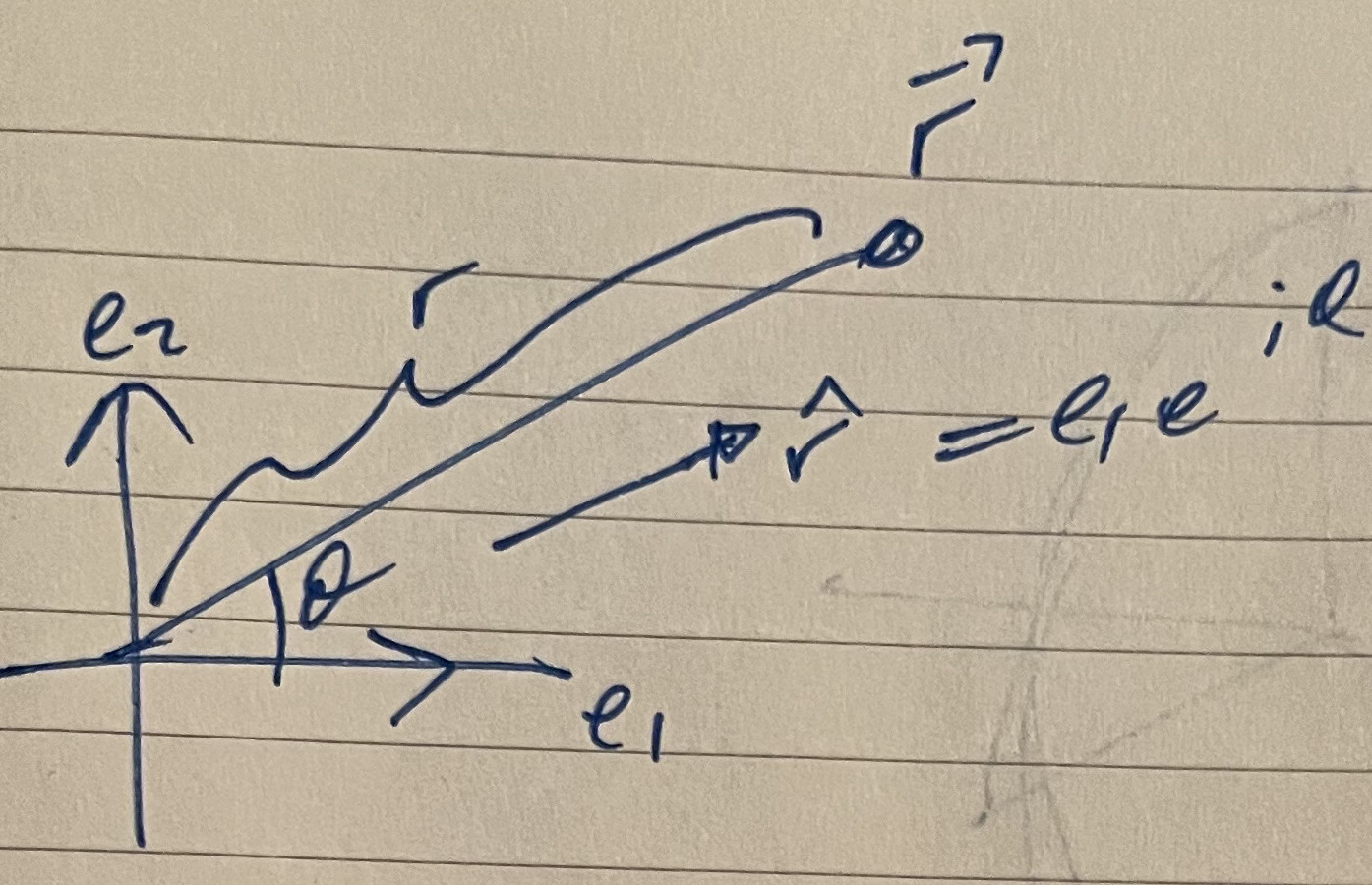
where \( \rcap = \rcap(\phi) \) encodes all the angular dependence of the position vector, and \( r \) is the length along that direction to our point, as illustrated in fig. 1.

fig. 1. Cylindrical coordinates position vector.

The radial unit vector has a compact GA representation
\begin{equation}\label{eqn:amomentum:40}
\rcap = \Be_1 e^{i\phi},
\end{equation}
where \( i = \Be_1 \Be_2 \).

The velocity (or momentum) will have both \( \rcap \) and \( \phicap \) dependence. By chain rule, that velocity is
\begin{equation}\label{eqn:amomentum:60}
\Bv = \dot{r} \rcap + r \dot{\rcap},
\end{equation}
where
\begin{equation}\label{eqn:amomentum:80}
\begin{aligned}
\dot{\rcap}
&= \Be_1 i e^{i\phi} \dot{\phi} \\
&= \Be_2 e^{i\phi} \dot{\phi} \\
&= \phicap \dot{\phi}.
\end{aligned}
\end{equation}
It is left to the reader to show that the vector designated \( \phicap \), is a unit vector and perpendicular to \( \rcap \) (Hint: compute the grade-0 selection of the product of the two to show that they are perpendicular.)

We can now compute the momentum, which is
\begin{equation}\label{eqn:amomentum:100}
\Bp = m \Bv = m \lr{ \dot{r} \rcap + r \dot{\phi} \phicap },
\end{equation}
and the angular momentum bivector
\begin{equation}\label{eqn:amomentum:120}
\begin{aligned}
L
&= \Br \wedge \Bp \\
&= m \lr{ r \rcap } \wedge \lr{ \dot{r} \rcap + r \dot{\phi} \phicap } \\
&= m r^2 \dot{\phi} \rcap \phicap.
\end{aligned}
\end{equation}

This has the \( m r^2 \dot{\phi} \) magnitude that the OP was seeking.

Spherical coordinates.

In spherical coordinates, our position vector is
\begin{equation}\label{eqn:amomentum:140}
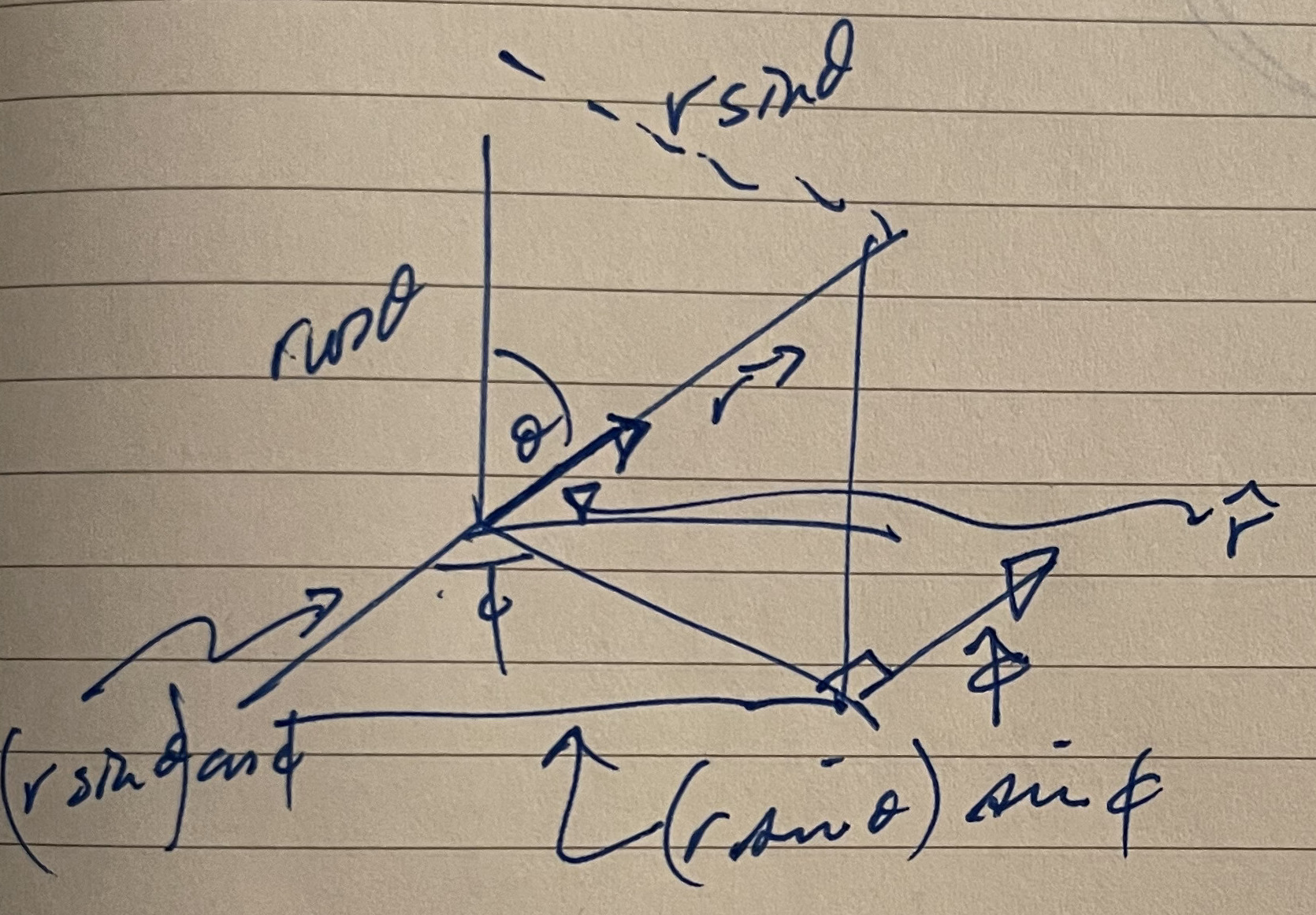
\Br = r \lr{ \Be_1 \sin\theta \cos\phi + \Be_2 \sin\theta \sin\phi + \Be_3 \cos\theta },
\end{equation}
as sketched in fig. 2.

fig. 2. Spherical coordinates.

We can factor this into a more compact representation
\begin{equation}\label{eqn:amomentum:160}
\begin{aligned}
\Br
&= r \lr{ \sin\theta \Be_1 (\cos\phi + \Be_{12} \sin\phi ) + \Be_3 \cos\theta } \\
&= r \lr{ \sin\theta \Be_1 e^{\Be_{12} \phi } + \Be_3 \cos\theta } \\
&= r \Be_3 \lr{ \cos\theta + \sin\theta \Be_3 \Be_1 e^{\Be_{12} \phi } }.
\end{aligned}
\end{equation}

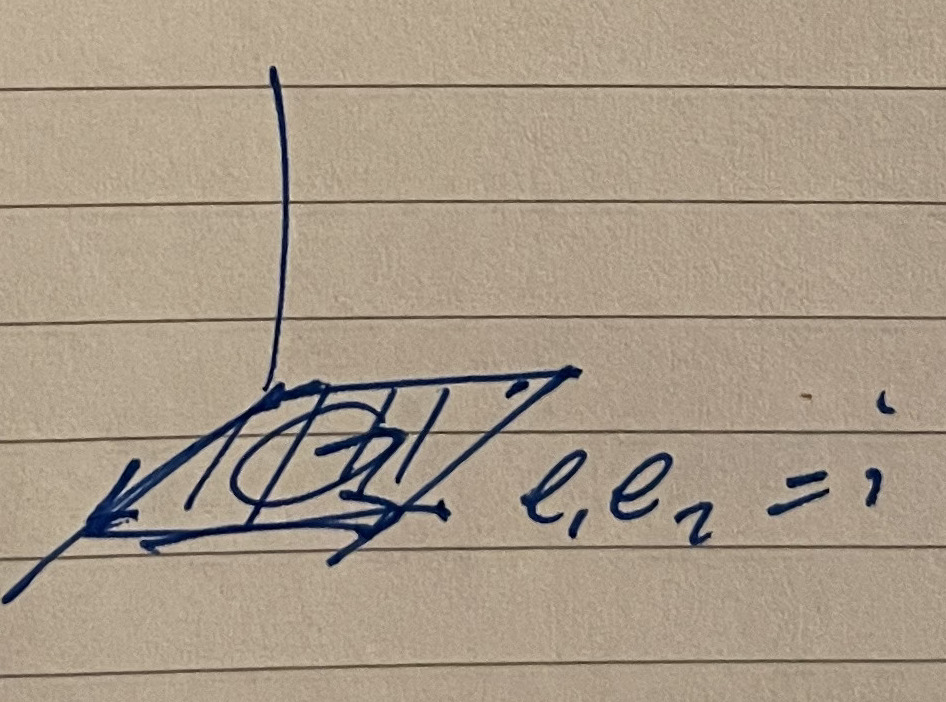
It is useful to name two of the bivector terms above, first, we write \( i \) for the azimuthal plane bivector sketched in fig. 3.

Spherical coordinates, azimuthal plane.

\begin{equation}\label{eqn:amomentum:180}
i = \Be_{12},
\end{equation}
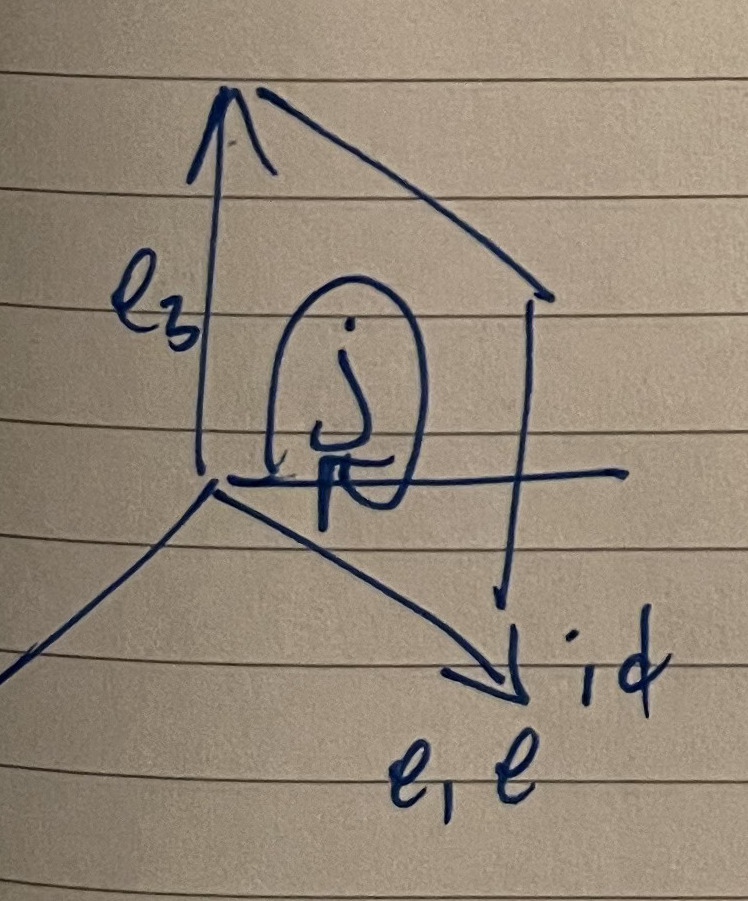
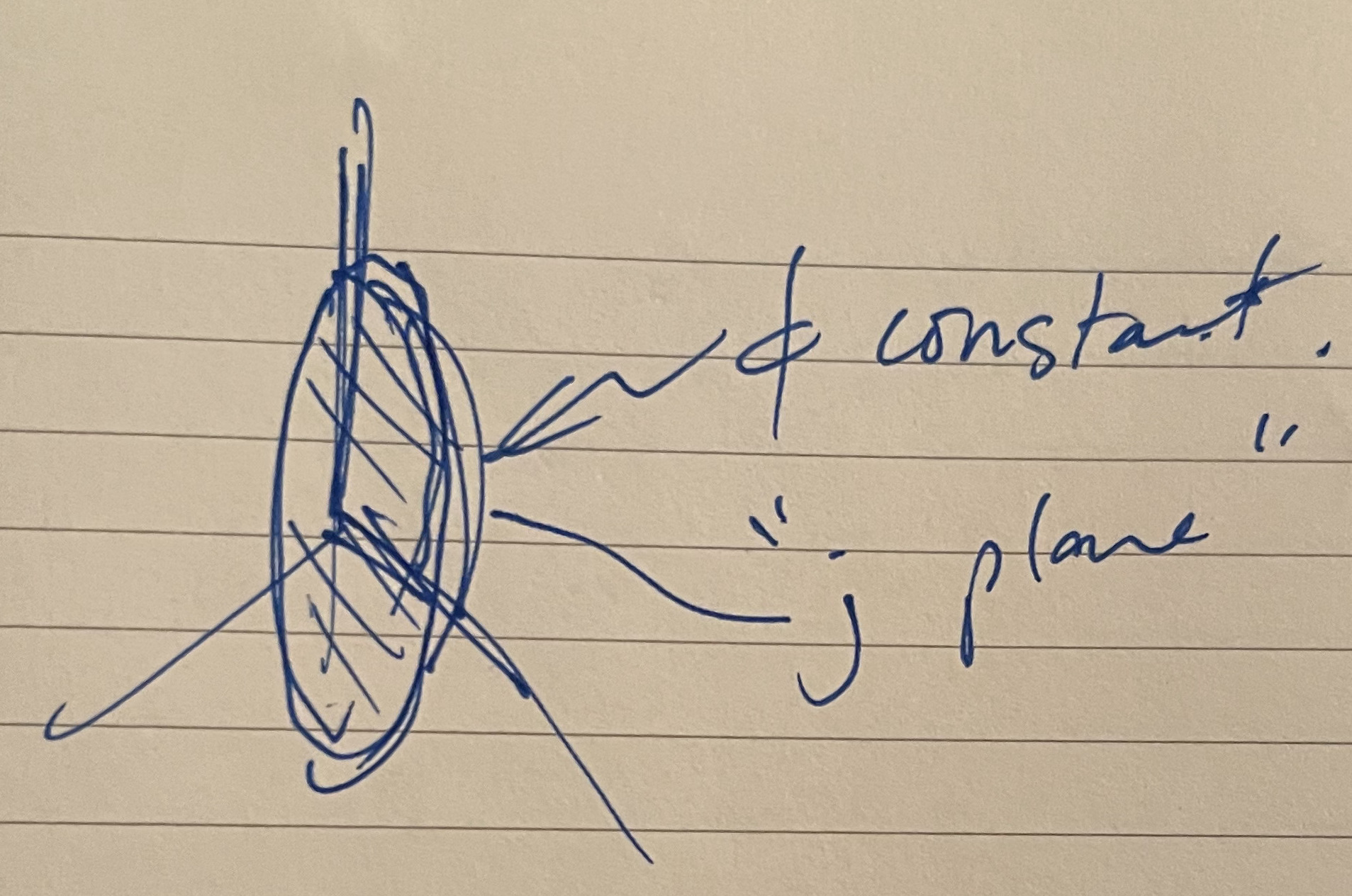
and introduce a bivector \( j \) that encodes the \( \Be_3, \rcap \) plane as sketched in fig. 4.

Spherical coordinates, “j-plane”.

\begin{equation}\label{eqn:amomentum:200}
j = \Be_{31} e^{i \phi}.
\end{equation}

Having done so, we now have a compact representation for our position vector
\begin{equation}\label{eqn:amomentum:220}
\begin{aligned}
\Br
&= r \Be_3 \lr{ \cos\theta + j \sin\theta } \\
&= r \Be_3 e^{j \theta}.
\end{aligned}
\end{equation}

This provides us with a nice compact representation of the radial unit vector
\begin{equation}\label{eqn:amomentum:240}
\rcap = \Be_3 e^{j \theta}.
\end{equation}

Just as was the case in cylindrical coordinates, our azimuthal plane unit vector is
\begin{equation}\label{eqn:amomentum:280}
\phicap = \Be_2 e^{i\phi}.
\end{equation}

Now we want to compute the velocity vector. As was the case in cylindrical coordinates, we have
\begin{equation}\label{eqn:amomentum:300}
\Bv = \dot{r} \rcap + r \dot{\rcap},
\end{equation}
but now we need the spherical representation for the \( \rcap \) derivative, which is
\begin{equation}\label{eqn:amomentum:320}
\begin{aligned}
\dot{\rcap}
&=
\PD{\theta}{\rcap} \dot{\theta} + \PD{\phi}{\rcap} \dot{\phi} \\
&=
\Be_3 e^{j\theta} j \dot{\theta} + \Be_3 \sin\theta \PD{\phi}{j} \dot{\phi} \\
&=
\rcap j \dot{\theta} + \Be_3 \sin\theta j i \dot{\phi}.
\end{aligned}
\end{equation}
We can reduce the second multivector term without too much work
\begin{equation}\label{eqn:amomentum:340}
\begin{aligned}
\Be_3 j i
&=
\Be_3 \Be_{31} e^{i\phi} i \\
&=
\Be_3 \Be_{31} i e^{i\phi} \\
&=
\Be_{33112} e^{i\phi} \\
&=
\Be_{2} e^{i\phi} \\
&= \phicap,
\end{aligned}
\end{equation}
so we have
\begin{equation}\label{eqn:amomentum:360}
\dot{\rcap}
=
\rcap j \dot{\theta} + \sin\theta \phicap \dot{\phi}.
\end{equation}

The velocity is
\begin{equation}\label{eqn:amomentum:380}
\Bv = \dot{r} \rcap + r \lr{ \rcap j \dot{\theta} + \sin\theta \phicap \dot{\phi} }.
\end{equation}

Now we can finally compute the angular momentum bivector, which is
\begin{equation}\label{eqn:amomentum:400}
\begin{aligned}
L &=
\Br \wedge \Bp \\
&=
m r \rcap \wedge \lr{ \dot{r} \rcap + r \lr{ \rcap j \dot{\theta} + \sin\theta \phicap \dot{\phi} } } \\
&=
m r^2 \rcap \wedge \lr{ \rcap j \dot{\theta} + \sin\theta \phicap \dot{\phi} } \\
&=
m r^2 \gpgradetwo{ \rcap \lr{ \rcap j \dot{\theta} + \sin\theta \phicap \dot{\phi} } },
\end{aligned}
\end{equation}
which is just
\begin{equation}\label{eqn:amomentum:420}
L =
m r^2 \lr{ j \dot{\theta} + \sin\theta \rcap \phicap \dot{\phi} }.
\end{equation}

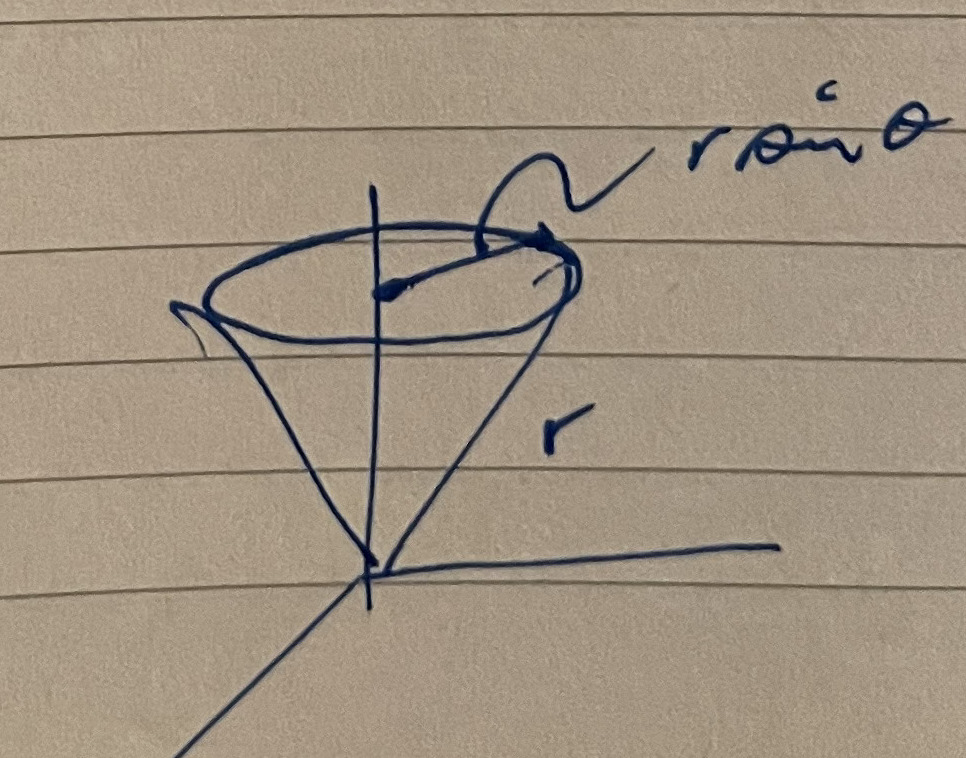
I was slightly surprised by this result, as I naively expected the cylindrical coordinate result. We have a \( m r^2 \rcap \phicap \dot{\phi} \) term, as was the case in cylindrical coordinates, but scaled down with a \( \sin\theta \) factor. However, this result does make sense. Consider for example, some fixed circular motion with \( \theta = \mathrm{constant} \), as sketched in fig. 5.

fig. 5. Circular motion for constant theta

The radius of this circle is actually \( r \sin\theta \), so the total angular momentum for that motion is scaled down to \( m r^2 \sin\theta \dot{\phi} \), smaller than the maximum circular angular momentum of \( m r^2 \dot{\phi} \) which occurs in the \( \theta = \pi/2 \) azimuthal plane. Similarly, if we have circular motion in the “j-plane”, sketched in fig. 6.

fig. 6. Circular motion for constant phi.

where \( \phi = \mathrm{constant} \), then our angular momentum is \( L = m r^2 j \dot{\theta} \).

Dipole field from multipole moment sum

November 12, 2016 math and physics play , , , , ,

[Click here for a PDF of this post with nicer formatting]

As indicated in Jackson [1], the components of the electric field can be obtained directly from the multipole moments

\begin{equation}\label{eqn:dipoleFromSphericalMoments:20}
\Phi(\Bx)
= \inv{4 \pi \epsilon_0} \sum \frac{4 \pi}{ (2 l + 1) r^{l + 1} } q_{l m} Y_{l m},
\end{equation}

so for the \( l,m \) contribution to this sum the components of the electric field are

\begin{equation}\label{eqn:dipoleFromSphericalMoments:40}
E_r
=
\inv{\epsilon_0} \sum \frac{l+1}{ (2 l + 1) r^{l + 2} } q_{l m} Y_{l m},
\end{equation}

\begin{equation}\label{eqn:dipoleFromSphericalMoments:60}
E_\theta
= -\inv{\epsilon_0} \sum \frac{1}{ (2 l + 1) r^{l + 2} } q_{l m} \partial_\theta Y_{l m}
\end{equation}

\begin{equation}\label{eqn:dipoleFromSphericalMoments:80}
\begin{aligned}
E_\phi
&= -\inv{\epsilon_0} \sum \frac{1}{ (2 l + 1) r^{l + 2} \sin\theta } q_{l m} \partial_\phi Y_{l m} \\
&= -\inv{\epsilon_0} \sum \frac{j m}{ (2 l + 1) r^{l + 2} \sin\theta } q_{l m} Y_{l m}.
\end{aligned}
\end{equation}

Here I’ve translated from CGS to SI. Let’s calculate the \( l = 1 \) electric field components directly from these expressions and check against the previously calculated results.

\begin{equation}\label{eqn:dipoleFromSphericalMoments:100}
\begin{aligned}
E_r
&=
\inv{\epsilon_0} \frac{2}{ 3 r^{3} }
\lr{
2 \lr{ -\sqrt{\frac{3}{8\pi}} }^2 \textrm{Re} \lr{
(p_x – j p_y) \sin\theta e^{j\phi}
}
+
\lr{ \sqrt{\frac{3}{4\pi}} }^2 p_z \cos\theta
} \\
&=
\frac{2}{4 \pi \epsilon_0 r^3}
\lr{
p_x \sin\theta \cos\phi + p_y \sin\theta \sin\phi + p_z \cos\theta
} \\
&=
\frac{1}{4 \pi \epsilon_0 r^3} 2 \Bp \cdot \rcap.
\end{aligned}
\end{equation}

Note that

\begin{equation}\label{eqn:dipoleFromSphericalMoments:120}
\partial_\theta Y_{11} = -\sqrt{\frac{3}{8\pi}} \cos\theta e^{j \phi},
\end{equation}

and

\begin{equation}\label{eqn:dipoleFromSphericalMoments:140}
\partial_\theta Y_{1,-1} = \sqrt{\frac{3}{8\pi}} \cos\theta e^{-j \phi},
\end{equation}

so

\begin{equation}\label{eqn:dipoleFromSphericalMoments:160}
\begin{aligned}
E_\theta
&=
-\inv{\epsilon_0} \frac{1}{ 3 r^{3} }
\lr{
2 \lr{ -\sqrt{\frac{3}{8\pi}} }^2 \textrm{Re} \lr{
(p_x – j p_y) \cos\theta e^{j\phi}
}

\lr{ \sqrt{\frac{3}{4\pi}} }^2 p_z \sin\theta
} \\
&=
-\frac{1}{4 \pi \epsilon_0 r^3}
\lr{
p_x \cos\theta \cos\phi + p_y \cos\theta \sin\phi – p_z \sin\theta
} \\
&=
-\frac{1}{4 \pi \epsilon_0 r^3} \Bp \cdot \thetacap.
\end{aligned}
\end{equation}

For the \(\phicap\) component, the \( m = 0 \) term is killed. This leaves

\begin{equation}\label{eqn:dipoleFromSphericalMoments:180}
\begin{aligned}
E_\phi
&=
-\frac{1}{\epsilon_0} \frac{1}{ 3 r^{3} \sin\theta }
\lr{
j q_{11} Y_{11} – j q_{1,-1} Y_{1,-1}
} \\
&=
-\frac{1}{3 \epsilon_0 r^{3} \sin\theta }
\lr{
j q_{11} Y_{11} – j (-1)^{2m} q_{11}^\conj Y_{11}^\conj
} \\
&=
\frac{2}{\epsilon_0} \frac{1}{ 3 r^{3} \sin\theta }
\textrm{Im} q_{11} Y_{11} \\
&=
\frac{2}{3 \epsilon_0 r^{3} \sin\theta }
\textrm{Im} \lr{
\lr{ -\sqrt{\frac{3}{8\pi}} }^2 (p_x – j p_y) \sin\theta e^{j \phi}
} \\
&=
\frac{1}{ 4 \pi \epsilon_0 r^{3} }
\textrm{Im} \lr{
(p_x – j p_y) e^{j \phi}
} \\
&=
\frac{1}{ 4 \pi \epsilon_0 r^{3} }
\lr{
p_x \sin\phi – p_y \cos\phi
} \\
&=
-\frac{\Bp \cdot \phicap}{ 4 \pi \epsilon_0 r^3}.
\end{aligned}
\end{equation}

That is
\begin{equation}\label{eqn:dipoleFromSphericalMoments:200}
\boxed{
\begin{aligned}
E_r &=
\frac{2}{4 \pi \epsilon_0 r^3}
\Bp \cdot \rcap \\
E_\theta &= –
\frac{1}{4 \pi \epsilon_0 r^3}
\Bp \cdot \thetacap \\
E_\phi &= –
\frac{1}{4 \pi \epsilon_0 r^3}
\Bp \cdot \phicap.
\end{aligned}
}
\end{equation}

These are consistent with equations (4.12) from the text for when \( \Bp \) is aligned with the z-axis.

Observe that we can sum each of the projections of \( \BE \) to construct the total electric field due to this \( l = 1 \) term of the multipole moment sum

\begin{equation}\label{eqn:dipoleFromSphericalMoments:n}
\begin{aligned}
\BE
&=
\frac{1}{4 \pi \epsilon_0 r^3}
\lr{
2 \rcap (\Bp \cdot \rcap)

\phicap ( \Bp \cdot \phicap)

\thetacap ( \Bp \cdot \thetacap)
} \\
&=
\frac{1}{4 \pi \epsilon_0 r^3}
\lr{
3 \rcap (\Bp \cdot \rcap)

\Bp
},
\end{aligned}
\end{equation}

which recovers the expected dipole moment approximation.

References

[1] JD Jackson. Classical Electrodynamics. John Wiley and Sons, 2nd edition, 1975.