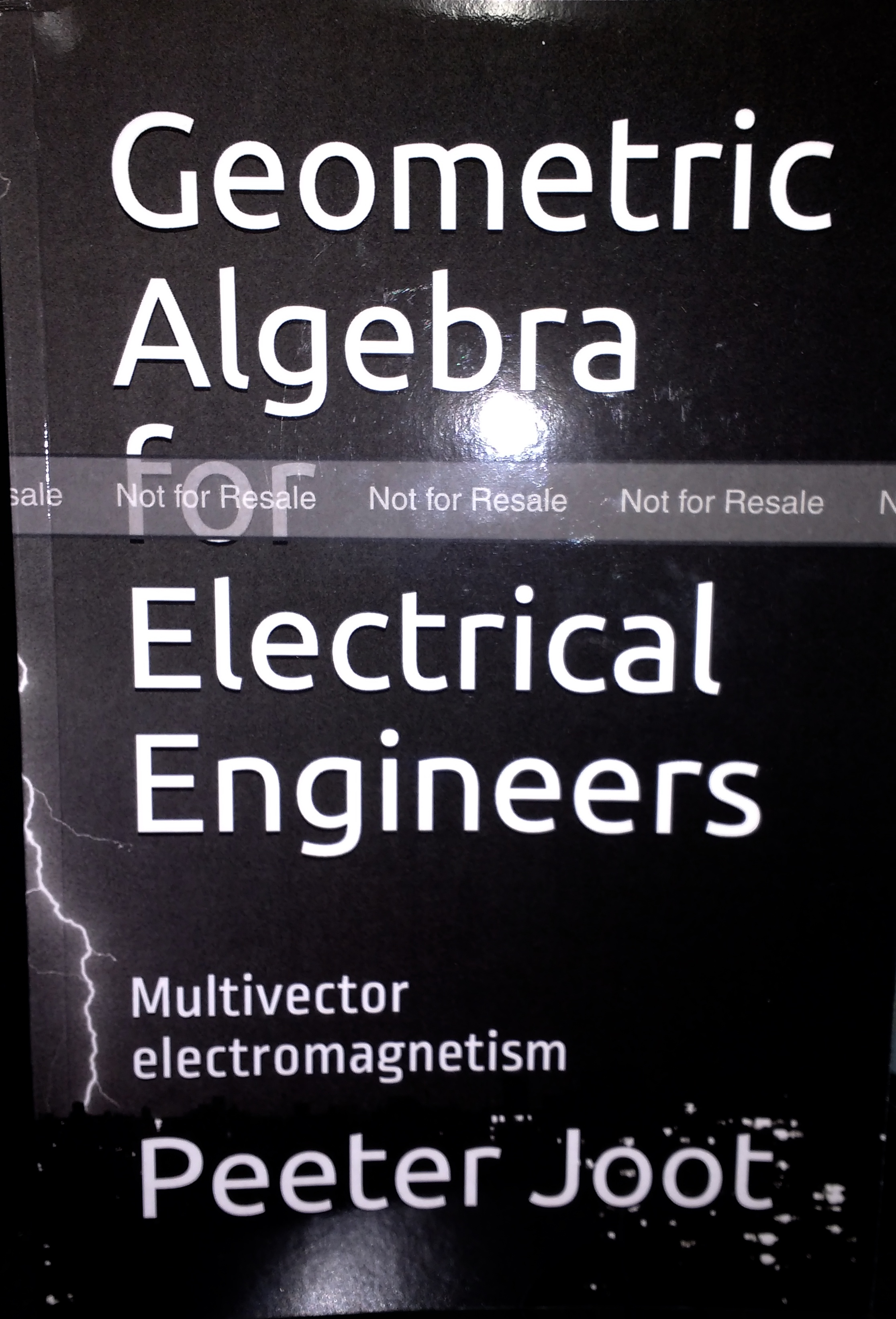
Why to study electromagnetism with geometric algebra.

February 3, 2019 Geometric Algebra for Electrical Engineers

The current draft of my book really ought to have some motivation in the preface. This is what I was thinking of.

Why you want to read this book.

When you first learned vector algebra you learned how to add and subtract vectors, and probably asked your instructor if it was possible to multiply vectors. Had you done so, you would have been told either “No”, or a qualified “No, but we can do multiplication like operations, the dot and cross products.” This book is based on a different answer, “Yes.” A set of rules that define a coherent multiplication operation are provided.

Were you ever bothered by the fact that the cross product was only defined in three dimensions, or had a nagging intuition that the dot and cross products were related somehow? The dot product and cross product seem to be complimentary, with the dot product encoding a projection operation (how much of a vector lies in the direction of another), and the magnitude of the cross product providing a rejection operation (how much of a vector is perpendicular to the direction of another). These projection and rejection operations should be perfectly well defined in 2, 4, or N dimemsions, not just 3. In this book you will see how to generalize the cross product to N dimensions, and how this more general product (the wedge product) is useful even in the two and three dimensional problems that are of interest for physical problems (like electromagnetism.) You will also see how the dot, cross (and wedge) products are all related to the vector multiplication operation of geometric algebra.

When you studied vector calculus, did the collection of Stokes’s, Green’s and Divergence operations available seem too random, like there ought to be a higher level structure that described all these similar operations? It turns out that such structure is available in the both the language of differential forms, and that of tensor calculus. We’d like a toolbox that doesn’t require expressing vectors as differentials, or resorting to coordinates. Not only does geometric calculus provides such a toolbox, it also provides the tools required to operate on functions of vector products, which has profound applications to electromagnetism.

Were you offended by the crazy mix of signs, dots and cross products in Maxwell’s equations? The geometric algebra form of Maxwells’s equation resolves that crazy mix, expressing Maxwell’s equations as a single equation. The formalism of tensor algebra and differential forms also provide simpler ways of expressing Maxwell’s equations, but are arguably harder to relate to the vector algebra formalism so familiar to electric engineers and physics practitioners. In this book, you will see how to work with the geometric algebra form of Maxwell’s equation, and how to relate these new techniques to familiar methods.

My book (Geometric Algebra for Electrical Engineers) now available in paper.

January 29, 2019 Geometric Algebra for Electrical Engineers

Edition 0.1.14 of my first book, Geometric Algebra for Electrical Engineers is now available, in a variety of pricing options:

Both paper versions are softcover, and have a 6×9″ format, whereas the PDF is formatted as letter size.  The leanpub version was made when I had the erroneous impression that it was a print on demand service like kindle-direct-publishing (aka createspace.) — it’s not, but the set your own price aspect of their service is kind of neat, so I’ve left it up.

If you download the free PDF or buy the black and white version, and feel undercharged, feel free to send some bitcoin my way.

Book review: Based on a true story, by Norm Macdonald: 3/5 stars.

January 6, 2019 Incoherent ramblings

It’s been a long time since I’ve had time to read anything fictional, so “Based on a true story” was a fun distraction, at least for a while.

This book has little bits of auto-biography mixed into a bizarre gambling win-big-or-die-trying story, as well as side visits with the Devil and God along the way.  I found that it held my attention until after Norm was released from his 40 year jail sentence for stalking Sarah Silverman and subsequently arranging a clumsy hit on her boyfriend.

There is a lot of funny content in this book, but the absurdity of it gets pretty tiresome about half way in.  The first half of the book is representative, and one need not read much further.

Spinor solutions with alternate \( \gamma^0 \) representation.

January 2, 2019 phy2403 , ,

[Click here for a PDF of this post with nicer formatting]

This follows an interesting derivation of the \( u, v \) spinors [2], adding some details.

In class (QFT I) and [3] we used a non-diagonal \( \gamma^0 \) representation
\begin{equation}\label{eqn:spinorSolutions:20}
\gamma^0 =
\begin{bmatrix}
0 & 1 \\
1 & 0
\end{bmatrix},
\end{equation}
whereas in [2] a diagonal representation is used
\begin{equation}\label{eqn:spinorSolutions:40}
\gamma^0 =
\begin{bmatrix}
1 & 0 \\
0 & -1
\end{bmatrix}.
\end{equation}
This representation makes it particularly simple to determine the form of the \( u, v \) spinors. We seek solutions of the Dirac equation
\begin{equation}\label{eqn:spinorSolutions:60}
\begin{aligned}
0 &= \lr{ i \gamma^\mu \partial_\mu – m } u(p) e^{-i p \cdot x} \\
0 &= \lr{ i \gamma^\mu \partial_\mu – m } v(p) e^{i p \cdot x},
\end{aligned}
\end{equation}
or
\begin{equation}\label{eqn:spinorSolutions:80}
\begin{aligned}
0 &= \lr{ \gamma^\mu p_\mu – m } u(p) e^{-i p \cdot x} \\
0 &= -\lr{ \gamma^\mu p_\mu + m } v(p) e^{i p \cdot x}.
\end{aligned}
\end{equation}
In the rest frame where \( \gamma^\mu p_\mu = E \gamma^0 \), where \( E = m = \omega_\Bp \), these take the particularly simple form
\begin{equation}\label{eqn:spinorSolutions:100}
\begin{aligned}
0 &= \lr{ \gamma^0 – 1 } u(E, \Bzero) \\
0 &= \lr{ \gamma^0 + 1 } v(E, \Bzero).
\end{aligned}
\end{equation}
This is a nice relation, as we can determine a portion of the structure of the rest frame \( u, v \) that is independent of the Dirac matrix representation
\begin{equation}\label{eqn:spinorSolutions:120}
\begin{aligned}
u(E, \Bzero) &= (\gamma^0 + 1) \psi \\
v(E, \Bzero) &= (\gamma^0 – 1) \psi
\end{aligned}
\end{equation}
Similarly, and more generally, we have
\begin{equation}\label{eqn:spinorSolutions:140}
\begin{aligned}
u(p) &= (\gamma^\mu p_\mu + m) \psi \\
v(p) &= (\gamma^\mu p_\mu – m) \psi
\end{aligned}
\end{equation}
also independent of the representation of \( \gamma^\mu \). Looking forward to non-matrix representations of the Dirac equation ([1]) note that we have not yet imposed a spinorial structure on the solution
\begin{equation}\label{eqn:spinorSolutions:260}
\psi
=
\begin{bmatrix}
\phi \\
\chi
\end{bmatrix},
\end{equation}
where \( \phi, \chi \) are two component matrices.

The particular choice of the diagonal representation \ref{eqn:spinorSolutions:40} for \( \gamma^0 \) makes it simple to determine additional structure for \( u, v \). Consider the rest frame first, where
\begin{equation}\label{eqn:spinorSolutions:160}
\begin{aligned}
\gamma^0 – 1 &=
\begin{bmatrix}
1 & 0 \\
0 & -1
\end{bmatrix}

\begin{bmatrix}
1 & 0 \\
0 & -1
\end{bmatrix}
=
\begin{bmatrix}
0 & 0 \\
0 & 2
\end{bmatrix} \\
\gamma^0 + 1 &=
\begin{bmatrix}
1 & 0 \\
0 & -1
\end{bmatrix}
+
\begin{bmatrix}
1 & 0 \\
0 & -1
\end{bmatrix}
=
\begin{bmatrix}
2 & 0 \\
0 & 0
\end{bmatrix},
\end{aligned}
\end{equation}
so we have
\begin{equation}\label{eqn:spinorSolutions:280}
\begin{aligned}
u(E, \Bzero) &=
\begin{bmatrix}
2 & 0 \\
0 & 0
\end{bmatrix}
\begin{bmatrix}
\phi \\
\chi
\end{bmatrix} \\
v(E, \Bzero) &=
\begin{bmatrix}
0 & 0 \\
0 & 2
\end{bmatrix}
\begin{bmatrix}
\phi \\
\chi
\end{bmatrix}
\end{aligned}
\end{equation}
Therefore a basis for the spinors \( u \) (in the rest frame), is
\begin{equation}\label{eqn:spinorSolutions:180}
u(E, \Bzero) \in \setlr{
\begin{bmatrix}
1 \\
0 \\
0 \\
0
\end{bmatrix},
\begin{bmatrix}
0 \\
1 \\
0 \\
0
\end{bmatrix}
},
\end{equation}
and a basis for the rest frame spinors \( v \) is
\begin{equation}\label{eqn:spinorSolutions:200}
v(E, \Bzero) \in \setlr{
\begin{bmatrix}
0 \\
0 \\
1 \\
0
\end{bmatrix},
\begin{bmatrix}
0 \\
0 \\
0 \\
1
\end{bmatrix}
}.
\end{equation}
Using the two spinor bases \( \zeta^a, \eta^a \) notation from class, we can write these
\begin{equation}\label{eqn:spinorSolutions:220}
\begin{aligned}
u^a(E, \Bzero) &=
\begin{bmatrix}
\zeta^a \\
0
\end{bmatrix},
\qquad
v^a(E, \Bzero) &=
\begin{bmatrix}
0 \\
\eta^a \\
\end{bmatrix}.
\end{aligned}
\end{equation}

For the non-rest frame solutions, [2] opts not to boost, as in [3], but to use the geometry of \( \gamma^\mu p_\mu \pm m \). With their diagonal representation of \( \gamma^0 \) those are
\begin{equation}\label{eqn:spinorSolutions:240}
\begin{aligned}
\gamma^\mu p_\mu – m
&=
p_0
\begin{bmatrix}
1 & 0 \\
0 & -1
\end{bmatrix}
+
p_k
\begin{bmatrix}
0 & \sigma^k \\
– \sigma^k & 0
\end{bmatrix}

m
\begin{bmatrix}
1 & 0 \\
0 & 1
\end{bmatrix}
=
\begin{bmatrix}
E – m & – \Bsigma \cdot \Bp \\
\Bsigma \cdot \Bp & -E – m
\end{bmatrix} \\
\gamma^\mu p_\mu + m
&=
p_0
\begin{bmatrix}
1 & 0 \\
0 & -1
\end{bmatrix}
+
p_k
\begin{bmatrix}
0 & \sigma^k \\
– \sigma^k & 0
\end{bmatrix}
+
m
\begin{bmatrix}
1 & 0 \\
0 & 1
\end{bmatrix}
=
\begin{bmatrix}
E + m & – \Bsigma \cdot \Bp \\
\Bsigma \cdot \Bp & -E + m
\end{bmatrix} \\
\end{aligned}
\end{equation}

Let’s assume that the arbitrary momentum solutions \ref{eqn:spinorSolutions:140} are each proportional to the rest frame solutions
\begin{equation}\label{eqn:spinorSolutions:300}
\begin{aligned}
u^a(p) &= (\gamma^\mu p_\mu + m) u^a(E, \Bzero) \\
v^a(p) &= (\gamma^\mu p_\mu – m) u^a(E, \Bzero).
\end{aligned}
\end{equation}
Plugging in \ref{eqn:spinorSolutions:240} gives
\begin{equation}\label{eqn:spinorSolutions:320}
\begin{aligned}
u^a(p) &=
\begin{bmatrix}
(E + m) \zeta^a \\
(\Bsigma \cdot \Bp ) \zeta^a
\end{bmatrix} \\
v^a(p) &=
\begin{bmatrix}
(\Bsigma \cdot \Bp) \eta^a \\
(E + m) \eta^a
\end{bmatrix},
\end{aligned}
\end{equation}
where an overall sign on \( v^a(p) \) has been dropped. Let’s check the assumption that the rest frame and general solutions are so simply related
\begin{equation}\label{eqn:spinorSolutions:340}
\begin{aligned}
\lr{ \gamma^\mu p_\mu – m } u^a(p)
&=
\begin{bmatrix}
E – m & – \Bsigma \cdot \Bp \\
\Bsigma \cdot \Bp & -E – m
\end{bmatrix}
\begin{bmatrix}
(E + m) \zeta^a \\
(\Bsigma \cdot \Bp ) \zeta^a
\end{bmatrix} \\
&=
\begin{bmatrix}
(E^2 – m^2 – \Bp^2) \zeta^a \\
0
\end{bmatrix} \\
&= 0,
\end{aligned}
\end{equation}
and
\begin{equation}\label{eqn:spinorSolutions:360}
\begin{aligned}
\lr{ \gamma^\mu p_\mu + m } v^a(p)
&=
\begin{bmatrix}
E + m & – \Bsigma \cdot \Bp \\
\Bsigma \cdot \Bp & -E + m
\end{bmatrix}
\begin{bmatrix}
(\Bsigma \cdot \Bp ) \eta^a \\
(E + m) \eta^a \\
\end{bmatrix} \\
&=
\begin{bmatrix}
0 \\
\Bp^2 + m^2 – E^2
\end{bmatrix} \\
&= 0.
\end{aligned}
\end{equation}
Everything works out nicely. The form of the solution for this representation of \( \gamma^0 \) is much simpler than the Chiral solution that we found in class. We end up with an explicit split of energy and spatial momentum components in the spinor solutions, instead of factors involving \( p \cdot \sigma \) and \( p \cdot \overline{\sigma} \), which are arguably nicer from a Lorentz invariance point of view.

References

[1] C. Doran and A.N. Lasenby. Geometric algebra for physicists. Cambridge University Press New York, Cambridge, UK, 1st edition, 2003.

[2] Claude Itzykson and Jean-Bernard Zuber. Quantum field theory. McGraw-Hill, 1980.

[3] Michael E Peskin and Daniel V Schroeder. An introduction to Quantum Field Theory. Westview, 1995.

Final first draft of complete notes for UofT PHY2403, QFT I .

December 27, 2018 phy2403 , ,

I’ve now uploaded a new version of my class notes for PHY2403, the UofT Quantum Field Theory I course, taught this year by Prof. Erich Poppitz.

This update adds notes for all remaining lectures (up to and including lecture 23.)  I’ve made a pass with a spellchecker to correct some of the aggregious spelling erorss, and also redrawn three figures, replacing photos, which cuts the size in half!

I’ve posted the redacted version (316 pages).  The full version, with my problem set solutions (including errors) is 409 pages.

Feel free to contact me for the complete version (i.e. including my problem set solutions, with errors) of any of these notes, provided you are not asking because you are taking or planning to take this course.

Contents:

  • Preface
  • Contents
  • List of Figures
  • 1 Fields, units, and scales.
  • 1.1 What is a field?
  • 1.2 Scales.
  • 1.2.1 Bohr radius.
  • 1.2.2 Compton wavelength.
  • 1.2.3 Relations.
  • 1.3 Natural units.
  • 1.4 Gravity.
  • 1.5 Cross section.
  • 1.6 Problems.
  • 2 Lorentz transformations.
  • 2.1 Lorentz transformations.
  • 2.2 Determinant of Lorentz transformations.
  • 2.3 Problems.
  • 3 Classical field theory.
  • 3.1 Field theory.
  • 3.2 Actions.
  • 3.3 Principles determining the form of the action.
  • 3.4 Principles (cont.)
  • 3.4.1 d = 2.
  • 3.4.2 d = 3.
  • 3.4.3 d = 4.
  • 3.4.4 d = 5.
  • 3.5 Least action principle.
  • 3.6 Problems.
  • 4 Canonical quantization, Klein-Gordon equation, SHOs, momentum space representation, raising and lowering operators.
  • 4.1 Canonical quantization.
  • 4.2 Canonical quantization (cont.)
  • 4.3 Momentum space representation.
  • 4.4 Quantization of Field Theory.
  • 4.5 Free Hamiltonian.
  • 4.6 QM SHO review.
  • 4.7 Discussion.
  • 4.8 Problems.
  • 5 Symmetries.
  • 5.1 Switching gears: Symmetries.
  • 5.2 Symmetries.
  • 5.3 Spacetime translation.
  • 5.4 1st Noether theorem.
  • 5.5 Unitary operators.
  • 5.6 Continuous symmetries.
  • 5.7 Classical scalar theory.
  • 5.8 Last time.
  • 5.9 Examples of symmetries.
  • 5.10 Scale invariance.
  • 5.11 Lorentz invariance.
  • 5.12 Problems.
  • 6 Lorentz boosts, generators, Lorentz invariance, microcausality.
  • 6.1 Lorentz transform symmetries.
  • 6.2 Transformation of momentum states.
  • 6.3 Relativistic normalization.
  • 6.4 Spacelike surfaces.
  • 6.5 Condition on microcausality.
  • 7 External sources.
  • 7.1 Harmonic oscillator.
  • 7.2 Field theory (where we are going).
  • 7.3 Green’s functions for the forced Klein-Gordon equation.
  • 7.4 Pole shifting.
  • 7.5 Matrix element representation of the Wightman function.
  • 7.6 Retarded Green’s function.
  • 7.7 Review: “particle creation problem”.
  • 7.8 Digression: coherent states.
  • 7.9 Problems.
  • 8 Perturbation theory.
  • 8.1 Feynman’s Green’s function.
  • 8.2 Interacting field theory: perturbation theory in QFT.
  • 8.3 Perturbation theory, interaction representation and Dyson formula.
  • 8.4 Next time.
  • 8.5 Review.
  • 8.6 Perturbation.
  • 8.7 Review.
  • 8.8 Unpacking it.
  • 8.9 Calculating perturbation.
  • 8.10 Wick contractions.
  • 8.11 Simplest Feynman diagrams.
  • 8.12 Phi fourth interaction.
  • 8.13 Tree level diagrams.
  • 8.14 Problems.
  • 9 Scattering and decay.
  • 9.1 Additional resources.
  • 9.2 Definitions and motivation.
  • 9.3 Calculating interactions.
  • 9.4 Example diagrams.
  • 9.5 The recipe.
  • 9.6 Back to our scalar theory.
  • 9.7 Review: S-matrix.
  • 9.8 Scattering in a scalar theory.
  • 9.9 Decay rates.
  • 9.10 Cross section.
  • 9.11 More on cross section.
  • 9.12 d(LIPS)_2.
  • 9.13 Problems.
  • 10 Fermions, and spinors.
  • 10.1 Fermions: R3 rotations.
  • 10.2 Lorentz group.
  • 10.3 Weyl spinors.
  • 10.4 Lorentz symmetry.
  • 10.5 Dirac matrices.
  • 10.6 Dirac Lagrangian.
  • 10.7 Review.
  • 10.8 Dirac equation.
  • 10.9 Helicity.
  • 10.10 Next time.
  • 10.11 Review.
  • 10.12 Normalization.
  • 10.13 Other solution.
  • 10.14 Lagrangian.
  • 10.15 General solution and Hamiltonian.
  • 10.16 Review.
  • 10.17 Hamiltonian action on single particle states.
  • 10.18 Spacetime translation symmetries.
  • 10.19 Rotation symmetries: angular momentum operator.
  • 10.20 U(1)_V symmetry: charge!
  • 10.21 U(1)_A symmetry: what was the charge for this one called?
  • 10.22 CPT symmetries.
  • 10.23 Review.
  • 10.24 Photon.
  • 10.25 Propagator.
  • 10.26 Feynman rules.
  • 10.27 Example: muon pair production
  • 10.28 Measurement of intermediate quark scattering processes.
  • 10.29 Problems.
  • A Useful formulas and review.
  • A.1 Review of old material.
  • A.2 Useful results from new material.
  • B Momentum of scalar field.
  • B.1 Expansion of the field momentum.
  • B.2 Conservation of the field momentum.
  • C Reflection using Pauli matrices.
  • D Explicit expansion of the Dirac u,v spinors.
  • D.1 Compact representation of
  • E Mathematica notebooks
  • Bibliography