clang

How to invoke the 2nd pass of the clang compiler manually

October 3, 2016 clang/llvm , , , , ,

Because the clang front end reexecs itself, breakpoints on the interesting parts of the clang front end don’t get hit by default. Here’s an example

$ cat g2
b llvm::Module::setDataLayout
b BackendConsumer::BackendConsumer
b llvm::TargetMachine::TargetMachine
b llvm::TargetMachine::createDataLayout
run -mbig-endian -m64 -c bytes.c -emit-llvm -o big.bc

$ gdb `which clang`
GNU gdb (GDB) Red Hat Enterprise Linux 7.9.1-19.lz.el7
...
(gdb) source g2
Breakpoint 1 at 0x2c04c3d: llvm::Module::setDataLayout. (2 locations)
Breakpoint 2 at 0x3d08870: file /source/llvm/lib/Target/TargetMachine.cpp, line 47.
Breakpoint 3 at 0x33108ca: file /source/llvm/include/llvm/Target/TargetMachine.h, line 133.
...
Detaching after vfork from child process 15795.
[Inferior 1 (process 15789) exited normally]

(The debugger finishes and exits, hitting none of the breakpoints)

One way to deal with this is to set the fork mode to child:

(gdb) set follow-fork-mode child

An alternate way of dealing with this is to use strace to collect the command line that clang invokes itself with. For example:

$ strace -f -s 1024 -v clang -mbig-endian -m64 big.bc -c 2>&1 | grep exec | tail -2 | head -1

This provides the command line options for the self invocation of clang

[pid  4650] execve("/usr/local/bin/clang-3.9", ["/usr/local/bin/clang-3.9", "-cc1", "-triple", "aarch64_be-unknown-linux-gnu", "-emit-obj", "-mrelax-all", "-disable-free", "-main-file-name", "big.bc", "-mrelocation-model", "static", "-mthread-model", "posix", "-mdisable-fp-elim", "-fmath-errno", "-masm-verbose", "-mconstructor-aliases", "-fuse-init-array", "-target-cpu", "generic", "-target-feature", "+neon", "-target-abi", "aapcs", "-dwarf-column-info", "-debugger-tuning=gdb", "-coverage-file", "/workspace/pass/run/big.bc", "-resource-dir", "/usr/local/bin/../lib/clang/3.9.0", "-fdebug-compilation-dir", "/workspace/pass/run", "-ferror-limit", "19", "-fmessage-length", "0", "-fallow-half-arguments-and-returns", "-fno-signed-char", "-fobjc-runtime=gcc", "-fdiagnostics-show-option", "-o", "big.o", "-x", "ir", "big.bc"],

With a bit of vim tweaking you can turn this into a command line that can be executed (or debugged) directly

/usr/local/bin/clang-3.9 -cc1 -triple aarch64_be-unknown-linux-gnu -emit-obj -mrelax-all -disable-free -main-file-name big.bc -mrelocation-model static -mthread-model posix -mdisable-fp-elim -fmath-errno -masm-verbose -mconstructor-aliases -fuse-init-array -target-cpu generic -target-feature +neon -target-abi aapcs -dwarf-column-info -debugger-tuning=gdb -coverage-file /workspace/pass/run/big.bc -resource-dir /usr/local/bin/../lib/clang/3.9.0 -fdebug-compilation-dir /workspace/pass/run -ferror-limit 19 -fmessage-length 0 -fallow-half-arguments-and-returns -fno-signed-char -fobjc-runtime=gcc -fdiagnostics-show-option -o big.o -x ir big.bc

Note that doing this also provides a mechanism to change the compiler triple manually, which is something that I wondered how to do (since clang documents -triple as an option, but seems to ignore it). For example, I’m able to able to change -triple aarch64_be to aarch64 and get little endian object code from bytecode prepared with -mbig-endian.
speeding up clang debug and builds

October 2, 2016 clang/llvm , , , , , , ,

I found the default static library configuration of clang slow to rebuild, so I started building it with in shared mode. That loaded pretty slow in gdb, so I went looking for how to enable split dwarf, and found a nice little presentation on how to speed up clang builds.

There’s a followup blog post with some speed up conclusions.

A failure of that blog post is actually listing the cmake commands required to build with all these tricks. Using all these tricks listed there, I’m now trying the following:

mkdir -p ~/freeware
cd ~/freeware

git clone git://sourceware.org/git/binutils-gdb.git
cd binutils-gdb
./configure --prefix=$HOME/local/binutils.gold --enable-gold=default
make 
make install

cd ..
git clone git://github.com/ninja-build/ninja.git 
cd ninja
./configure.py --bootstrap
mkdir -p ~/local/ninja/bin/
cp ninja ~/local/ninja/bin/

With ninja in my PATH, I can now build clang with:

CC=clang CXX=clang++ \
cmake -G Ninja \
../llvm \
-DLLVM_USE_SPLIT_DWARF=TRUE \
-DLLVM_ENABLE_ASSERTIONS=TRUE \
-DCMAKE_BUILD_TYPE=Debug \
-DCMAKE_INSTALL_PREFIX=$HOME/clang39.be \
-DCMAKE_SHARED_LINKER_FLAGS="-B$HOME/local/binutils.gold/bin -Wl,--gdb-index' \
-DCMAKE_EXE_LINKER_FLAGS="-B$HOME/local/binutils.gold/bin -Wl,--gdb-index' \
-DBUILD_SHARED_LIBS=true \
-DLLVM_TARGETS_TO_BUILD=X86 \
2>&1 | tee o

ninja

ninja install

This does build way faster, both for full builds and incremental builds.

Build tree size

Dynamic libraries: 4.4 Gb. Static libraries: 19.8Gb.

Installed size

Dynamic libraries: 0.7 Gb. Static libraries: 14.7Gb.

Results: full build time.

Static libraries, non-ninja, all backends:

real    51m6.494s
user    160m47.027s
sys     8m49.429s

Dynamic libraries, ninja, split dwarf, x86 backend only:

real    26m19.360s
user    86m11.477s
sys     3m14.478s

Results: incremental build. touch lib/Target/X86/MCTargetDesc/X86MCCodeEmitter.cpp.

Static libraries, non-ninja, all backends:

real    2m17.709s
user    6m8.648s
sys     0m28.594s

Dynamic libraries, ninja, split dwarf, x86 backend only:

real    0m3.245s
user    0m6.104s
sys     0m0.802s

make install times

make:

real    2m6.353s
user    0m7.827s
sys     0m15.316s

ninja:

real    0m2.138s
user    0m0.420s
sys     0m0.831s

The time for rerunning a sharedlib-config ‘ninja install’ is even faster!

Results: time for gdb, b main, run, quit

Static libraries:

real    0m45.904s
user    0m32.376s
sys     0m1.787s

Dynamic libraries, with split dwarf:

real    0m44.440s
user    0m37.096s
sys     0m1.067s

This one isn’t what I would have expected. The initial gdb load time for the split-dwarf exe is almost instantaneous, however it still takes a long time to break in main and continue to that point. I guess that we are taking the hit for a lot of symbol lookup at that point, so it comes out as a wash.

Thinking about this, I noticed that the clang make system doesn’t seem to add ‘-Wl,-gdb-index’ to the link step along with the addition of -gsplit-dwarf to the compilation command line. I thought that was required to get all the deferred symbol table lookup?

Attempting to do so, I found that the insertion of an alternate linker in my PATH wasn’t enough to get clang to use it. Adding –Wl,–gdb-index into the link flags caused complaints from /usr/bin/ld! The cmake magic required was:

-DCMAKE_SHARED_LINKER_FLAGS="-B$HOME/local/binutils.gold/bin -Wl,--gdb-index' \
-DCMAKE_EXE_LINKER_FLAGS="-B$HOME/local/binutils.gold/bin -Wl,--gdb-index' \

This is in the first cmake invocation flags above, but wasn’t used for my initial 45s gdb+clang time measurements. With –gdb-index, the time for the gdb b-main, run, quit sequence is now reduced to:

real    0m10.268s
user    0m3.623s
sys     0m0.429s

A 4x reduction, which is quite nice!

stack corruption detection with clang: safe-stack notes

June 10, 2016 C/C++ development and debugging. , , ,

At LZ our development and nightly builds are done with clang, so it is of interest to check out what stack protection checking compiler options are available.  DB2 LUW used the intel compiler, which had very nice stack clobbering code.  How does clang’s fair against the intel compiler in this respect?

Clang does support a safe-stack option.  Here’s an example of some stack corrupting code:

#include <string.h>

void corrupt( char * b ) ;

int main()
{
   char b[12] ;

   corrupt( b ) ;

   return 0 ;
}

void corrupt( char * b )
{
   memset( b - 4, 'a', 20 ) ;
}

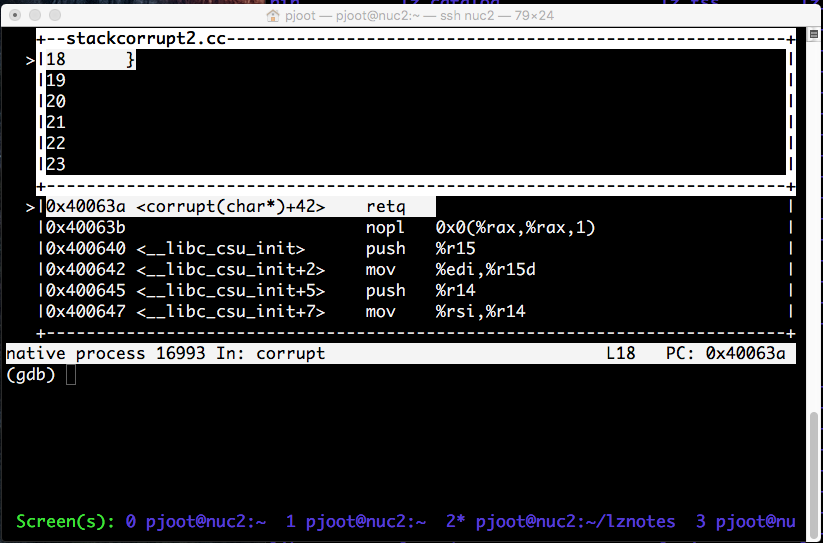
Running this without safe stack results in a SEGV on return from from corrupt():

Screen Shot 2016-06-10 at 11.08.54 AM

with safe-stack we have a “nicer” trap:

(gdb) run
Starting program: /home/pjoot/lznotes/proto/stackcorrupt2
[Thread debugging using libthread_db enabled]
Using host libthread_db library "/lib64/libthread_db.so.1".

Program received signal SIGSEGV, Segmentation fault.
__memset_sse2 () at ../sysdeps/x86_64/memset.S:415
415     L(P4Q0): mov    %edx,-0x4(%rdi)
Missing separate debuginfos, use: debuginfo-install libgcc-4.8.3-9.el7.x86_64 libstdc++-4.8.3-9.el7.x86_64
(gdb) where
#0  __memset_sse2 () at ../sysdeps/x86_64/memset.S:415
#1  0x0000000000411835 in corrupt (
    b=0x7ffff6bd2ff4 'a' <repeats 12 times>, "\177ELF\002\001\001\003")
    at stackcorrupt2.cc:16
#2  0x00000000004117f1 in main () at stackcorrupt2.cc:9

The compiler is able to catch the corruption in the act, right in the offending memset.

Limitations

What I do notice with this compiler option, is that the implementation has opted not to catch corruptions within the valid stack frame, nor is there any attempt to catch a corruption that does not walk over the return pointer. Here’s an example:

#include <string.h>

void corrupt( char * b ) ;

#define SZ 12
#if 0
   // safe-stack catches this:
   #define PRESZ 0
   #define POSTSZ 4
#else
   // safe-stack catches this buffer overwrite
   #define PRESZ 4
   #define POSTSZ 0
#endif
int main()
{
   char b[SZ] ;

   corrupt( b ) ;

   return 0 ;
}

void corrupt( char * b )
{
   memset( b - PRESZ, 'a', SZ + PRESZ + POSTSZ ) ;
}

and another non-trapping stack corruption:

#include <stdio.h>
#include <string.h>

void corrupt2( int & a, char * b, int & c ) ;

int main()
{
   int a = 0 ;
   char b[12] ;
   int c = 0 ;

   corrupt2( a, b, c ) ;

   printf( "0x%08X 0x%08X\n", a, c ) ;

   return 0 ;
}

void corrupt2( int & a, char * b, int & c )
{
   memset( b - 4, 'a', 20 ) ;
}

The intel compiler appeared to use guard bytes between stack variables, and was able to tell you exactly which stack variable was overwritten. Clang appears to be opting for a write-forbidden guard region on the stack frame, so it able to catch the corruption in the act, but only if the corruption is “big enough”. There are benefits of both approaches. Unfortunately, there are a number of restrictions in the safe-stack documentation. I’m not sure that I’ll be able to use this at all in LZ code.

First build break at the new job: C++ uniform initialization

May 12, 2016 C/C++ development and debugging. , , , , ,

Development builds at LZ are done with clang-3.8, but there is an alternate nightly build done with the older RHEL7 GCC-4.8.3 compiler (gcc is up to 6.1 now, so the RHEL7 default is truly _ancient_). This bit of code didn’t compile with gcc:

   template <typename mutex_type>
   class shared_lock
   {  
      mutex_type &      m_mutex ;

   public:

      /** construct and acquire the mutex in shared mode */
      explicit shared_lock( mutex_type & mutex )
         : m_mutex{ mutex }
      {  

The error is:

error: invalid initialization of non-const reference of type ‘lz::shared_mutex&’ from an rvalue of type ‘<brace-enclosed initializer list>’

This seems like a compiler bug to me, one that I’d seen when doing my scinet scientific computing course, which mandated the use of at least -std=c++11. In the scinet assignments, I fixed all such issues by using -std=c++14, which worked fine, but I was using gcc-5.3 for those assignments.

It appears that this is a compiler bug, and not just an issue with the c++11 language specification, as I initially thought while doing my scinet assignments. If I rebuild this code with g++-6.1, explicitly specifying -std=c++11 (GCC 6.1 defaults to c++14), then the issue goes away, so specification of -std=c++14 is not required to allow uniform initialization to work in this situation.

Because of being forced to use the older compiler, it looks like I have to fix this by using pre-c++11 syntax:

      explicit shared_lock( mutex_type & mutex )
         : m_mutex( mutex )

My conclusion is that gcc-4.8.3 is not truly up to the job of building c++11 compliant code. I’ll have to be more careful with the language features that I use in the future.

extern vs const in C++ and C code.

October 5, 2015 C/C++ development and debugging. , , , , , ,

We now build DB2 on linux ppcle with the IBM xlC 13.1.2 compiler. This version of the compiler is a hybrid compared to any previous compilers, retaining the IBM xlC backend for power, but using the clang front end. Because of this we are exposed to a large number of warnings that we don’t see with many other compilers (well we probably do for our MacOSX port, but we do not really have active development on that platform at the moment), and I’ve been trying to take down those counts to manageable levels. Header files that produce warnings have been my first target since they introduce the most repeated noise.

One message that I was seeing hundreds of was

warning: 'extern' variable has an initializer [-Wextern-initializer]

This seemed to be coming from headers that did something like:

#if defined FOO_INITIALIZE_IT_IN_SOME_SOURCE_FILE
extern const TYPE foo[] = { ... } ;
#else
extern const TYPE foo[] ;
#endif


where FOO_INITIALIZE_IT_IN_SOME_SOURCE_FILE is defined at the top of a source file that explicitly includes this header. My attempt to handle the messages was to remove the ‘extern’ from the initialization case, but I was suprised to see link errors as a result of some of those changes. It turns out that there are some subtle differences between different variations of const and extern with an array declaration of this sort. Here’s a bit of sample code:

// t.h
extern const int x[] ;
extern int y[] ;
extern int z[] ;


// t.cc
#if defined WANT_LINK_ERROR
const int x[] = { 42 } ;
#else
extern const int x[] = { 42 } ;
#endif

extern int y[] = { 42 } ;
int z[] = { 42 } ;


When WANT_LINK_ERROR isn’t defined, this produces just one clang warning message

t.cc:8:12: warning: 'extern' variable has an initializer [-Wextern-initializer]
extern int y[] = { 42 } ;
           ^

Note that the ‘extern const’ has no such warning, nor does the non-const symbol that’s been declared ‘extern’ in the header. However, removing the extern from the const case (via -DWANT_LINK_ERROR) results in no symbol ‘x’ available to other consumers. The extern is required for const symbols, but generates a warning for non-const symbols.

It appears that this is also C++ specific. A const symbol in C compiled code is available for external use, regardless of whether extern is used:


$ clang -c t.c
t.c:5:18: warning: 'extern' variable has an initializer [-Wextern-initializer]
extern const int x[] = { 42 } ;
                 ^
t.c:8:12: warning: 'extern' variable has an initializer [-Wextern-initializer]
extern int y[] = { 42 } ;
           ^
2 warnings generated.

$ nm t.o
0000000000000000 R x
0000000000000000 D y
0000000000000004 D z

$ clang -c -DWANT_LINK_ERROR t.c
t.c:8:12: warning: 'extern' variable has an initializer [-Wextern-initializer]
extern int y[] = { 42 } ;
           ^
1 warning generated.
$  nm t.o
0000000000000000 R x
0000000000000000 D y
0000000000000004 D z


whereas that same symbol requires extern if it is const in C++:


$ clang++ -c t.cc
t.cc:8:12: warning: 'extern' variable has an initializer [-Wextern-initializer]
extern int y[] = { 42 } ;
           ^
1 warning generated.
$ nm t.o
0000000000000000 R x
0000000000000000 D y
0000000000000004 D z


$ clang++ -c -DWANT_LINK_ERROR t.cc
t.cc:8:12: warning: 'extern' variable has an initializer [-Wextern-initializer]
extern int y[] = { 42 } ;
           ^
1 warning generated.
$ nm t.o
0000000000000000 D y
0000000000000004 D z


I hadn’t expected the const to interact this way with extern. I am guessing that C++ allows for the compiler to not generate symbols for global scope const variables, unless you ask for that by using extern, whereas with C you get the symbol like-it-or-not. This particular message from the clang front end is only for non-const extern initializations, making across the board fixing of messages for extern initialization of the sort above trickier. This makes it so that you can’t do an across the board replacement of extern in initializers for a given file without first ensuring that the symbol isn’t const. It looks like dealing with this will have to be done much more carefully than I first tried.