Angular momentum bivector in cylindrical and spherical bases.

September 15, 2022 math and physics play , , , , , , ,

[Click here for a PDF version of this post]

Motivation

In a discord thread on the bivector group (a geometric algebra group chat), MoneyKills posts about trouble he has calculating the correct expression for the angular momentum bivector or it’s dual.

This blog post is a more long winded answer than my bivector response and includes this calculation using both cylindrical and spherical coordinates.

Cylindrical coordinates.

The position vector for any point on a plane can be expressed as
\begin{equation}\label{eqn:amomentum:20}
\Br = r \rcap,
\end{equation}
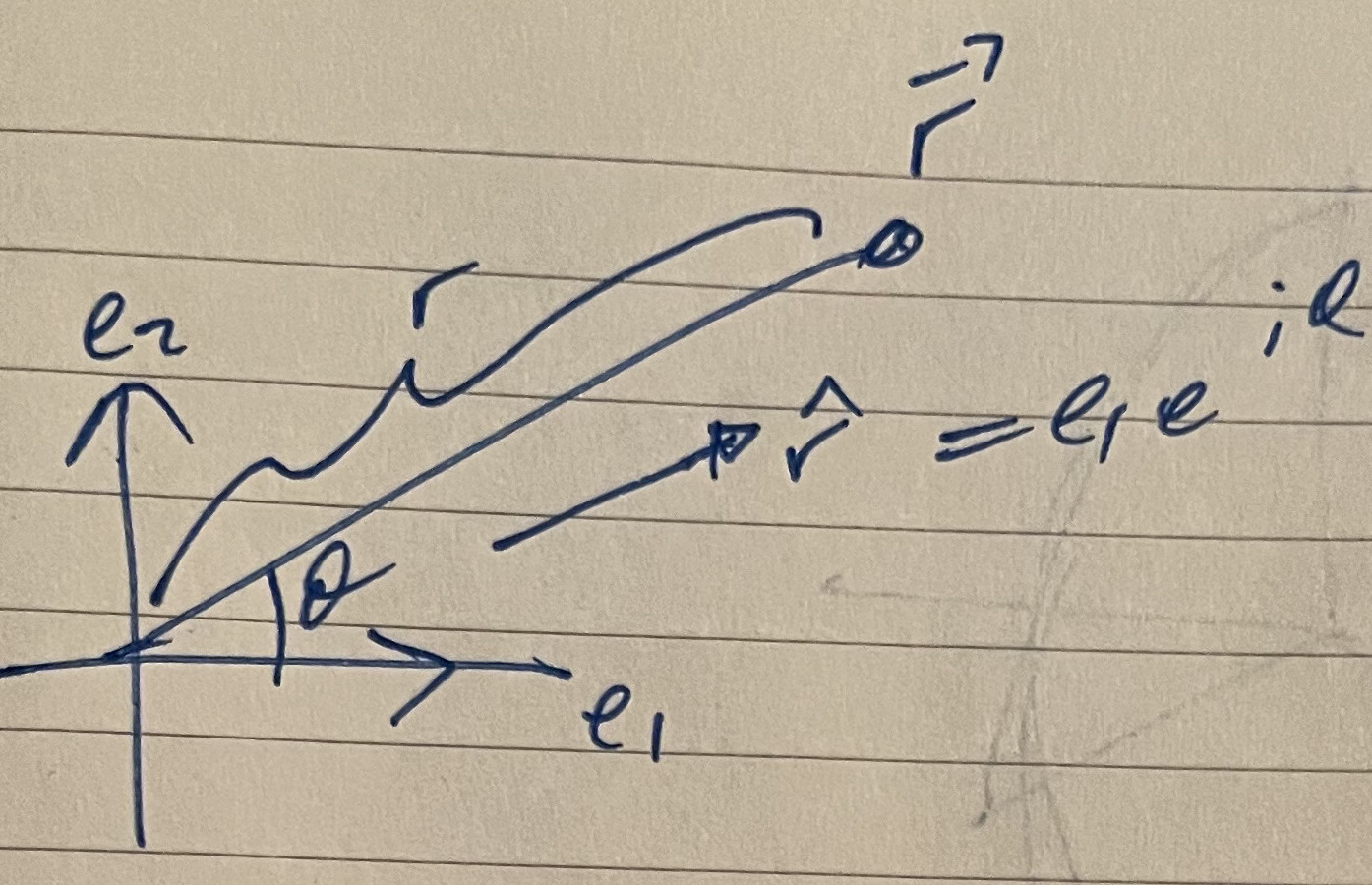
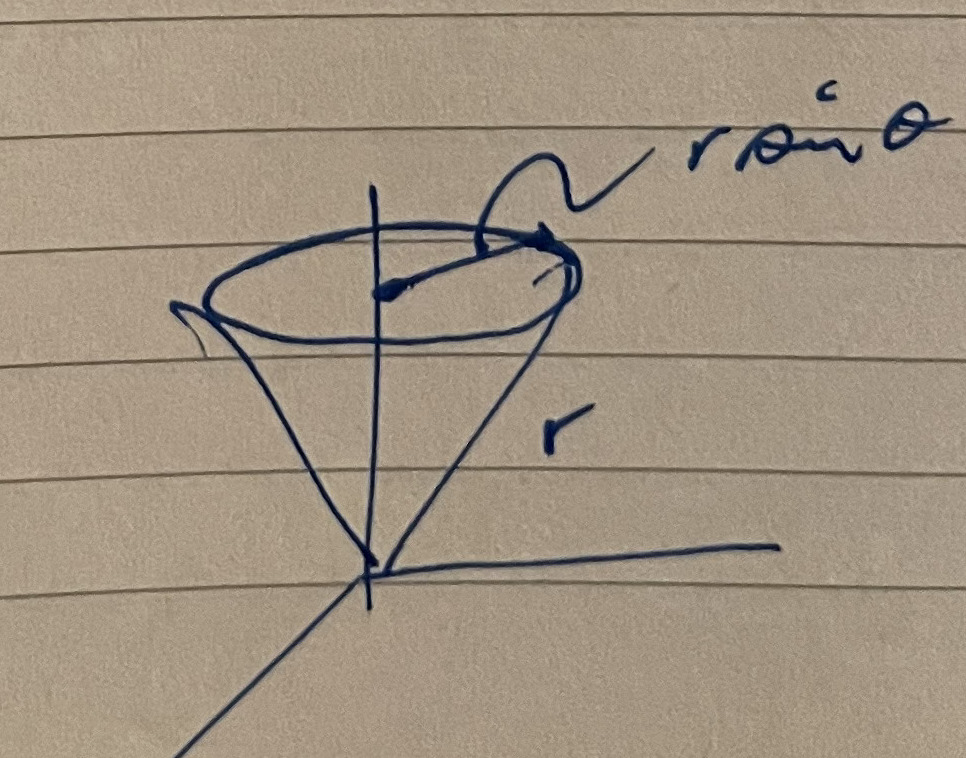
where \( \rcap = \rcap(\phi) \) encodes all the angular dependence of the position vector, and \( r \) is the length along that direction to our point, as illustrated in fig. 1.
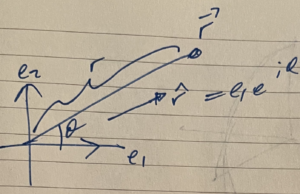
fig. 1. Cylindrical coordinates position vector.

The radial unit vector has a compact GA representation
\begin{equation}\label{eqn:amomentum:40}
\rcap = \Be_1 e^{i\phi},
\end{equation}
where \( i = \Be_1 \Be_2 \).

The velocity (or momentum) will have both \( \rcap \) and \( \phicap \) dependence. By chain rule, that velocity is
\begin{equation}\label{eqn:amomentum:60}
\Bv = \dot{r} \rcap + r \dot{\rcap},
\end{equation}
where
\begin{equation}\label{eqn:amomentum:80}
\begin{aligned}
\dot{\rcap}
&= \Be_1 i e^{i\phi} \dot{\phi} \\
&= \Be_2 e^{i\phi} \dot{\phi} \\
&= \phicap \dot{\phi}.
\end{aligned}
\end{equation}
It is left to the reader to show that the vector designated \( \phicap \), is a unit vector and perpendicular to \( \rcap \) (Hint: compute the grade-0 selection of the product of the two to show that they are perpendicular.)

We can now compute the momentum, which is
\begin{equation}\label{eqn:amomentum:100}
\Bp = m \Bv = m \lr{ \dot{r} \rcap + r \dot{\phi} \phicap },
\end{equation}
and the angular momentum bivector
\begin{equation}\label{eqn:amomentum:120}
\begin{aligned}
L
&= \Br \wedge \Bp \\
&= m \lr{ r \rcap } \wedge \lr{ \dot{r} \rcap + r \dot{\phi} \phicap } \\
&= m r^2 \dot{\phi} \rcap \phicap.
\end{aligned}
\end{equation}

This has the \( m r^2 \dot{\phi} \) magnitude that the OP was seeking.

Spherical coordinates.

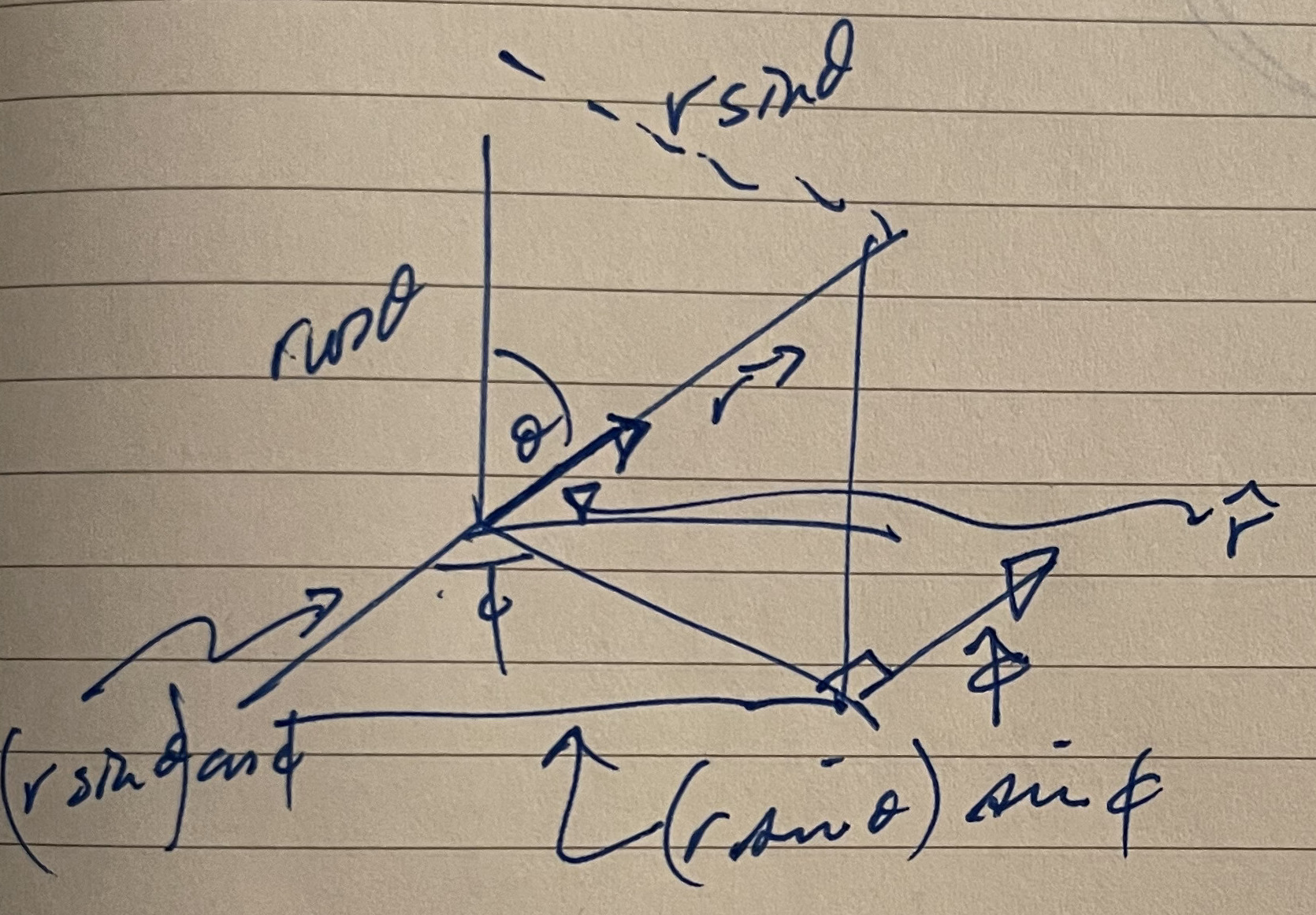
In spherical coordinates, our position vector is
\begin{equation}\label{eqn:amomentum:140}
\Br = r \lr{ \Be_1 \sin\theta \cos\phi + \Be_2 \sin\theta \sin\phi + \Be_3 \cos\theta },
\end{equation}
as sketched in fig. 2.
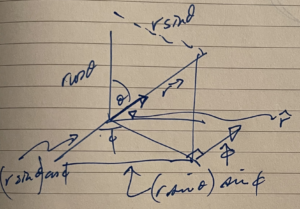
fig. 2. Spherical coordinates.

We can factor this into a more compact representation
\begin{equation}\label{eqn:amomentum:160}
\begin{aligned}
\Br
&= r \lr{ \sin\theta \Be_1 (\cos\phi + \Be_{12} \sin\phi ) + \Be_3 \cos\theta } \\
&= r \lr{ \sin\theta \Be_1 e^{\Be_{12} \phi } + \Be_3 \cos\theta } \\
&= r \Be_3 \lr{ \cos\theta + \sin\theta \Be_3 \Be_1 e^{\Be_{12} \phi } }.
\end{aligned}
\end{equation}

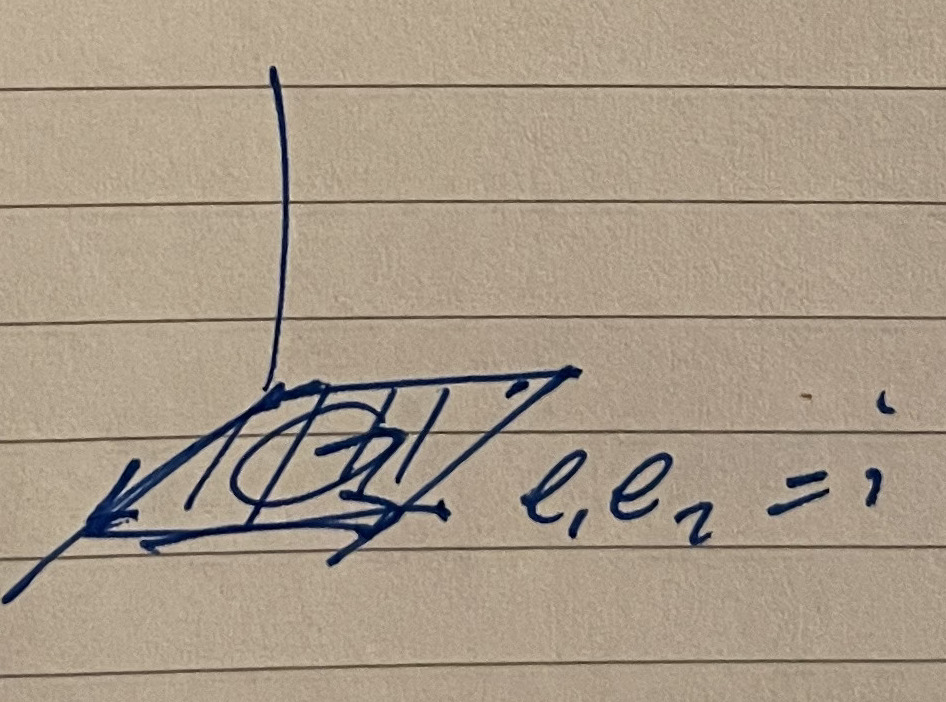
It is useful to name two of the bivector terms above, first, we write \( i \) for the azimuthal plane bivector sketched in fig. 3.
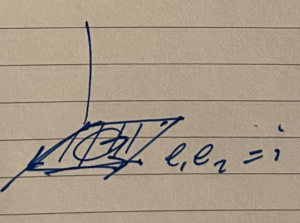
Spherical coordinates, azimuthal plane.

\begin{equation}\label{eqn:amomentum:180}
i = \Be_{12},
\end{equation}
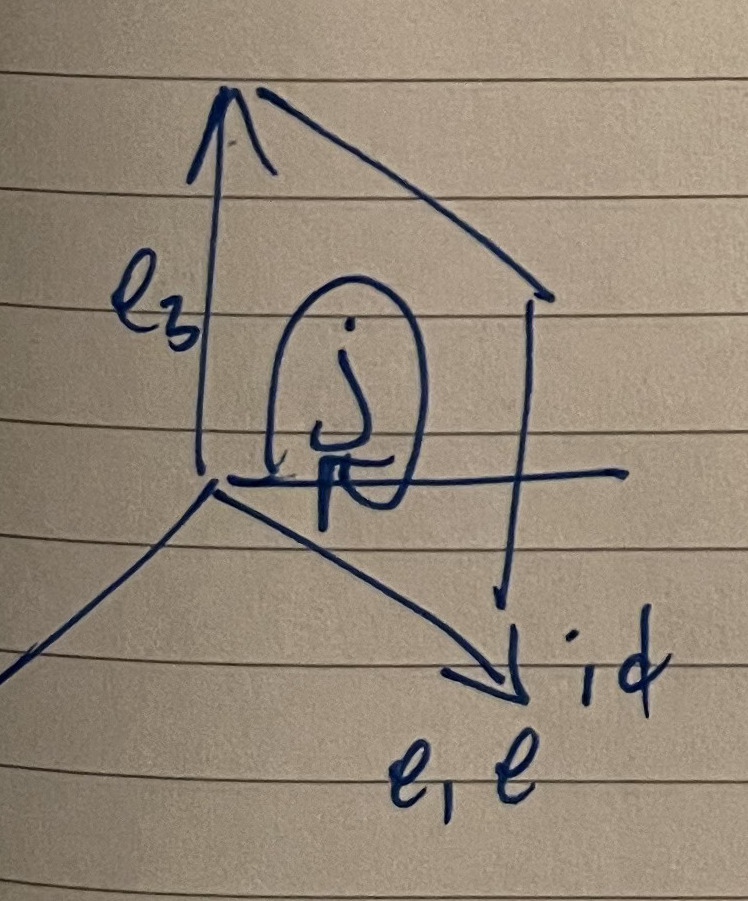
and introduce a bivector \( j \) that encodes the \( \Be_3, \rcap \) plane as sketched in fig. 4.
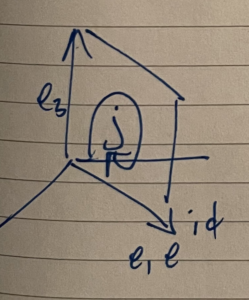
Spherical coordinates, “j-plane”.

\begin{equation}\label{eqn:amomentum:200}
j = \Be_{31} e^{i \phi}.
\end{equation}

Having done so, we now have a compact representation for our position vector
\begin{equation}\label{eqn:amomentum:220}
\begin{aligned}
\Br
&= r \Be_3 \lr{ \cos\theta + j \sin\theta } \\
&= r \Be_3 e^{j \theta}.
\end{aligned}
\end{equation}

This provides us with a nice compact representation of the radial unit vector
\begin{equation}\label{eqn:amomentum:240}
\rcap = \Be_3 e^{j \theta}.
\end{equation}

Just as was the case in cylindrical coordinates, our azimuthal plane unit vector is
\begin{equation}\label{eqn:amomentum:280}
\phicap = \Be_2 e^{i\phi}.
\end{equation}

Now we want to compute the velocity vector. As was the case in cylindrical coordinates, we have
\begin{equation}\label{eqn:amomentum:300}
\Bv = \dot{r} \rcap + r \dot{\rcap},
\end{equation}
but now we need the spherical representation for the \( \rcap \) derivative, which is
\begin{equation}\label{eqn:amomentum:320}
\begin{aligned}
\dot{\rcap}
&=
\PD{\theta}{\rcap} \dot{\theta} + \PD{\phi}{\rcap} \dot{\phi} \\
&=
\Be_3 e^{j\theta} j \dot{\theta} + \Be_3 \sin\theta \PD{\phi}{j} \dot{\phi} \\
&=
\rcap j \dot{\theta} + \Be_3 \sin\theta j i \dot{\phi}.
\end{aligned}
\end{equation}
We can reduce the second multivector term without too much work
\begin{equation}\label{eqn:amomentum:340}
\begin{aligned}
\Be_3 j i
&=
\Be_3 \Be_{31} e^{i\phi} i \\
&=
\Be_3 \Be_{31} i e^{i\phi} \\
&=
\Be_{33112} e^{i\phi} \\
&=
\Be_{2} e^{i\phi} \\
&= \phicap,
\end{aligned}
\end{equation}
so we have
\begin{equation}\label{eqn:amomentum:360}
\dot{\rcap}
=
\rcap j \dot{\theta} + \sin\theta \phicap \dot{\phi}.
\end{equation}

The velocity is
\begin{equation}\label{eqn:amomentum:380}
\Bv = \dot{r} \rcap + r \lr{ \rcap j \dot{\theta} + \sin\theta \phicap \dot{\phi} }.
\end{equation}

Now we can finally compute the angular momentum bivector, which is
\begin{equation}\label{eqn:amomentum:400}
\begin{aligned}
L &=
\Br \wedge \Bp \\
&=
m r \rcap \wedge \lr{ \dot{r} \rcap + r \lr{ \rcap j \dot{\theta} + \sin\theta \phicap \dot{\phi} } } \\
&=
m r^2 \rcap \wedge \lr{ \rcap j \dot{\theta} + \sin\theta \phicap \dot{\phi} } \\
&=
m r^2 \gpgradetwo{ \rcap \lr{ \rcap j \dot{\theta} + \sin\theta \phicap \dot{\phi} } },
\end{aligned}
\end{equation}
which is just
\begin{equation}\label{eqn:amomentum:420}
L =
m r^2 \lr{ j \dot{\theta} + \sin\theta \rcap \phicap \dot{\phi} }.
\end{equation}

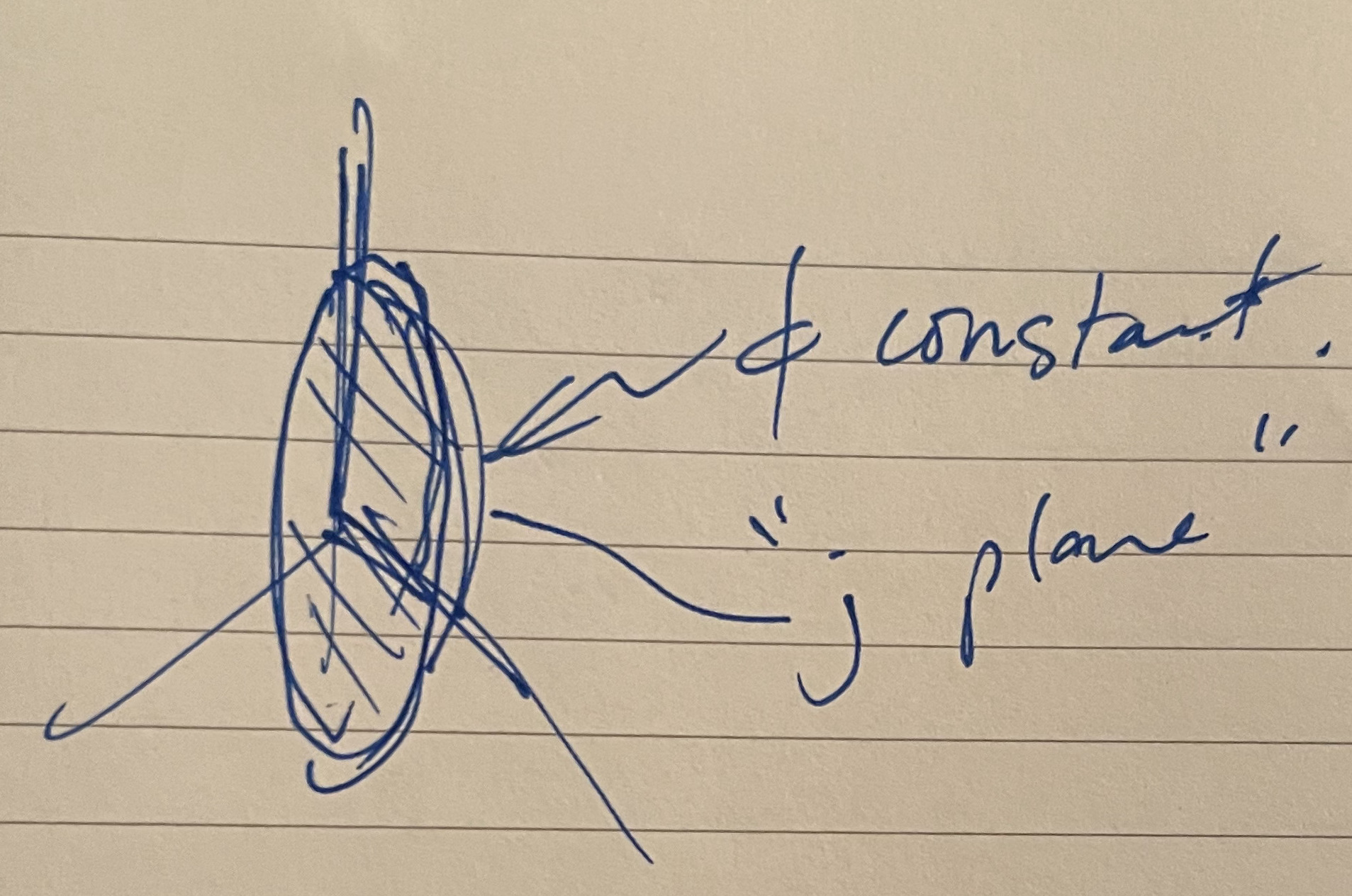
I was slightly surprised by this result, as I naively expected the cylindrical coordinate result. We have a \( m r^2 \rcap \phicap \dot{\phi} \) term, as was the case in cylindrical coordinates, but scaled down with a \( \sin\theta \) factor. However, this result does make sense. Consider for example, some fixed circular motion with \( \theta = \mathrm{constant} \), as sketched in fig. 5.
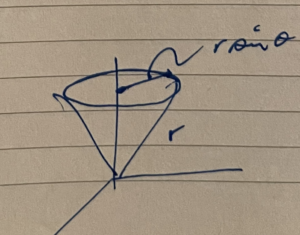
fig. 5. Circular motion for constant theta

The radius of this circle is actually \( r \sin\theta \), so the total angular momentum for that motion is scaled down to \( m r^2 \sin\theta \dot{\phi} \), smaller than the maximum circular angular momentum of \( m r^2 \dot{\phi} \) which occurs in the \( \theta = \pi/2 \) azimuthal plane. Similarly, if we have circular motion in the “j-plane”, sketched in fig. 6.
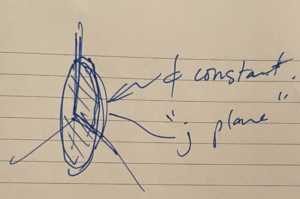
fig. 6. Circular motion for constant phi.

where \( \phi = \mathrm{constant} \), then our angular momentum is \( L = m r^2 j \dot{\theta} \).
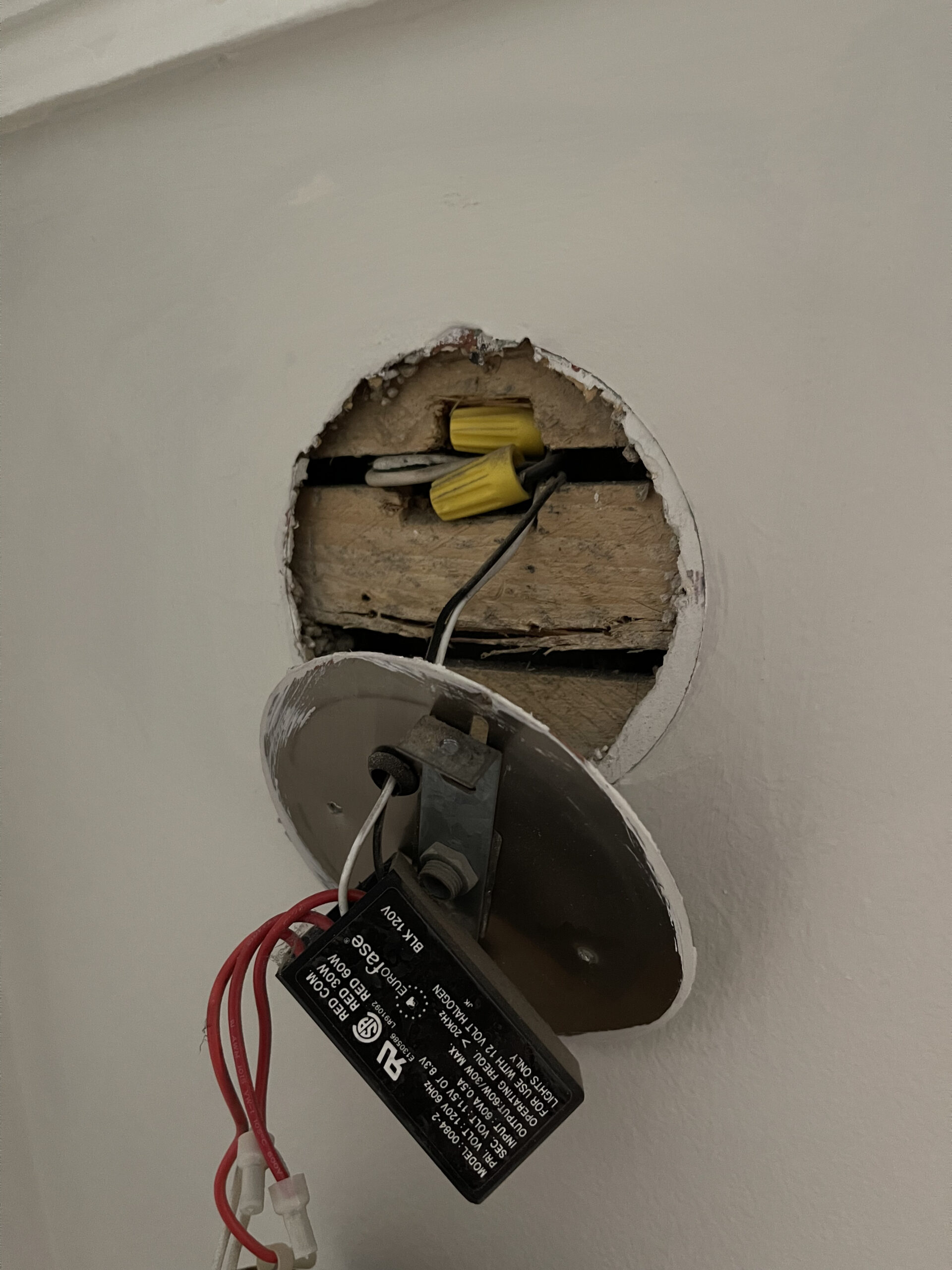
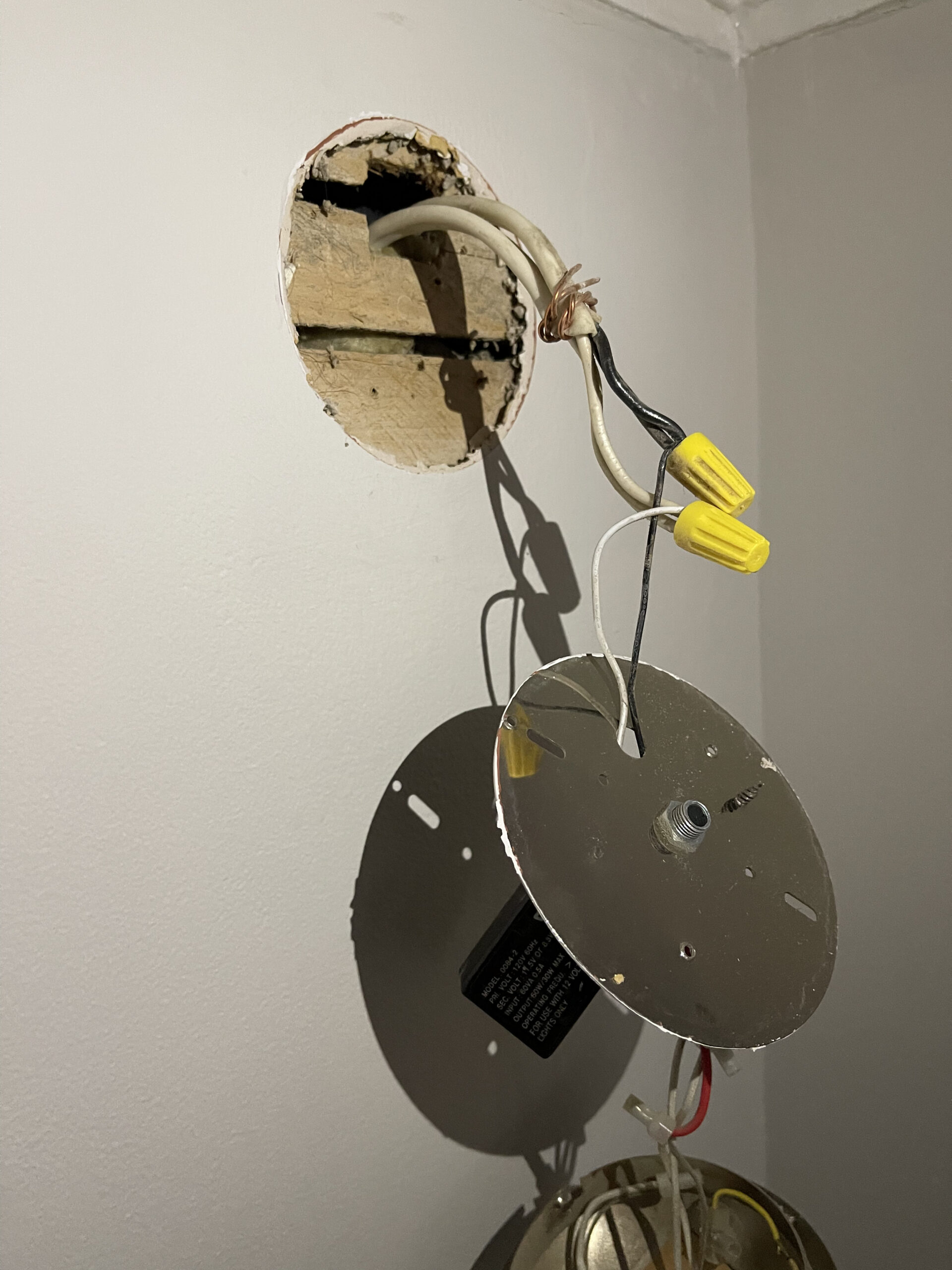
Scary electrical… What could go wrong?

September 4, 2022 Home renos

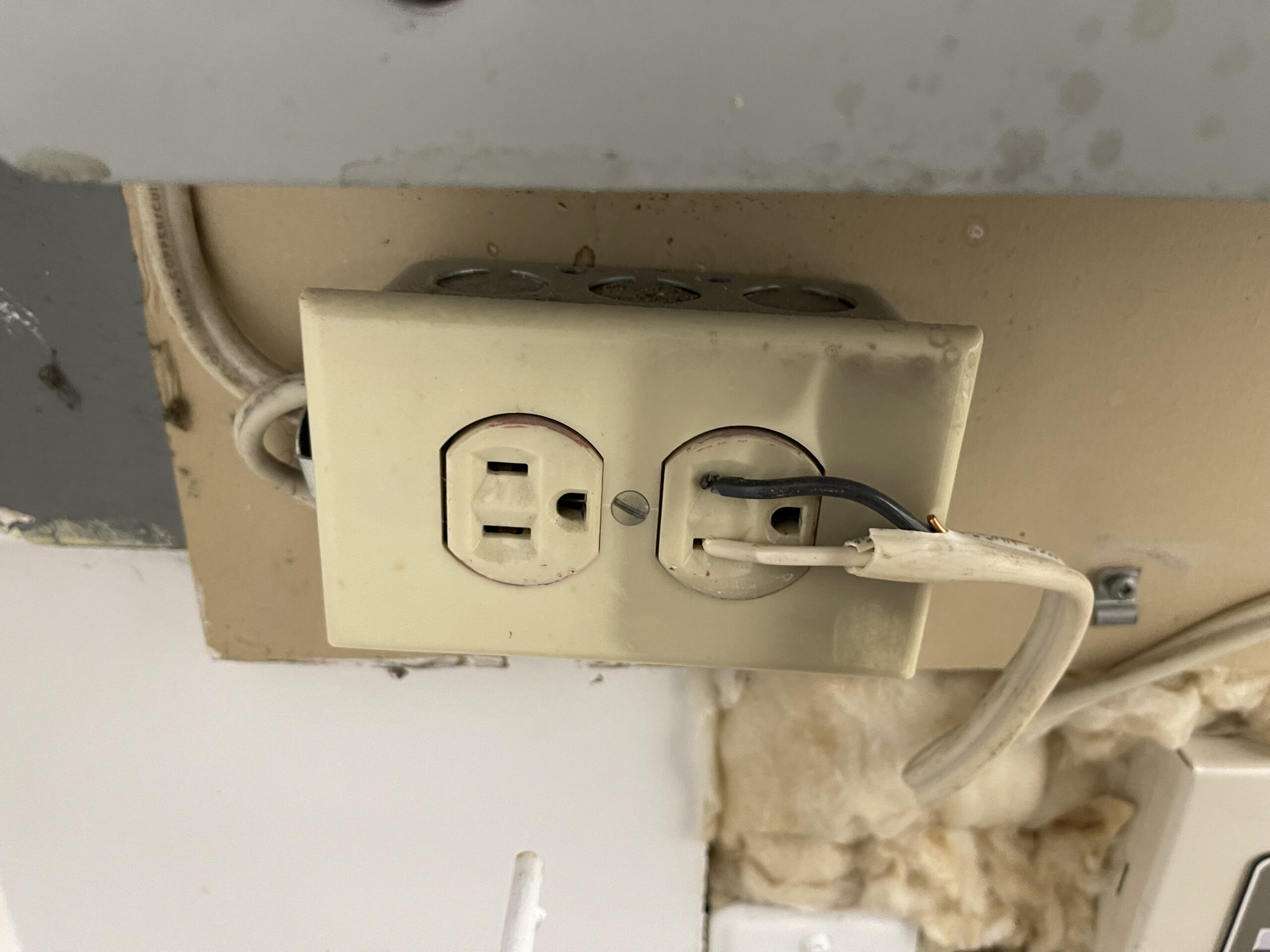
Unplugged an A/C adapter and found this hiding behind it.

Why not just open the box and connect the wire properly?  This is right under the electrical panel, so the shutoff for the circuit isn’t far away.

Interior angles of a regular n-sided polygon: a strange way to find them.

August 8, 2022 math and physics play , , , , , ,

[Click here for a PDF version of this post]

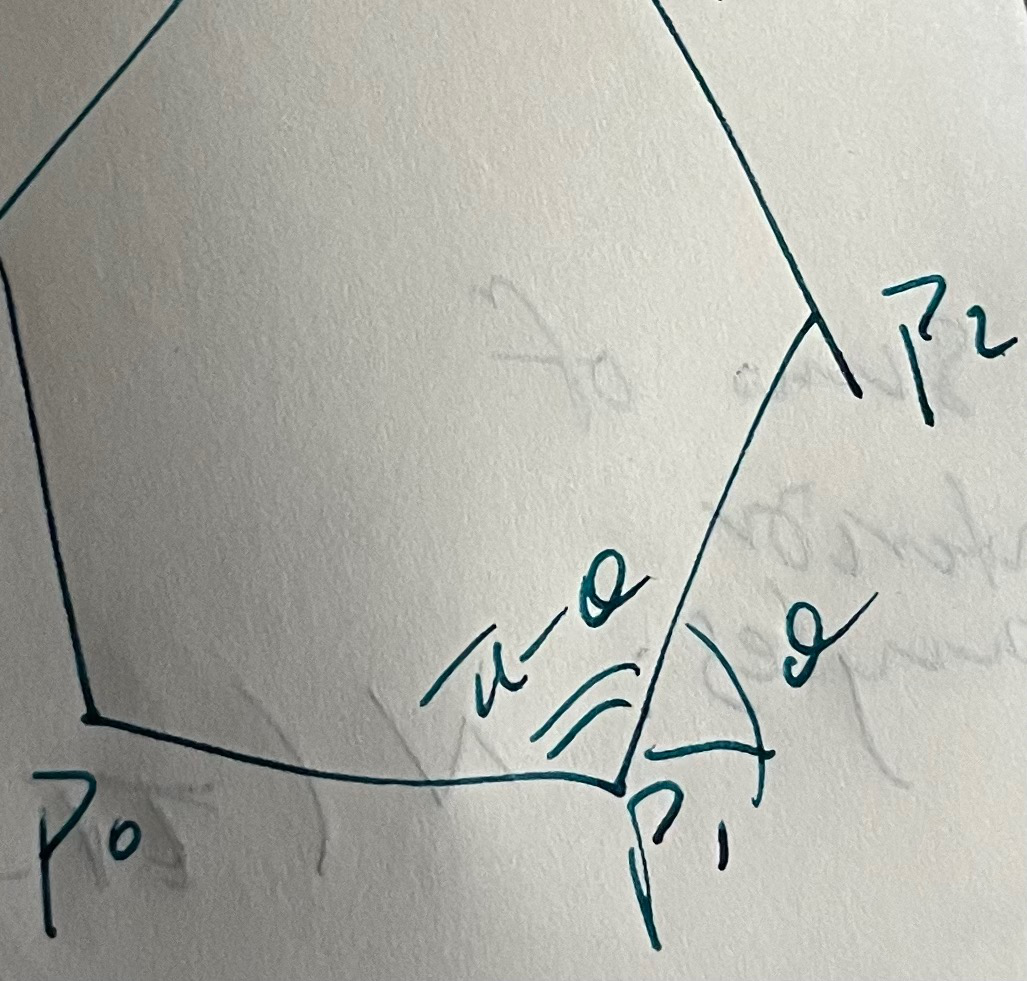
Fig 1. Regular polygon, interior angles.

For reasons that I can’t explain, I woke up this morning dreaming about the interior angles of regular polygons. i.e. the angles \( \pi – \theta \), as illustrated in fig. 1.

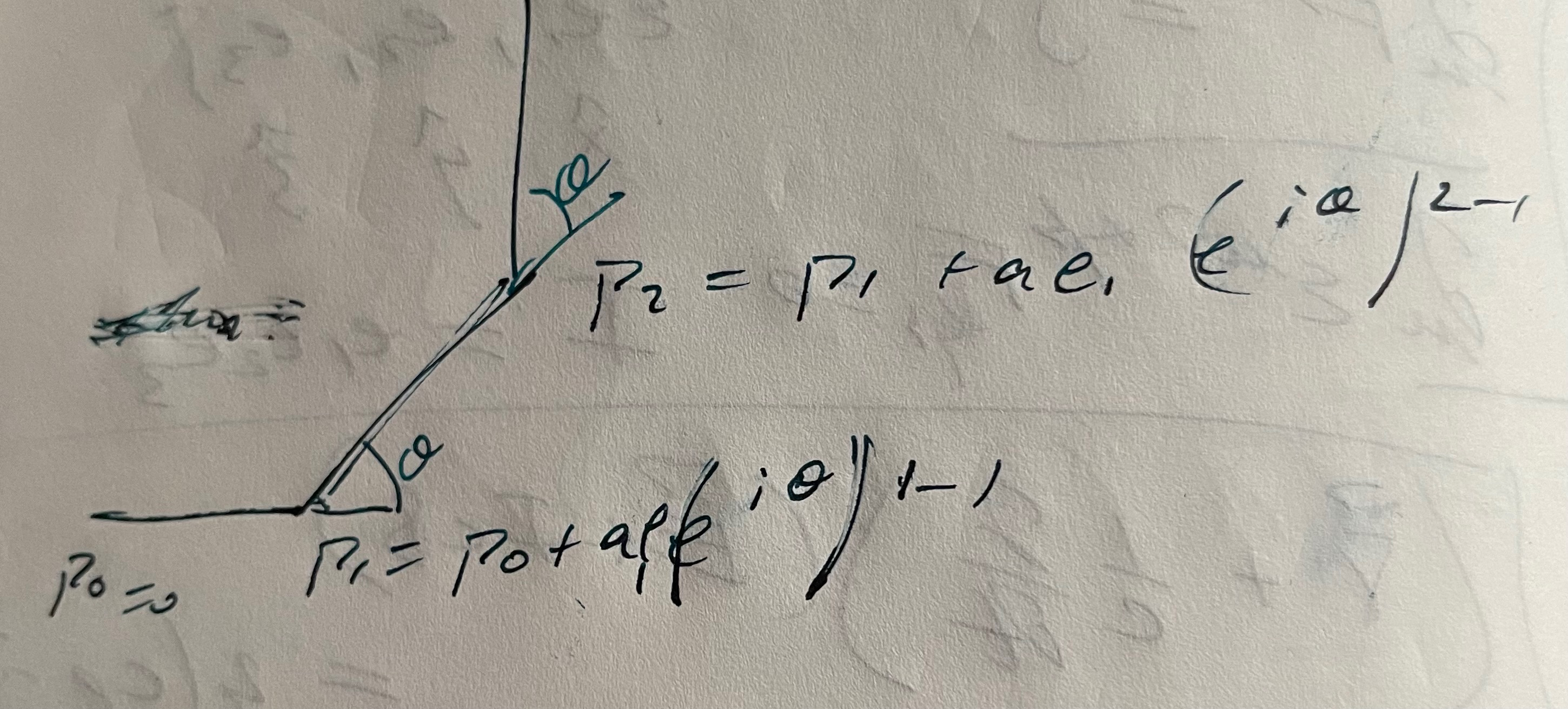
The logical way to calculate that angle would be to slice the polygon up into triangles from the center, since each slice would have an interior angle would be \( 2 \pi / N \), and then the problem is just trigonometric. However, in my dream, I was going around the outside, each time rotating by a constant angle, until reaching the original starting point. This was a vector algebra problem, instead of a trigonometric problem, as illustrated in
fig. 2.

fig. 2. Polygon vertex iteration.

I didn’t have the computational power in my dream to solve the problem, and had to write it down when I woke up, to do so. The problem has the structure of a recurrence relation:
\begin{equation}\label{eqn:regularNgon:20}
\Bp_k = \Bp_{k-1} + a \Be_1 \lr{ e^{i\theta} }^{k-1},
\end{equation}
where
\begin{equation}\label{eqn:regularNgon:40}
\Bp_N = \Bp_0.
\end{equation}

We can write these out explicitly for the first few \( k \) to see the pattern
\begin{equation}\label{eqn:regularNgon:60}
\begin{aligned}
\Bp_2
&= \Bp_{1} + a \Be_1 \lr{ e^{i\theta} }^{2-1} \\
&= \Bp_{0} + a \Be_1 \lr{ e^{i\theta} }^{1-1} + a \Be_1 \lr{ e^{i\theta} }^{2-1} \\
&= \Bp_{0} + a \Be_1 \lr{ 1 + \lr{ e^{i\theta} }^{2-1} },
\end{aligned}
\end{equation}
or
\begin{equation}\label{eqn:regularNgon:80}
\Bp_k = \Bp_{0} + a \Be_1 \lr{ 1 + e^{i\theta} + \lr{ e^{i\theta} }^{2-1} + \cdots + \lr{ e^{i\theta} }^{k-1} },
\end{equation}
so the equation to solve (for \(\theta\)) is
\begin{equation}\label{eqn:regularNgon:100}
\Bp_N = \Bp_0 + a \Be_1 \lr{ 1 + \cdots + \lr{ e^{i\theta} }^{N-1} } = \Bp_0,
\end{equation}
or
\begin{equation}\label{eqn:regularNgon:120}
1 + \cdots + \lr{ e^{i\theta} }^{N-1} = 0.
\end{equation}
The LHS is a geometric series of the form
\begin{equation}\label{eqn:regularNgon:140}
S_N = 1 + \alpha + \cdots \alpha^{N-1}.
\end{equation}
Recall that the trick to solve this is noting that
\begin{equation}\label{eqn:regularNgon:160}
\alpha S_N = \alpha + \cdots \alpha^{N-1} + \alpha^N,
\end{equation}
so
\begin{equation}\label{eqn:regularNgon:180}
\alpha S_N – S_N = \alpha^N – 1,
\end{equation}
or
\begin{equation}\label{eqn:regularNgon:200}
S_N = \frac{\alpha^N – 1}{\alpha – 1}.
\end{equation}
For our polygon, we seek a zero numerator, that is
\begin{equation}\label{eqn:regularNgon:220}
e^{N i \theta} = 1,
\end{equation}
and the smallest \( \theta \) solution to this equation is
\begin{equation}\label{eqn:regularNgon:240}
N \theta = 2 \pi,
\end{equation}
or
\begin{equation}\label{eqn:regularNgon:260}
\theta = \frac{2 \pi}{N}.
\end{equation}
The interior angle is the complement of this, since we are going around the outside edge. That is
\begin{equation}\label{eqn:regularNgon:280}
\begin{aligned}
\pi – \theta &= \pi – \frac{2 \pi}{N} \\ &= \frac{ N – 2 }{N} \pi,
\end{aligned}
\end{equation}
and the sum of all the interior angles is
\begin{equation}\label{eqn:regularNgon:300}
N \lr{ \pi – \theta } = \lr{N – 2 } \pi.
\end{equation}

Plugging in some specific values, for \( N = 3, 4, 5, 6 \), we find that the interior angles are \( \pi/3, \pi/2, 3 \pi/5, 4 \pi/6 \), and the respective sums of these interior angles for the entire polygons are \( \pi, 2 \pi, 3 \pi, 4 \pi \).

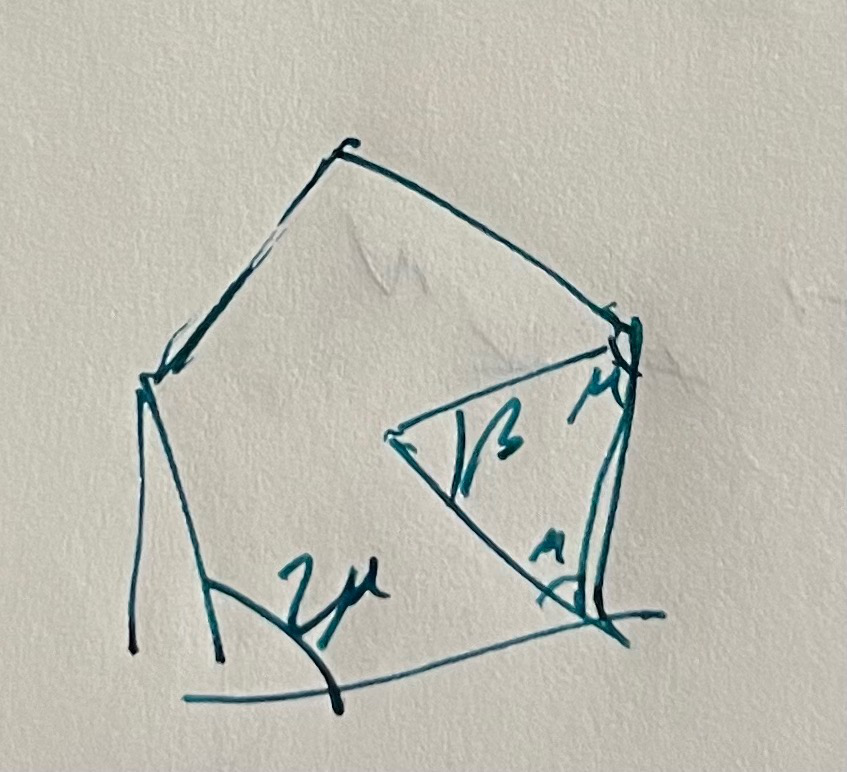
Like, I said, this isn’t the simplest way to solve this problem. Instead, we could solve for \( 2 \mu \) with respect to interior triangle illustrated in
fig. 3, where

fig. 3. Polygon interior geometry.

\begin{equation}\label{eqn:regularNgon:320}
2 \mu + \frac{ 2\pi}{N} = \pi,
\end{equation}
or
\begin{equation}\label{eqn:regularNgon:340}
2 \mu = \frac{N – 2}{N} \pi,
\end{equation}
as found the hard way. The hard way was kind of fun though.

The toughest problem to solve would be “why on earth was my brain pondering this in the early morning?” I didn’t even go to bed thinking about anything math or geometry related (we finished the night with the brain-dead activity of watching an episode of “Stranger things”.)

A great tip for throttling IO intensive processes.

July 9, 2022 Linux , , ,

If I do anything too IO intensive on my Vmware Linux installation (running on MacOSX), it often crashes my VM and the MacOS host along with it, and I have no choice but to powercycle the mac.

This used to happen with my previous Mac too (both work machines, intel generation cpus, not M1/M2.)

Today I crashed my VM/host pair trying to unpack a 4G tar.gz file, and found this great way to throttle the unpacking enough that my machine stayed alive.

My use case was:

# cat master.tar.gz | pv -L 50M | tar zxf -       

I’m running RHEL8 on my VM, but was able to find a EPEL pv rpm (pv-1.6.6-7.el8.x86_64.rpm) to install on rpmsearch.

A multivector Lagrangian for Maxwell’s equation, w/ electric and magnetic current density four-vector sources

June 29, 2022 math and physics play , , , , , , , ,

[Click here for a PDF version of this and previous related posts .]

Initially I had trouble generalizing the multivector Lagrangian to include both the electric and magnetic sources without using two independent potentials. However, this can be done, provided one is careful enough. Recall that we found that a useful formulation for the field in terms of two potentials is
\begin{equation}\label{eqn:maxwellLagrangian:2050}
F = F_{\mathrm{e}} + I F_{\mathrm{m}},
\end{equation}
where
\begin{equation}\label{eqn:maxwellLagrangian:2070}
\begin{aligned}
F_{\mathrm{e}} = \grad \wedge A \\
F_{\mathrm{m}} = \grad \wedge K,
\end{aligned}
\end{equation}
and where \( A, K \) are arbitrary four-vector potentials.
Use of two potentials allowed us to decouple Maxwell’s equations into two separate gradient equations. We don’t want to do that now, but let’s see how we can combine the two fields into a single multivector potential. Letting the gradient act bidirectionally, and introducing a dummy grade-two selection into the mix, we have
\begin{equation}\label{eqn:maxwellLagrangian:2090}
\begin{aligned}
F
&= \rgrad \wedge A + I \lr{ \rgrad \wedge K } \\
&= – A \wedge \lgrad – I \lr{ K \wedge \lgrad } \\
&= -\gpgradetwo{ A \wedge \lgrad + I \lr{ K \wedge \lgrad } } \\
&= -\gpgradetwo{ A \lgrad + I K \lgrad } \\
&= -\gpgradetwo{ \lr{ A + I K } \lgrad }.
\end{aligned}
\end{equation}
Now, we call
\begin{equation}\label{eqn:maxwellLagrangian:2110}
N = A + I K,
\end{equation}
(a 1,3 multivector), the multivector potential, and write the electromagnetic field not in terms of curls explicitly, but using a grade-2 selection filter
\begin{equation}\label{eqn:maxwellLagrangian:2130}
F = -\gpgradetwo{ N \lgrad }.
\end{equation}

We can now form the following multivector Lagrangian
\begin{equation}\label{eqn:maxwellLagrangian:2150}
L = \inv{2} F^2 – \gpgrade{ N \lr{ J – I M } }{0,4},
\end{equation}
and vary the action to (eventually) find our multivector Maxwell’s equation, without ever resorting to coordinates. We have
\begin{equation}\label{eqn:maxwellLagrangian:2170}
\begin{aligned}
\delta S
&= \int d^4 x \inv{2} \lr{ \lr{ \delta F } F + F \lr{ \delta F } } – \gpgrade{ \delta N \lr{ J – I M } }{0,4} \\
&= \int d^4 x \gpgrade{ \lr{ \delta F } F – \lr{ \delta N } \lr{ J – I M } }{0,4} \\
&= \int d^4 x \gpgrade{ -\gpgradetwo{ \lr{ \delta N} \lgrad } F – \lr{ \delta N } \lr{ J – I M } }{0,4} \\
&= \int d^4 x \gpgrade{ -\gpgradetwo{ \lr{ \delta N} \lrgrad } F +\gpgradetwo{ \lr{ \delta N} \rgrad } F – \lr{ \delta N } \lr{ J – I M } }{0,4}.
\end{aligned}
\end{equation}
The \( \lrgrad \) term can be evaluated using the fundamential theorem of GC, and will be zero, as \( \delta N = 0 \) on the boundary. Let’s look at the next integrand term a bit more carefully
\begin{equation}\label{eqn:maxwellLagrangian:2190}
\begin{aligned}
\gpgrade{ \gpgradetwo{ \lr{ \delta N} \rgrad } F }{0,4}
&=
\gpgrade{ \gpgradetwo{ \lr{ \lr{ \delta A } + I \lr{ \delta K } } \rgrad } F }{0,4} \\
&=
\gpgrade{ \lr{ \lr{\delta A} \wedge \rgrad + I \lr{ \lr{ \delta K } \wedge \rgrad }} F }{0,4} \\
&=
\gpgrade{ \lr{\delta A} \rgrad F – \lr{ \lr{\delta A} \cdot \rgrad} F + I \lr{ \delta K } \rgrad F – I \lr{ \lr{ \delta K } \cdot \rgrad} F }{0,4} \\
&=
\gpgrade{ \lr{\delta A} \rgrad F + I \lr{ \delta K } \rgrad F }{0,4} \\
&=
\gpgrade{ \lr{ \lr{\delta A} + I \lr{ \delta K} } \rgrad F }{0,4} \\
&=
\gpgrade{ \lr{ \delta N} \rgrad F }{0,4},
\end{aligned}
\end{equation}
so
\begin{equation}\label{eqn:maxwellLagrangian:2210}
\begin{aligned}
\delta S
&= \int d^4 x \gpgrade{ \lr{ \delta N} \rgrad F – \lr{ \delta N } \lr{ J – I M } }{0,4} \\
&= \int d^4 x \gpgrade{ \lr{ \delta N} \lr{ \rgrad F – \lr{ J – I M } } }{0,4}.
\end{aligned}
\end{equation}
for this to be zero for all variations \( \delta N \) of the 1,3-multivector potential \( N \), we must have
\begin{equation}\label{eqn:maxwellLagrangian:2230}
\grad F = J – I M.
\end{equation}
This is Maxwell’s equation, as desired, including both electric and (if desired) magnetic sources.