rotation

PHY1520H Graduate Quantum Mechanics. Lecture 9: Dirac equation (cont.). Taught by Prof. Arun Paramekanti

October 15, 2015 phy1520 , , , , , , , ,

[Click here for a PDF of this post with nicer formatting]

Disclaimer

Peeter’s lecture notes from class. These may be incoherent and rough.

These are notes for the UofT course PHY1520, Graduate Quantum Mechanics, taught by Prof. Paramekanti.

Where we left off

\begin{equation}\label{eqn:qmLecture9:20}
-i \Hbar \PD{t}{}
\begin{bmatrix}
\psi_1 \\
\psi_2
\end{bmatrix}
=
\begin{bmatrix}
-i \Hbar c \PD{x}{} & m c^2 \\
m c^2 & i \Hbar c \PD{x}{} \\
\end{bmatrix}.
\end{equation}

With a potential this would be

\begin{equation}\label{eqn:qmLecture9:40}
-i \Hbar \PD{t}{}
\begin{bmatrix}
\psi_1 \\
\psi_2
\end{bmatrix}
=
\begin{bmatrix}
-i \Hbar c \PD{x}{} + V(x) & m c^2 \\
m c^2 & i \Hbar c \PD{x}{} + V(x) \\
\end{bmatrix}.
\end{equation}

This means that the potential is raising the energy eigenvalue of the system.

Free Particle

Assuming a form

\begin{equation}\label{eqn:qmLecture9:60}
\begin{bmatrix}
\psi_1(x,t) \\
\psi_2(x,t)
\end{bmatrix}
=
e^{i k x}
\begin{bmatrix}
f_1(t) \\
f_2(t) \\
\end{bmatrix},
\end{equation}

and plugging back into the Dirac equation we have

\begin{equation}\label{eqn:qmLecture9:80}
-i \Hbar \PD{t}{}
\begin{bmatrix}
f_1 \\
f_2
\end{bmatrix}
=
\begin{bmatrix}
k \Hbar c & m c^2 \\
m c^2 & – \Hbar k c \\
\end{bmatrix}
\begin{bmatrix}
f_1 \\
f_2
\end{bmatrix}.
\end{equation}

We can use a diagonalizing rotation

\begin{equation}\label{eqn:qmLecture9:100}
\begin{bmatrix}
f_1 \\
f_2
\end{bmatrix}
=
\begin{bmatrix}
\cos\theta_k & -\sin\theta_k \\
\sin\theta_k & \cos\theta_k \\
\end{bmatrix}
\begin{bmatrix}
f_{+} \\
f_{-} \\
\end{bmatrix}.
\end{equation}

Plugging this in reduces the system to the form

\begin{equation}\label{eqn:qmLecture9:140}
-i \Hbar \PD{t}{}
\begin{bmatrix}
f_{+} \\
f_{-} \\
\end{bmatrix}
=
\begin{bmatrix}
E_k & 0 \\
0 & -E_k
\end{bmatrix}
\begin{bmatrix}
f_{+} \\
f_{-} \\
\end{bmatrix}.
\end{equation}

Where the rotation angle is found to be given by

\begin{equation}\label{eqn:qmLecture9:160}
\begin{aligned}
\sin(2 \theta_k) &= \frac{m c^2}{\sqrt{(\Hbar k c)^2 + m^2 c^4}} \\
\cos(2 \theta_k) &= \frac{\Hbar k c}{\sqrt{(\Hbar k c)^2 + m^2 c^4}} \\
E_k &= \sqrt{(\Hbar k c)^2 + m^2 c^4}
\end{aligned}
\end{equation}

See fig. 1 for a sketch of energy vs momentum. The asymptotes are the limiting cases when \( m c^2 \rightarrow 0 \). The \( + \) branch is what we usually associate with particles. What about the other energy states. For Fermions Dirac argued that the lower energy states could be thought of as “filled up”, using the Pauli principle to leave only the positive energy states available. This was called the “Dirac Sea”. This isn’t a good solution, and won’t work for example for Bosons.
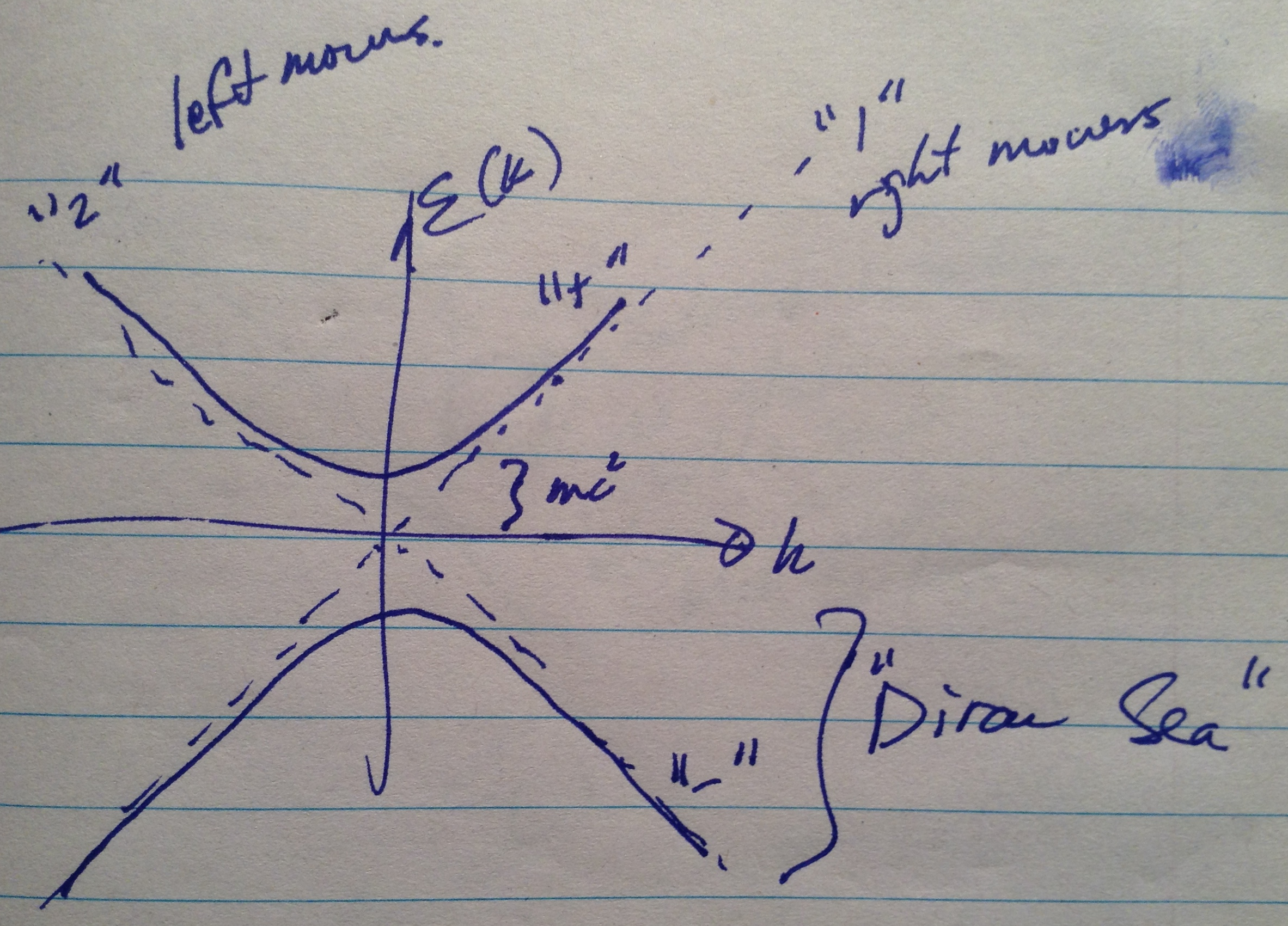
fig. 1. Dirac equation solution space

fig. 1. Dirac equation solution space

Another way to rationalize this is to employ ideas from solid state theory. For example consider a semiconductor with a valence and conduction band as sketched in fig. 2.
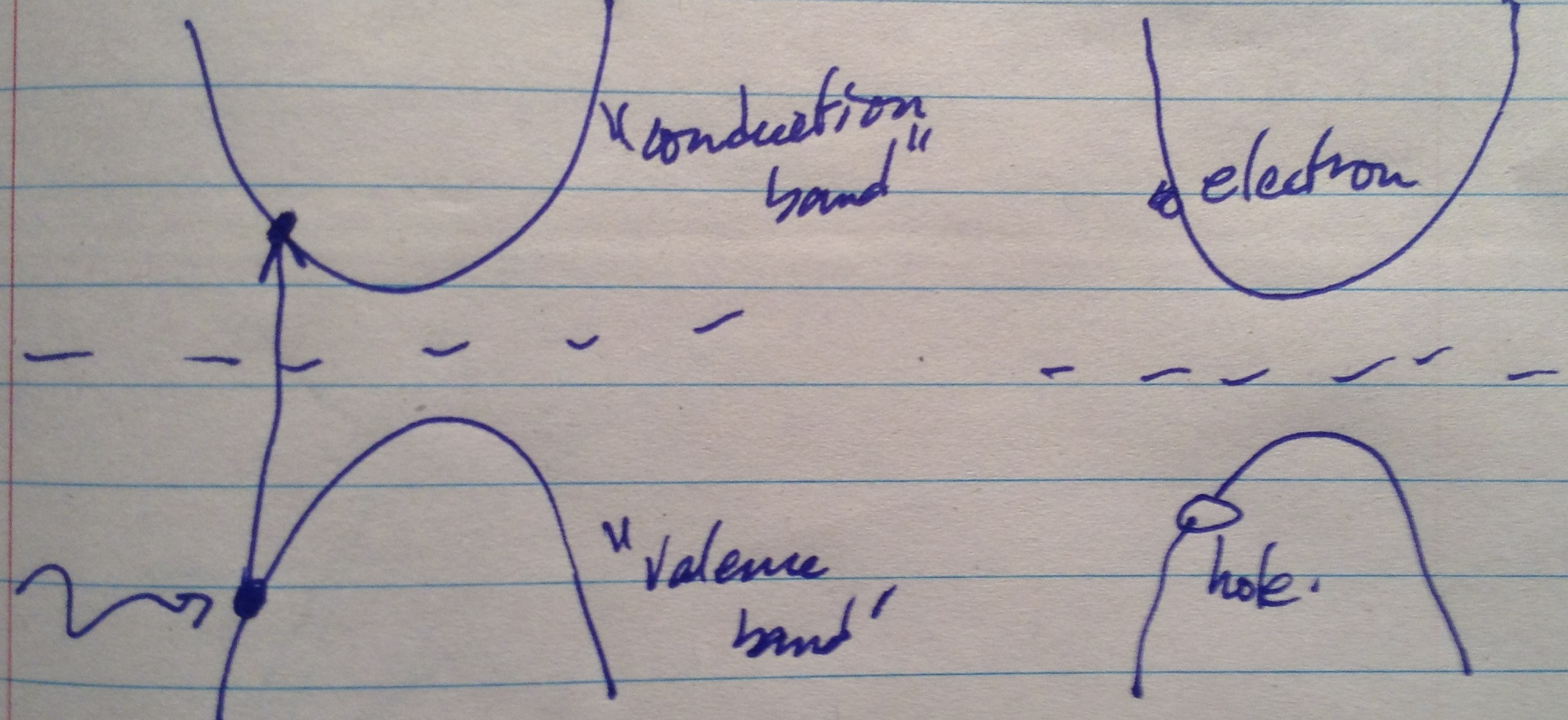
fig. 2. Solid state valence and conduction band transition

fig. 2. Solid state valence and conduction band transition

A photon can excite an electron from the valence band to the conduction band, leaving all the valence band states filled except for one (a hole). For an electron we can use almost the same picture, as sketched in fig. 3.
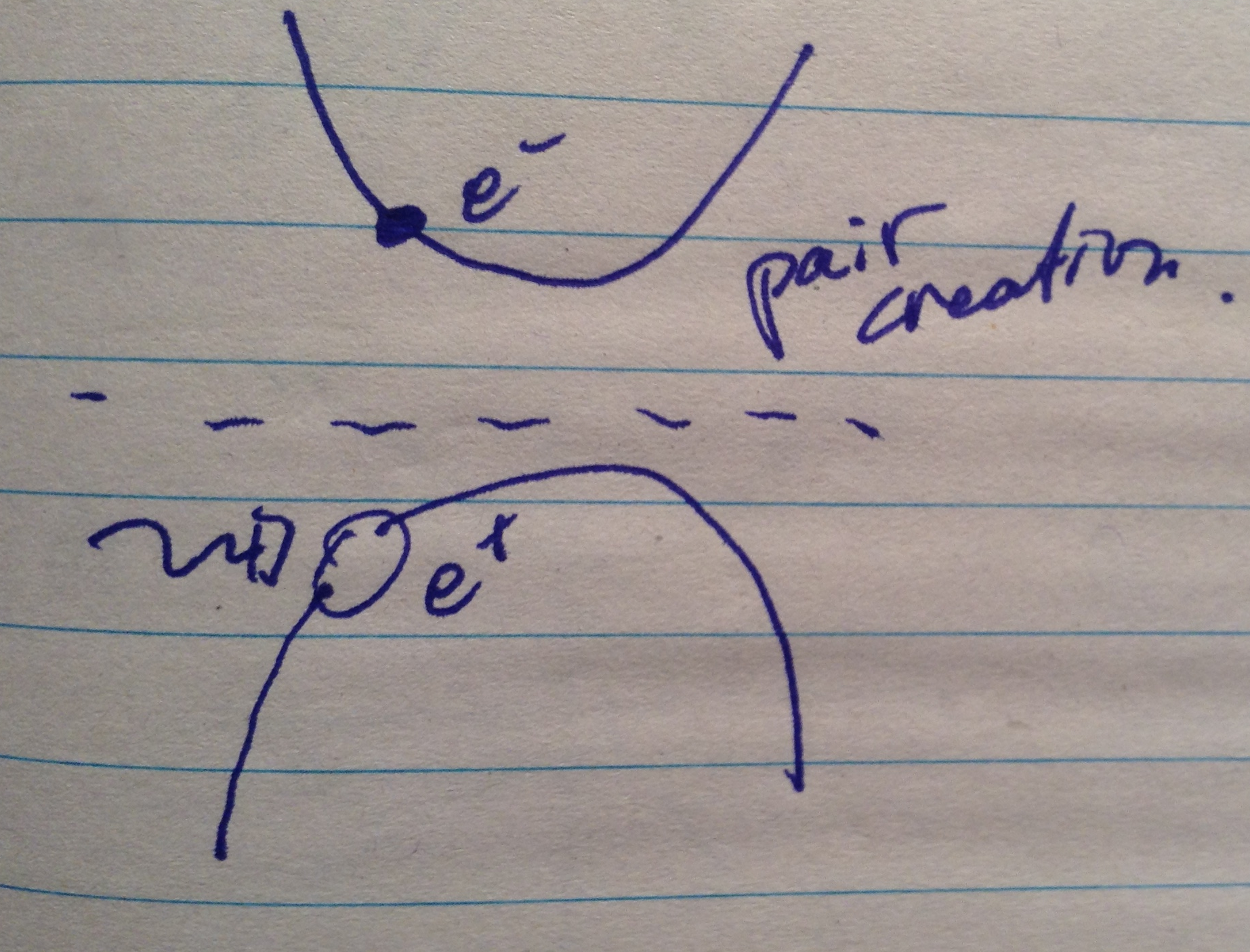
fig. 3. Pair creation

fig. 3. Pair creation

A photon with energy \( E_k – (-E_k) \) can create a positron-electron pair from the vacuum, where the energy of the electron and positron pair is \( E_k \).

At high enough energies, we can see this pair creation occur.

Zitterbewegung

If a particle is created at a non-eigenstate such as one on the asymptotes, then oscillations between the positive and negative branches are possible as sketched in fig. 4.
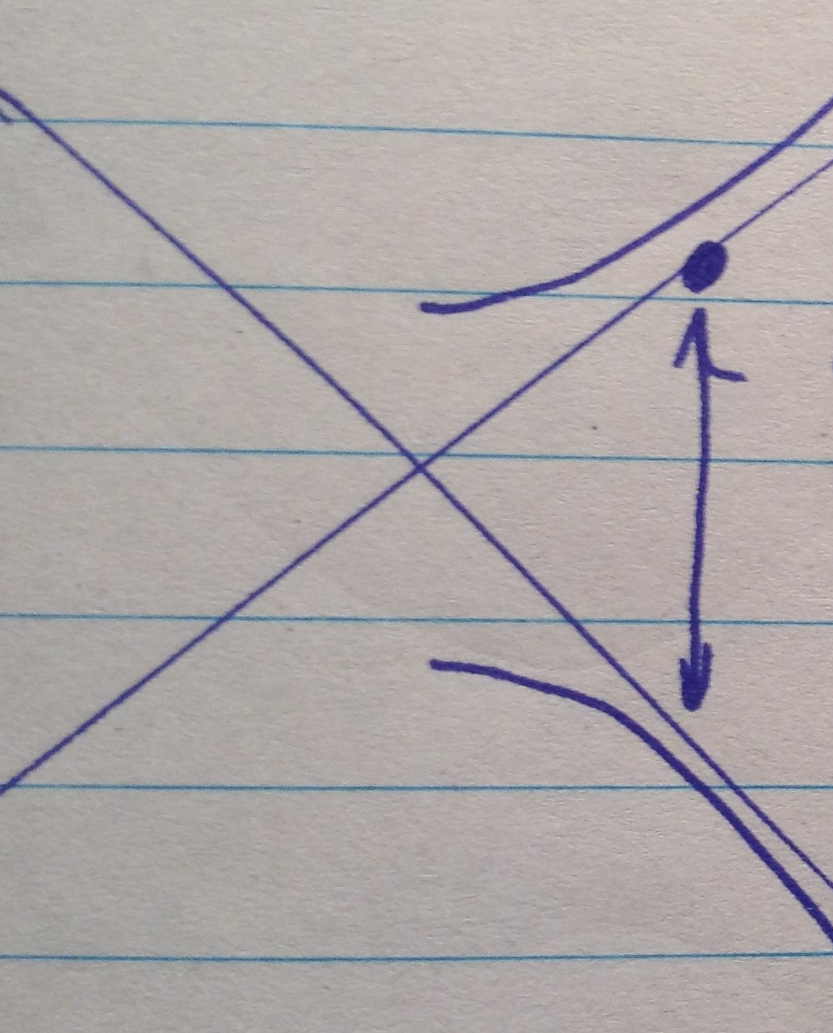
fig. 4. Zitterbewegung oscillation

fig. 4. Zitterbewegung oscillation

Only “vertical” oscillations between the positive and negative locations on these branches is possible since those are the points that match the particle momentum. Examining this will be the aim of one of the problem set problems.

Probability and current density

If we define a probability density

\begin{equation}\label{eqn:qmLecture9:180}
\rho(x, t) = \Abs{\psi_1}^2 + \Abs{\psi_2}^2,
\end{equation}

does this satisfy a probability conservation relation

\begin{equation}\label{eqn:qmLecture9:200}
\PD{t}{\rho} + \PD{x}{j} = 0,
\end{equation}

where \( j \) is the probability current. Plugging in the density, we have

\begin{equation}\label{eqn:qmLecture9:220}
\PD{t}{\rho}
=
\PD{t}{\psi_1^\conj} \psi_1
+
\psi_1^\conj \PD{t}{\psi_1}
+
\PD{t}{\psi_2^\conj} \psi_2
+
\psi_2^\conj \PD{t}{\psi_2}.
\end{equation}

It turns out that the probability current has the form

\begin{equation}\label{eqn:qmLecture9:240}
j(x,t) = c \lr{ \psi_1^\conj \psi_1 + \psi_2^\conj \psi_2 }.
\end{equation}

Here the speed of light \( c \) is the slope of the line in the plots above. We can think of this current density as right movers minus the left movers. Any state that is given can be thought of as a combination of right moving and left moving states, neither of which are eigenstates of the free particle Hamiltonian.

Potential step

The next logical thing to think about, as in non-relativistic quantum mechanics, is to think about what occurs when the particle hits a potential step, as in fig. 5.
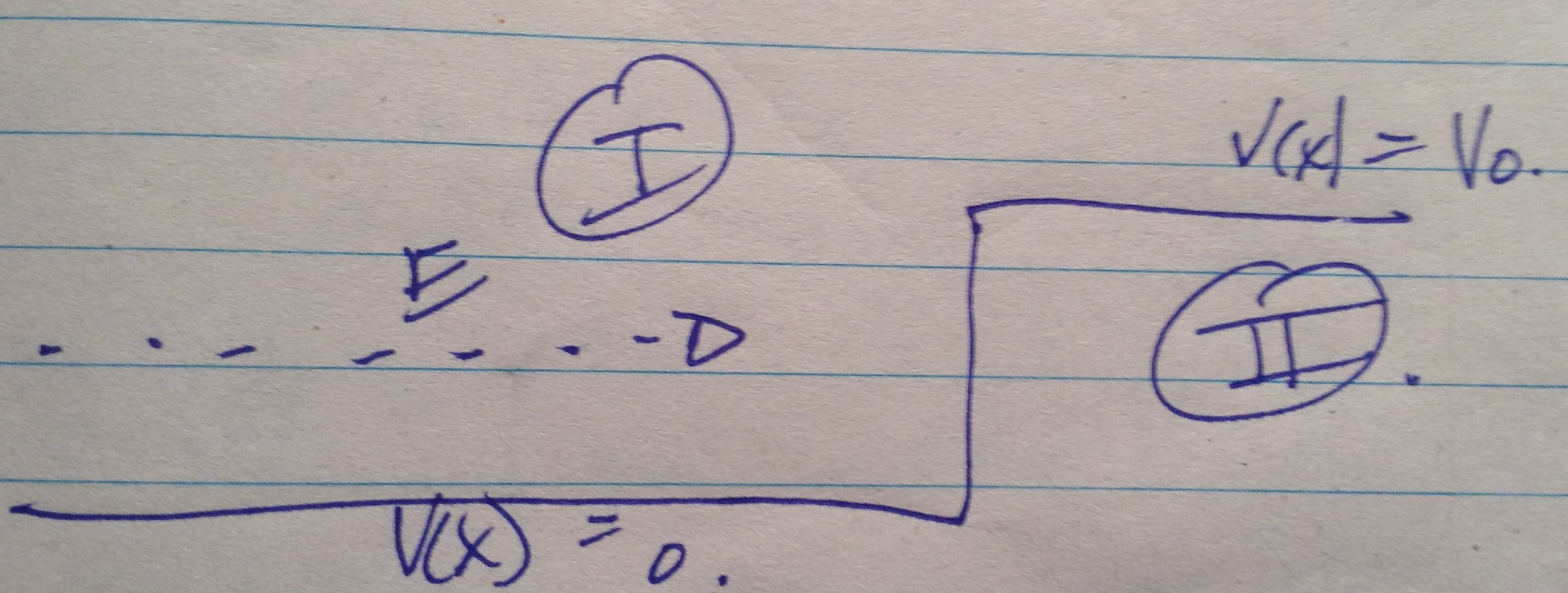
fig. 5. Reflection off a potential barrier

fig. 5. Reflection off a potential barrier

The approach is the same. We write down the wave functions for the \( V = 0 \) region (I), and the higher potential region (II).

The eigenstates are found on the solid lines above the asymptotes on the right hand movers side as sketched in fig. 6. The right and left moving designations are based on the phase velocity \( \PDi{k}{E} \) (approaching \( \pm c \) on the top-right and top-left quadrants respectively).
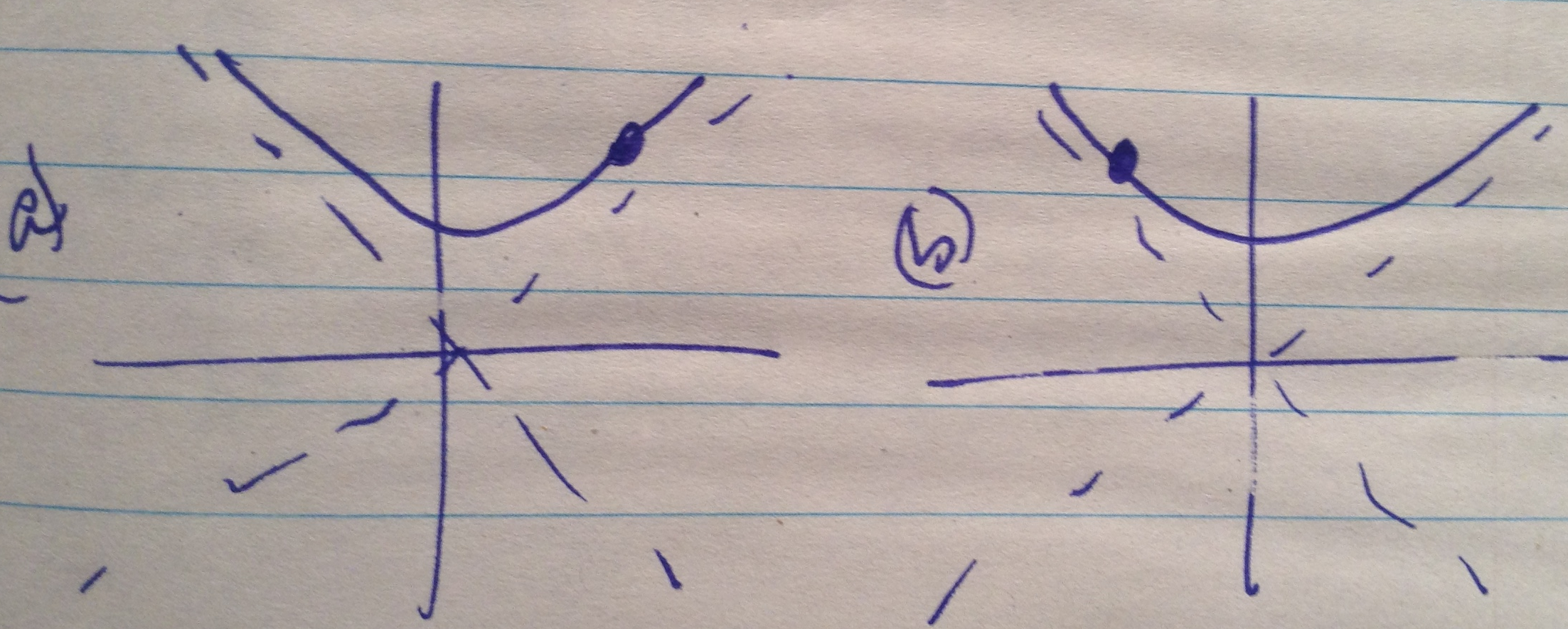
fig. 6. Right movers and left movers

fig. 6. Right movers and left movers

For \( k > 0 \), an eigenstate for the incident wave is

\begin{equation}\label{eqn:qmLecture9:261}
\Bpsi_{\textrm{inc}}(x) =
\begin{bmatrix}
\cos\theta_k \\
\sin\theta_k
\end{bmatrix}
e^{i k x},
\end{equation}

For the reflected wave function, we pick a function on the left moving side of the positive energy branch.

\begin{equation}\label{eqn:qmLecture9:260}
\Bpsi_{\textrm{ref}}(x) =
\begin{bmatrix}
? \\
?
\end{bmatrix}
e^{-i k x},
\end{equation}

We’ll go through this in more detail next time.

Question: Calculate the right going diagonalization

Prove (7).

Answer

To determine the relations for \( \theta_k \) we have to solve

\begin{equation}\label{eqn:qmLecture9:280}
\begin{bmatrix}
E_k & 0 \\
0 & -E_k
\end{bmatrix}
= R^{-1} H R.
\end{equation}

Working with \( \Hbar = c = 1 \) temporarily, and \( C = \cos\theta_k, S = \sin\theta_k \), that is

\begin{equation}\label{eqn:qmLecture9:300}
\begin{aligned}
\begin{bmatrix}
E_k & 0 \\
0 & -E_k
\end{bmatrix}
&=
\begin{bmatrix}
C & S \\
-S & C
\end{bmatrix}
\begin{bmatrix}
k & m \\
m & -k
\end{bmatrix}
\begin{bmatrix}
C & -S \\
S & C
\end{bmatrix} \\
&=
\begin{bmatrix}
C & S \\
-S & C
\end{bmatrix}
\begin{bmatrix}
k C + m S & -k S + m C \\
m C – k S & -m S – k C
\end{bmatrix} \\
&=
\begin{bmatrix}
k C^2 + m S C + m C S – k S^2 & -k S C + m C^2 -m S^2 – k C S \\
-k C S – m S^2 + m C^2 – k S C & k S^2 – m C S -m S C – k C^2
\end{bmatrix} \\
&=
\begin{bmatrix}
k \cos(2 \theta_k) + m \sin(2 \theta_k) & m \cos(2 \theta_k) – k \sin(2 \theta_k) \\
m \cos(2 \theta_k) – k \sin(2 \theta_k) & -k \cos(2 \theta_k) – m \sin(2 \theta_k) \\
\end{bmatrix}.
\end{aligned}
\end{equation}

This gives

\begin{equation}\label{eqn:qmLecture9:320}
\begin{aligned}
E_k
\begin{bmatrix}
1 \\
0
\end{bmatrix}
&=
\begin{bmatrix}
k \cos(2 \theta_k) + m \sin(2 \theta_k) \\
m \cos(2 \theta_k) – k \sin(2 \theta_k) \\
\end{bmatrix} \\
&=
\begin{bmatrix}
k & m \\
m & -k
\end{bmatrix}
\begin{bmatrix}
\cos(2 \theta_k) \\
\sin(2 \theta_k) \\
\end{bmatrix}.
\end{aligned}
\end{equation}

Adding back in the \(\Hbar\)’s and \(c\)’s this is

\begin{equation}\label{eqn:qmLecture9:340}
\begin{aligned}
\begin{bmatrix}
\cos(2 \theta_k) \\
\sin(2 \theta_k) \\
\end{bmatrix}
&=
\frac{E_k}{-(\Hbar k c)^2 -(m c^2)^2}
\begin{bmatrix}
– \Hbar k c & – m c^2 \\
– m c^2 & \Hbar k c
\end{bmatrix}
\begin{bmatrix}
1 \\
0
\end{bmatrix} \\
&=
\inv{E_k}
\begin{bmatrix}
\Hbar k c \\
m c^2
\end{bmatrix}.
\end{aligned}
\end{equation}

Question: Verify the Dirac current relationship.

Prove \ref{eqn:qmLecture9:240}.

Answer

The components of the Schrodinger equation are

\begin{equation}\label{eqn:qmLecture9:360}
\begin{aligned}
-i \Hbar \PD{t}{\psi_1} &= -i \Hbar c \PD{x}{\psi_1} + m c^2 \psi_2 \\
-i \Hbar \PD{t}{\psi_2} &= m c^2 \psi_1 + i \Hbar c \PD{x}{\psi_2},
\end{aligned}
\end{equation}

The conjugates of these are
\begin{equation}\label{eqn:qmLecture9:380}
\begin{aligned}
i \Hbar \PD{t}{\psi_1^\conj} &= i \Hbar c \PD{x}{\psi_1^\conj} + m c^2 \psi_2^\conj \\
i \Hbar \PD{t}{\psi_2^\conj} &= m c^2 \psi_1^\conj – i \Hbar c \PD{x}{\psi_2^\conj}.
\end{aligned}
\end{equation}

This gives
\begin{equation}\label{eqn:qmLecture9:400}
\begin{aligned}
i \Hbar \PD{t}{\rho}
&=
\lr{ i \Hbar c \PD{x}{\psi_1^\conj} + m c^2 \psi_2^\conj } \psi_1 \\
&+ \psi_1^\conj \lr{ i \Hbar c \PD{x}{\psi_1} – m c^2 \psi_2 } \\
&+ \lr{ m c^2 \psi_1^\conj – i \Hbar c \PD{x}{\psi_2^\conj} } \psi_2 \\
&+ \psi_2^\conj \lr{ -m c^2 \psi_1 – i \Hbar c \PD{x}{\psi_2} }.
\end{aligned}
\end{equation}

All the non-derivative terms cancel leaving

\begin{equation}\label{eqn:qmLecture9:420}
\inv{c} \PD{t}{\rho}
=
\PD{x}{\psi_1^\conj} \psi_1
+ \psi_1^\conj \PD{x}{\psi_1}
– \PD{x}{\psi_2^\conj} \psi_2
– \psi_2^\conj \PD{x}{\psi_2}
=
\PD{x}{}
\lr{
\psi_1^\conj \psi_1 –
\psi_2^\conj \psi_2
}.
\end{equation}

Pauli matrix problems

July 21, 2015 phy1520 ,

[Click here for a PDF of this post with nicer formatting]

Q: [1] problem 1.2.

Given an arbitrary \( 2 \times 2 \) matrix \( X = a_0 + \Bsigma \cdot \Ba \),
show the relationships between \( a_\mu \) and \( \textrm{tr}(X), \textrm{tr}(\sigma_k X) \), and \( X_{ij} \).

A.

Observe that each of the Pauli matrices \( \sigma_k \) are traceless

\begin{equation}\label{eqn:pauliProblems:20}
\begin{aligned}
\sigma_x &= \begin{bmatrix} 0 & 1 \\ 1 & 0 \\ \end{bmatrix} \\
\sigma_y &= \begin{bmatrix} 0 & -i \\ i & 0 \\ \end{bmatrix} \\
\sigma_z &= \begin{bmatrix} 1 & 0 \\ 0 & -1 \\ \end{bmatrix} \\
\end{aligned},
\end{equation}

so \( \textrm{tr}(X) = 2 a_0 \). Note that \( \textrm{tr}(\sigma_k \sigma_m) = 2 \delta_{k m} \), so \( \textrm{tr}(\sigma_k X) = 2 a_k \).

Notationally, it would seem to make sense to define \( \sigma_0 \equiv I \), so that \( \textrm{tr}(\sigma_\mu X) = a_\mu \). I don’t know if that is common practice.

For the opposite relations, given

\begin{equation}\label{eqn:pauliProblems:40}
\begin{aligned}
X
&= a_0 + \Bsigma \cdot \Ba \\
&= \begin{bmatrix} 1 & 0 \\ 0 & 1 \\ \end{bmatrix} a_0 + \begin{bmatrix} 0 & 1 \\ 1 & 0 \\ \end{bmatrix} a_1 + \begin{bmatrix} 0 & -i \\ i & 0 \\ \end{bmatrix} a_2 + \begin{bmatrix} 1 & 0 \\ 0 & -1 \\ \end{bmatrix} a_3 \\
&=
\begin{bmatrix}
a_0 + a_3 & a_1 – i a_2 \\
a_1 + i a_2 & a_0 – a_3
\end{bmatrix} \\
&=
\begin{bmatrix}
X_{11} & X_{12} \\
X_{21} & X_{22} \\
\end{bmatrix},
\end{aligned}
\end{equation}

so

\begin{equation}\label{eqn:pauliProblems:80}
\begin{aligned}
a_0 &= \inv{2} \lr{ X_{11} + X_{22} } \\
a_1 &= \inv{2} \lr{ X_{12} + X_{21} } \\
a_2 &= \inv{2 i} \lr{ X_{21} – X_{12} } \\
a_3 &= \inv{2} \lr{ X_{11} – X_{22} }
\end{aligned}.
\end{equation}

Q: [1] problem 1.3.

Determine the structure and determinant of the transformation

\begin{equation}\label{eqn:pauliProblems:100}
\Bsigma \cdot \Ba \rightarrow
\Bsigma \cdot \Ba’ =
\exp\lr{ i \Bsigma \cdot \ncap \phi/2}
\Bsigma \cdot \Ba
\exp\lr{ -i \Bsigma \cdot \ncap \phi/2}.
\end{equation}

A.

Knowing Geometric Algebra, this is recognized as a rotation transformation. In GA, \( i \) is treated as a pseudoscalar (which commutes with all grades in \R{3}), and the expression can be reduced to one involving dot and wedge products. Let’s see how can this be reduced using only the Pauli matrix toolbox.

First, consider the determinant of one of the exponentials. Showing that one such exponential has unit determinant is sufficient. The matrix representation of the unit normal is

\begin{equation}\label{eqn:pauliProblems:120}
\begin{aligned}
\Bsigma \cdot \ncap
&= n_x \begin{bmatrix} 0 & 1 \\ 1 & 0 \\ \end{bmatrix}
+ n_y \begin{bmatrix} 0 & -i \\ i & 0 \\ \end{bmatrix}
+ n_z \begin{bmatrix} 1 & 0 \\ 0 & -1 \\ \end{bmatrix} \\
&=
\begin{bmatrix}
n_z & n_x – i n_y \\
n_x + i n_y & -n_z
\end{bmatrix}.
\end{aligned}
\end{equation}

This is expected to have a unit square, and does

\begin{equation}\label{eqn:pauliProblems:140}
\begin{aligned}
\lr{ \Bsigma \cdot \ncap }^2
&=
\begin{bmatrix}
n_z & n_x – i n_y \\
n_x + i n_y & -n_z
\end{bmatrix}
\begin{bmatrix}
n_z & n_x – i n_y \\
n_x + i n_y & -n_z
\end{bmatrix} \\
&=
\lr{ n_x^2 + n_y^2 + n_z^2 }
\begin{bmatrix}
1 & 0 \\
0 & 1
\end{bmatrix} \\
&=
1.
\end{aligned}
\end{equation}

This allows for a cosine and sine expansion of the exponential, as in

\begin{equation}\label{eqn:pauliProblems:160}
\begin{aligned}
\exp\lr{ i \Bsigma \cdot \ncap \theta}
&=
\cos\theta + i \Bsigma \cdot \ncap \sin\theta \\
&=
\cos\theta
\begin{bmatrix}
1 & 0 \\
0 & 1
\end{bmatrix}
+
i \sin\theta
\begin{bmatrix}
n_z & n_x – i n_y \\
n_x + i n_y & -n_z
\end{bmatrix} \\
&=
\begin{bmatrix}
\cos\theta + i n_z \sin\theta & \lr{ n_x – i n_y } i \sin\theta \\
\lr{ n_x + i n_y } i \sin\theta & \cos\theta – i n_z \sin\theta \\
\end{bmatrix}.
\end{aligned}
\end{equation}

This has determinant

\begin{equation}\label{eqn:pauliProblems:180}
\begin{aligned}
\Abs{\exp\lr{ i \Bsigma \cdot \ncap \theta} }
&=
\cos^2\theta + n_z^2 \sin^2\theta

\lr{ -n_x^2 + -n_y^2 } \sin^2\theta \\
&=
\cos^2\theta + \lr{ n_x^2 + n_y^2 + n_z^2 } \sin^2\theta \\
&= 1,
\end{aligned}
\end{equation}

as expected.

Next step is to show that this transformation is a rotation, and determine the sense of the rotation. Let \( C = \cos\phi/2, S = \sin\phi/2 \), so that

\begin{equation}\label{eqn:pauliProblems:200}
\begin{aligned}
\Bsigma \cdot \Ba’
&=
\exp\lr{ i \Bsigma \cdot \ncap \phi/2}
\Bsigma \cdot \Ba
\exp\lr{ -i \Bsigma \cdot \ncap \phi/2} \\
&=
\lr{ C + i \Bsigma \cdot \ncap S }
\Bsigma \cdot \Ba
\lr{ C – i \Bsigma \cdot \ncap S } \\
&=
\lr{ C + i \Bsigma \cdot \ncap S }
\lr{ C \Bsigma \cdot \Ba – i \Bsigma \cdot \Ba \Bsigma \cdot \ncap S } \\
&=
C^2 \Bsigma \cdot \Ba + \Bsigma \cdot \ncap \Bsigma \cdot \Ba \Bsigma \cdot \ncap S^2
+ i \lr{
-\Bsigma \cdot \Ba \Bsigma \cdot \ncap
+ \Bsigma \cdot \ncap \Bsigma \cdot \Ba
} S C \\
&=
\inv{2} \lr{ 1 + \cos\phi}
\Bsigma \cdot \Ba
+ \Bsigma \cdot \ncap \Bsigma \cdot \Ba \Bsigma \cdot \ncap \inv{2} \lr{ 1 – \cos\phi}
+ i
\antisymmetric{
\Bsigma \cdot \ncap }{\Bsigma \cdot \Ba }
\inv{2} \sin\phi \\
&=
\inv{2}
\Bsigma \cdot \ncap
\symmetric{
\Bsigma \cdot \ncap }{\Bsigma \cdot \Ba }
+ \inv{2}
\Bsigma \cdot \ncap
\antisymmetric{
\Bsigma \cdot \ncap }{\Bsigma \cdot \Ba } \cos\phi
+
\inv{2}
i
\antisymmetric{
\Bsigma \cdot \ncap }{\Bsigma \cdot \Ba }
\sin\phi.
\end{aligned}
\end{equation}

Observe that the angle dependent portion can be written in a compact exponential form

\begin{equation}\label{eqn:pauliProblems:220}
\begin{aligned}
\Bsigma \cdot \Ba’
&=
\inv{2}
\Bsigma \cdot \ncap
\symmetric{
\Bsigma \cdot \ncap }{\Bsigma \cdot \Ba }
+
\lr{
\cos\phi
+
i
\Bsigma \cdot \ncap
\sin\phi
}
\inv{2}
\Bsigma \cdot \ncap
\antisymmetric{
\Bsigma \cdot \ncap }{\Bsigma \cdot \Ba } \\
&=
\inv{2}
\Bsigma \cdot \ncap
\symmetric{
\Bsigma \cdot \ncap }{\Bsigma \cdot \Ba }
+
\exp\lr{ i \Bsigma \cdot \ncap \phi }
\inv{2}
\Bsigma \cdot \ncap
\antisymmetric{
\Bsigma \cdot \ncap }{\Bsigma \cdot \Ba }.
\end{aligned}
\end{equation}

The anticommutator and commutator products with the unit normal can be identified as projections and rejections respectively. Consider the symmetric product first

\begin{equation}\label{eqn:pauliProblems:240}
\begin{aligned}
\inv{2}
\symmetric{
\Bsigma \cdot \ncap }{\Bsigma \cdot \Ba } \\
&=
\inv{2}
\sum n_r a_s \lr{ \sigma_r \sigma_s + \sigma_s \sigma_r } \\
&=
\inv{2}
\sum_{r \ne s} n_r a_s \lr{ \sigma_r \sigma_s + \sigma_s \sigma_r }
+
\inv{2}
\sum_{r } n_r a_r 2 \\
&= 2 \ncap \cdot \Ba.
\end{aligned}
\end{equation}

This shows that
\begin{equation}\label{eqn:pauliProblems:260}
\inv{2}
\Bsigma \cdot \ncap
\symmetric{
\Bsigma \cdot \ncap }{\Bsigma \cdot \Ba }
=
\lr{ \ncap \cdot \Ba } \Bsigma \cdot \ncap,
\end{equation}

which is the projection of \( \Ba \) in the direction of the normal \( \ncap \). To show that the commutator term is the rejection, consider the sum of the two

\begin{equation}\label{eqn:pauliProblems:280}
\begin{aligned}
\inv{2}
\Bsigma \cdot \ncap
\symmetric{
\Bsigma \cdot \ncap }{\Bsigma \cdot \Ba }
+
\inv{2}
\Bsigma \cdot \ncap
\antisymmetric{
\Bsigma \cdot \ncap }{\Bsigma \cdot \Ba }
&=
\Bsigma \cdot \ncap
\Bsigma \cdot \ncap \Bsigma \cdot \Ba \\
&=
\Bsigma \cdot \Ba,
\end{aligned}
\end{equation}

so we must have

\begin{equation}\label{eqn:pauliProblems:300}
\Bsigma \cdot \Ba – \lr{ \ncap \cdot \Ba } \Bsigma \cdot \ncap
=
\inv{2}
\Bsigma \cdot \ncap
\antisymmetric{
\Bsigma \cdot \ncap }{\Bsigma \cdot \Ba }.
\end{equation}

This is the component of \( \Ba \) that has the projection in the \( \ncap \) direction removed. Looking back to \ref{eqn:pauliProblems:220}, the transformation leaves components of the vector that are colinear with the unit normal unchanged, and applies an exponential operation to the component that lies in what is presumed to be the rotation plane. To verify that this latter portion of the transformation is a rotation, and to determine the sense of the rotation, let’s expand the factor of the sine of \ref{eqn:pauliProblems:200}.

That is

\begin{equation}\label{eqn:pauliProblems:320}
\begin{aligned}
\frac{i}{2} \antisymmetric{ \Bsigma \cdot \ncap }{\Bsigma \cdot \Ba }
&=
\frac{i}{2} \sum n_r a_s \antisymmetric{ \sigma_r }{\sigma_s } \\
&=
\frac{i}{2} \sum n_r a_s 2 i \epsilon_{r s t} \sigma_t \\
&=
– \sum \sigma_t n_r a_s \epsilon_{r s t} \\
&=
-\Bsigma \cdot \lr{ \ncap \cross \Ba } \\
&=
\Bsigma \cdot \lr{ \Ba \cross \ncap }.
\end{aligned}
\end{equation}

Since \( \Ba \cross \ncap = \lr{ \Ba – \ncap (\ncap \cdot \Ba) } \cross \ncap \), this vector is seen to lie in the plane normal to \( \ncap \), but perpendicular to the rejection of \( \ncap \) from \( \Ba \). That completes the demonstration that this is a rotation transformation.

To understand the sense of this rotation, consider \( \ncap = \zcap, \Ba = \xcap \), so

\begin{equation}\label{eqn:pauliProblems:340}
\Bsigma \cdot \lr{ \Ba \cross \ncap }
=
\Bsigma \cdot \lr{ \xcap \cross \zcap }
=
-\Bsigma \cdot \ycap,
\end{equation}

and
\begin{equation}\label{eqn:pauliProblems:360}
\Bsigma \cdot \Ba’
=
\xcap \cos\phi – \ycap \sin\phi,
\end{equation}

showing that this rotation transformation has a clockwise sense.

References

[1] Jun John Sakurai and Jim J Napolitano. Modern quantum mechanics. Pearson Higher Ed, 2014.