transverse field

Transverse electric and magnetic field relations.

August 10, 2025 math and physics play , , , , , , , , , , , , , , ,

[Click here for a PDF version of this post]

I found a sign error in my book. Here’s I’ll re-derive all the results for myself here in a standalone fashion, also verifying signs as I go.

Setup

Suppose that a field is propagating in a medium along the z-axis. We may represent that field as the real part of
\begin{equation}\label{eqn:transverseField:20}
F = F(x,y) e^{j(\omega t – k z)}.
\end{equation}
This is a doubly complex relationship, as we have a scalar complex imaginary \( j \), as well as the spatial imaginary \(I = \Be_1 \Be_2 \Be_3 \) that is part of the multivector field itself
\begin{equation}\label{eqn:transverseField:40}
F = \BE + I \eta \BH.
\end{equation}

Let’s call
\begin{equation}\label{eqn:transverseField:60}
F_z = \lr{ \BE \cdot \Be_3} \Be_3 + I \eta \lr{ \BH \cdot \Be_3 } \Be_3,
\end{equation}
the propagation component of the field and \( F_t = F – F_z \) the transverse component of the field. We can write these in a more symmetric fashion by expanding the dot products and regrouping
\begin{equation}\label{eqn:transverseField:80}
\begin{aligned}
F_z
&= \lr{ \BE \cdot \Be_3} \Be_3 + I \eta \lr{ \BH \cdot \Be_3 } \Be_3 \\
&= \inv{2} \lr{ \BE \Be_3 + \Be_3 \BE } \Be_3 + \frac{I \eta}{2} \lr{ \BH \Be_3 + \Be_3 \BH} \Be_3 \\
&= \inv{2} \lr{ \BE + \Be_3 \BE \Be_3 } + \frac{I \eta}{2} \lr{ \BH + \Be_3 \BH \Be_3} \Be_3 \\
&= \inv{2} \lr{ F + \Be_3 F \Be_3 }.
\end{aligned}
\end{equation}
By subtraction, we also have
\begin{equation}\label{eqn:transverseField:100}
F_t = \inv{2} \lr{ F – \Be_3 F \Be_3 }.
\end{equation}

Relating the transverse and propagation direction fields

The multivector form of Maxwell’s equation, for source free conditions, is
\begin{equation}\label{eqn:transverseField:120}
0 = \lr{ \spacegrad + \inv{c} \partial_t } F.
\end{equation}
We split the gradient into a propagation direction component and a transverse component \( \spacegrad_t \)
\begin{equation}\label{eqn:transverseField:140}
\spacegrad = \spacegrad_t + \Be_3 \partial_z,
\end{equation}
so
\begin{equation}\label{eqn:transverseField:160}
\begin{aligned}
0
&= \lr{ \spacegrad_t + \Be_3 \partial_z + \inv{c} \partial_t } F \\
&= \lr{ \spacegrad_t + \Be_3 \partial_z + \inv{c} \partial_t } F(x,y) e^{j(\omega t – k z) } \\
&= \lr{ \spacegrad_t – j\Be_3 k + j\frac{\omega}{c} } F(x,y) e^{j(\omega t – k z) },
\end{aligned}
\end{equation}
or
\begin{equation}\label{eqn:transverseField:180}
-j \lr{ \frac{\omega}{c} – k \Be_3 } F = \spacegrad_t F.
\end{equation}

Observe that
\begin{equation}\label{eqn:transverseField:200}
-j \lr{ \frac{\omega}{c} – k \Be_3 } \Be_3 F \Be_3 = -\spacegrad_t \Be_3 F \Be_3,
\end{equation}
which means that
\begin{equation}\label{eqn:transverseField:220}
-j \lr{ \frac{\omega}{c} – k \Be_3 } \inv{2} \lr{ F \pm \Be_3 F \Be_3 } = \spacegrad_t \inv{2} \lr{ F \mp \Be_3 F \Be_3 },
\end{equation}
or
\begin{equation}\label{eqn:transverseField:240}
\begin{aligned}
-j \lr{ \frac{\omega}{c} – k \Be_3 } F_z &= \spacegrad_t F_t \\
-j \lr{ \frac{\omega}{c} – k \Be_3 } F_t &= \spacegrad_t F_z.
\end{aligned}
\end{equation}

Provided \( \omega^2 \ne k^2 c^2 \), this can be inverted, meaning that \( F_t \) fully specifies \( F_z \) if known, as well as the opposite.

That inversion provides the propagation direction field in terms of the transverse
\begin{equation}\label{eqn:transverseField:260a}
F_z = j \frac{ \frac{\omega}{c} + k \Be_3 }{ \omega^2 \mu \epsilon – k^2 } \spacegrad_t F_t,
\end{equation}
and the transverse field in terms of the propagation direction field
\begin{equation}\label{eqn:transverseField:260b}
F_t = j \frac{ \frac{\omega}{c} + k \Be_3 }{ \omega^2 \mu \epsilon – k^2 } \spacegrad_t F_z.
\end{equation}

Transverse field in terms of propagation

Let’s expand \ref{eqn:transverseField:260b} in terms of component electric and magnetic fields. First note that
\begin{equation}\label{eqn:transverseField:280}
\begin{aligned}
\spacegrad_t F_z
&= \spacegrad_t \Be_3 \lr{ E_z + I \eta H_z } \\
&= -\Be_3 \spacegrad_t \lr{ E_z + I \eta H_z }.
\end{aligned}
\end{equation}
so
\begin{equation}\label{eqn:transverseField:300}
F_t = -j \frac{ \frac{\omega}{c} \Be_3 + k }{ \omega^2 \mu \epsilon – k^2 } \spacegrad_t \lr{ E_z + I \eta H_z }.
\end{equation}
This may now be split into electric and magnetic fields, but first note that the multivector operator
\begin{equation}\label{eqn:transverseField:320}
\begin{aligned}
\Be_3 \spacegrad_t
&=
\Be_3 \cdot \spacegrad_t + \Be_3 \wedge \spacegrad_t \\
&=
\Be_3 \wedge \spacegrad_t,
\end{aligned}
\end{equation}
has only a bivector component.

For the transverse electric field component, we have
\begin{equation}\label{eqn:transverseField:340}
\begin{aligned}
\gpgradeone{ \lr{ \frac{\omega}{c} \Be_3 + k } \spacegrad_t \lr{ E_z + I \eta H_z } }
&=
k \spacegrad_t E_z + \frac{\omega}{c} \Be_3 \wedge \spacegrad_t \lr{ I \eta H_z } \\
&=
k \spacegrad_t E_z – \frac{\eta \omega}{c} \Be_3 \cross \spacegrad_t H_z.
\end{aligned}
\end{equation}
and for the magnetic field component
\begin{equation}\label{eqn:transverseField:360}
\begin{aligned}
\gpgradetwo{ \lr{ \frac{\omega}{c} \Be_3 + k } \spacegrad_t \lr{ E_z + I \eta H_z } }
=
\frac{\omega}{c} \Be_3 \wedge \spacegrad_t E_z + I \eta k \spacegrad_t H_z
\end{aligned}
\end{equation}

This means that
\begin{equation}\label{eqn:transverseField:380}
\begin{aligned}
\BE_t &= \frac{j}{\omega^2 \mu \epsilon – k^2 } \lr{ -k \spacegrad_t E_z + \frac{\eta \omega}{c} \Be_3 \cross \spacegrad_t H_z } \\
\eta I \BH_t &= -\frac{j}{\omega^2 \mu \epsilon – k^2 } \lr{ \frac{\omega}{c} \Be_3 \wedge \spacegrad_t E_z + I \eta k \spacegrad_t H_z }
\end{aligned}
\end{equation}

Cancelling out the \( \eta I \) factors in the magnetic field component, and substituting \( \eta/c = \mu, 1/(c\eta) = \epsilon \), leaves us with
\begin{equation}\label{eqn:transverseField:400}
\begin{aligned}
\BE_t &= \frac{j}{\omega^2 \mu \epsilon – k^2 } \lr{ -k \spacegrad_t E_z + \mu \omega \Be_3 \cross \spacegrad_t H_z } \\
\BH_t &= -\frac{j}{\omega^2 \mu \epsilon – k^2 } \lr{ \epsilon \omega \Be_3 \cross \spacegrad_t E_z + k \spacegrad_t H_z }.
\end{aligned}
\end{equation}

Propagation field in terms of transverse.

Now let’s invert \ref{eqn:transverseField:260a}. We seek the grade selections
\begin{equation}\label{eqn:transverseField:420}
\gpgrade{ \lr{ \frac{\omega}{c} + k \Be_3 } \spacegrad_t F_t }{1,2}
\end{equation}

Performing each of these four grade selections in turn, for the \( \spacegrad_t F_t \) products we have
\begin{equation}\label{eqn:transverseField:440}
\begin{aligned}
\gpgradeone{ \spacegrad_t F_t }
&=
\gpgradeone{ \spacegrad_t \lr{ \BE_t + I \eta \BH_t } } \\
&=
\eta \gpgradeone{ I \spacegrad_t \BH_t } \\
&=
\eta I \lr{ \spacegrad_t \wedge \BH_t } \\
&=
-\eta \lr{ \spacegrad_t \cross \BH_t }.
\end{aligned}
\end{equation}
Because \( \spacegrad_t \BE_t \) has only 0,2 grades, so the grade-one selection was zero, leaving us with only \( \BH_t \) dependence.

For the grade two selection of the same, we have
\begin{equation}\label{eqn:transverseField:460}
\begin{aligned}
\gpgradetwo{ \spacegrad_t F_t }
&=
\gpgradetwo{ \spacegrad_t \lr{ \BE_t + I \eta \BH_t } } \\
&=
\spacegrad_t \wedge \BE_t \\
&=
I \lr{ \spacegrad_t \cross \BE_t }.
\end{aligned}
\end{equation}
This time we note that the vector-bivector product \( \spacegrad_t (I \BH_t) \) has only 1,3 grades, and is killed by the grade-2 selection.

For the \( \Be_3 \spacegrad_t F_t \) products, we have
\begin{equation}\label{eqn:transverseField:480}
\begin{aligned}
\gpgradeone{ \Be_3 \spacegrad_t F_t }
&=
\gpgradeone{ \Be_3 \spacegrad_t \lr{ \BE_t + I \eta \BH_t } } \\
&=
\gpgradeone{ \lr{ \Be_3 \cdot \spacegrad_t + \Be_3 \wedge \spacegrad_t } \BE_t }
+
\eta \gpgradeone{ I \Be_3 \lr{ \spacegrad_t \cdot \BH_t + \spacegrad_t \wedge \BH_t } } \\
&=
\gpgradeone{ I \lr{ \Be_3 \cross \spacegrad_t } \BE_t } \\
&=
-\lr{ \Be_3 \cross \spacegrad_t } \cross \BE_t.
\end{aligned}
\end{equation}
Observe that we’ve made use of \( \Be_3 \cdot \spacegrad_t = 0 \), regardless of what it operates on. For the \( \BH_t \) dependence, we had a bivector-scalar product \( (I \Be_3) (\spacegrad_t \cdot \BH_t) \), and a bivector-bivector product \( (I \Be_3) (\spacegrad_t \wedge \BH_t) \), neither of which have any vector grades.

Finally
\begin{equation}\label{eqn:transverseField:500}
\begin{aligned}
\gpgradetwo{ \Be_3 \spacegrad_t F_t }
&=
\eta \gpgradetwo{ I \Be_3 \spacegrad_t \BH_t } \\
&=
-\eta \gpgradetwo{ \lr{\Be_3 \cross \spacegrad_t} \BH_t } \\
&=
-\eta I \lr{\Be_3 \cross \spacegrad_t} \cross \BH_t.
\end{aligned}
\end{equation}
Here we’ve discarded the \( \BE_t \) dependent terms, since the bivector-vector product \( \lr{ \Be_3 \wedge \spacegrad_t } \BE_t \) has only grades 1,3, and we seek grade 2 only.

Putting all the pieces together, noting that \( \eta/c = \mu \) and \( 1/(c \eta) = \epsilon \), we have
we have
\begin{equation}\label{eqn:transverseField:520}
\BE_z = -\frac{j}{\omega^2 \mu \epsilon – k^2 } \lr{ \omega \mu \lr{ \spacegrad_t \cross \BH_t } + k \lr{ \Be_3 \cross \spacegrad_t } \cross \BE_t },
\end{equation}
and
\begin{equation}\label{eqn:transverseField:540}
\BH_z = \frac{j}{\omega^2 \mu \epsilon – k^2 } \lr{ \omega \epsilon \lr{ \spacegrad_t \cross \BE_t } – k \lr{\Be_3 \cross \spacegrad_t} \cross \BH_t }.
\end{equation}
Resolving fields into components parallel to the reflecting plane

March 6, 2015 ece1229 , , , , ,

[Click here for a PDF of this post with nicer formatting]

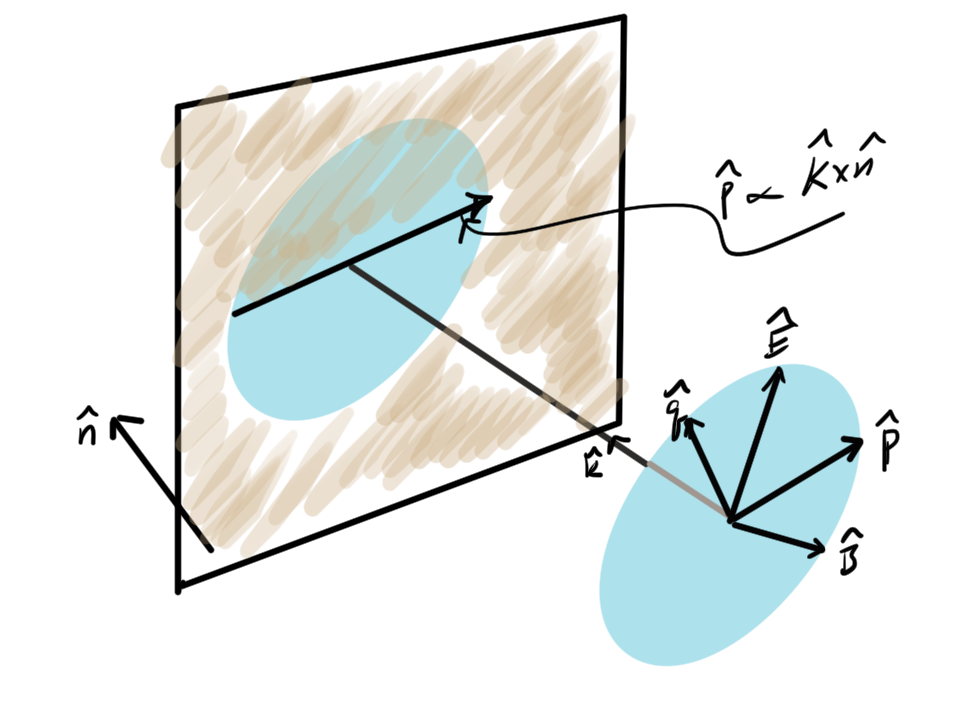
In order to apply the Fresnel equations, the field components have to be resolved into components where either the electric field or the magnetic field is parallel to the plane of reflection. The geometry of this, with the wave vector direction \( \kcap \) and the electric and magnetic field phasors perpendicular to that direction is sketched in fig. 1.

resolvingFieldsIncidentOnObliquePlaneFig1

fig. 1. Field components relative to reflecting plane


If the incident wave is a plane wave, or equivalently a far field spherical wave, it will have the form

\begin{equation}\label{eqn:resolvingFieldsIncidentOnPlane:20}
\BH = \inv{\mu_0} \kcap \cross \BE,
\end{equation}

with the field directions and wave vector directions satisfying

\begin{equation}\label{eqn:resolvingFieldsIncidentOnPlane:60}
\Ecap \cross \Hcap = \kcap
\end{equation}
\begin{equation}\label{eqn:resolvingFieldsIncidentOnPlane:80}
\Ecap \cdot \kcap = 0
\end{equation}
\begin{equation}\label{eqn:resolvingFieldsIncidentOnPlane:100}
\Hcap \cdot \kcap = 0.
\end{equation}

The key to resolving the fields into components parallel to the plane of reflection lies in the observation that the cross product of the plane normal \( \ncap \) and the incident wave vector direction \( \kcap \) lies in that plane. With

\begin{equation}\label{eqn:resolvingFieldsIncidentOnPlane:140}
\pcap = \frac{\kcap \cross \ncap}{\Abs{\kcap \cross \ncap}}
\end{equation}
\begin{equation}\label{eqn:resolvingFieldsIncidentOnPlane:160}
\qcap = \kcap \cross \pcap,
\end{equation}

the field directions can be resolved into components

\begin{equation}\label{eqn:resolvingFieldsIncidentOnPlane:200}
\BE = \lr{ \BE \cdot \pcap } \pcap + \lr{ \BE \cdot \qcap } \qcap = E_\parallel \pcap + E_\perp \qcap
\end{equation}
\begin{equation}\label{eqn:resolvingFieldsIncidentOnPlane:220}
\BH = \lr{ \BH \cdot \pcap } \pcap + \lr{ \BH \cdot \qcap } \qcap = H_\parallel \pcap + H_\perp \qcap.
\end{equation}

This subdivides the fields into two pairs, one with the electric field parallel to the reflection plane

\begin{equation}\label{eqn:resolvingFieldsIncidentOnPlane:240}
\begin{aligned}
\BE_1 &= \lr{ \BE \cdot \pcap } \pcap = E_\parallel \pcap \\
\BH_1 &= \lr{ \BH \cdot \qcap } \qcap = H_\perp \qcap,
\end{aligned}
\end{equation}

and one with the magnetic field parallel to the reflection plane

\begin{equation}\label{eqn:resolvingFieldsIncidentOnPlane:260}
\begin{aligned}
\BH_2 &= \lr{ \BH \cdot \pcap } \pcap = H_\parallel \pcap \\
\BE_2 &= \lr{ \BE \cdot \qcap } \qcap = E_\perp \qcap.
\end{aligned}
\end{equation}

This is most of what we need to proceed with the reflection and transmission analysis. The only task remaining is to determine the reflection angle.

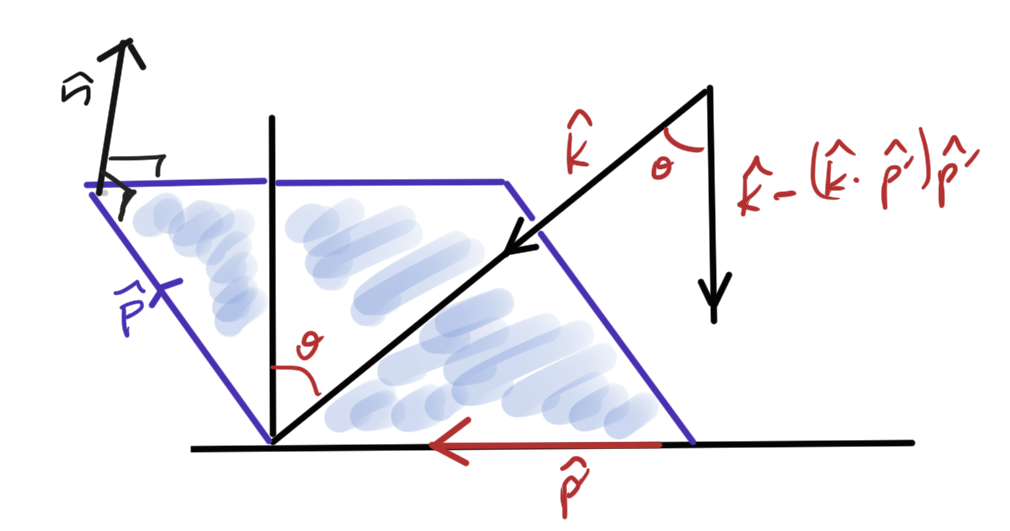
Using a pencil with the tip on the table I was able to convince myself by observation that there is always a normal plane of incidence regardless of any oblique angle that the ray hits the reflecting surface. This was, for some reason, not intuitively obvious to me. Having done that, the geometry must be reduced to what is sketched in fig. 2.

resolvingAngleOfIncidenceFig1

fig. 2. Angle of incidence determination


Once \( \pcap \) has been determined, regardless of it’s orientation in the reflection plane, the component of \( \kcap \) that is normal, directed towards, the plane of reflection is

\begin{equation}\label{eqn:resolvingFieldsIncidentOnPlane:280}
\kcap – \lr{ \kcap \cdot \pcap } \pcap,
\end{equation}

with (squared) length

\begin{equation}\label{eqn:resolvingFieldsIncidentOnPlane:300}
\begin{aligned}
\lr{ \kcap – \lr{ \kcap \cdot \pcap } \pcap }^2
&=
1 + \lr{ \kcap \cdot \pcap }^2 – 2 \lr{ \kcap \cdot \pcap }^2 \\
&=
1 – \lr{ \kcap \cdot \pcap }^2.
\end{aligned}
\end{equation}

The angle of incidence, relative to the normal to the reflection plane, follows from

\begin{equation}\label{eqn:resolvingFieldsIncidentOnPlane:320}
\begin{aligned}
\cos\theta
&= \kcap \cdot \frac{
\kcap – \lr{ \kcap \cdot \pcap } \pcap }{
\sqrt{
1 – \lr{ \kcap \cdot \pcap }^2
}
} \\
&=
\sqrt{
1 – \lr{ \kcap \cdot \pcap }^2
},
\end{aligned}
\end{equation}

Expanding the dot product above gives

\begin{equation}\label{eqn:resolvingFieldsIncidentOnPlane:360}
\begin{aligned}
\kcap \cdot \pcap’
&=
\kcap \cdot \lr{ \pcap \cross \ncap } \\
&=
\frac{1}{\Abs{\kcap \cross \ncap} } \kcap \cdot \lr{ \lr{\kcap \cross \ncap} \cross \ncap },
\end{aligned}
\end{equation}

where

\begin{equation}\label{eqn:resolvingFieldsIncidentOnPlane:380}
\begin{aligned}
\kcap \cdot \lr{ \lr{\kcap \cross \ncap} \cross \ncap }
&=
k_r \epsilon_{r s t} \lr{\kcap \cross \ncap}_s n_t \\
&=
k_r \epsilon_{r s t} \epsilon_{s a b} k_a n_b n_t \\
&=
-k_r \delta_{r t}^{[a b]} k_a n_b n_t \\
&=
-k_r n_t \lr{ k_r n_t – k_t n_r } \\
&=
-1 + \lr{ \kcap \cdot \ncap}^2.
\end{aligned}
\end{equation}

That gives

\begin{equation}\label{eqn:resolvingFieldsIncidentOnPlane:400}
\begin{aligned}
\kcap \cdot \pcap’
&=
\frac{-1 + \lr{ \kcap \cdot \ncap}^2}{\sqrt{1 – \lr{ \kcap \cdot \ncap}^2} } \\
&=
-\sqrt{1 – \lr{ \kcap \cdot \ncap}^2},
\end{aligned}
\end{equation}

or

\begin{equation}\label{eqn:resolvingFieldsIncidentOnPlane:420}
\begin{aligned}
\cos\theta
&= \sqrt{ 1 – \lr{-\sqrt{1 – \lr{ \kcap \cdot \ncap}^2}}^2 } \\
&= \sqrt{ \lr{ \kcap \cdot \ncap}^2 } \\
&= \kcap \cdot \ncap.
\end{aligned}
\end{equation}

This surprisingly simple result makes so much sense, it is an awful admission of stupidity that I went through all the vector algebra to get it instead of just writing it down directly.

The end result is the reflection angle is given by

\begin{equation}\label{eqn:resolvingFieldsIncidentOnPlane:340}
\boxed{
\theta = \cos^{-1} \kcap \cdot \ncap,
}
\end{equation}

where the reflection plane normal should off the back surface to get the sign right. The only detail left is the vector direction of the reflected ray (as well as the direction for the transmitted ray if that is of interest). The reflected ray direction flips the sign of the normal component of the ray

\begin{equation}\label{eqn:resolvingFieldsIncidentOnPlane:440}
\begin{aligned}
\kcap’
&= -\lr{\kcap \cdot \ncap} \ncap + \lr{ \kcap \wedge \ncap} \ncap \\
&= -\lr{\kcap \cdot \ncap} \ncap + \kcap – \lr{ \ncap \kcap} \cdot \ncap \\
&= \kcap -2 \lr{\kcap \cdot \ncap} \ncap.
\end{aligned}
\end{equation}

Here the sign of the normal doesn’t matter since it only occurs quadratically.

This now supplies everything needed for the application of the Fresnel equations to determine the reflected ray characteristics of an arbitrarily polarized incident field.

Reciprocity theorem: background

February 19, 2015 ece1229 , , , , , , ,

[Click here for a PDF of this post with nicer formatting]

The class slides presented a derivation of the reciprocity theorem, a theorem that contained the integral of

\begin{equation}\label{eqn:reciprocityTheorem:360}
\int \lr{ \BE^{(a)} \cross \BH^{(b)} – \BE^{(b)} \cross \BH^{(a)} } \cdot d\BS = \cdots
\end{equation}

over a surface, where the RHS was a volume integral involving the fields and (electric and magnetic) current sources.
The idea was to consider two different source loading configurations of the same system, and to show that the fields and sources in the two configurations can be related.

To derive the result in question, a simple way to start is to look at the divergence of the difference of cross products above. This will require the phasor form of the two cross product Maxwell’s equations

\begin{equation}\label{eqn:reciprocityTheorem:100}
\spacegrad \cross \BE = – (\BM + j \omega \mu_0 \BH) % \BM^{(a)} + j \omega \mu_0 \BH^{(a)}
\end{equation}
\begin{equation}\label{eqn:reciprocityTheorem:120}
\spacegrad \cross \BH = \BJ + j \omega \epsilon_0 \BE, % \BJ^{(a)} + j \omega \epsilon_0 \BE^{(a)}
\end{equation}

so the divergence is

\begin{equation}\label{eqn:reciprocityTheorem:380}
\begin{aligned}
\spacegrad \cdot
\lr{ \BE^{(a)} \cross \BH^{(b)} – \BE^{(b)} \cross \BH^{(a)} }
&=
\BH^{(b)} \cdot \lr{ \spacegrad \cross \BE^{(a)} } -\BE^{(a)} \cdot \lr{ \spacegrad \cross \BH^{(b)} } \\
&-\BH^{(a)} \cdot \lr{ \spacegrad \cross \BE^{(b)} } +\BE^{(b)} \cdot \lr{ \spacegrad \cross \BH^{(a)} } \\
&=
-\BH^{(b)} \cdot \lr{ \BM^{(a)} + j \omega \mu_0 \BH^{(a)} } -\BE^{(a)} \cdot \lr{ \BJ^{(b)} + j \omega \epsilon_0 \BE^{(b)} } \\
&+\BH^{(a)} \cdot \lr{ \BM^{(b)} + j \omega \mu_0 \BH^{(b)} } +\BE^{(b)} \cdot \lr{ \BJ^{(a)} + j \omega \epsilon_0 \BE^{(a)} }.
\end{aligned}
\end{equation}

The non-source terms cancel, leaving

\begin{equation}\label{eqn:reciprocityTheorem:440}
\boxed{
\spacegrad \cdot
\lr{ \BE^{(a)} \cross \BH^{(b)} – \BE^{(b)} \cross \BH^{(a)} }
=
-\BH^{(b)} \cdot \BM^{(a)} -\BE^{(a)} \cdot \BJ^{(b)}
+\BH^{(a)} \cdot \BM^{(b)} +\BE^{(b)} \cdot \BJ^{(a)}
}
\end{equation}

Should we be suprised to have a relation of this form? Probably not, given that the energy momentum relationship between the fields and currents of a single source has the form

\begin{equation}\label{eqn:reciprocityTheorem:n}
\PD{t}{}\frac{\epsilon_0}{2} \left(\BE^2 + c^2 \BB^2\right) + \spacegrad \cdot \inv{\mu_0}(\BE \cross \BB) = -\BE \cdot \BJ.
\end{equation}

(this is without magnetic sources).

This suggests that the reciprocity theorem can be expressed more generally in terms of the energy-momentum tensor.

far field integral form

Employing the divergence theorem over a sphere the identity above takes the form

\begin{equation}\label{eqn:reciprocityTheorem:480}
\int_S
\lr{ \BE^{(a)} \cross \BH^{(b)} – \BE^{(b)} \cross \BH^{(a)} } \cdot \rcap dS
=
\int_V \lr{
-\BH^{(b)} \cdot \BM^{(a)} -\BE^{(a)} \cdot \BJ^{(b)}
+\BH^{(a)} \cdot \BM^{(b)} +\BE^{(b)} \cdot \BJ^{(a)}
}
dV
\end{equation}

In the far field, the cross products are strictly radial. That surface integral can be written as

\begin{equation}\label{eqn:reciprocityTheorem:500}
\begin{aligned}
\int_S
\lr{ \BE^{(a)} \cross \BH^{(b)} – \BE^{(b)} \cross \BH^{(a)} } \cdot \rcap dS
&=
\inv{\mu_0}
\int_S
\lr{ \BE^{(a)} \cross \lr{ \rcap \cross \BE^{(b)}} – \BE^{(b)} \cross \lr{ \rcap \cross \BE^{(a)}} } \cdot \rcap dS \\
&=
\inv{\mu_0}
\int_S
\lr{ \BE^{(a)} \cdot \BE^{(b)} – \BE^{(b)} \cdot \BE^{(a)}
}
dS \\
&= 0
\end{aligned}
\end{equation}

The above expansions used \ref{eqn:reciprocityTheorem:540} to expand the terms of the form

\begin{equation}\label{eqn:reciprocityTheorem:560}
\lr{ \BA \cross \lr{ \rcap \cross \BC } } \cdot \rcap
= \BA \cdot \BC -\lr{ \BA \cdot \rcap } \lr{ \BC \cdot \rcap },
\end{equation}

in which only the first dot product survives due to the transverse nature of the fields.

So in the far field we have a direct relation between the fields and sources of two source configurations of the same system of the form

\begin{equation}\label{eqn:reciprocityTheorem:580}
\boxed{
\int_V \lr{
\BH^{(a)} \cdot \BM^{(b)} +\BE^{(b)} \cdot \BJ^{(a)}
}
dV
=
\int_V \lr{
\BH^{(b)} \cdot \BM^{(a)} +\BE^{(a)} \cdot \BJ^{(b)}
}
dV
}
\end{equation}

Application to antenna

This is the underlying reason that we are able to pose the problem of what an antenna can recieve, in terms of what the antenna can transmit.

More on that to come.

Identities

Lemma: Divergence of a cross product.

\begin{equation}\label{thm:polarizationReview:400}
\spacegrad \cdot \lr{ \BA \cross \BB } =
\BB \lr{\spacegrad \cross \BA}
-\BA \lr{\spacegrad \cross \BB}.
\end{equation}

Proof.

\begin{equation}\label{eqn:reciprocityTheorem:420}
\begin{aligned}
\spacegrad \cdot \lr{ \BA \cross \BB }
&=
\partial_a \epsilon_{a b c} A_b B_c \\
&=
\epsilon_{a b c} (\partial_a A_b )B_c

\epsilon_{b a c} A_b (\partial_a B_c) \\
&=
\BB \cdot (\spacegrad \cross \BA)
-\BB \cdot (\spacegrad \cross \BA).
\end{aligned}
\end{equation}

Lemma: Triple cross product dotted
\begin{equation}\label{thm:polarizationReview:520}
\begin{aligned}
\lr{ \BA \cross \lr{ \BB \cross \BC } } \cdot \BD
=
\lr{ \BA \cdot \BC } \lr{ \BB \cdot \BD }
-\lr{ \BA \cdot \BB } \lr{ \BC \cdot \BD }
\end{aligned}
\end{equation}

Proof.

\begin{equation}\label{eqn:reciprocityTheorem:540}
\begin{aligned}
\lr{ \BA \cross \lr{ \BB \cross \BC } } \cdot \BD
&=
\epsilon_{a b c} A_b \epsilon_{r s c } B_r C_s D_a \\
&=
\delta_{[a b]}^{r s}
A_b B_r C_s D_a \\
&=
A_s B_r C_s D_r
-A_r B_r C_s D_s \\
&=
\lr{ \BA \cdot \BC } \lr{ \BB \cdot \BD }
-\lr{ \BA \cdot \BB } \lr{ \BC \cdot \BD }.
\end{aligned}
\end{equation}