math and physics play

PHY2403H Quantum Field Theory. Lecture 9: Unbroken and spontaneously broken symmetries, Higgs Lagrangian, scale invariance, Lorentz invariance, angular momentum quantization. Taught by Prof. Erich Poppitz

October 11, 2018 phy2403 , , , , , , , , , , , , , , ,

[Click here for a PDF of this post with nicer formatting (and a Mathematica listing that I didn’t include in this blog post’s latex export)]

DISCLAIMER: Very rough notes from class, with some additional side notes.

These are notes for the UofT course PHY2403H, Quantum Field Theory I, taught by Prof. Erich Poppitz fall 2018.

Last time

We followed a sequence of operations

  1. Noether’s theorem
  2. \( \rightarrow \) conserved currents
  3. \( \rightarrow \) charges (classical)
  4. \( \rightarrow \) “correspondence principle”
  5. \( \rightarrow \hatQ \)
  • Hermitian operators
  • “generators of symmetry”
    \begin{equation}\label{eqn:qftLecture9:20}
    \hatU(\alpha) = e^{i \alpha \hatQ}
    \end{equation}
    We found
    \begin{equation}\label{eqn:qftLecture9:40}
    \hatU(\alpha) \phihat \hatU^\dagger(\alpha) = \phihat + i \alpha \antisymmetric{\hatQ}{\phihat} + \cdots
    \end{equation}

Example: internal symmetries:

(non-spacetime), such as \( O(N)\) or \( U(1) \).

In QFT internal symmetries can have different “\underline{modes of realization}”.

    [I]

  1. “Wigner mode”. These are also called “unbroken symmetries”.
    \begin{equation}\label{eqn:qftLecture9:60}
    \hatQ \ket{0} = 0
    \end{equation}
    i.e. \( \hatU(\alpha) \ket{0} = 0 \).
    Ground state invariant. Formally \( :\hatQ: \) annihilates \( \ket{0} \).
    \( \antisymmetric{\hatQ}{\hatH} = 0 \) implies that all eigenstates are eigenstates of \( \hatQ \) in \( U(1) \). Example from HW 1
    \begin{equation}\label{eqn:qftLecture9:80}
    \hatQ = \text{“charge” under \( U(1) \)}.
    \end{equation}
    All states have definite charge, just live in QU.
  2. “Nambu-Goldstone mode” (Landau-ginsburg). This is also called a “spontaneously broken symmetry”\footnote{
    First encounter example (HWII, \( SU(2) \times SU(2) \rightarrow SU(2) \)). Here a \( U(1) \) spontaneous broken symmetry.}.
    \( H \) or \( L \) is invariant under symmetry, but ground state is not.
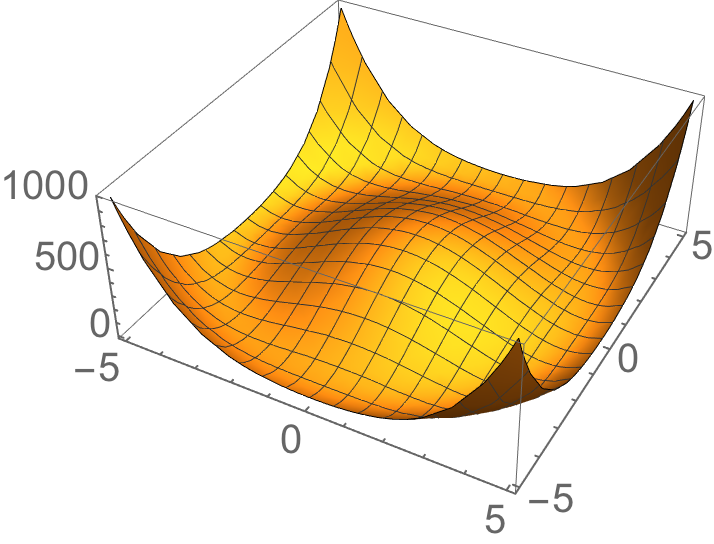
fig. 1. Mexican hat potential.
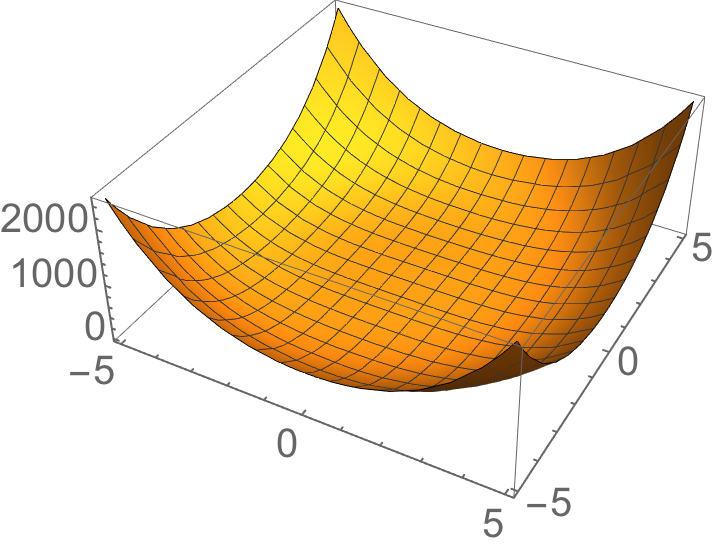
fig. 2. Degenerate Mexican hat potential ( v = 0)

Example:
\begin{equation}\label{eqn:qftLecture9:100}
\LL = \partial_\mu \phi^\conj \partial^\mu \phi – V(\Abs{\phi}),
\end{equation}
where
\begin{equation}\label{eqn:qftLecture9:120}
V(\Abs{\phi}) = m^2 \phi^\conj \phi + \frac{\lambda}{4} \lr{ \phi^\conj \phi }^2.
\end{equation}
When \( m^2 > 0 \) we have a Wigner mode, but when \( m^2 < 0 \) we have an issue: \( \phi = 0 \) is not a minimum of potential.
When \( m^2 < 0 \) we write
\begin{equation}\label{eqn:qftLecture9:140}
\begin{aligned}
V(\phi)
&= – m^2 \phi^\conj \phi + \frac{\lambda}{4} \lr{ \phi^\conj \phi}^2 \\
&= \frac{\lambda}{4} \lr{
\lr{ \phi^\conj \phi}^2 – \frac{4}{\lambda} m^2 } \\
&= \frac{\lambda}{4} \lr{
\phi^\conj \phi – \frac{2}{\lambda} m^2 }^2 – \frac{4 m^4}{\lambda^2},
\end{aligned}
\end{equation}
or simply
\begin{equation}\label{eqn:qftLecture9:780}
V(\phi)
=
\frac{\lambda}{4} \lr{ \phi^\conj \phi – v^2 }^2 + \text{const}.
\end{equation}
The potential (called the Mexican hat potential) is illustrated in fig. 1 for non-zero \( v \), and in
fig. 2 for \( v = 0 \).
We choose to expand around some point on the minimum ring (it doesn’t matter which one).
When there is no potential, we call the field massless (i.e. if we are in the minimum ring).
We expand as
\begin{equation}\label{eqn:qftLecture9:160}
\phi(x) = v \lr{ 1 + \frac{\rho(x)}{v} } e^{i \alpha(x)/v },
\end{equation}
so
\begin{equation}\label{eqn:qftLecture9:180}
\begin{aligned}
\frac{\lambda}{4}
\lr{\phi^\conj \phi – v^2}^2
&=
\lr{
v^2 \lr{ 1 + \frac{\rho(x)}{v} }^2
– v^2
}^2 \\
&=
\frac{\lambda}{4}
v^4 \lr{ \lr{ 1 + \frac{\rho(x)}{v} }^2 – 1 } \\
&=
\frac{\lambda}{4}
v^4
\lr{
\frac{2 \rho}{v} + \frac{\rho^2}{v^2}
}^2.
\end{aligned}
\end{equation}

\begin{equation}\label{eqn:qftLecture9:200}
\partial_\mu \phi =
\lr{
v \lr{ 1 + \frac{\rho(x)}{v} } \frac{i}{v} \partial_\mu \alpha
+ \partial_\mu \rho
} e^{i \alpha}
\end{equation}

so
\begin{equation}\label{eqn:qftLecture9:220}
\begin{aligned}
\LL
&= \Abs{\partial \phi^\conj}^2 – \frac{\lambda}{4} \lr{ \Abs{\phi^\conj}^2 – v^2 }^2 \\
&=
\partial_\mu \rho \partial^\mu \rho + \partial_\mu \alpha \partial^\mu \alpha \lr{ 1 + \frac{\rho}{v} }

\frac{\lambda v^4}{4} \frac{ 4\rho^2}{v^2} + O(\rho^3) \\
&=
\partial_\mu \rho \partial^\mu \rho
– \lambda v^2\rho^2
+
\partial_\mu \alpha \partial^\mu \alpha \lr{ 1 + \frac{\rho}{v} }.
\end{aligned}
\end{equation}
We have two fields, \( \rho \) : a massive scalar field, the “Higgs”, and a massless field \( \alpha \) (the Goldstone Boson).

\( U(1) \) symmetry acts on \( \phi(x) \rightarrow e^{i \omega } \phi(x) \) i.t.o \( \alpha(x) \rightarrow \alpha(x) + v \omega \).
\( U(1) \) global symmetry (broken) acts on the Goldstone field \( \alpha(x) \) by a constant shift. (\(U(1)\) is still a symmetry of the Lagrangian.)

The current of the \( U(1) \) symmetry is:
\begin{equation}\label{eqn:qftLecture9:240}
j_\mu = \partial_\mu \alpha \lr{ 1 + \text{higher dimensional \( \rho \) terms} }.
\end{equation}

When we quantize
\begin{equation}\label{eqn:qftLecture9:260}
\alpha(x) =
\int \frac{d^3p}{(2\pi)^3 \sqrt{ 2 \omega_p }} e^{i \omega_p t – i \Bp \cdot \Bx} \hat{a}_\Bp^\dagger +
\int \frac{d^3p}{(2\pi)^3 \sqrt{ 2 \omega_p }} e^{-i \omega_p t + i \Bp \cdot \Bx} \hat{a}_\Bp
\end{equation}
\begin{equation}\label{eqn:qftLecture9:280}
j^\mu(x) = \partial^\mu \alpha(x) =
\int \frac{d^3p}{(2\pi)^3 \sqrt{ 2 \omega_p }} \lr{ i \omega_\Bp – i \Bp } e^{i \omega_p t – i \Bp \cdot \Bx} \hat{a}_\Bp^\dagger +
\int \frac{d^3p}{(2\pi)^3 \sqrt{ 2 \omega_p }} \lr{ -i \omega_\Bp + i \Bp } e^{-i \omega_p t + i \Bp \cdot \Bx} \hat{a}_\Bp.
\end{equation}

\begin{equation}\label{eqn:qftLecture9:300}
j^\mu(x) \ket{0} \ne 0,
\end{equation}
instead it creates a single particle state.

Examples of symmetries

In particle physics, examples of Wigner vs Nambu-Goldstone, ignoring gravity the only exact internal symmetry in the standard module is
\( (B\# – L\#) \), believed to be a \( U(1) \) symmetry in Wigner mode.

Here \(B\#\) is the Baryon number, and \( L\# \) is the Lepton number. Examples:

  • \( B(p) = 1 \), proton.
  • \( B(q) = 1/3 \), quark
  • \( B(e) = 1 \), electron
  • \( B(n) = 1 \), neutron.
  • \( L(p) = 1 \), proton.
  • \( L(q) = 0 \), quark.
  • \( L(e) = 0 \), electron.

The major use of global internal symmetries in the standard model is as “approximate” ones. They become symmetries when one neglects some effect( “terms in \( \LL \)”).
There are other approximate symmetries (use of group theory to find the Balmer series).

Example from HW2:

QCD in limit
\begin{equation}\label{eqn:qftLecture9:320}
m_u = m_d = 0.
\end{equation}
\( m_u m_d \ll m_p \) (the products of the up-quark mass and the down-quark mass are much less than a composite one (name?)).
\( SU(2)_L \times SU(2)_R \rightarrow SU(2)_V \)

EWSB (Electro-Weak-Symmetry-Breaking) sector

When the couplings \( g_2, g_1 = 0 \). (\( g_2 \in SU(2), g_1 \in U(1) \)).

Scale invariance

\begin{equation}\label{eqn:qftLecture9:340}
\begin{aligned}
x &\rightarrow e^{\lambda} x \\
\phi &\rightarrow e^{-\lambda} \phi \\
A_\mu &\rightarrow e^{-\lambda} A_\mu
\end{aligned}
\end{equation}
Any unitary theory which is scale invariant is also \underline{conformal} invariant. Conformal invariance means that angles are preserved.
The point here is that there is more than scale invariance.

We have classical internal global continuous symmetries.
These can be either

  1. “unbroken” (Wigner mode)
    \begin{equation}\label{eqn:qftLecture9:360}
    \hatQ\ket{0} = 0.
    \end{equation}
  2. “spontaneously broken”
    \begin{equation}\label{eqn:qftLecture9:380}
    j^\mu(x) \ket{0} \ne 0
    \end{equation}
    (creates Goldstone modes).
  3. “anomalous”. Classical symmetries are not a symmetry of QFT.
    Examples:

    • Scale symmetry (to be studied in QFT II), although this is not truly internal.
    • In QCD again when \( \omega_\Bq = 0 \), a \( U(1\) symmetry (chiral symmetry) becomes exact, and cannot be preserved in QFT.
    • In the standard model (E.W sector), the Baryon number and Lepton numbers are not symmetries, but their difference \( B\# – L\# \) is a symmetry.

Lorentz invariance.

We’d like to study the action of Lorentz symmetries on quantum states. We are going to “go by the book”, finding symmetries, currents, quantize, find generators, and so forth.

Under a Lorentz transformation
\begin{equation}\label{eqn:qftLecture9:400}
x^\mu \rightarrow {x’}^\mu = {\Lambda^\mu}_\nu x^\nu,
\end{equation}
We are going to consider infinitesimal Lorentz transformations
\begin{equation}\label{eqn:qftLecture9:420}
{\Lambda^\mu}_\nu \approx
{\delta^\mu}_\nu + {\omega^\mu}_\nu
,
\end{equation}
where \( {\omega^\mu}_\nu \) is small.
A Lorentz transformation \( \Lambda \) must satisfy \( \Lambda^\T G \Lambda = G \), or
\begin{equation}\label{eqn:qftLecture9:800}
g_{\mu\nu} = {{\Lambda}^\alpha}_\mu g_{\alpha \beta} {{\Lambda}^\beta}_\nu,
\end{equation}
into which we insert the infinitesimal transformation representation
\begin{equation}\label{eqn:qftLecture9:820}
\begin{aligned}
0
&=
– g_{\mu\nu} +
\lr{ {\delta^\alpha}_\mu + {\omega^\alpha}_\mu }
g_{\alpha \beta}
\lr{ {\delta^\beta}_\nu + {\omega^\beta}_\nu } \\
&=
– g_{\mu\nu} +
\lr{
g_{\mu \beta}
+
\omega_{\beta\mu}
}
\lr{ {\delta^\beta}_\nu + {\omega^\beta}_\nu } \\
&=
– g_{\mu\nu} +
g_{\mu \nu}
+
\omega_{\nu\mu}
+
\omega_{\mu\nu}
+
\omega_{\beta\mu}
{\omega^\beta}_\nu.
\end{aligned}
\end{equation}
The quadratic term can be ignored, leaving just
\begin{equation}\label{eqn:qftLecture9:840}
0 =
\omega_{\nu\mu}
+
\omega_{\mu\nu},
\end{equation}
or
\begin{equation}\label{eqn:qftLecture9:860}
\omega_{\nu\mu} = – \omega_{\mu\nu}.
\end{equation}
Note that \( \omega \) is a completely antisymmetric tensor, and like \( F_{\mu\nu} \) this has only 6 elements.
This means that the
infinitesimal transformation of the coordinates is
\begin{equation}\label{eqn:qftLecture9:440}
x^\mu \rightarrow {x’}^\mu \approx x^\mu + \omega^{\mu\nu} x_\nu,
\end{equation}
the field transforms as
\begin{equation}\label{eqn:qftLecture9:460}
\phi(x) \rightarrow \phi'(x’) = \phi(x)
\end{equation}
or
\begin{equation}\label{eqn:qftLecture9:760}
\phi'(x^\mu + \omega^{\mu\nu} x_\nu) =
\phi'(x) + \omega^{\mu\nu} x_\nu \partial_\mu\phi(x) = \phi(x),
\end{equation}
so
\begin{equation}\label{eqn:qftLecture9:480}
\delta \phi = \phi'(x) – \phi(x) =
-\omega^{\mu\nu} x_\nu \partial_\mu \phi.
\end{equation}

Since \( \LL \) is a scalar
\begin{equation}\label{eqn:qftLecture9:500}
\begin{aligned}
\delta \LL
&=
-\omega^{\mu\nu} x_\nu \partial_\mu \LL \\
&=

\partial_\mu \lr{
\omega^{\mu\nu} x_\nu \LL
}
+
(\partial_\mu x_\nu) \omega^{\mu\nu} \LL \\
&=
\partial_\mu \lr{

\omega^{\mu\nu} x_\nu \LL
},
\end{aligned}
\end{equation}
since \( \partial_\nu x_\mu = g_{\nu\mu} \) is symmetric, and \( \omega \) is antisymmetric.
Our current is
\begin{equation}\label{eqn:qftLecture9:520}
J^\mu_\omega
=

\omega^{\mu\nu} x_\mu \LL
.
\end{equation}
Our Noether current is
\begin{equation}\label{eqn:qftLecture9:540}
\begin{aligned}
j^\nu_{\omega^{\mu\rho}}
&= \PD{\phi_{,\nu}}{\LL} \delta \phi – J^\mu_\omega \\
&=
\partial^\nu \phi\lr{ – \omega^{\mu\rho} x_\rho \partial_\mu \phi } + \omega^{\nu \rho} x_\rho \LL \\
&=
\omega^{\mu\rho}
\lr{
\partial^\nu \phi\lr{ – x_\rho \partial_\mu \phi } + {\delta^{\nu}}_\mu x_\rho \LL
} \\
&=
\omega^{\mu\rho} x_\rho
\lr{
-\partial^\nu \phi \partial_\mu \phi + {\delta^{\nu}}_\mu \LL
}
\end{aligned}
\end{equation}
We identify
\begin{equation}\label{eqn:qftLecture9:560}

{T^\nu}_\mu =
-\partial^\nu \phi \partial_\mu \phi + {\delta^{\nu}}_\mu \LL,
\end{equation}
so the current is
\begin{equation}\label{eqn:qftLecture9:580}
\begin{aligned}
j^\nu_{\omega_{\mu\rho}}
&=
-\omega^{\mu\rho} x_\rho
{T^\nu}_\mu \\
&=
-\omega_{\mu\rho} x^\rho
T^{\nu\mu}
.
\end{aligned}
\end{equation}
Define
\begin{equation}\label{eqn:qftLecture9:600}
j^{\nu\mu\rho} = \inv{2} \lr{ x^\rho T^{\nu\mu} – x^{\mu} T^{\nu\rho} },
\end{equation}
which retains the antisymmetry in \( \mu \rho \) yet still drops the parameter \( \omega^{\mu\rho} \).
To check that this makes sense, we can contract
\( j^{\nu\mu\rho} \) with \( \omega_{\rho\mu} \)
\begin{equation}\label{eqn:qftLecture9:880}
\begin{aligned}
j^{\nu\mu\rho} \omega_{\rho\mu}
&= -\inv{2} \lr{ x^\rho T^{\nu\mu} – x^{\mu} T^{\nu\rho} }
\omega_{\mu\rho} \\
&=
-\inv{2} x^\rho T^{\nu\mu}
\omega_{\mu\rho}
– \inv{2} x^{\mu} T^{\nu\rho}
\omega_{\rho\mu} \\
&=
-\inv{2} x^\rho T^{\nu\mu}
\omega_{\mu\rho}
– \inv{2} x^{\rho} T^{\nu\mu}
\omega_{\mu\rho} \\
&=
– x^{\rho} T^{\nu\mu}
\omega_{\mu\rho},
\end{aligned}
\end{equation}
which matches \ref{eqn:qftLecture9:580} as desired.

Example. Rotations \( \mu\rho = ij \)

\begin{equation}\label{eqn:qftLecture9:620}
\begin{aligned}
J^{0 i j} \epsilon_{ijk}
&=
\inv{2} \lr{ x^i T^{0j} – x^{j} T^{0i} } \epsilon_{ijk} \\
&=
x^i T^{0j} \epsilon_{ijk}.
\end{aligned}
\end{equation}
Observe that this has the structure of \( (\Bx \cross \Bp)_k \), where \( \Bp \) is the momentum density of the field.
Let
\begin{equation}\label{eqn:qftLecture9:640}
L_k \equiv Q_k = \int d^3 x J^{0ij} \epsilon_{ijk}.
\end{equation}
We can now quantize and build a generator
\begin{equation}\label{eqn:qftLecture9:660}
\begin{aligned}
\hatU(\Balpha)
&= e^{i \Balpha \cdot \hat{\BL}} \\
&= \exp\lr{i \alpha_k
\int d^3 x x^i \hat{T}^{0j} \epsilon_{ijk}
}
\end{aligned}
\end{equation}
From \ref{eqn:qftLecture9:560} we can quantize with \( T^{0j} = \partial^0 \phi \partial^j \phi \rightarrow \hat{\pi} \lr{\spacegrad \phihat}_j\), or
\begin{equation}\label{eqn:qftLecture9:900}
\begin{aligned}
\hatU(\Balpha)
&=
\exp\lr{i \alpha_k
\int d^3 x x^i \hat{\pi} (\spacegrad \phihat)_j \epsilon_{ijk}
} \\
&=
\exp\lr{i \Balpha \cdot
\int d^3 x \hat{\pi} \spacegrad \phihat \cross \Bx
}
\end{aligned}
\end{equation}
(up to a sign in the exponent which doesn’t matter)
\begin{equation}\label{eqn:qftLecture9:680}
\begin{aligned}
\phihat(\By) \rightarrow \hatU(\alpha) \phihat(\By) \hatU^\dagger(\alpha)
&\approx
\phihat(\By) +
i \Balpha \cdot
\antisymmetric{
\int d^3 x \hat{\pi}(\Bx) \spacegrad \phihat(\Bx) \cross \Bx
}
{
\phihat(\By)
} \\
&=
\phihat(\By) +
i \Balpha \cdot
\int d^3 x
(-i) \delta^3(\Bx – \By)
\spacegrad \phihat(\Bx) \cross \Bx \\
&=
\phihat(\By) +
\Balpha \cdot \lr{ \spacegrad \phihat(\By ) \cross \By}
\end{aligned}
\end{equation}
Explicitly, in coordinates, this is
\begin{equation}\label{eqn:qftLecture9:700}
\begin{aligned}
\phihat(\By)
&\rightarrow
\phihat(\By) +
\alpha^i
\lr{
\partial^j \phihat(\By) y^k \epsilon_{jki}
} \\
&=
\phihat(\By) –
\epsilon_{ikj} \alpha^i y^k \partial^j \phihat \\
&=
\phihat( y^j – \epsilon^{ikj} \alpha^i y^k ).
\end{aligned}
\end{equation}
This is a rotation. To illustrate, pick \( \Balpha = (0, 0, \alpha) \), so \( y^j \rightarrow y^j – \epsilon^{ikj} \alpha y^k \delta_{i3} = y^j – \epsilon^{3kj} \alpha y^k \), or
\begin{equation}\label{eqn:qftLecture9:n}
\begin{aligned}
y^1 &\rightarrow y^1 – \epsilon^{3k1} \alpha y^k = y^1 + \alpha y^2 \\
y^2 &\rightarrow y^2 – \epsilon^{3k2} \alpha y^k = y^2 – \alpha y^1 \\
y^3 &\rightarrow y^3 – \epsilon^{3k3} \alpha y^k = y^3,
\end{aligned}
\end{equation}
or in matrix form
\begin{equation}\label{eqn:qftLecture9:720}
\begin{bmatrix}
y^1 \\
y^2 \\
y^3 \\
\end{bmatrix}
\rightarrow
\begin{bmatrix}
1 & \alpha & 0 \\
-\alpha & 1 & 0 \\
0 & 0 & 1
\end{bmatrix}
\begin{bmatrix}
y^1 \\
y^2 \\
y^3 \\
\end{bmatrix}.
\end{equation}
PHY2403H Quantum Field Theory. Lecture 7: Symmetries, translation currents, energy momentum tensor. Taught by Prof. Erich Poppitz

October 3, 2018 phy2403 , , , , , ,

[Click here for a PDF of this post with nicer formatting]

DISCLAIMER: Very rough notes from class, with some additional side notes.

These are notes for the UofT course PHY2403H, Quantum Field Theory I, taught by Prof. Erich Poppitz fall 2018.

Symmetries

Given the complexities of the non-linear systems we want to investigate, examination of symmetries gives us simpler problems that we can solve.

  • “internal” symmetries. This means that the symmetries do not act on space time \( (\Bx, t) \). An example is
    \begin{equation}\label{eqn:qftLecture7:20}
    \phi^i =
    \begin{bmatrix}
    \psi_1 \\
    \psi_2 \\
    \vdots \\
    \psi_N \\
    \end{bmatrix}
    \end{equation}
    If we map \( \phi^i \rightarrow O^i_j \phi^j \) where \( O^\T O = 1 \), then we call this an internal symmetry.
    The corresponding Lagrangian density might be something like
    \begin{equation}\label{eqn:qftLecture7:40}
    \LL = \inv{2} \partial_\mu \Bphi \cdot \partial^\mu \Bphi – \frac{m^2}{2} \Bphi \cdot \Bphi – V(\Bphi \cdot \Bphi)
    \end{equation}

  • spacetime symmetries: Translations, rotations, boosts, dilatations. We will consider continuous symmetries, which can be defined as a succession of infinitesimal transformations.
    An example from \(O(2)\) is a rotation
    \begin{equation}\label{eqn:qftLecture7:60}
    \begin{bmatrix}
    \phi^1 \\
    \phi^2 \\
    \end{bmatrix}
    \rightarrow
    \begin{bmatrix}
    \cos\alpha & \sin\alpha \\
    -\sin\alpha & \cos\alpha \\
    \end{bmatrix}
    \begin{bmatrix}
    \phi^1 \\
    \phi^2
    \end{bmatrix},
    \end{equation}
    or if \( \alpha \sim 0 \)
    \begin{equation}\label{eqn:qftLecture7:80}
    \begin{bmatrix}
    \phi^1 \\
    \phi^2 \\
    \end{bmatrix}
    \rightarrow
    \begin{bmatrix}
    1 & \alpha \\
    -\alpha & 1\\
    \end{bmatrix}
    \begin{bmatrix}
    \phi^1 \\
    \phi^2
    \end{bmatrix}
    =
    \begin{bmatrix}
    \phi^1 \\
    \phi^2
    \end{bmatrix}
    +
    \alpha
    \begin{bmatrix}
    \phi^2 \\
    -\phi^1
    \end{bmatrix}
    \end{equation}
    In index notation we write
    \begin{equation}\label{eqn:qftLecture7:100}
    \phi^i \rightarrow \phi^i + \alpha e^{ij} \phi^j,
    \end{equation}
    where \( \epsilon^{12} = +1, \epsilon^{21} = -1 \) is the completely antisymmetric tensor. This can be written in more general form as
    \begin{equation}\label{eqn:qftLecture7:120}
    \phi^i \rightarrow \phi^i + \delta \phi^i,
    \end{equation}
    where \( \delta \phi^i \) is considered to be an infinitesimal transformation.

Definition: Symmetry

A symmetry means that there is some transformation
\begin{equation*}
\phi^i \rightarrow \phi^i + \delta \phi^i,
\end{equation*}
where \( \delta \phi^i \) is an infinitesimal transformation, and the equations of motion are invariant under this transformation.

Theorem: Noether’s theorem (1st).

If the equations of motion re invariant under \( \phi^\mu \rightarrow \phi^\mu + \delta \phi^\mu \), then there exists a conserved current \( j^\mu \) such that \( \partial_\mu j^\mu = 0 \).

Noether’s first theorem applies to global symmetries, where the parameters are the same for all \( (\Bx, t)\). Gauge symmetries are not examples of such global symmetries.

Given a Lagrangian density \( \LL(\phi(x), \phi_{,\mu}(x)) \), where \( \phi_{,\mu} \equiv \partial_\mu \phi \). The action is
\begin{equation}\label{eqn:qftLecture7:160}
S = \int d^d x \LL.
\end{equation}
EOMs are invariant if under \( \phi(x) \rightarrow \phi'(x) = \phi(x) + \delta_\epsilon \phi(x)\), we have
\begin{equation}\label{eqn:qftLecture7:180}
\LL(\phi) \rightarrow \LL'(\phi’) = \LL(\phi) + \partial_\mu J_\epsilon^\mu(\phi) + O(\epsilon^2).
\end{equation}
Then there exists a conserved current. In QFT we say that the E.O.M’s are “on shell”. Note that \ref{eqn:qftLecture7:180} is a symmetry since we have added a total derivative to the Lagrangian which leaves the equations of motion of unchanged.

In general, the change of action under arbitrary variation of \( \delta \phi\) of the fields is
\begin{equation}\label{eqn:qftLecture7:200}
\begin{aligned}
\delta S
&=
\int d^d x \delta \LL(\phi, \partial_\mu \phi) \\
&=
\int d^d x \lr{
\PD{\phi}{\LL} \delta \phi
+
\PD{(\partial_\mu \phi)}{\LL} \delta \partial_\mu \phi
} \\
&=
\int d^d x \lr{
\partial_\mu \lr{ \PD{(\partial_\mu \phi)}{\LL} } \delta \phi
+
\PD{(\partial_\mu \phi)}{\LL} \partial_\mu \delta \phi
} \\
&=
\int d^d x
\partial_\mu \lr{ \frac{\delta \LL}{\delta(\partial_\mu \phi)} \delta \phi }
\end{aligned}
\end{equation}
However from \ref{eqn:qftLecture7:180}
\begin{equation}\label{eqn:qftLecture7:220}
\delta_\epsilon \LL = \partial_\mu J_\epsilon^\mu(\phi, \partial_\mu \phi),
\end{equation}
so after equating these variations we fine that
\begin{equation}\label{eqn:qftLecture7:240}
\delta S = \int d^d x \delta_\epsilon \LL = \int d^d x \partial_\mu J_\epsilon^\mu,
\end{equation}
or
\begin{equation}\label{eqn:qftLecture7:260}
0 = \int d^d x
\partial_\mu \lr{ \frac{\delta \LL}{\delta(\partial_\mu \phi)} \delta \phi – J_\epsilon^\mu },
\end{equation}
or \( \partial_\mu j^\mu = 0 \) provided
\begin{equation}\label{eqn:qftLecture7:280}
\boxed{
j^\mu =
\frac{\delta \LL}{\delta(\partial_\mu \phi)} \delta_\epsilon \phi – J_\epsilon^\mu.
}
\end{equation}

Integrating the divergence of the current over a space time volume, perhaps that of cylinder (time up, space out) is also zero. That is
\begin{equation}\label{eqn:qftLecture7:300}
\begin{aligned}
0
&=
\int d^4 x \, \partial_\mu j^\mu \\
&=
\int d^3 \Bx dt \, \partial_\mu j^\mu \\
&=
\int d^3 \Bx dt \, \partial_t j^0 –
\int d^3 \Bx dt \spacegrad \cdot \Bj \\
&=
\int d^3 \Bx dt \, \partial_t j^0 ,
\end{aligned}
\end{equation}
where the spatial divergence is zero assuming there’s no current leaving the volume on the infinite boundary
(no \(\Bj\) at spatial infinity.)

We write
\begin{equation}\label{eqn:qftLecture7:560}
Q = \int d^3x \partial_t j^0,
\end{equation}
and call this the on-shell charge associated with the symmetry.

Spacetime translation.

A spacetime translation has the form
\begin{equation}\label{eqn:qftLecture7:320}
x^\mu \rightarrow {x’}^\mu = x^\mu + a^\mu,
\end{equation}
\begin{equation}\label{eqn:qftLecture7:340}
\phi(x) \rightarrow \phi'(x’) = \phi(x)
\end{equation}
(contrast this to a Lorentz transformation that had the form \( x^\mu \rightarrow {x’}^\mu = {\Lambda^\mu}_\nu x^\nu \)).

If \(\phi'(x + a) = \phi(x) \), then
\begin{equation}\label{eqn:qftLecture7:360}
\phi'(x) + a^\mu \partial_\mu \phi'(x) =
\phi'(x) + a^\mu \partial_\mu \phi(x) =
\phi(x),
\end{equation}
so
\begin{equation}\label{eqn:qftLecture7:380}
\phi'(x)
= \phi(x) – a^\mu \partial_\mu \phi'(x)
= \phi(x) + \delta_a \phi(x),
\end{equation}
or
\begin{equation}\label{eqn:qftLecture7:580}
\delta_a \phi(x) = – a^\mu \partial_\mu \phi(x).
\end{equation}
Under \( \phi \rightarrow \phi – a^\mu \partial_\mu \phi \), we have
\begin{equation}\label{eqn:qftLecture7:400}
\LL(\phi) \rightarrow \LL(\phi) – a^\mu \partial_\mu \LL.
\end{equation}
Let’s calculate this with our scalar theory Lagrangian
\begin{equation}\label{eqn:qftLecture7:420}
\LL = \inv{2} \partial_\mu \phi \partial^\mu \phi – \frac{m^2}{2} \phi^2 – V(\phi)
\end{equation}
The Lagrangian variation is
\begin{equation}\label{eqn:qftLecture7:440}
\begin{aligned}
\evalbar{\delta \LL}{\phi \rightarrow \phi + \delta \phi, \delta\phi = – a^\mu \partial_\mu \phi}
&=
(\partial_\mu \phi) \delta (\partial^\mu \phi) – m^2 \phi \delta \phi – \PD{\phi}{V} \delta \phi \\
&=
(\partial_\mu \phi)(-a^\nu \partial_\nu \phi \partial^\mu \phi) + m^2 \phi a^\nu \partial_\nu \phi + \PD{\phi}{V} a^\nu \partial_\nu \phi \\
&=
– a^\nu \partial_\nu \lr{ \inv{2} \partial_\mu \partial^\mu \phi – \frac{m^2}{2} \phi^2 – V(\phi) } \\
&=
– a^\nu \partial_\nu \LL.
\end{aligned}
\end{equation}

So the current is
\begin{equation}\label{eqn:qftLecture7:600}
\begin{aligned}
j^\mu
&=
(\partial^\mu \phi) (-a^\nu \partial_\nu \phi) + a^\nu \LL \\
&=
-a^\nu \lr{ \partial^\mu \phi \partial_\nu \phi – \LL }
\end{aligned}
\end{equation}

We really have a current for each \( \nu \) direction and can make that explicit writing
\begin{equation}\label{eqn:qftLecture7:460}
\begin{aligned}
\delta_\nu \LL
&= -\partial_\nu \LL \\
&= – \partial_\mu \lr{ {\delta^\mu}_\nu \LL } \\
&= \partial_\mu {J^\mu}_\nu
\end{aligned}
\end{equation}
we write
\begin{equation}\label{eqn:qftLecture7:480}
{j^\mu}_\nu = \PD{x_\mu}{\phi} \lr{ – \PD{x^\nu}{\phi} } + {\delta^\mu}_\nu \LL,
\end{equation}
where \( \nu \) are labels which coordinates are translated:
\begin{equation}\label{eqn:qftLecture7:500}
\begin{aligned}
\partial_\nu \phi &= – \partial_\nu \phi \\
\partial_\nu \LL &= – \partial_\nu \LL.
\end{aligned}
\end{equation}
We call the conserved quantities elements of the energy-momentum tensor, and write it as
\begin{equation}\label{eqn:qftLecture7:520}
\boxed{
{T^\mu}_\nu = -\PD{x_\mu}{\phi} \PD{x^\nu}{\phi} + {\delta^\mu}_\nu \LL.
}
\end{equation}

Incidentally, we picked a non-standard sign convention for the tensor, as an explicit expansion of \( T^{00} \), the energy density component, shows
\begin{equation}\label{eqn:qftLecture7:540}
\begin{aligned}
{T^0}_0
&=
-\PD{t}{\phi}
\PD{t}{\phi}
+\inv{2}
\PD{t}{\phi}
\PD{t}{\phi}
– \inv{2} (\spacegrad \phi) \cdot (\spacegrad \phi)
– \frac{m^2}{2} \phi^2 – V(\phi) \\
&=
-\inv{2} \PD{t}{\phi} \PD{t}{\phi}
– \inv{2} (\spacegrad \phi) \cdot (\spacegrad \phi)
– \frac{m^2}{2} \phi^2 – V(\phi).
\end{aligned}
\end{equation}
Had we translated by \( -a^\mu \) we’d have a positive definite tensor instead.

Complex Klein-Gordon field: dead ends take III (or more?)

September 29, 2018 phy2403

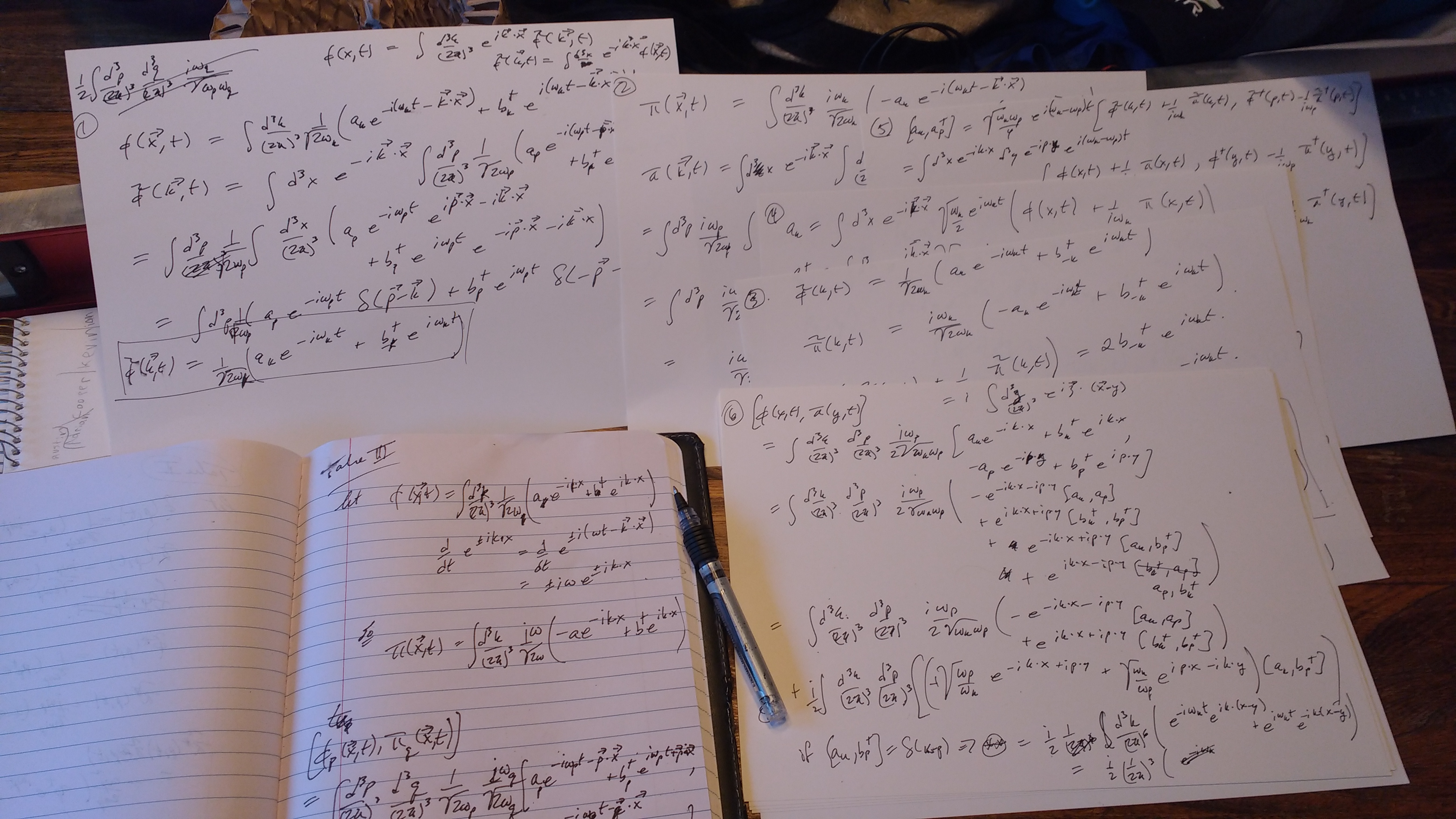
Working on a problem from Peskin and Schroeder (and Zee too actually), I’ve hit dead ends in many different ways. The last dead end looks impressive just sitting there on the table where I abandoned it:

… however, after getting results that weren’t expected a number of different ways, I think I finally understand the fundamental assumption that I had wrong.  Take >= IV.

PHY2403H Quantum Field Theory. Lecture 6: Canonical quantization, Simple Harmonic Oscillators, Symmetries. Taught by Prof. Erich Poppitz

September 26, 2018 phy2403 , , ,

[Click here for a PDF of this post with nicer formatting]

DISCLAIMER: Very rough notes from class, with some additional side notes (QM SHO review, …).

These are notes for the UofT course PHY2403H, Quantum Field Theory I, taught by Prof. Erich Poppitz fall 2018.

Quantization of Field Theory

We are engaging in the “canonical” or Hamiltonian method of quantization. It is also possible to quantize using path integrals, but it is hard to prove that operators are unitary doing so. In fact, the mechanism used to show unitarity from path integrals is often to find the Lagrangian and show that there is a Hilbert space (i.e. using canonical quantization). Canonical quantization essentially demands that the fields obey a commutator relation of the following form
\begin{equation}\label{eqn:qftLecture6:20}
\antisymmetric{\pi(\Bx, t)}{\phi(\By, t)} = -i \delta^3(\Bx – \By).
\end{equation}
We assumed that the quantized fields obey the Hamiltonian relations
\begin{equation}\label{eqn:qftLecture6:160}
\begin{aligned}
\ddt{\phi} &= i \antisymmetric{H}{\phi} \\
\ddt{\pi} &= i \antisymmetric{H}{\pi}.
\end{aligned}
\end{equation}

We were working with the Hamiltonian density
\begin{equation}\label{eqn:qftLecture6:40}
\mathcal{H} =
\inv{2} (\pi(\Bx, t))^2
+
\inv{2} (\spacegrad \phi(\Bx, t))^2
+
\frac{m^2}{2} \phi^2
+
\frac{\lambda}{4} \phi^4,
\end{equation}
which included a mass term \( m \) and a potential term (\(\lambda\)). We will expand all quantities in Taylor series in \( \lambda \) assuming they have a structure such as
\begin{equation}\label{eqn:qftLecture6:180}
\begin{aligned}
f(\lambda) =
c_0 \lambda^0
+ c_1 \lambda^1
+ c_2 \lambda^2
+ c_3 \lambda^3
+ \cdots
\end{aligned}
\end{equation}
We will stop this \underline{perturbation theory} approach at \( O(\lambda^2) \), and will ignore functions such as \( e^{-1/\lambda} \).

Within perturbation theory, to leaving order, set \( \lambda = 0 \), so that \( \phi \) obeys the Klein-Gordon equation (if \( m = 0 \) we have just a d’Lambertian (wave equation)).

We can write our field as a Fourier transform
\begin{equation}\label{eqn:qftLecture6:60}
\phi(\Bx, t) = \int \frac{d^3 p}{(2\pi)^3} e^{i \Bp \cdot \Bx} \tilde{\phi}(\Bp, t),
\end{equation}
and due to a Hermitian assumption (i.e. real field) this implies
\begin{equation}\label{eqn:qftLecture6:80}
\tilde{\phi}^\conj(\Bp, t) = \tilde{\phi}(-\Bp, t).
\end{equation}

We found that the Klein-Gordon equation implied that the momentum space representation obey Harmonic oscillator equations
\begin{equation}\label{eqn:qftLecture6:100}
\begin{aligned}
\ddot{\tilde{\phi}}(\Bp, t) &= – \omega_\Bp \tilde{\phi}(\Bp, t) \\
\omega_\Bp &= \sqrt{\Bp^2 + m^2}.
\end{aligned}
\end{equation}
We may represent the solution to this equation as
\begin{equation}\label{eqn:qftLecture6:120}
\tilde{\phi}(\Bq, t) = \inv{\sqrt{2 \omega_\Bq}} \lr{
e^{-i \omega_\Bq t} a_\Bq
+
e^{i \omega_\Bq t} b_\Bq^\conj
}.
\end{equation}
This is a general solution, but imposing \( a_\Bq = b_{-\Bq} \) ensures \ref{eqn:qftLecture6:80} is satisfied.
This leaves us with
\begin{equation}\label{eqn:qftLecture6:140}
\tilde{\phi}(\Bq, t) = \inv{\sqrt{2 \omega_\Bq}} \lr{
e^{-i \omega_\Bq t} a_\Bq
+
e^{i \omega_\Bq t} a_{-\Bq}^\conj
}.
\end{equation}
We want to show that iff
\begin{equation}\label{eqn:qftLecture6:200}
\antisymmetric{a_\Bq}{a^\dagger_\Bp} = \lr{ 2 \pi }^3 \delta^3(\Bp – \Bq),
\end{equation}
then
\begin{equation}\label{eqn:qftLecture6:220}
\antisymmetric{\pi(\By, t)}{\phi(\Bx, t)} = -i \delta^3(\Bx – \By)
\end{equation}
where everything else commutes (i.e. \(
\antisymmetric{a_\Bp}{a_\Bq} =
\antisymmetric{a_\Bp^\dagger}{a_\Bq^\dagger} = 0 \)).
We will only show one direction, but you can go the other way too.

\begin{equation}\label{eqn:qftLecture6:240}
\phi(\Bx, t)
=
\int \frac{d^3 p}{(2\pi)^3 \sqrt{2 \omega_\Bp}} e^{i \Bp \cdot \Bx}
\lr{
e^{-i \omega_\Bp t} a_\Bp
+
e^{i \omega_\Bp t} a_{-\Bp}^\dagger
}
\end{equation}
\begin{equation}\label{eqn:qftLecture6:260}
\pi(\Bx, t) = \dot{\phi}
=
i \int \frac{d^3 q}{(2\pi)^3 \sqrt{2 \omega_\Bq}} \omega_\Bq e^{i \Bq \cdot \Bx}
\lr{
-e^{-i \omega_\Bq t} a_\Bq
+
e^{i \omega_\Bq t} a_{-\Bq}^\dagger
}
\end{equation}
The commutator is
\begin{equation}\label{eqn:qftLecture6:280}
\begin{aligned}
\antisymmetric{\pi(\By, t)}{\phi(\Bx, t)}
&=
i \int \frac{d^3 p}{(2\pi)^3
\sqrt{2 \omega_\Bp}}
\frac{d^3 q}{(2\pi)^3 \sqrt{2 \omega_\Bq}}
\omega_\Bq
e^{i \Bp \cdot \By + i \Bq \cdot \Bx}
\antisymmetric
{
-e^{-i \omega_\Bq t} a_\Bq
+
e^{i \omega_\Bq t} a_{-\Bq}^\dagger
}
{
e^{-i \omega_\Bp t} a_\Bp
+
e^{i \omega_\Bp t} a_{-\Bp}^\dagger
} \\
&=
i \int \frac{d^3 p}{(2\pi)^3
\sqrt{2 \omega_\Bp}}
\frac{d^3 q}{(2\pi)^3 \sqrt{2 \omega_\Bq}}
\omega_\Bq
e^{i \Bp \cdot \By + i \Bq \cdot \Bx}
\lr{
– e^{i (\omega_\Bp -\omega_\Bq) t}
\antisymmetric { a_\Bq } { a_{-\Bp}^\dagger }
+
e^{i (\omega_\Bq -\omega_\Bp) t}
\antisymmetric{a_{-\Bq}^\dagger}{ a_\Bp }
} \\
&=
i \int \frac{d^3 p}{(2\pi)^3
\sqrt{2 \omega_\Bp}}
\frac{d^3 q}{(2\pi)^3 \sqrt{2 \omega_\Bq}}
\omega_\Bq (2\pi)^3
e^{i \Bp \cdot \By + i \Bq \cdot \Bx}
\lr{
– e^{i (\omega_\Bp -\omega_\Bq) t} \delta^3(\Bq + \Bp)
– e^{i (\omega_\Bq -\omega_\Bp) t} \delta^3(-\Bq -\Bp)
} \\
&=
– 2 i \int \frac{d^3 p}{(2\pi)^3
2 \omega_\Bp}
\omega_\Bp
e^{i \Bp \cdot (\By – \Bx)} \\
&=
-i \delta^3(\By – \Bx),
\end{aligned}
\end{equation}
which is what we wanted to prove.

Free Hamiltonian

We call the \( \lambda = 0 \) case the “free” Hamiltonian.

\begin{equation}\label{eqn:qftLecture6:300}
\begin{aligned}
H
&= \int d^3 x \lr{ \inv{2} \pi^2 + \inv{2} (\spacegrad \phi)^2 + \frac{m^2}{2} \phi^2 } \\
&=
\inv{2} \int d^3 x
\frac{d^3 p}{(2\pi)^3}
\frac{d^3 q}{(2\pi)^3}
\frac{
e^{i (\Bp + \Bq)\cdot \Bx}
}{\sqrt{2 \omega_\Bp}
\sqrt{2 \omega_\Bq}}
\lr{

(\omega_\Bp)
(\omega_\Bq)
\lr{
-e^{-i \omega_\Bp t} a_\Bp
+
e^{i \omega_\Bp t} a_{-\Bp}^\dagger
}
\lr{
-e^{-i \omega_\Bq t} a_\Bq
+
e^{i \omega_\Bq t} a_{-\Bq}^\dagger
}
}

\Bp \cdot \Bq
\lr{
e^{-i \omega_\Bp t} a_\Bp
+
e^{i \omega_\Bp t} a_{-\Bp}^\dagger
}
\lr{
e^{-i \omega_\Bq t} a_\Bq
+
e^{i \omega_\Bq t} a_{-\Bq}^\dagger
}
+
m^2
\lr{
e^{-i \omega_\Bp t} a_\Bp
+
e^{i \omega_\Bp t} a_{-\Bp}^\dagger
}
\lr{
e^{-i \omega_\Bq t} a_\Bq
+
e^{i \omega_\Bq t} a_{-\Bq}^\dagger
}.
\end{aligned}
\end{equation}
An immediate simplification is possible by identifying a delta function factor \( \int d^3 x e^{i(\Bp + \Bq) \cdot \Bx}/(2\pi)^3 = \delta^3(\Bp + \Bq) \), so
\begin{equation}\label{eqn:qftLecture6:1060}
\begin{aligned}
H
&=
\inv{2}
\int
\frac{d^3 p}{(2\pi)^3}
\frac{1
}{2 \omega_\Bp}
\lr{

(\omega_\Bp)^2
\lr{
-e^{-i \omega_\Bp t} a_\Bp
+
e^{i \omega_\Bp t} a_{-\Bp}^\dagger
}
\lr{
-e^{-i \omega_\Bp t} a_{-\Bp}
+
e^{i \omega_\Bp t} a_{\Bp}^\dagger
}
}
+
(\Bp^2 + m^2)
\lr{
e^{-i \omega_\Bp t} a_\Bp
+
e^{i \omega_\Bp t} a_{-\Bp}^\dagger
}
\lr{
e^{-i \omega_\Bp t} a_{-\Bp}
+
e^{i \omega_\Bp t} a_{\Bp}^\dagger
} \\
&=
\inv{2} \int \frac{d^3 p}{(2 \pi)^3} \inv{2 \omega_\Bp}
\lr{
a_\Bp a_{-\Bp}
\lr{
{-\omega_\Bp^2 e^{-2 i \omega_\Bp t}}
+
{\omega_\Bp^2 e^{-2 i \omega_\Bp t}}
}
+
a_{-\Bp}^\dagger a_{\Bp}^\dagger
\lr{
-{\omega_\Bp^2 e^{2 i \omega_\Bp t}}
+
{\omega_\Bp^2 e^{2 i \omega_\Bp t}}
}
+
a_\Bp a^\dagger_{\Bp} \omega^2_\Bp(1 + 1)
+
a^\dagger_{-\Bp} a_{-\Bp} \omega^2_\Bp(1 + 1)
}
\end{aligned}
\end{equation}
When all is said and done we are left with
\begin{equation}\label{eqn:qftLecture6:320}
H =
\int \frac{d^3 p}{(2 \pi)^3} \frac{\omega_\Bp}{2} \lr{
a^\dagger_{-\Bp}
a_{-\Bp}
+
a_{\Bp}
a^\dagger_{\Bp}
}
\end{equation}
and finally with a \( \Bp \rightarrow -\Bp \) transformation (\( \iiint_{-R}^R d^3 p \rightarrow (-1)^3 \iiint_R^{-R} d^3 p’ = (-1)^6 \iiint_{-R}^R d^3 p’ \)) in the first integral our free Hamiltonian (\( \lambda = 0 \)) is
\begin{equation}\label{eqn:qftLecture6:340}
\boxed{
H_0 =
\int \frac{d^3 p}{(2 \pi)^3} \frac{\omega_\Bp}{2} \lr{
a^\dagger_{\Bp}
a_{\Bp}
+
a_{\Bp}
a^\dagger_{\Bp}
}
}
\end{equation}

From the commutator relationship \ref{eqn:qftLecture6:200} we can write
\begin{equation}\label{eqn:qftLecture6:360}
a_\Bp a^\dagger_\Bq
=
a^\dagger_\Bq
a_\Bp
+ (2 \pi)^3 \delta^3(\Bp – \Bq),
\end{equation}
so

\begin{equation}\label{eqn:qftLecture6:380}
H_0 =
\int \frac{d^3 p}{(2 \pi)^3} \omega_\Bp
\lr{
a^\dagger_{\Bp}
a_{\Bp}
+
\inv{2} (2 \pi)^3 \delta^3(0)
}
\end{equation}
The delta function term can be interpreted using
\begin{equation}\label{eqn:qftLecture6:400}
(2 \pi)^3 \delta^3(\Bq)
= \int d^3 x e^{i \Bq \cdot \Bx},
\end{equation}
so when \( \Bq = 0 \)
\begin{equation}\label{eqn:qftLecture6:420}
(2 \pi)^3 \delta^3(0) = \int d^3 x = V.
\end{equation}

We can write the Hamiltonian now in terms of the volume
\begin{equation}\label{eqn:qftLecture6:440}
\boxed{
H_0 =
\int \frac{d^3 p}{(2 \pi)^3} \omega_\Bp
a^\dagger_{\Bp}
a_{\Bp}
+ V_3
\int \frac{d^3 p}{(2 \pi)^3} \frac{\omega_\Bp }{2} \times 1
}
\end{equation}

QM SHO review

In units with \( m = 1 \) the non-relativistic QM SHO has the Hamiltonian
\begin{equation}\label{eqn:qftLecture6:460}
H
= \inv{2} p^2 + \frac{\omega^2}{2} q^2.
\end{equation}

If we define a position operator with a time-domain Fourier representation given by
\begin{equation}\label{eqn:qftLecture6:480}
q = \inv{\sqrt{2\omega}} \lr{ a e^{-i \omega t} + a^\dagger e^{i \omega t} },
\end{equation}
where the Fourier coefficients \( a, a^\dagger \) are operator valued, then the momentum operator is
\begin{equation}\label{eqn:qftLecture6:500}
p = \dot{q} =
\frac{i\omega}{\sqrt{2\omega}} \lr{ -a e^{-i \omega t} + a^\dagger e^{i \omega t} },
\end{equation}
or inverting for \( a, a^\dagger \)
\begin{equation}\label{eqn:qftLecture6:1080}
\begin{aligned}
a &= \sqrt{\frac{\omega}{2}} \lr{ q – \inv{i \omega} p } e^{-i \omega t} \\
a^\dagger &= \sqrt{\frac{\omega}{2}} \lr{ q + \inv{i \omega} p } e^{i \omega t}.
\end{aligned}
\end{equation}
By inspection it is apparent that the product \( a^\dagger a \) will be related to the Hamiltonian (i.e. a difference of squares). That product is
\begin{equation}\label{eqn:qftLecture6:1120}
\begin{aligned}
a^\dagger a
&=
\frac{\omega}{2}
\lr{ q + \inv{i \omega} p }
\lr{ q – \inv{i \omega} p } \\
&=
\frac{\omega}{2} \lr{ q^2 + \inv{\omega^2} p^2 – \inv{i \omega} \antisymmetric{q}{p} } \\
&= \inv{2 \omega} \lr{ p^2 + \omega^2 q^2 – \omega },
\end{aligned}
\end{equation}
or
\begin{equation}\label{eqn:qftLecture6:1140}
H = \omega \lr{ a^\dagger a + \inv{2} }.
\end{equation}
We can glean some of the properties of \( a, a^\dagger \) by computing the commutator of \( p, q \), since that has a well known value
\begin{equation}\label{eqn:qftLecture6:520}
\begin{aligned}
i
&= \antisymmetric{q}{p} \\
&=
\frac{i\omega}{2 \omega} \antisymmetric
{ a e^{-i \omega t} + a^\dagger e^{i \omega t} }
{ -a e^{-i \omega t} + a^\dagger e^{i \omega t} } \\
&=
\frac{i}{2} \lr{
\antisymmetric{a}{a^\dagger} –
\antisymmetric{a^\dagger}{a} } \\
&=
i
\antisymmetric{a}{a^\dagger},
\end{aligned}
\end{equation}
so
\begin{equation}\label{eqn:qftLecture6:1100}
\antisymmetric{a}{a^\dagger} = 1.
\end{equation}
The operator \( a^\dagger a \) is the workhorse of the Hamiltonian and worth studying independently. In particular, assume that we have a set of states \( \ket{n} \) that are eigenstates of \( a^\dagger a \) with eigenvalues \( \lambda_n \), that is
\begin{equation}\label{eqn:qftLecture6:1160}
a^\dagger a \ket{n} = \lambda_n \ket{n}.
\end{equation}
The action of \( a^\dagger a \) on \( a^\dagger \ket{n} \) is easy to compute
\begin{equation}\label{eqn:qftLecture6:1180}
\begin{aligned}
a^\dagger a a^\dagger \ket{n}
&=
a^\dagger \lr{ a^\dagger a + 1 } \ket{n} \\
&=
\lr{ \lambda_n + 1 } a^\dagger \ket{n},
\end{aligned}
\end{equation}
so \( \lambda_n + 1 \) is an eigenvalue of \( a^\dagger \ket{n} \). The state \( a^\dagger \ket{n} \) has an energy eigenstate that is one unit of energy larger than \( \ket{n} \). For this reason we called \( a^\dagger \) the raising (or creation) operator.
Similarly,
\begin{equation}\label{eqn:qftLecture6:1200}
\begin{aligned}
a^\dagger a a \ket{n}
&=
\lr{ a a^\dagger – 1 } a \ket{n} \\
&=
(\lambda_n – 1) a \ket{n},
\end{aligned}
\end{equation}
so \( \lambda_n – 1 \) is the energy eigenvalue of \( a \ket{n} \), having one less unit of energy than \( \ket{n} \).
We call \( a \) the annihilation (or lowering) operator.
If we argue that there is a lowest energy state, perhaps designated as \( \ket{0} \) then we must have
\begin{equation}\label{eqn:qftLecture6:560}
a\ket{0} = 0,
\end{equation}
by the assumption that there are no energy eigenstates with less energy than \( \ket{0} \).
We can think of higher order states being constructed from the ground state from using the raising operator \( a^\dagger \)
\begin{equation}\label{eqn:qftLecture6:580}
\ket{n} = \frac{(a^\dagger)^n}{\sqrt{n!}} \ket{0}
\end{equation}

Discussion

We’ve diagonalized in the Fourier representation for the momentum space fields. For every value of momentum \( \Bp \) we have a quantum SHO.

For our field space we call our space the Fock vacuum and
\begin{equation}\label{eqn:qftLecture6:620}
a_\Bp\ket{0} = 0,
\end{equation}
and call \( a_\Bp \) the “annihilation operator”, and
call \( a^\dagger_\Bp \) the “creation operator”.
We say that \( a^\dagger_\Bp \ket{0} \) is the creation of a state of a single particle of momentum \( \Bp \) by \( a^\dagger_\Bp \).

We are discarding the volume term, a procedure called “normal ordering”. We define
\begin{equation}\label{eqn:qftLecture6:640}
\frac{a^\dagger a + a a^\dagger}{2}
:\equiv
a^\dagger a
\end{equation}
We are essentially forgetting the vacuum energy as some sort of unobservable quantity, leaving us with the free Hamiltonian of
\begin{equation}\label{eqn:qftLecture6:660}
H_0 =
\int \frac{d^3 p}{(2 \pi)^3} \omega_\Bp
a^\dagger_{\Bp}
a_{\Bp}
\end{equation}
Consider
\begin{equation}\label{eqn:qftLecture6:680}
\begin{aligned}
H_0
a^\dagger_\Bq \ket{0}
&=
\int \frac{d^3 p}{(2 \pi)^3} \omega_\Bp
a^\dagger_{\Bp}
a_{\Bp}
a^\dagger_\Bq
\ket{0} \\
&=
\int \frac{d^3 p}{(2 \pi)^3} \omega_\Bp
a^\dagger_{\Bp}
\lr{
a^\dagger_\Bq a_\Bp + (2 \pi)^3 \delta^3(\Bp – \Bq)
}
\ket{0} \\
&=
\int \frac{d^3 p}{(2 \pi)^3} \omega_\Bp
a^\dagger_{\Bp} \lr{
a^\dagger_\Bq {a_\Bp \ket{0}}
+ (2 \pi)^3 \delta^3(\Bp – \Bq) \ket{0}
} \\
&=
\omega_\Bq a^\dagger_\Bq \ket{0}.
\end{aligned}
\end{equation}

Question:

Is it possible to modify the Lagrangian or Hamiltonian that we start with so that this vacuum ground state is eliminated? Answer: Only by imposing super-symmetric constraints (that pairs this (Bosonic) Hamiltonian to a Fermonic system in a way that there is exact cancellation).

We will see that the momentum operator has the form
\begin{equation}\label{eqn:qftLecture6:700}
\mathcal{P}
=
\int \frac{d^3 p}{(2 \pi)^3} \Bp a^\dagger_\Bp a_\Bp.
\end{equation}
We say that \( a^\dagger_\Bp a^\dagger_\Bq \ket{0} \) a two particle space with energy \( \omega_\Bp + \omega_q\), and \(
(a^\dagger_\Bp)^m (a^\dagger_\Bq)^n \ket{0} \equiv
(a^\dagger_\Bp)^m \ket{0} \otimes (a^\dagger_\Bq)^n \ket{0} \), a \( m + n \) particle space.

There is a connection to statistical mechanics that is of interest

\begin{equation}\label{eqn:qftLecture6:720}
\begin{aligned}
\expectation{E}
&= \inv{Z} \sum_n E_n e^{-E_n/\kB T} \\
&= \inv{Z} \sum_n \bra{n} e^{-\hat{H}/\kB T} \hat{H} \ket{n},
\end{aligned}
\end{equation}
so for a SHO Hamiltonian system
\begin{equation}\label{eqn:qftLecture6:740}
\begin{aligned}
\expectation{E}
&= \inv{Z} \sum_n e^{-E_n/\kB T} \bra{n} \hat{H} \ket{n} \\
&= \inv{Z} \sum_n e^{-E_n/\kB T} \bra{n} \omega a^\dagger a \ket{n} \\
&= \frac{\omega}{e^{\omega/\kB T} – 1 } \\ \\
&= \expectation{ \omega a^\dagger a }_{\kB T}
\end{aligned}
\end{equation}
the \( \kB T \) ensemble average energy for a SHO system. Note that this sum was evaluated by noting that \( \bra{n} a^\dagger a \ket{n} = n \) which leaves sums of the form
\begin{equation}\label{eqn:qftLecture6:1220}
\begin{aligned}
\frac{\sum_{n = 0}^\infty n a^n }{\sum_{n = 0}^\infty a^n}
&=
a \frac{\sum_{n = 1}^\infty n a^{n-1} }{\sum_{n = 0}^\infty a^n} \\
&=
a (1 – a) \frac{d}{da} \lr{ \inv{1 – a} } \\
&=
\frac{a}{1 – a}.
\end{aligned}
\end{equation}

If we consider a real scalar field of mass \( m \) we have \( \omega_\Bp = \sqrt{ \Bp^2 + m^2 } \), but for a Maxwell field \( \BE, \BB \) where \( m = 0 \), our dispersion relation is \( \omega_\Bp = \Abs{\Bp} \).

We will see that for a free Maxwell field (no charges or currents) the Hamiltonian is
\begin{equation}\label{eqn:qftLecture6:760}
H_{\text{Maxwell}} =
\sum_{i = 1}^2
\int \frac{d^3 p}{(2 \pi)^3} \omega_\Bp {a^i}^\dagger_\Bp {a^i}_\Bp,
\end{equation}
where \( i \) is a polarization index.

We expect that we can evaluate an average such as \ref{eqn:qftLecture6:740} for our field, and operate using the analogy

\begin{equation}\label{eqn:qftLecture6:780}
\begin{aligned}
a a^\dagger &= a^\dagger a + 1 \\
a_\Bp a_\Bp^\dagger &= a_\Bp^\dagger a_\Bp + V_3.
\end{aligned}
\end{equation}
so if we rescale by \( \sqrt{V_3} \)
\begin{equation}\label{eqn:qftLecture6:800}
a_\Bp = \sqrt{V_3} \tilde{a}_\Bp
\end{equation}
Then we have commutator relations like standard QM
\begin{equation}\label{eqn:qftLecture6:820}
\tilde{a} \tilde{a}^\dagger = \tilde{a}^\dagger \tilde{a} + 1.
\end{equation}

So we can immediately evaluate the energy expectation for our quantized fields
\begin{equation}\label{eqn:qftLecture6:840}
\begin{aligned}
\expectation{H_0}
&=
\expectation{
\int \frac{d^3 p}{(2 \pi)^3} \omega_\Bp a_\Bp^\dagger a_\Bp
} \\
&=
\int \frac{d^3 p}{(2 \pi)^3} \omega_\Bp V_3 \expectation{ \tilde{a}^\dagger_\Bp a_\Bp } \\
&=
V_3
\int \frac{d^3 p}{(2 \pi)^3} \frac{\omega_\Bp}{e^{\omega_\Bp/\kB T} – 1}.
\end{aligned}
\end{equation}
Using this with the Maxwell field, we have a factor of two from polarization
\begin{equation}\label{eqn:qftLecture6:860}
U^{\text{Maxwell}} = 2 V_3
\int \frac{d^3 p}{(2 \pi)^3} \frac{\Abs{\Bp}}{e^{\omega_\Bp/\kB T} – 1},
\end{equation}
which is Planck’s law describing the blackbody energy spectrum.

Switching gears: Symmetries.

The question is how to apply the CCR results to moving frames, which is done using Lorentz transformations. Just like we know that the exponential of the Hamiltonian (times time) represents time translations, we will examine symmetries that relate results in different frames.

Examples.

For scalar field(s) with action
\begin{equation}\label{eqn:qftLecture6:880}
S = \int d^d x \LL(\phi^i, \partial_\mu \phi^i).
\end{equation}
For example, we’ve been using our massive (Boson) real scalar field with Lagrangian density
\begin{equation}\label{eqn:qftLecture6:900}
\LL = \inv{2} \partial_\mu \phi\partial^\mu \phi – \frac{m^2}{2} \phi^2 – V(\phi).
\end{equation}

Internal symmetry example

\begin{equation}\label{eqn:qftLecture6:920}
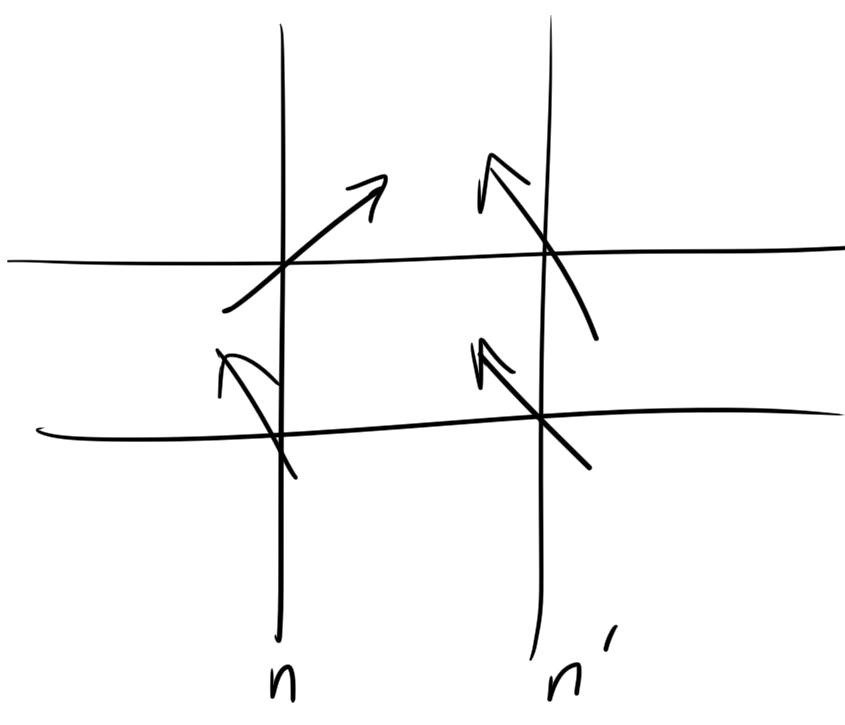
H = J \sum_{\expectation{n, n’}} \BS_n \cdot \BS_{n’},
\end{equation}
where the sum means the sum over neighbouring indexes \( n, n’ \) as sketched in

fig. 1. Neighbouring spin cells.

Such a Hamiltonian is left invariant by the transformation \( \BS_n \rightarrow -\BS_n \) since the Hamiltonian is quadratic.

Suppose that \( \phi \rightarrow -\phi\) is a symmetry (it leaves the Lagrangian unchanged). Example

\begin{equation}\label{eqn:qftLecture6:940}
\phi =
\begin{bmatrix}
\phi^1 \\
\phi^2 \\
\vdots
\phi^n \\
\end{bmatrix}
\end{equation}

the Lagrangian
\begin{equation}\label{eqn:qftLecture6:960}
\LL = \inv{2} \partial_\mu \phi^\T \partial^\mu \phi – \frac{m^2}{2} \phi^\T \phi – V(\phi^\T \phi).
\end{equation}
If \( O \) is any \( n \times n \) orthogonal matrix, then it is symmetry since
\begin{equation}\label{eqn:qftLecture6:980}
\phi^\T \phi \rightarrow \phi^\T O^\T O \phi = \phi^\T \phi.
\end{equation}

O(2) model, HW, problem 2. Example for complex \( \phi \)
\begin{equation}\label{eqn:qftLecture6:1000}
\phi \rightarrow e^{i \phi} \phi,
\end{equation}
\begin{equation}\label{eqn:qftLecture6:1020}
\phi = \frac{\psi_1 + i \psi_2}{\sqrt{2}}
\end{equation}

\begin{equation}\label{eqn:qftLecture6:1040}
\begin{bmatrix}
\psi_1 \\
\psi_2
\end{bmatrix}
\rightarrow
\begin{bmatrix}
\cos\alpha & \sin\alpha \\
-\sin\alpha & \cos\alpha
\end{bmatrix}
\begin{bmatrix}
\psi_1 \\
\psi_2
\end{bmatrix}
\end{equation}

PHY2403H Quantum Field Theory. Lecture 5: Klein-Gordon equation, Hamilton’s equations, SHOs, momentum space representation, raising and lowering operators. Taught by Prof. Erich Poppitz

September 25, 2018 phy2403 , , , , , , , , , , ,

[Click here for a PDF of this post with nicer formatting]

Disclaimer

DISCLAIMER: Very rough notes from class. Some additional side notes, but otherwise barely edited.

These are notes for the UofT course PHY2403H, Quantum Field Theory I, taught by Prof. Erich Poppitz fall 2018.

Canonical quantization

Last time we introduced a Lagrangian density associated with the Klein-Gordon equation (with a quadratic potential coupling)
\begin{equation}\label{eqn:qftLecture5:20}
L = \int d^3 x
\lr{
\inv{2} \lr{\partial_0 \phi}^2 – \inv{2} \lr{\spacegrad \phi}^2 – \frac{m^2}{2} \phi^2 – \frac{\lambda}{4} \phi^4
}.
\end{equation}
This Lagrangian density was related to the action by
\begin{equation}\label{eqn:qftLecture5:40}
S = \int dt L = \int dt d^3 x \LL,
\end{equation}
with momentum canonically conjugate to the field \( \phi \) defined as
\begin{equation}\label{eqn:qftLecture5:60}
\Pi(\Bx, t) = \frac{\delta \LL}{\delta \phidot(\Bx, t) } = \PD{\phidot(\Bx, t)}{\LL}
\end{equation}

The Hamiltonian defined as
\begin{equation}\label{eqn:qftLecture5:80}
H = \int d^3 x \lr{ \Pi(\Bx, t) \phidot(\Bx, t) – \LL },
\end{equation}
led to
\begin{equation}\label{eqn:qftLecture5:680}
H
= \int d^3 x
\lr{ \inv{2} \Pi^2 + (\spacegrad \phi)^2 + \inv{2} m^2 \phi^2 + \frac{\lambda}{4} \phi^4 }.
\end{equation}
Like the Lagrangian density, we may introduce a Hamiltonian density \( \mathcal{H} \) as
\begin{equation}\label{eqn:qftLecture5:100}
H = \int d^3 x \mathcal{H}(\Bx, t).
\end{equation}
For our Klein-Gordon system, this is
\begin{equation}\label{eqn:qftLecture5:120}
\mathcal{H}(\Bx, t) =
\inv{2} \Pi^2 + (\spacegrad \phi)^2 + \inv{2} m^2 \phi^2 + \frac{\lambda}{4} \phi^4.
\end{equation}

Canonical Commutation Relations (CCR)

:

We quantize the system by promoting our fields to Heisenberg-Picture (HP) operators, and imposing commutation relations
\begin{equation}\label{eqn:qftLecture5:140}
\antisymmetric{\hat{\Pi}(\Bx, t)}{\hat{\phi}(\By, t)} = -i \delta^3 (\Bx – \By)
\end{equation}

This is in analogy to
\begin{equation}\label{eqn:qftLecture5:160}
\antisymmetric{\hat{p}_i}{\hat{q}_j} = -i \delta_{ij},
\end{equation}

To choose a representation, we may map the \( \Psi \) of QM \( \rightarrow \) to a wave functional \( \Psi[\phi] \)
\begin{equation}\label{eqn:qftLecture5:180}
\hat{\phi}(\By, t) \Psi[\phi] = \phi(\By, t) \Psi[\phi]
\end{equation}

This is similar to the QM wave functions
\begin{equation}\label{eqn:qftLecture5:200}
\begin{aligned}
\hat{q}_i \Psi(\setlr{q}) &= q_i \Psi(q) \\
\hat{p}_i \Psi(\setlr{q}) &= -i \PD{q_i}{} \Psi(p)
\end{aligned}
\end{equation}

Our momentum operator is quantized by expressing it in terms of a variational derivative
\begin{equation}\label{eqn:qftLecture5:220}
\hat{\Pi}(\Bx, t) = -i \frac{\delta}{\delta \phi(\Bx, t)}.
\end{equation}
(Fixme: I’m not really sure exactly what is meant by using the variation derivative \(\delta\) notation here), and to
quantize the Hamiltonian we just add hats, assuming that our fields are all now HP operators
\begin{equation}\label{eqn:qftLecture5:240}
\hat{\mathcal{H}}(\Bx, t)
=
\inv{2} \hat{\Pi}^2 + (\spacegrad \hat{\phi})^2 + \inv{2} m^2 \hat{\phi}^2 + \frac{\lambda}{4} \hat{\phi}^4.
\end{equation}

QM SHO review

Recall the QM SHO had a Hamiltonian
\begin{equation}\label{eqn:qftLecture5:260}
\hat{H} = \inv{2} \hat{p}^2 + \inv{2} \omega^2 \hat{q}^2,
\end{equation}
where
\begin{equation}\label{eqn:qftLecture5:280}
\antisymmetric{\hat{p}}{\hat{q}} = -i,
\end{equation}
and that
HP time evolution operators \( O \) satisfied
\begin{equation}\label{eqn:qftLecture5:700}
\ddt{\hatO} = i \antisymmetric{\hatH}{\hatO}.
\end{equation}
In particular
\begin{equation}\label{eqn:qftLecture5:300}
\begin{aligned}
\ddt{\hat{p}}
&= i \antisymmetric{\hat{H}}{\hatp} \\
&= i \frac{\omega^2}{2} \antisymmetric{\hat{q}^2}{\hatp} \\
&= i \frac{\omega^2}{2} (2 i \hat{q}) \\
&= -i \omega^2 \hat{q},
\end{aligned}
\end{equation}
and
\begin{equation}\label{eqn:qftLecture5:320}
\begin{aligned}
\ddt{\hat{q}}
&= i \antisymmetric{\hat{H}}{\hat{q}} \\
&= i \inv{2} \antisymmetric{\hatp^2}{\hat{q}} \\
&= \frac{i}{2}(-2 i \hatp ) \\
&= \hatp.
\end{aligned}
\end{equation}
Applying the time evolution operator twice, we find
\begin{equation}\label{eqn:qftLecture5:340}
\frac{d^2}{dt^2}{\hat{q}}
= \ddt{\hat{p}}
= – \omega^2 \hat{q}.
\end{equation}
We see that the Heisenberg operators obey the classical equations of motion.

Now we want to try this with the quantized QFT fields we’ve promoted to operators
\begin{equation}\label{eqn:qftLecture5:360}
\begin{aligned}
\ddt{\hat{\Pi}}(\Bx, t)
&= i \antisymmetric{\hatH}{\hat{\Pi}(\Bx, t)} \\
&=
i \int d^3 y \inv{2} \antisymmetric{ \lr{\spacegrad \phihat(\By) }^2 }{\hat{\Pi}(\Bx) }
+
i \int d^3 y \frac{m^2}{2} \antisymmetric{ \phihat(\By)^2 }{\hat{\Pi}(\Bx) }
+
i \frac{\lambda}{4} \int d^3 \antisymmetric{ \phihat(\By)^4 }{\hat{\Pi}(\Bx) }
\end{aligned}
\end{equation}

Starting with the non-gradient commutators, and utilizing the HP field analogues of the relations \( \antisymmetric{\hat{q}^n}{\hatp} = n i \hat{q}^{n-1} \), we find
\begin{equation}\label{eqn:qftLecture5:780}
\int d^3 y \antisymmetric{ \lr{ \phihat(\By) }^2 }{\hat{\Pi}(\Bx) }
=
\int d^3 y 2 i \phihat(\By) \delta^3(\Bx – \By)
= 2 i \phihat(\Bx).
\end{equation}
\begin{equation}\label{eqn:qftLecture5:740}
\int d^3 y \antisymmetric{ \lr{ \phihat(\By) }^4 }{\hat{\Pi}(\Bx) }
=
\int d^3 y 4 i \phihat(\By)^3 \delta^3(\Bx – \By)
= 4 i \phihat(\Bx)^3.
\end{equation}
For the gradient commutators, we have more work. Prof Poppitz blitzed through that, just calling it integration by parts. I had trouble seeing what he was doing, so here’s a more explicit dumb expansion required to calculate the commutator
\begin{equation}\label{eqn:qftLecture5:720}
\begin{aligned}
\int d^3 y (\spacegrad \phihat(\By))^2 \hat{\Pi}(\Bx)
&=
\int d^3 y
\lr{ \spacegrad \phihat(\By) \cdot \spacegrad \phihat(\By) } \hat{\Pi}(\Bx) \\
&=
\int d^3 y
\spacegrad \phihat(\By) \cdot
\lr{ \spacegrad (\phihat(\By) \hat{\Pi}(\Bx)) } \\
&=
\int d^3 y
\spacegrad \phihat(\By) \cdot
\lr{ \spacegrad (\hat{\Pi}(\Bx) \phihat(\By) + i \delta^3(\Bx – \By)) } \\
&=
\int d^3 y
\Biglr{
\spacegrad \lr{ \phihat(\By) \hat{\Pi}(\Bx) } \cdot \spacegrad \phihat(\By)
+ i
\spacegrad \phihat(\By) \cdot \spacegrad \delta^3(\Bx – \By)
} \\
&=
\int d^3 y
\Biglr{
\spacegrad \lr{ \hat{\Pi}(\Bx) \phihat(\By) + i \delta^3(\Bx – \By) } \cdot \spacegrad \phihat(\By)
+ i
\spacegrad \phihat(\By) \cdot \spacegrad \delta^3(\Bx – \By)
} \\
&=
\int d^3 y
\hat{\Pi}(\Bx)
\lr{
\spacegrad \phihat(\By) \cdot \spacegrad \phihat(\By)
}
+ 2 i
\int d^3 y
\spacegrad \phihat(\By) \cdot \spacegrad \delta^3(\Bx – \By) \\
&=
\int d^3 y
\hat{\Pi}(\Bx) \spacegrad^2 \phihat(\By)
+
2 i
\int d^3 y
\spacegrad \cdot \lr{ \delta^3(\Bx – \By) \spacegrad \phihat(\By) }

2 i
\int d^3 y
\delta^3(\Bx – \By) \spacegrad^2 \phihat(\By) \\
&=
\int d^3 y
\hat{\Pi}(\Bx) \spacegrad^2 \phihat(\By)
+
2 i
\int_\partial d^2 y
\delta^3(\Bx – \By)
\ncap \cdot \spacegrad \phihat(\By)

2 i \spacegrad^2 \phihat(\Bx).
\end{aligned}
\end{equation}
Here we take advantage of the fact that the derivative operators \( \spacegrad = \spacegrad_\By \) commute with \( \hat{\Pi}(\Bx) \), and use the identity
\( \spacegrad \cdot (a \spacegrad b) = (\spacegrad a) \cdot (\spacegrad b) + a \spacegrad^2 b \), so the commutator is
\begin{equation}\label{eqn:qftLecture5:800}
\begin{aligned}
\int d^3 y \antisymmetric{(\spacegrad \phihat(\By))^2}{\hat{\Pi}(\Bx)}
&=
2 i
\int_\partial d^2 y
\delta^3(\Bx – \By)
\ncap \cdot \spacegrad \phihat(\By)

2 i \spacegrad^2 \phihat(\Bx) \\
&=

2 i \spacegrad^2 \phihat(\Bx),
\end{aligned}
\end{equation}
where the boundary integral is presumed to be zero (without enough justification.) All the pieces can now be put back together
\begin{equation}\label{eqn:qftLecture5:820}
\ddt{} \hat{\Pi}(\Bx, t)
=
\spacegrad^2 \phihat(\Bx, t)

m^2 \phihat(\Bx, t)

\lambda \phihat^3(\Bx, t).
\end{equation}

Now, for the \( \phihat \) time evolution, which is much easier
\begin{equation}\label{eqn:qftLecture5:380}
\begin{aligned}
\ddt{\hat{\phi}}(\Bx, t)
&= i \antisymmetric{\hatH}{\hat{\phi}(\Bx, t)} \\
&= i \inv{2} \int d^3 y \antisymmetric{\hat{\Pi}^2(\By)}{\hat{\phi}(\Bx)} \\
&= i \inv{2} \int d^3 y (-2 i) \hat{\Pi}(\By, t) \delta^3(\Bx – \By) \\
&= \hat{\Pi}(\Bx, t)
\end{aligned}
\end{equation}
\begin{equation}\label{eqn:qftLecture5:400}
\frac{d^2}{dt^2}{\hat{\phi}}(\Bx, t)
=
\spacegrad^2 \phi
-m^2 \phi – \lambda \phihat^3.
\end{equation}
That is
\begin{equation}\label{eqn:qftLecture5:420}
\ddot{\phihat} – \spacegrad^2 \phihat + m^2 \phihat + \lambda \phihat^3 = 0,
\end{equation}
which is the classical Euler-Lagrange equation, also obeyed by the Heisenberg operator \( \phi(\Bx, t) \). When \( \lambda = 0 \) this is the Klein-Gordon equation.

Momentum space representation.

Dropping hats, we now consider the momentum space representation of our operators, as determined by Fourier transform pairs
\begin{equation}\label{eqn:qftLecture5:440}
\begin{aligned}
\phi(\Bx, t) &= \int \frac{d^3 p}{(2\pi)^3} e^{i \Bp \cdot \Bx} \tilde{\phi}(\Bp, t) \\
\tilde{\phi}(\Bp, t) &= \int d^3 x e^{-i \Bp \cdot \Bx} \phi(\Bx, t)
\end{aligned}
\end{equation}

We can discover a representation of the delta function by applying these both in turn
\begin{equation}\label{eqn:qftLecture5:480}
\tilde{\phi}(\Bp, t)
= \int d^3 x e^{-i \Bp \cdot \Bx} \int \frac{d^3 q}{(2 \pi)^3} e^{i \Bq \cdot \Bx} \tilde{\phi}(\Bq, t)
\end{equation}
so
\begin{equation}\label{eqn:qftLecture5:500}
\boxed{
\int d^3 x e^{i \BA \cdot \Bx} = (2 \pi)^3 \delta^3(\BA)
}
\end{equation}

Also observe that \( \phi^\conj(\Bx, t) = \phi(\Bx, t) \) iff \( \tilde{\phi}(\Bp, t) = \tilde{\phi}^\conj(-\Bp, t) \).

We want the EOM for \( \tilde{\phi}(\Bp, t) \) where the operator obeys the KG equation
\begin{equation}\label{eqn:qftLecture5:520}
\lr{ \partial_t^2 – \spacegrad^2 + m^2 } \phi(\Bx, t) = 0
\end{equation}

Inserting the transform relation \ref{eqn:qftLecture5:440} we get
\begin{equation}\label{eqn:qftLecture5:540}
\int \frac{d^3 p}{(2 \pi)^3} e^{i \Bp \cdot \Bx}
\lr{
\ddot{\tilde{\phi}}(\Bp, t) + \lr{ \Bp^2 + m^2 }
\tilde{\phi}(\Bp, t)
}
= 0,
\end{equation}
or
\begin{equation}\label{eqn:qftLecture5:580}
\boxed{
\ddot{\tilde{\phi}}(\Bp, t) = – \omega_\Bp^2 \,\tilde{\phi}(\Bp, t),
}
\end{equation}
where
\begin{equation}\label{eqn:qftLecture5:560}
\omega_\Bp = \sqrt{ \Bp^2 + m^2 }.
\end{equation}
The Fourier components of the HP operators are SHOs!

As we have SHO’s and know how to deal with these in QM, we use the same strategy, introducing raising and lowering operators
\begin{equation}\label{eqn:qftLecture5:600}
\tilde{\phi}(\Bp, t) = \inv{\sqrt{2 \omega_\Bp}} \lr{ e^{-i \omega_\Bp t } a_\Bp + e^{i \omega_\Bp t} a^\dagger_{-\Bp}
}
\end{equation}

Observe that
\begin{equation}\label{eqn:qftLecture5:840}
\begin{aligned}
\tilde{\phi}^\dagger(-\Bp, t)
&= \inv{\sqrt{2 \omega_\Bp}} \lr{ e^{i \omega_\Bp t } a^\dagger_{-\Bp} + e^{-i \omega_\Bp t} a_{\Bp} } \\
&=
\tilde{\phi}(\Bp, t),
\end{aligned}
\end{equation}
or
\begin{equation}\label{eqn:qftLecture5:620}
\tilde{\phi}^\dagger(\Bp, t) = \tilde{\phi}(-\Bp, t),
\end{equation}
so \( \phi(\Bp, t) \) has a real representation in terms of \( a_\Bp \).

We will find (Wednesday) that
\begin{equation}\label{eqn:qftLecture5:640}
\antisymmetric{a_\Bq}{a^+_\Bp} = \delta^3(\Bp – \Bq) (2 \pi)^3.
\end{equation}

These are equivalent to
\begin{equation}\label{eqn:qftLecture5:660}
\antisymmetric{\hat{\Pi}(\By, t)}{\tilde{\phi}(\Bx, t)} = -i \delta^3(\Bx – \By)
\end{equation}