math and physics play

UofT QFT Fall 2018 phy2403 ; Lecture 1, What is a field? Taught by Prof. Erich Poppitz

September 14, 2018 math and physics play

[Click here for a PDF of this post with nicer formatting]

DISCLAIMER: Very rough notes from class. Some additional side notes, but otherwise barely edited.

What is a field?

A field is a map from space(time) to some set of numbers. These set of numbers may be organized some how, possibly scalars, or vectors, …

One example is the familiar spacetime vector, where \( \Bx \in \mathbb{R}^{d} \)

\begin{equation}\label{eqn:qftLecture1:20}
(\Bx, t) \rightarrow \mathbb{R}^{\lr{d,1}}
\end{equation}

Examples of fields:

  1. \( 0 + 1 \) dimensional “QFT”, where the spatial dimension is zero dimensional and we have one time dimension. Fields in this case are just functions of time \( x(t) \). That is, particle mechanics is a 0 + 1 dimensional classical field theory. We know that classical mechanics is described by the action
    \begin{equation}\label{eqn:qftLecture1:40}
    S = \frac{m}{2} \int dt \xdot^2.
    \end{equation}
    This is non-relativistic. We can make this relativistic by saying this is the first order term in the Taylor expansion
    \begin{equation}\label{eqn:qftLecture1:60}
    S = – m c^2 \int dt \sqrt{ 1 – \xdot^2/c^2 }.
    \end{equation}
    Classical field theory (of \( x(t) \)). The “QFT” of \( x(t) \). i.e. QM.
    All of you know quantum mechanics. If you don’t just leave. Not this way (pointing to the window), but this way (pointing to the door).
    The solution of a quantum mechanical state is
    \begin{equation}\label{eqn:qftLecture1:80}
    \bra{x} e^{-i H t/\,\hbar } \ket{x’},
    \end{equation}
    which can be found by evaluating the “Feynman path integral”
    \begin{equation}\label{eqn:qftLecture1:100}
    \sum_{\text{all paths x}} e^{i S[x]/\,\hbar}
    \end{equation}
    This will be particularly useful for QFT, despite the fact that such a sum is really hard to evaluate (try it for the Hydrogen atom for example).
  2. \( 3 + 0 \) dimensional field theory, where we have 3 spatial dimensions and 0 time dimensions. Classical equilibrium static systems. The field may have a structure like
    \begin{equation}\label{eqn:qftLecture1:120}
    \Bx \rightarrow \BM(\Bx),
    \end{equation}
    for example, magnetization.
    We can write the solution to such a system using the partition function
    \begin{equation}\label{eqn:qftLecture1:140}
    Z \sim \sum_{\text{all} \BM(x)} e^{-E[\BM]/\kB T}.
    \end{equation}
    For such a system the energy function may be like
    \begin{equation}\label{eqn:qftLecture1:160}
    E[\BM] = \int d^3 \Bx \lr{ a \BM^2(\Bx) + b \BM^4(\Bx) + c \sum_{i = 1}^3 \lr{ \PD{x_i}{} \BM }
    \cdot \lr{ \PD{x_i}{} \BM }
    }.
    \end{equation}
    There is an analogy between the partition function and the Feynman path integral, as both are summing over all possible energy states in both cases.
    This will be probably be the last time that we mention the partition function and condensed matter physics in this term for this class.
  3. \( 3 + 1 \) dimensional field theories, with 3 spatial dimensions and 1 time dimension.
    Example, electromagnetism with \( \BE(\Bx, t), \BB(\Bx, t) \) or better use \( \BA(\Bx, t), \phi(\Bx, t) \). The action is
    \begin{equation}\label{eqn:qftLecture1:180}
    S = -\inv{16 \pi c} \int d^3 \Bx dt \lr{ \BE^2 – \BB^2 }.
    \end{equation}
    This is our first example of a relativistic field theory in \( 3 + 1 \) dimensions. It will take us a while to get there.

These are examples of classical field theories, such as fluid dynamics and general relativity. We want to consider electromagnetism because this is the place that we everything starts to fall apart (i.e. blackbody radiation, relating to the equilibrium states of radiating matter). Part of the resolution of this was the quantization of the energy states, where we studied the normal modes of electromagnetic radiation in a box. These modes can be considered an infinite number of radiating oscillators (the ultraviolet catastrophe). This was resolved by Planck by requiring those energy states to be quantized (an excellent discussion of this can be found in [1]. In that sense you have already seen quantum field theory.

For electromagnetism the classical description is not always good. Examples:

  1. blackbody radiation.
  2. electron energy \( e^2/r_\txte \) of a point charge diverges as \( r_\txte \rightarrow 0 \).
    We can define the classical radius of the electron by
    \begin{equation}\label{eqn:qftLecture1:200}
    \frac{e^2}{r^{\textrm{cl}}_{\txte}} \sim m_\txte c^2,
    \end{equation}
    or
    \begin{equation}\label{eqn:qftLecture1:220}
    r^{\textrm{cl}}_{\txte} \sim \frac{m_\txte c^2}{e^2} \sim 10^{-15} \text{m}
    \end{equation}
    Don’t treat this very seriously, but it becomes useful at frequencies \( \omega \sim c/r_\txte \), where \( r_\txte/c \) is approximately the time for light to cross a distance \( r_\txte \).
    At frequencies like this, we should not believe the solutions that are obtained by classical electrodynamics.
    In particular, self-accelerating solutions appear at these frequencies in classical EM. This is approximately \( \omega_\conj \sim 10^{23} Hz \), or
    \begin{equation}\label{eqn:qftLecture1:240}
    \begin{aligned}
    \,\hbar \omega_\conj
    &\sim \lr{ 10^{-21} \,\text{MeV s}} \lr{ 10^{23} \,\text{1/s} }\\
    &\sim 100 \text{MeV}.
    \end{aligned}
    \end{equation}

At such frequencies particle creation becomes possible.

Scales

A (dimensionless) value that is very useful in determining scale is
\begin{equation}\label{eqn:qftLecture1:260}
\alpha = \frac{e^2}{4 \pi \,\hbar c} \sim \inv{137},
\end{equation}
called the fine scale constant, which relates three important scales relevant to quantum mechanics, as sketched in fig. 1.
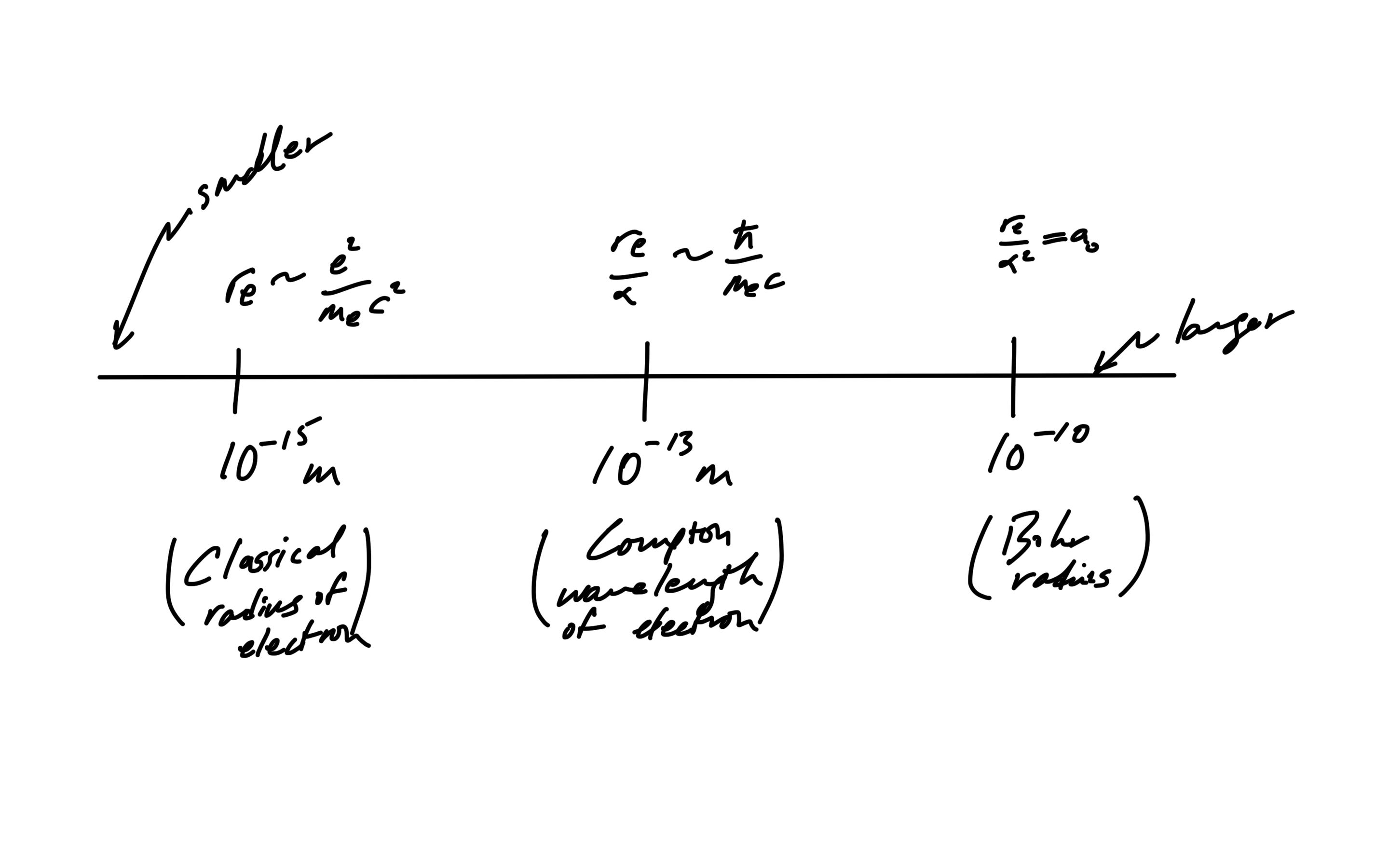
fig. 1. Interesting scales in quantum mechanics.

fig. 1. Interesting scales in quantum mechanics.


  • The Bohr radius (large end of the scale).
  • The Compton wavelength of the electron.
  • The classical radius of the electron.

Bohr radius

A quick motivation for the Bohr radius was mentioned in passing in class while discussing scale, following the high school method of deriving the Balmer series ([2]).

That method assumes a circular electron trajectory (\(i = \Be_1 \Be_2\))
\begin{equation}\label{eqn:qftLecture1:280}
\begin{aligned}
\Br &= r \Be_1 e^{i \omega t} \\
\Bv &= \omega r \Be_2 e^{i \omega t} \\
\Ba &= -\omega^2 r \Be_1 e^{i \omega t} \\
\end{aligned}
\end{equation}
The Coulomb force (in cgs units) on the electron is
\begin{equation}\label{eqn:qftLecture1:300}
\BF = m\Ba = -m \omega^2 r \Be_1 e^{i \omega t} = \frac{-e (e)}{r^2} \Be_1 e^{i \omega t},
\end{equation}
or
\begin{equation}\label{eqn:qftLecture1:320}
m \lr{ \frac{v}{r}}^2 r = \frac{e^2}{r^2},
\end{equation}
giving
\begin{equation}\label{eqn:qftLecture1:340}
m v^2 = \frac{e^2}{r}.
\end{equation}
The energy of the system, including both Kinetic and potential (from an infinite reference point) is
\begin{equation}\label{eqn:qftLecture1:360}
\begin{aligned}
E
&= \inv{2} m v^2 – \frac{e^2}{r} \\
&= – \inv{2} m v^2 \sim \,\hbar \omega = \,\hbar \frac{v}{r},
\end{aligned}
\end{equation}
or
\begin{equation}\label{eqn:qftLecture1:380}
m v r \sim \,\hbar.
\end{equation}
Eliminating \( v \) using \ref{eqn:qftLecture1:340}, assuming a ground state radius \( r = a_0 \) gives

\begin{equation}\label{eqn:qftLecture1:400}
a_0 \sim \frac{\hbar^2}{m e^2}.
\end{equation}
The Bohr radius is of the order \( 10^{-10} \text{m} \).

Compton wavelength.

When particle momentum starts approaching the speed of light, by the uncertainty relation (\(\Delta x \Delta p \sim \,\hbar\)) the variation in position must be of the order
\begin{equation}\label{eqn:qftLecture1:420}
\lambda_\txtc \sim \frac{\hbar}{m_\txte c},
\end{equation}
called the Compton wavelength.
Similarly, when the length scales are reduced to the Compton wavelength, the momentum increases to relativistic levels.
Because of the relativistic velocities at the Compton wavelength, particle creation and annihilation occurs and any theory has to account for multiple particle states.

Relations.

Scaling the Bohr radius once by the fine structure constant, we obtain the Compton wavelength (after dropping factors of \( 4\pi \))
\begin{equation}\label{eqn:qftLecture1:440}
\begin{aligned}
a_0 \alpha
&= \frac{\hbar^2}{m e^2}
\frac{e^2}{4 \pi \,\hbar c} \\
&= \frac{\hbar}{4 \pi m c} \\
&\sim
\frac{\hbar}{m c} \\
&= \lambda_\txtc.
\end{aligned}
\end{equation}
Scaling once more, we obtain (after dropping another \( 4\pi\)) the classical electron radius
\begin{equation}\label{eqn:qftLecture1:n}
\begin{aligned}
\lambda_\txtc \alpha
&=
\frac{e^2}{4 \pi m c^2} \\
&\sim
\frac{e^2}{m c^2}.
\end{aligned}
\end{equation}

References

[1] D. Bohm. Quantum Theory. Courier Dover Publications, 1989.

[2] A.P. French and E.F. Taylor. An Introduction to Quantum Physics. CRC Press, 1998.
Applied vanity press

April 9, 2018 math and physics play , , , ,

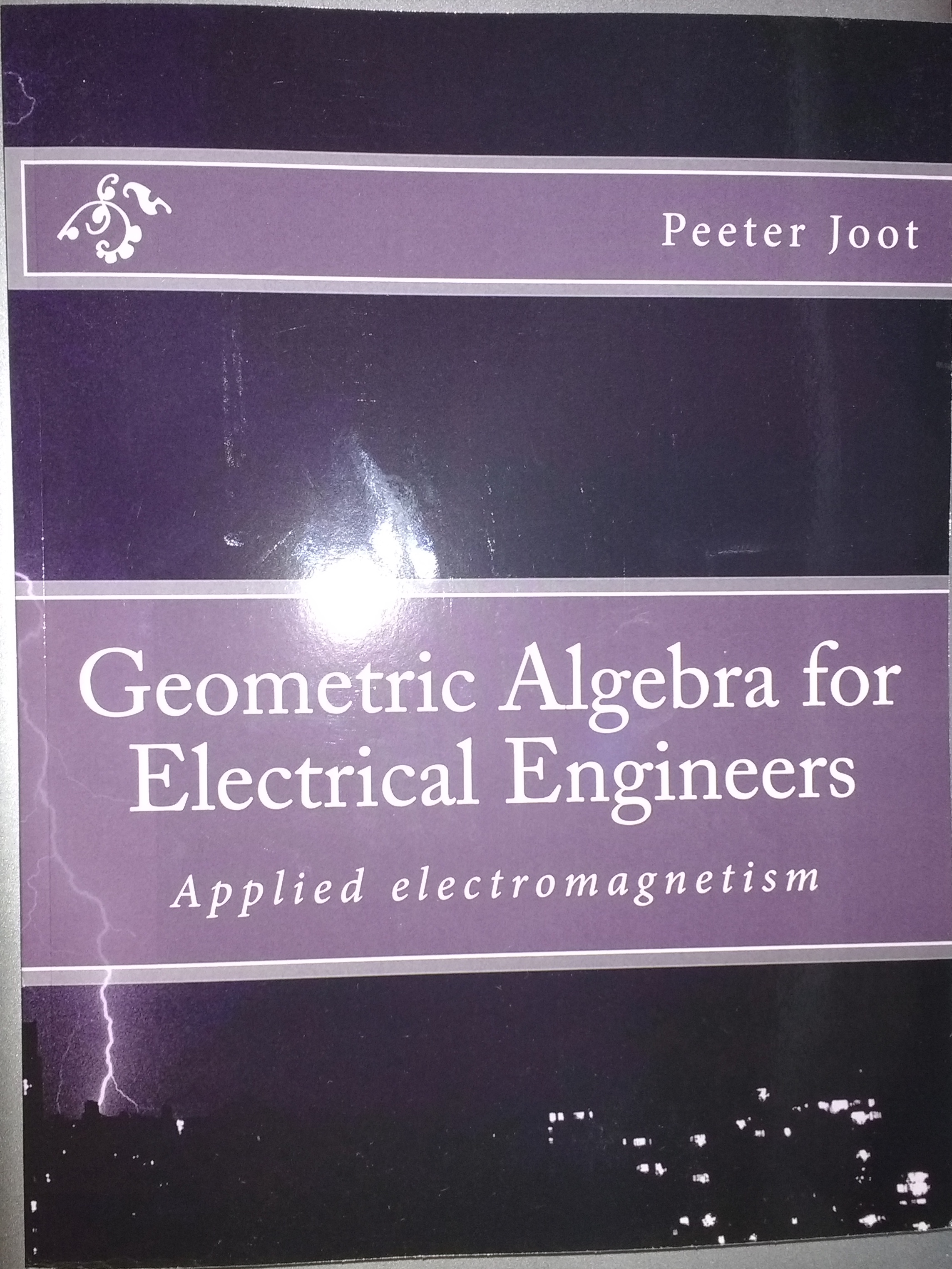
Amazon’s createspace turns out to be a very cost effective way to get a personal color copy of large pdf (>250 pages) to markup for review. The only hassle was having to use their app to create cover art (although that took less time than commuting downtown to one of the cheap copy shops near the university.)

As a side effect, after I edit it, I’d have something I could actually list for sale.  Worldwide, I’d guess at least three people would buy it, that is, if they weren’t happy with the pdf version already available.

I wrote a book: Geometric Algebra for Electrical Engineers

April 5, 2018 math and physics play , ,

The book.

A draft of my book: Geometric Algebra for Electrical Engineers, is now available. I’ve supplied limited distribution copies of some of the early drafts and have had some good review comments of the chapter I (introduction to geometric algebra), and chapter II (multivector calculus) material, but none on the electromagnetism content. In defense of the reviewers, the initial version of the electromagnetism chapter, while it had a lot of raw content, was pretty exploratory and very rough. It’s been cleaned up significantly and is hopefully now more reader friendly.

Why I wrote this book.

I have been working on a part time M.Eng degree for a number of years. I wasn’t happy with the UofT ECE electromagnetics offerings in recent years, which have been inconsistently offered or unsatisfactory. For example: the microwave circuits course which sounded interesting, and had an interesting text book, was mind numbing, almost entirely about Smith charts. I had to go elsewhere to obtain the M.Eng degree requirements. That elsewhere was a project course.

I proposed a project to an electromagnetism project with the following goals

  1. Perform a literature review of applications of geometric algebra to the study of electromagnetism.
  2. Identify the subset of the literature that had direct relevance to electrical engineering.
  3. Create a complete, and as compact as possible, introduction to the prerequisites required for a graduate or advanced undergraduate electrical engineering student to be able to apply geometric algebra to problems in electromagnetism. With those prerequisites in place, work through the fundamentals of electromagnetism in a geometric algebra context.

In retrospect, doing this project was a mistake. I could have done this work outside of an academic context without paying so much (in both time and money). Somewhere along the way I lost track of the fact that I enrolled on the M.Eng to learn (it provided a way to take grad physics courses on a part time schedule), and got side tracked by degree requirements. Basically I fell victim to a “I may as well graduate” sentiment that would have been better to ignore. All that coupled with the fact that I did not actually get any feedback from my “supervisor”, who did not even read my work (at least so far after one year), made this project-course very frustrating. On the bright side, I really like what I produced, even if I had to do so in isolation.

Why geometric algebra?

Geometric algebra generalizes vectors, providing algebraic representations of not just directed line segments, but also points, plane segments, volumes, and higher degree geometric objects (hypervolumes.). The geometric algebra representation of planes, volumes and hypervolumes requires a vector dot product, a vector multiplication operation, and a generalized addition operation. The dot product provides the length of a vector and a test for whether or not any two vectors are perpendicular. The vector multiplication operation is used to construct directed plane segments (bivectors), and directed volumes (trivectors), which are built from the respective products of two or three mutually perpendicular vectors. The addition operation allows for sums of scalars, vectors, or any products of vectors. Such a sum is called a multivector.

The power to add scalars, vectors, and products of vectors can be exploited to simplify much of electromagnetism. In particular, Maxwell’s equations for isotropic media can be merged into a single multivector equation
\begin{equation}\label{eqn:quaternion2maxwellWithGA:20}
\lr{ \spacegrad + \inv{c} \PD{t}{}} \lr{ \BE + I c \BB } = \eta\lr{ c \rho – \BJ },
\end{equation}
where \( \spacegrad \) is the gradient, \( I = \Be_1 \Be_2 \Be_3 \) is the ordered product of the three R^3 basis vectors, \( c = 1/\sqrt{\mu\epsilon}\) is the group velocity of the medium, \( \eta = \sqrt{\mu/\epsilon} \), \( \BE, \BB \) are the electric and magnetic fields, and \( \rho \) and \( \BJ \) are the charge and current densities. This can be written as a single equation
\begin{equation}\label{eqn:ece2500report:40}
\lr{ \spacegrad + \inv{c} \PD{t}{}} F = J,
\end{equation}
where \( F = \BE + I c \BB \) is the combined (multivector) electromagnetic field, and \( J = \eta\lr{ c \rho – \BJ } \) is the multivector current.

Encountering Maxwell’s equation in its geometric algebra form leaves the student with more questions than answers. Yes, it is a compact representation, but so are the tensor and differential forms (or even the quaternionic) representations of Maxwell’s equations. The student needs to know how to work with the representation if it is to be useful. It should also be clear how to use the existing conventional mathematical tools of applied electromagnetism, or how to generalize those appropriately. Individually, there are answers available to many of the questions that are generated attempting to apply the theory, but they are scattered and in many cases not easily accessible.

Much of the geometric algebra literature for electrodynamics is presented with a relativistic bias, or assumes high levels of mathematical or physics sophistication. The aim of this work was an attempt to make the study of electromagnetism using geometric algebra more accessible, especially to other dumb engineering undergraduates like myself. In particular, this project explored non-relativistic applications of geometric algebra to electromagnetism. The end product of this project was a fairly small self contained book, titled “Geometric Algebra for Electrical Engineers”. This book includes an introduction to Euclidean geometric algebra focused on R^2 and R^3 (64 pages), an introduction to geometric calculus and multivector Green’s functions (64 pages), applications to electromagnetism (82 pages), and some appendices. Many of the fundamental results of electromagnetism are derived directly from the multivector Maxwell’s equation, in a streamlined and compact fashion. This includes some new results, and many of the existing non-relativistic results from the geometric algebra literature. As a conceptual bridge, the book includes many examples of how to extract familiar conventional results from simpler multivector representations. Also included in the book are some sample calculations exploiting unique capabilities that geometric algebra provides. In particular, vectors in a plane may be manipulated much like complex numbers, which has a number of advantages over working with coordinates explicitly.

Followup.

In many ways this work only scratches the surface. Many more worked examples, problems, figures and computer algebra listings should be added. In depth applications of derived geometric algebra relationships to problems customarily tackled with separate electric and magnetic field equations should also be incorporated. There are also theoretical holes, topics covered in any conventional introductory electromagnetism text, that are missing. Examples include the Fresnel relationships for transmission and reflection at an interface, in depth treatment of waveguides, dipole radiation and motion of charged particles, bound charges, and meta materials to name a few. Many of these topics can probably be handled in a coordinate free fashion using geometric algebra. Despite all the work that is required to help bridge the gap between formalism and application, making applied electromagnetism using geometric algebra truly accessible, it is my belief this book makes some good first steps down this path.

The choice that I made to completely avoid the geometric algebra space-time-algebra (STA) is somewhat unfortunate. It is exceedingly elegant, especially in a relativisitic context. Despite that, I think that this was still a good choice from a pedagogical point of view, as most of the prerequisites for an STA based study will have been taken care of as a side effect, making that study much more accessible.

Potential solutions to the static Maxwell’s equation using geometric algebra

March 20, 2018 math and physics play , , , , , , , , , , , , , , , , ,

[Click here for a PDF of this post with nicer formatting]

When neither the electromagnetic field strength \( F = \BE + I \eta \BH \), nor current \( J = \eta (c \rho – \BJ) + I(c\rho_m – \BM) \) is a function of time, then the geometric algebra form of Maxwell’s equations is the first order multivector (gradient) equation
\begin{equation}\label{eqn:staticPotentials:20}
\spacegrad F = J.
\end{equation}

While direct solutions to this equations are possible with the multivector Green’s function for the gradient
\begin{equation}\label{eqn:staticPotentials:40}
G(\Bx, \Bx’) = \inv{4\pi} \frac{\Bx – \Bx’}{\Norm{\Bx – \Bx’}^3 },
\end{equation}
the aim in this post is to explore second order (potential) solutions in a geometric algebra context. Can we assume that it is possible to find a multivector potential \( A \) for which
\begin{equation}\label{eqn:staticPotentials:60}
F = \spacegrad A,
\end{equation}
is a solution to the Maxwell statics equation? If such a solution exists, then Maxwell’s equation is simply
\begin{equation}\label{eqn:staticPotentials:80}
\spacegrad^2 A = J,
\end{equation}
which can be easily solved using the scalar Green’s function for the Laplacian
\begin{equation}\label{eqn:staticPotentials:240}
G(\Bx, \Bx’) = -\inv{\Norm{\Bx – \Bx’} },
\end{equation}
a beastie that may be easier to convolve than the vector valued Green’s function for the gradient.

It is immediately clear that some restrictions must be imposed on the multivector potential \(A\). In particular, since the field \( F \) has only vector and bivector grades, this gradient must have no scalar, nor pseudoscalar grades. That is
\begin{equation}\label{eqn:staticPotentials:100}
\gpgrade{\spacegrad A}{0,3} = 0.
\end{equation}
This constraint on the potential can be avoided if a grade selection operation is built directly into the assumed potential solution, requiring that the field is given by
\begin{equation}\label{eqn:staticPotentials:120}
F = \gpgrade{\spacegrad A}{1,2}.
\end{equation}
However, after imposing such a constraint, Maxwell’s equation has a much less friendly form
\begin{equation}\label{eqn:staticPotentials:140}
\spacegrad^2 A – \spacegrad \gpgrade{\spacegrad A}{0,3} = J.
\end{equation}
Luckily, it is possible to introduce a transformation of potentials, called a gauge transformation, that eliminates the ugly grade selection term, and allows the potential equation to be expressed as a plain old Laplacian. We do so by assuming first that it is possible to find a solution of the Laplacian equation that has the desired grade restrictions. That is
\begin{equation}\label{eqn:staticPotentials:160}
\begin{aligned}
\spacegrad^2 A’ &= J \\
\gpgrade{\spacegrad A’}{0,3} &= 0,
\end{aligned}
\end{equation}
for which \( F = \spacegrad A’ \) is a grade 1,2 solution to \( \spacegrad F = J \). Suppose that \( A \) is any formal solution, free of any grade restrictions, to \( \spacegrad^2 A = J \), and \( F = \gpgrade{\spacegrad A}{1,2} \). Can we find a function \( \tilde{A} \) for which \( A = A’ + \tilde{A} \)?

Maxwell’s equation in terms of \( A \) is
\begin{equation}\label{eqn:staticPotentials:180}
\begin{aligned}
J
&= \spacegrad \gpgrade{\spacegrad A}{1,2} \\
&= \spacegrad^2 A
– \spacegrad \gpgrade{\spacegrad A}{0,3} \\
&= \spacegrad^2 (A’ + \tilde{A})
– \spacegrad \gpgrade{\spacegrad A}{0,3}
\end{aligned}
\end{equation}
or
\begin{equation}\label{eqn:staticPotentials:200}
\spacegrad^2 \tilde{A} = \spacegrad \gpgrade{\spacegrad A}{0,3}.
\end{equation}
This non-homogeneous Laplacian equation that can be solved as is for \( \tilde{A} \) using the Green’s function for the Laplacian. Alternatively, we may also solve the equivalent first order system using the Green’s function for the gradient.
\begin{equation}\label{eqn:staticPotentials:220}
\spacegrad \tilde{A} = \gpgrade{\spacegrad A}{0,3}.
\end{equation}
Clearly \( \tilde{A} \) is not unique, as we can add any function \( \psi \) satisfying the homogeneous Laplacian equation \( \spacegrad^2 \psi = 0 \).

In summary, if \( A \) is any multivector solution to \( \spacegrad^2 A = J \), that is
\begin{equation}\label{eqn:staticPotentials:260}
A(\Bx)
= \int dV’ G(\Bx, \Bx’) J(\Bx’)
= -\int dV’ \frac{J(\Bx’)}{\Norm{\Bx – \Bx’} },
\end{equation}
then \( F = \spacegrad A’ \) is a solution to Maxwell’s equation, where \( A’ = A – \tilde{A} \), and \( \tilde{A} \) is a solution to the non-homogeneous Laplacian equation or the non-homogeneous gradient equation above.

Integral form of the gauge transformation.

Additional insight is possible by considering the gauge transformation in integral form. Suppose that
\begin{equation}\label{eqn:staticPotentials:280}
A(\Bx) = -\int_V dV’ \frac{J(\Bx’)}{\Norm{\Bx – \Bx’} } – \tilde{A}(\Bx),
\end{equation}
is a solution of \( \spacegrad^2 A = J \), where \( \tilde{A} \) is a multivector solution to the homogeneous Laplacian equation \( \spacegrad^2 \tilde{A} = 0 \). Let’s look at the constraints on \( \tilde{A} \) that must be imposed for \( F = \spacegrad A \) to be a valid (i.e. grade 1,2) solution of Maxwell’s equation.
\begin{equation}\label{eqn:staticPotentials:300}
\begin{aligned}
F
&= \spacegrad A \\
&=
-\int_V dV’ \lr{ \spacegrad \inv{\Norm{\Bx – \Bx’} } } J(\Bx’)
– \spacegrad \tilde{A}(\Bx) \\
&=
\int_V dV’ \lr{ \spacegrad’ \inv{\Norm{\Bx – \Bx’} } } J(\Bx’)
– \spacegrad \tilde{A}(\Bx) \\
&=
\int_V dV’ \spacegrad’ \frac{J(\Bx’)}{\Norm{\Bx – \Bx’} } – \int_V dV’ \frac{\spacegrad’ J(\Bx’)}{\Norm{\Bx – \Bx’} }
– \spacegrad \tilde{A}(\Bx) \\
&=
\int_{\partial V} dA’ \ncap’ \frac{J(\Bx’)}{\Norm{\Bx – \Bx’} } – \int_V \frac{\spacegrad’ J(\Bx’)}{\Norm{\Bx – \Bx’} }
– \spacegrad \tilde{A}(\Bx).
\end{aligned}
\end{equation}
Where \( \ncap’ = (\Bx’ – \Bx)/\Norm{\Bx’ – \Bx} \), and the fundamental theorem of geometric calculus has been used to transform the gradient volume integral into an integral over the bounding surface. Operating on Maxwell’s equation with the gradient gives \( \spacegrad^2 F = \spacegrad J \), which has only grades 1,2 on the left hand side, meaning that \( J \) is constrained in a way that requires \( \spacegrad J \) to have only grades 1,2. This means that \( F \) has grades 1,2 if
\begin{equation}\label{eqn:staticPotentials:320}
\spacegrad \tilde{A}(\Bx)
= \int_{\partial V} dA’ \frac{ \gpgrade{\ncap’ J(\Bx’)}{0,3} }{\Norm{\Bx – \Bx’} }.
\end{equation}
The product \( \ncap J \) expands to
\begin{equation}\label{eqn:staticPotentials:340}
\begin{aligned}
\ncap J
&=
\gpgradezero{\ncap J_1} + \gpgradethree{\ncap J_2} \\
&=
\ncap \cdot (-\eta \BJ) + \gpgradethree{\ncap (-I \BM)} \\
&=- \eta \ncap \cdot \BJ -I \ncap \cdot \BM,
\end{aligned}
\end{equation}
so
\begin{equation}\label{eqn:staticPotentials:360}
\spacegrad \tilde{A}(\Bx)
=
-\int_{\partial V} dA’ \frac{ \eta \ncap’ \cdot \BJ(\Bx’) + I \ncap’ \cdot \BM(\Bx’)}{\Norm{\Bx – \Bx’} }.
\end{equation}
Observe that if there is no flux of current density \( \BJ \) and (fictitious) magnetic current density \( \BM \) through the surface, then \( F = \spacegrad A \) is a solution to Maxwell’s equation without any gauge transformation. Alternatively \( F = \spacegrad A \) is also a solution if \( \lim_{\Bx’ \rightarrow \infty} \BJ(\Bx’)/\Norm{\Bx – \Bx’} = \lim_{\Bx’ \rightarrow \infty} \BM(\Bx’)/\Norm{\Bx – \Bx’} = 0 \) and the bounding volume is taken to infinity.

References

Generalizing Ampere’s law using geometric algebra.

March 16, 2018 math and physics play , , , , , , , , , , , , , , , , , , , ,

[Click here for a PDF of this post with nicer formatting, and oriented integrals. All oriented integrals in this post have a clockwise direction.].

The question I’d like to explore in this post is how Ampere’s law, the relationship between the line integral of the magnetic field to current (i.e. the enclosed current)
\begin{equation}\label{eqn:flux:20}
\oint_{\partial A} d\Bx \cdot \BH = -\int_A \ncap \cdot \BJ,
\end{equation}
generalizes to geometric algebra where Maxwell’s equations for a statics configuration (all time derivatives zero) is
\begin{equation}\label{eqn:flux:40}
\spacegrad F = J,
\end{equation}
where the multivector fields and currents are
\begin{equation}\label{eqn:flux:60}
\begin{aligned}
F &= \BE + I \eta \BH \\
J &= \eta \lr{ c \rho – \BJ } + I \lr{ c \rho_\txtm – \BM }.
\end{aligned}
\end{equation}
Here (fictitious) the magnetic charge and current densities that can be useful in antenna theory have been included in the multivector current for generality.

My presumption is that it should be possible to utilize the fundamental theorem of geometric calculus for expressing the integral over an oriented surface to its boundary, but applied directly to Maxwell’s equation. That integral theorem has the form
\begin{equation}\label{eqn:flux:80}
\int_A d^2 \Bx \boldpartial F = \oint_{\partial A} d\Bx F,
\end{equation}
where \( d^2 \Bx = d\Ba \wedge d\Bb \) is a two parameter bivector valued surface, and \( \boldpartial \) is vector derivative, the projection of the gradient onto the tangent space. I won’t try to explain all of geometric calculus here, and refer the interested reader to [1], which is an excellent reference on geometric calculus and integration theory.

The gotcha is that we actually want a surface integral with \( \spacegrad F \). We can split the gradient into the vector derivative a normal component
\begin{equation}\label{eqn:flux:160}
\spacegrad = \boldpartial + \ncap (\ncap \cdot \spacegrad),
\end{equation}
so
\begin{equation}\label{eqn:flux:100}
\int_A d^2 \Bx \spacegrad F
=
\int_A d^2 \Bx \boldpartial F
+
\int_A d^2 \Bx \ncap \lr{ \ncap \cdot \spacegrad } F,
\end{equation}
so
\begin{equation}\label{eqn:flux:120}
\begin{aligned}
\oint_{\partial A} d\Bx F
&=
\int_A d^2 \Bx \lr{ J – \ncap \lr{ \ncap \cdot \spacegrad } F } \\
&=
\int_A dA \lr{ I \ncap J – \lr{ \ncap \cdot \spacegrad } I F }
\end{aligned}
\end{equation}

This is not nearly as nice as the magnetic flux relationship which was nicely split with the current and fields nicely separated. The \( d\Bx F \) product has all possible grades, as does the \( d^2 \Bx J \) product (in general). Observe however, that the normal term on the right has only grades 1,2, so we can split our line integral relations into pairs with and without grade 1,2 components
\begin{equation}\label{eqn:flux:140}
\begin{aligned}
\oint_{\partial A} \gpgrade{d\Bx F}{0,3}
&=
\int_A dA \gpgrade{ I \ncap J }{0,3} \\
\oint_{\partial A} \gpgrade{d\Bx F}{1,2}
&=
\int_A dA \lr{ \gpgrade{ I \ncap J }{1,2} – \lr{ \ncap \cdot \spacegrad } I F }.
\end{aligned}
\end{equation}

Let’s expand these explicitly in terms of the component fields and densities to check against the conventional relationships, and see if things look right. The line integrand expands to
\begin{equation}\label{eqn:flux:180}
\begin{aligned}
d\Bx F
&=
d\Bx \lr{ \BE + I \eta \BH }
=
d\Bx \cdot \BE + I \eta d\Bx \cdot \BH
+
d\Bx \wedge \BE + I \eta d\Bx \wedge \BH \\
&=
d\Bx \cdot \BE
– \eta (d\Bx \cross \BH)
+ I (d\Bx \cross \BE )
+ I \eta (d\Bx \cdot \BH),
\end{aligned}
\end{equation}
the current integrand expands to
\begin{equation}\label{eqn:flux:200}
\begin{aligned}
I \ncap J
&=
I \ncap
\lr{
\frac{\rho}{\epsilon} – \eta \BJ + I \lr{ c \rho_\txtm – \BM }
} \\
&=
\ncap I \frac{\rho}{\epsilon} – \eta \ncap I \BJ – \ncap c \rho_\txtm + \ncap \BM \\
&=
\ncap \cdot \BM
+ \eta (\ncap \cross \BJ)
– \ncap c \rho_\txtm
+ I (\ncap \cross \BM)
+ \ncap I \frac{\rho}{\epsilon}
– \eta I (\ncap \cdot \BJ).
\end{aligned}
\end{equation}

We are left with
\begin{equation}\label{eqn:flux:220}
\begin{aligned}
\oint_{\partial A}
\lr{
d\Bx \cdot \BE + I \eta (d\Bx \cdot \BH)
}
&=
\int_A dA
\lr{
\ncap \cdot \BM – \eta I (\ncap \cdot \BJ)
} \\
\oint_{\partial A}
\lr{
– \eta (d\Bx \cross \BH)
+ I (d\Bx \cross \BE )
}
&=
\int_A dA
\lr{
\eta (\ncap \cross \BJ)
– \ncap c \rho_\txtm
+ I (\ncap \cross \BM)
+ \ncap I \frac{\rho}{\epsilon}
-\PD{n}{} \lr{ I \BE – \eta \BH }
}.
\end{aligned}
\end{equation}
This is a crazy mess of dots, crosses, fields and sources. We can split it into one equation for each grade, which will probably look a little more regular. That is
\begin{equation}\label{eqn:flux:240}
\begin{aligned}
\oint_{\partial A} d\Bx \cdot \BE &= \int_A dA \ncap \cdot \BM \\
\oint_{\partial A} d\Bx \cross \BH
&=
\int_A dA
\lr{
– \ncap \cross \BJ
+ \frac{ \ncap \rho_\txtm }{\mu}
– \PD{n}{\BH}
} \\
\oint_{\partial A} d\Bx \cross \BE &=
\int_A dA
\lr{
\ncap \cross \BM
+ \frac{\ncap \rho}{\epsilon}
– \PD{n}{\BE}
} \\
\oint_{\partial A} d\Bx \cdot \BH &= -\int_A dA \ncap \cdot \BJ \\
\end{aligned}
\end{equation}
The first and last equations could have been obtained much more easily from Maxwell’s equations in their conventional form more easily. The two cross product equations with the normal derivatives are not familiar to me, even without the fictitious magnetic sources. It is somewhat remarkable that so much can be packed into one multivector equation:
\begin{equation}\label{eqn:flux:260}
\oint_{\partial A} d\Bx F
=
I \int_A dA \lr{ \ncap J – \PD{n}{F} }.
\end{equation}

References

[1] A. Macdonald. Vector and Geometric Calculus. CreateSpace Independent Publishing Platform, 2012.