math and physics play

PHY2403H Quantum Field Theory. Lecture 23: QED and QCD interaction Lagrangian, Feynman propagator and rules for Fermions, hadron pair production, scattering cross section, quark pair production. Taught by Prof. Erich Poppitz

December 26, 2018 phy2403 , , , , , , , , , , , , , , , ,

Here is a link to [a PDF with my notes for the final QFT I lecture.] That lecture followed [1] section 5.1 fairly closely (filling in some details, leaving out some others.)

This lecture

  • Introduced an interaction Lagrangian with QED and QCD interaction terms
    \begin{equation*}
    \LL_{\text{QED}}
    =
    – \inv{4} F_{\mu\nu} F^{\mu\nu}
    +
    \overline{\Psi}_e \lr{ i \gamma^\mu \partial_\mu – m } \Psi_e

    e \overline{\Psi}_e \gamma_\mu \Psi_e A^\mu
    +
    \overline{\Psi}_\mu \lr{ i \gamma^\mu \partial_\mu – m } \Psi_\mu

    e \overline{\Psi}_\mu \gamma_\mu \Psi_\mu A^\mu,
    \end{equation*}
    as well as the quark interaction Lagrangian
    \begin{equation*}
    \LL_{\text{quarks}} = \sum_q \overline{\Psi}_q \lr{ i \gamma^\mu – m_q } \Psi_q + e Q_q \overline{\Psi}_q \gamma^\nu \Psi_q A_\nu.
    \end{equation*}
  • The Feynman propagator for Fermions was calculated
    \begin{equation*}
    \expectation{ T( \Psi_\alpha(x) \Psi_\beta(x) }_0
    =
    \lr{ \gamma^\mu_{\alpha\beta} \partial_\mu^{(x)} + m } D_F(x – y)
    =
    \int \frac{d^4 p}{(2 \pi)^4 } \frac{ i ( \gamma^\mu_{\alpha\beta} p_\mu + m ) }{p^2 – m^2 + i \epsilon} e^{-i p \cdot (x – y)}.
    \end{equation*}
  • We determined the Feynman rules for Fermion diagram nodes and edges.
    The Feynman propagator for Fermions is
    \begin{equation*}
    \frac{ i \lr{ \gamma^\mu p_\mu + m } }{p^2 – m^2 + i \epsilon},
    \end{equation*}
    whereas the photon propagator is
    \begin{equation*}
    \expectation{ A_\mu A_\nu } = -i \frac{g_{\mu\nu}}{q^2 + i \epsilon}.
    \end{equation*}
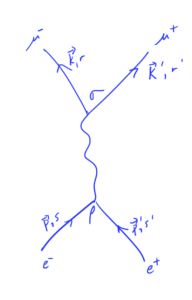
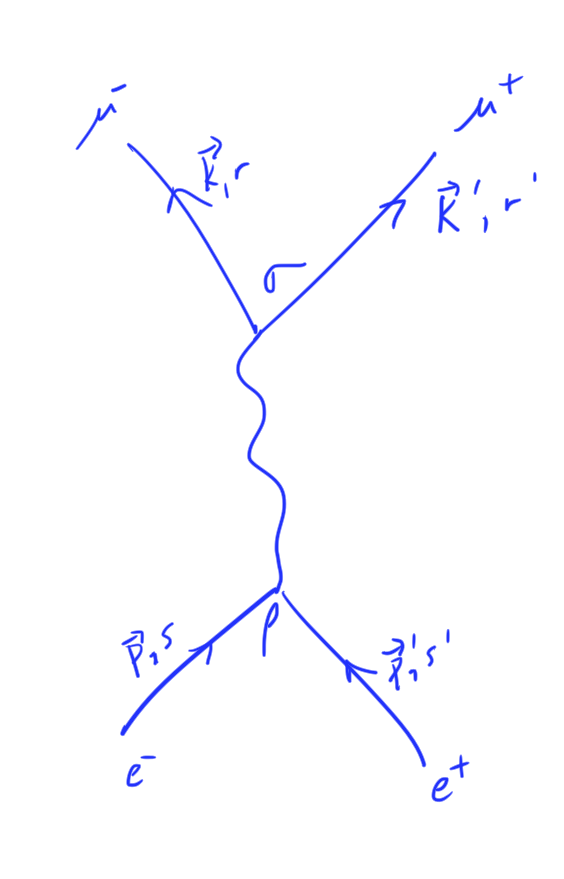
  • Muon pair production

    We then studied muon pair production in detail, and determined the form of the scattering matrix element
    \begin{equation*}
    i M
    =
    i \frac{e^2}{q^2}
    \overline{v}^{s’}(p’) \gamma^\rho u^s(p)
    \overline{u}^r(k) \gamma_\rho v^{r’}(k’),
    \end{equation*}
    where the \( (2 \pi)^4 \delta^4(…) \) term hasn’t been made explicit, and detemined that the average of its square over all input and output polarization (spin) states was
    \begin{equation*}
    \inv{4} \sum_{ss’, rr’} \Abs{M}^2
    =
    \frac{e^4}{4 q^4}
    \textrm{tr}{ \lr{
    \lr{ \gamma^\alpha {k’}_\alpha – m_\mu }
    \gamma_\nu
    \lr{ \gamma^\beta {k}_\beta + m_\mu }
    \gamma_\mu
    }}
    \times
    \textrm{tr}{ \lr{
    \lr{ \gamma^\kappa {p}_\kappa + m_e }
    \gamma^\nu
    \lr{ \gamma^\rho {p’}_\rho – m_e }
    \gamma^\mu
    }}.
    \end{equation*}.
    In the CM frame (neglecting the electron mass, which is small relative to the muon mass), this reduced to
    \begin{equation*}
    \inv{4} \sum_{\text{spins}} \Abs{M}^2
    =
    \frac{8 e^4}{q^4}
    \lr{
    p \cdot k’ p’ \cdot k
    + p \cdot k p’ \cdot k’
    + p \cdot p’ m_\mu^2
    }.
    \end{equation*}

  • We computed the differential cross section
    \begin{equation*}
    {\frac{d\sigma}{d\Omega}}_{\text{CM}}
    =
    \frac{\alpha^2}{4 E_{\text{CM}}^2 }
    \sqrt{ 1 – \frac{m_\mu^2}{E^2} }
    \lr{
    1 + \frac{m_\mu^2}{E^2}
    + \lr{ 1 – \frac{m_\mu^2}{E^2} } \cos^2\theta
    },
    \end{equation*}
    and the total cross section
    \begin{equation*}
    \sigma_{\text{total}}
    =
    \frac{4 \pi \alpha^2}{3 E_{\text{CM}}^2 }
    \sqrt{ 1 – \frac{m_\mu^2}{E^2} }
    \lr{
    1 + \inv{2} \frac{m_\mu^2}{E^2}
    },
    \end{equation*}
    and compared that to the cross section that we was determined with the dimensional analysis handwaving at the start of the course.
  • We finished off with a quick discussion of quark pair production, and how some of the calculations we performed for muon pair production can be used to measure and validate the intermediate quark states that were theorized as carriers of the strong force.
References

[1] Michael E Peskin and Daniel V Schroeder. An introduction to Quantum Field Theory. Westview, 1995.

Dirac spinor relations after rest frame boost

December 18, 2018 phy2403 , , , , ,

[Click here for a PDF of this post with nicer formatting]

In [1], Prof Osmond explicitly boosts a \( u^s(p_0) \) Dirac spinor from the rest frame with rest frame energy \( p_0 \).
After doing so he claims the identification
\begin{equation}\label{eqn:squarerootpsigma:20}
\begin{aligned}
\sqrt{m} e^{-\inv{2} \eta \sigma^3} &= \sqrt{ p \cdot \sigma } \\
\sqrt{m} e^{\inv{2} \eta \sigma^3} &= \sqrt{ p \cdot \overline{\sigma} },
\end{aligned}
\end{equation}
for the components of \( u^s(\Lambda p_0) \).

Let’s verify this by squaring. First
\begin{equation}\label{eqn:squarerootpsigma:40}
e^{\pm \inv{2} \eta \sigma^3 }
=
\cosh\lr{ \inv{2} \eta \sigma^3 }
\pm
\sinh\lr{ \inv{2} \eta \sigma^3 } \sigma^3,
\end{equation}
which squares to (FIXME: link to uvspinor.nb)
\begin{equation}\label{eqn:squarerootpsigma:60}
\lr{ e^{\pm \inv{2} \eta \sigma^3 } }^2
=
\begin{bmatrix}
e^{\pm \eta} & 0 \\
0 & e^{\mp \eta}
\end{bmatrix}.
\end{equation}

Explicitly boosting the rest energy \( p_0 \) gives
\begin{equation}\label{eqn:squarerootpsigma:80}
\begin{bmatrix}
p_0 \\
0
\end{bmatrix}
\rightarrow
\begin{bmatrix}
\cosh\eta & \sinh\eta \\
\sinh\eta & \cosh\eta \\
\end{bmatrix}
\begin{bmatrix}
p_0 \\
0
\end{bmatrix}
=
p_0
\begin{bmatrix}
\cosh\eta \\
\sinh\eta
\end{bmatrix},
\end{equation}
so after the boost
\begin{equation}\label{eqn:squarerootpsigma:100}
\begin{aligned}
p \cdot \sigma
&\rightarrow
p_0 \lr{ \cosh \eta – \sinh \eta \sigma^3 } \\
&= p_0
\begin{bmatrix}
\cosh\eta – \sinh\eta & 0 \\
0 & \cosh\eta + \sinh\eta
\end{bmatrix} \\
&=
p_0
\begin{bmatrix}
e^{-\eta} & 0 \\
0 & e^{\eta}
\end{bmatrix},
\end{aligned}
\end{equation}
where \( p_0 = m \) is still the rest frame energy. However, according to \ref{eqn:squarerootpsigma:60} this is exactly
\begin{equation}\label{eqn:squarerootpsigma:120}
\lr{\sqrt{m} e^{-\inv{2} \eta \sigma^3 }}^2
\end{equation}

Since \( p \cdot \overline{\sigma} \) flips the signs of the spatial momentum, we have shown that
\begin{equation}\label{eqn:squarerootpsigma:140}
\begin{aligned}
\lr{\sqrt{m} e^{-\inv{2} \eta \sigma^3 }}^2 &= p \cdot \sigma \\
\lr{\sqrt{m} e^{\inv{2} \eta \sigma^3 }}^2 &= p \cdot \overline{\sigma},
\end{aligned}
\end{equation}
which isn’t a full proof of the claimed result (i.e. the most general orientation isn’t considered), but at least validates the claim.

References

[1] Dr. Tobias Osborne. Qft lecture 15, dirac equation, boost from stationary frame. Youtube. URL https://youtu.be/J2lV8uNx0LU?list=PLDfPUNusx1EpRs-wku83aqYSKfR5fFmfS&t=4328. [Online; accessed 18-December-2018].

PHY2403H Quantum Field Theory. Lecture 22: Dirac sea, charges, angular momentum, spin, U(1) symmetries, electrons and positrons. Taught by Prof. Erich Poppitz

December 17, 2018 phy2403 , , , , , , , ,

This post is a synopsis of the material from the second last lecture of QFT I. I missed that class, but worked from notes kindly provided by Emily Tyhurst, and Stefan Divic, filling in enough details that it made sense to me.

[Click here for an unabrided PDF of my full notes on this day’s lecture material.]

Topics covered include

  • The Hamiltonian action on single particle states showed that the Hamiltonian was an energy eigenoperator
    \begin{equation}\label{eqn:qftLecture22:140}
    H \ket{\Bp, r}
    =
    \omega_\Bp \ket{\Bp, r}.
    \end{equation}
  • The conserved Noether current and charge for spatial translations, the momentum operator, was found to be
    \begin{equation}\label{eqn:momentumDirac:260}
    \BP =
    \int d^3 x
    \Psi^\dagger (-i \spacegrad) \Psi,
    \end{equation}
    which could be written in creation and anhillation operator form as
    \begin{equation}\label{eqn:momentumDirac:261}
    \BP = \sum_{s = 1}^2
    \int \frac{d^3 q}{(2\pi)^3} \Bp \lr{
    a_\Bp^{s\dagger}
    a_\Bp^{s}
    +
    b_\Bp^{s\dagger}
    b_\Bp^{s}
    }.
    \end{equation}
    Single particle states were found to be the eigenvectors of this operator, with momentum eigenvalues
    \begin{equation}\label{eqn:momentumDirac:262}
    \BP a_\Bq^{s\dagger} \ket{0} = \Bq (a_\Bq^{s\dagger} \ket{0}).
    \end{equation}
  • The conserved Noether current and charge for a rotation was found. That charge is
    \begin{equation}\label{eqn:qftLecture22:920}
    \BJ = \int d^3 x \Psi^\dagger(x) \lr{ \underbrace{\Bx \cross (-i \spacegrad)}_{\text{orbital angular momentum}} + \inv{2} \underbrace{\mathbf{1} \otimes \Bsigma}_{\text{spin angular momentum}} } \Psi,
    \end{equation}
    where
    \begin{equation}\label{eqn:qftLecture22:260}
    \mathbf{1} \otimes \Bsigma =
    \begin{bmatrix}
    \Bsigma & 0 \\
    0 & \Bsigma
    \end{bmatrix},
    \end{equation}
    which has distinct orbital and spin angular momentum components. Unlike NRQM, we see both types of angular momentum as components of a single operator. It is argued in [3] that for a particle at rest the single particle state is an eigenvector of this operator, with eigenvalues \( \pm 1/2 \) — the Fermion spin eigenvalues!
  • We examined two \( U(1) \) global symmetries. The Noether charge for the “vector” \( U(1) \) symmetry is
    \begin{equation}\label{eqn:qftLecture22:380}
    Q
    =
    \int \frac{d^3 q}{(2\pi)^3} \sum_{s = 1}^2
    \lr{
    a_\Bp^{s \dagger} a_\Bp^s

    b_\Bp^{s \dagger}
    b_\Bp^s
    },
    \end{equation}
    This charge operator characterizes the \( a, b \) operators. \( a \) particles have charge \( +1 \), and \( b \) particles have charge \( -1 \), or vice-versa depending on convention. We call \( a \) the operator for the electron, and \( b \) the operator for the positron.
  • CPT (Charge-Parity-TimeReversal) symmetries were also mentioned, but not covered in class. We were pointed to [2], [3], [4] to start studying that topic.

References

[1] C. Doran and A.N. Lasenby. Geometric algebra for physicists. Cambridge University Press New York, Cambridge, UK, 1st edition, 2003.

[2] Dr. Michael Luke. Quantum Field Theory., 2011. URL https://www.physics.utoronto.ca/~luke/PHY2403F/References_files/lecturenotes.pdf. [Online; accessed 05-Dec-2018].

[3] Michael E Peskin and Daniel V Schroeder. An introduction to Quantum Field Theory. Westview, 1995.

[4] Dr. David Tong. Quantum Field Theory. URL http://www.damtp.cam.ac.uk/user/tong/qft.html.

Explicit form of the square root of p . sigma.

December 10, 2018 phy2403 , , , ,

[Click here for a PDF of this post with nicer formatting]

With the help of Mathematica, a fairly compact form was found for the root of \( p \cdot \sigma \)
\begin{equation}\label{eqn:DiracUVmatricesExplicit:121}
\sqrt{ p \cdot \sigma }
=
\inv{
\sqrt{ \omega_\Bp- \Norm{\Bp} } + \sqrt{ \omega_\Bp+ \Norm{\Bp} }
}
\begin{bmatrix}
\omega_\Bp- p^3 + \sqrt{ \omega_\Bp^2 – \Bp^2 } & – p^1 + i p^2 \\
– p^1 – i p^2 & \omega_\Bp+ p^3 + \sqrt{ \omega_\Bp^2 – \Bp^2 }
\end{bmatrix}.
\end{equation}
A bit of examination shows that we can do much better. The leading scalar term can be simplified by squaring it
\begin{equation}\label{eqn:squarerootpsigma:140}
\begin{aligned}
\lr{ \sqrt{ \omega_\Bp- \Norm{\Bp} } + \sqrt{ \omega_\Bp+ \Norm{\Bp} } }^2
&=
\omega_\Bp- \Norm{\Bp} + \omega_\Bp+ \Norm{\Bp} + 2 \sqrt{ \omega_\Bp^2 – \Bp^2 } \\
&=
2 \omega_\Bp + 2 m,
\end{aligned}
\end{equation}
where the on-shell value of the energy \( \omega_\Bp^2 = m^2 + \Bp^2 \) has been inserted. Using that again in the matrix, we have
\begin{equation}\label{eqn:squarerootpsigma:160}
\begin{aligned}
\sqrt{ p \cdot \sigma }
&=
\inv{\sqrt{ 2 \omega_\Bp + 2 m }}
\begin{bmatrix}
\omega_\Bp- p^3 + m & – p^1 + i p^2 \\
– p^1 – i p^2 & \omega_\Bp+ p^3 + m
\end{bmatrix} \\
&=
\inv{\sqrt{ 2 \omega_\Bp + 2 m }}
\lr{
(\omega_\Bp + m) \sigma^0
-p^1 \begin{bmatrix} 0 & 1 \\ 1 & 0 \\ \end{bmatrix}
-p^2 \begin{bmatrix} 0 & -i \\ i & 0 \\ \end{bmatrix}
-p^3 \begin{bmatrix} 1 & 0 \\ 0 & -1 \\ \end{bmatrix}
} \\
&=
\inv{\sqrt{ 2 \omega_\Bp + 2 m }}
\lr{
(\omega_\Bp + m) \sigma^0
-p^1 \sigma^1
-p^2 \sigma^2
-p^3 \sigma^3
} \\
&=
\inv{\sqrt{ 2 \omega_\Bp + 2 m }}
\lr{
(\omega_\Bp + m) \sigma^0 – \Bsigma \cdot \Bp
}.
\end{aligned}
\end{equation}

We’ve now found a nice algebraic form for these matrix roots
\begin{equation}\label{eqn:squarerootpsigma:180}
\boxed{
\begin{aligned}
\sqrt{p \cdot \sigma} &= \inv{\sqrt{ 2 \omega_\Bp + 2 m }} \lr{ m + p \cdot \sigma } \\
\sqrt{p \cdot \overline{\sigma}} &= \inv{\sqrt{ 2 \omega_\Bp + 2 m }} \lr{ m + p \cdot \overline{\sigma}}.
\end{aligned}}
\end{equation}

As a check, let’s square one of these explicitly
\begin{equation}\label{eqn:squarerootpsigma:101}
\begin{aligned}
\lr{ \sqrt{p \cdot \sigma} }^2
&= \inv{2 \omega_\Bp + 2 m }
\lr{ m^2 + (p \cdot \sigma)^2 + 2 m (p \cdot \sigma) } \\
&= \inv{2 \omega_\Bp + 2 m }
\lr{ m^2 + (\omega_\Bp^2 – 2 \omega_\Bp \Bsigma \cdot \Bp + \Bp^2) + 2 m (p \cdot \sigma) } \\
&= \inv{2 \omega_\Bp + 2 m }
\lr{ 2 \omega_\Bp^2 – 2 \omega_\Bp \Bsigma \cdot \Bp + 2 m (\omega_\Bp – \Bsigma \cdot \Bp) } \\
&= \inv{2 \omega_\Bp + 2 m }
\lr{ 2 \omega_\Bp \lr{ \omega_\Bp + m } – (2 \omega_\Bp + 2 m) \Bsigma \cdot \Bp } \\
&=
\omega_\Bp – \Bsigma \cdot \Bp \\
&=
p \cdot \sigma,
\end{aligned}
\end{equation}
which validates the result.

Explicit expansion of the Dirac u,v matrices

December 9, 2018 phy2403 , , , ,

[Click here for a PDF of this post with nicer formatting]

We found that the solution of the \( u(p), v(p) \) matrices were
\begin{equation}\label{eqn:DiracUVmatricesExplicit:20}
\begin{aligned}
u(p) &=
\begin{bmatrix}
\sqrt{p \cdot \sigma} \zeta \\
\sqrt{p \cdot \overline{\sigma}} \zeta \\
\end{bmatrix} \\
v(p) &=
\begin{bmatrix}
\sqrt{p \cdot \sigma} \eta \\
-\sqrt{p \cdot \overline{\sigma}} \eta \\
\end{bmatrix},
\end{aligned}
\end{equation}
where
\begin{equation}\label{eqn:DiracUVmatricesExplicit:40}
\begin{aligned}
p \cdot \sigma &= p_0 \sigma_0 – \Bsigma \cdot \Bp \\
p \cdot \overline{\sigma} &= p_0 \sigma_0 + \Bsigma \cdot \Bp.
\end{aligned}
\end{equation}
It was pointed out that these square roots can be conceptualized as (in the right basis) as the diagonal matrices of the eigenvalue square roots.

It was also pointed out that we don’t tend to need the explicit form of these square roots.We saw that to be the case in all our calculations, where these always showed up in the end in quadratic combinations like \( \sqrt{ (p \cdot \sigma)^2 }, \sqrt{ (p \cdot \sigma)(p \cdot \overline{\sigma})}, \cdots \), which nicely reduced each time without requiring the matrix roots.

I encountered a case where it would have been nice to have the explicit representation. In particular, I wanted to use Mathematica to symbolically expand \( \overline{\Psi} i \gamma^\mu \partial_\mu \Psi \) in terms of \( a^s_\Bp, b^r_\Bp, \cdots \) representation, to verify that the massless Dirac Lagrangian are in fact the energy and momentum operators (and to compare to the explicit form of the momentum operator found in eq. 3.105 [1]). For that mechanical task, I needed explicit representations of all the \( u^s(p), v^r(p) \) matrices to plug in.

It happens that \( 2 \times 2 \) matrices can be square-rooted symbolically (FIXME: link to squarerootOfFourSigmaDotP.nb notebook). In particular, the matrices \( p \cdot \sigma, p \cdot \overline{\sigma} \) have nice simple eigenvalues \( \pm \Norm{\Bp} + \omega_\Bp \). The corresponding unnormalized eigenvectors for \( p \cdot \sigma \) are
\begin{equation}\label{eqn:DiracUVmatricesExplicit:60}
\begin{aligned}
e_1 &=
\begin{bmatrix}
– p_x + i p_y \\
p_z + \Norm{\Bp}
\end{bmatrix} \\
e_1 &=
\begin{bmatrix}
– p_x + i p_y \\
p_z – \Norm{\Bp}
\end{bmatrix}.
\end{aligned}
\end{equation}
This means that we can diagonalize \( p \cdot \sigma \) as
\begin{equation}\label{eqn:DiracUVmatricesExplicit:80}
p \cdot \sigma
= U
\begin{bmatrix}
\omega_\Bp+ \Norm{\Bp} & 0 \\
0 & \omega_\Bp- \Norm{\Bp}
\end{bmatrix}
U^\dagger,
\end{equation}
where \( U \) is the matrix of the normalized eigenvectors
\begin{equation}\label{eqn:DiracUVmatricesExplicit:100}
U =
\begin{bmatrix}
e_1′ & e_2′
\end{bmatrix}
=
\inv{ \sqrt{ 2 \Bp^2 + 2 p_z \Norm{\Bp} } }
\begin{bmatrix}
-p_x + i p_y & -p_x + i p_y \\
p_z + \Norm{\Bp} & p_z – \Norm{\Bp}
\end{bmatrix}.
\end{equation}

Letting Mathematica churn through the matrix products \ref{eqn:DiracUVmatricesExplicit:80} verifies the diagonalization, and for the roots, we find
\begin{equation}\label{eqn:DiracUVmatricesExplicit:120}
\sqrt{ p \cdot \sigma }
=
\inv{
\sqrt{ \omega_\Bp- \Norm{\Bp} } + \sqrt{ \omega_\Bp+ \Norm{\Bp} }
}
\begin{bmatrix}
\omega_\Bp- p_z + \sqrt{ \omega_\Bp^2 – \Bp^2 } & – p_x + i p_y \\
– p_x – i p_y & \omega_\Bp+ p_z + \sqrt{ \omega_\Bp^2 – \Bp^2 }
\end{bmatrix}.
\end{equation}
Now we can plug in \( \zeta^{1\T} = (1,0), \zeta^{2\T} = (0,1), \eta^{1\T} = (1,0), \eta^{2\T} = (0,1) \) to find the explicit form of our \( u\)’s and \( v\)’s
\begin{equation}\label{eqn:DiracUVmatricesExplicit:140}
\begin{aligned}
u^1(p) &=
\inv{
\sqrt{ \omega_\Bp- \Norm{\Bp} } + \sqrt{ \omega_\Bp+ \Norm{\Bp} }
}
\begin{bmatrix}
\omega_\Bp- p_z + \sqrt{ \omega_\Bp^2 – \Bp^2 } \\
– p_x – i p_y \\
\omega_\Bp+ p_z + \sqrt{ \omega_\Bp^2 – \Bp^2 } \\
p_x + i p_y \\
\end{bmatrix} \\
u^2(p) &=
\inv{
\sqrt{ \omega_\Bp- \Norm{\Bp} } + \sqrt{ \omega_\Bp+ \Norm{\Bp} }
}
\begin{bmatrix}
– p_x + i p_y \\
\omega_\Bp+ p_z + \sqrt{ \omega_\Bp^2 – \Bp^2 } \\
p_x – i p_y \\
\omega_\Bp- p_z + \sqrt{ \omega_\Bp^2 – \Bp^2 } \\
\end{bmatrix} \\
v^1(p) &=
\inv{
\sqrt{ \omega_\Bp- \Norm{\Bp} } + \sqrt{ \omega_\Bp+ \Norm{\Bp} }
}
\begin{bmatrix}
\omega_\Bp- p_z + \sqrt{ \omega_\Bp^2 – \Bp^2 } \\
– p_x – i p_y \\
-\omega_\Bp- p_z + \sqrt{ \omega_\Bp^2 – \Bp^2 } \\
-p_x – i p_y \\
\end{bmatrix} \\
v^2(p) &=
\inv{
\sqrt{ \omega_\Bp- \Norm{\Bp} } + \sqrt{ \omega_\Bp+ \Norm{\Bp} }
}
\begin{bmatrix}
– p_x + i p_y \\
\omega_\Bp+ p_z + \sqrt{ \omega_\Bp^2 – \Bp^2 } \\
-p_x + i p_y \\
-\omega_\Bp+ p_z + \sqrt{ \omega_\Bp^2 – \Bp^2 } \\
\end{bmatrix}.
\end{aligned}
\end{equation}
This is now a convenient form to try the next symbolic manipulation task. If nothing else this takes some of the mystery out of the original compact notation, since we see that the \( u,v \)’s are just \( 4 \) element column vectors, and we know their explicit should we want them.

Also note that in class we made a note that we should take the positive roots of the eigenvalue diagonal matrix. It doesn’t look like that is really required. We need not even use the same sign for each root. Squaring the resulting matrix root in the end will recover the original \( p \cdot \sigma \) matrix.

References

[1] Michael E Peskin and Daniel V Schroeder. An introduction to Quantum Field Theory. Westview, 1995.