math and physics play

PHY1520H Graduate Quantum Mechanics. Lecture 17: Clebsch-Gordan. Taught by Prof. Arun Paramekanti

November 21, 2015 phy1520 , , ,

[Click here for a PDF of this post with nicer formatting]

Disclaimer

Peeter’s lecture notes from class. These may be incoherent and rough.

These are notes for the UofT course PHY1520, Graduate Quantum Mechanics, taught by Prof. Paramekanti, covering [1] chap. 3 content.

Clebsch-Gordan

How can we related total momentum states to individual momentum states in the \( 1 \otimes 2 \) space?

\begin{equation}\label{eqn:qmLecture16:720}
\ket{l_1, l_2, l, m } = \sum_{m_1, m_2} C_{l_1 l_2 m_1 m_2}^{l_1 l_2 l m} \ket{l_1 m_1 ; l_2 m_2 }
\end{equation}

The values \( C_{l_1 l_2 m_1 m_2}^{l_1 l_2 l m} \) are called the Clebsch-Gordan coefficients.

Example: spin one and spin one half

With individual momentum states \( \ket{l_1 m_1 ; l_2 m_2 } \)

\begin{equation}\label{eqn:qmLecture16:740}
\begin{aligned}
l_1 &= 1 \\
m_1 &= \pm 1, 0 \\
l_2 &= \inv{2} \\
m_2 &= \pm \inv{2}
\end{aligned}
\end{equation}

The total angular momentum numbers are

\begin{equation}\label{eqn:qmLecture16:760}
l_{\textrm{tot}} \in [l_1 – l_2, l_1 + l_2] = [\ifrac{1}{2}, \ifrac{3}{2}]
\end{equation}

The possible states \( \ket{ l_{\textrm{tot}}, m_{\textrm{tot}} } \) are

\begin{equation}\label{eqn:qmLecture16:780}
\ket{\inv{2}, \inv{2} }, \ket{\inv{2}, -\inv{2} },
\end{equation}

and
\begin{equation}\label{eqn:qmLecture16:800}
\ket{\frac{3}{2}, \frac{3}{2} }, \ket{\frac{3}{2}, \frac{1}{2} },
\ket{\frac{3}{2}, -\frac{1}{2} }
\ket{\frac{3}{2}, -\frac{3}{2} }.
\end{equation}

The Clebsch-Gordan procedure is the search for an orthogonal angular momentum basis, built up from the individual momentum bases. For the total momentum basis we want the basis states to satisfy the ladder operators, but also have them satisfy the consistuient ladder operators for the individual particle angular momenta. This procedure is sketched in fig. 1.
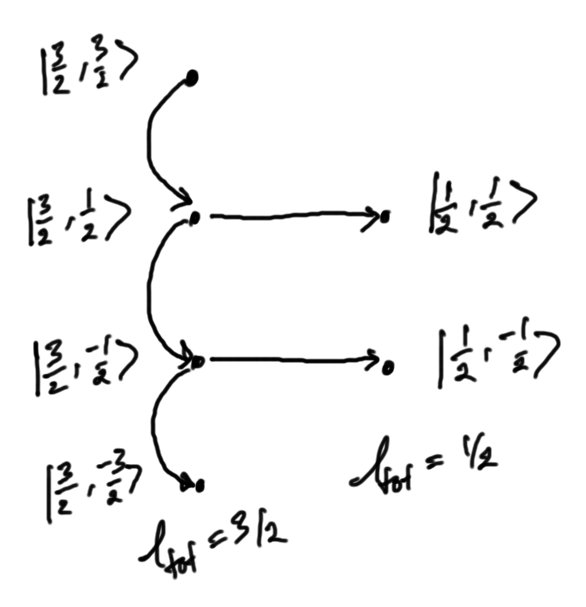
fig. 1. Spin one,one-half Clebsch-Gordan procedure

fig. 1. Spin one,one-half Clebsch-Gordan procedure

Demonstrating by example, let the highest total momentum state be proportional to the highest product of individual momentum states

\begin{equation}\label{eqn:qmLecture16:820}
\ket{ \frac{3}{2} \frac{3}{2} } = \ket{ 1 1 } \otimes \ket{ \frac{1}{2} \frac{1}{2} }.
\end{equation}

A lowered state can be constructed in two different ways, one using the total angular momentum lowering operator

\begin{equation}\label{eqn:qmLecture16:840}
\begin{aligned}
\ket{ \frac{3}{2} \frac{1}{2} }
&=
\hat{L}_{-}^{\textrm{tot}} \ket{ \frac{3}{2} \frac{3}{2} } \\
&= \Hbar \sqrt{\lr{\frac{3}{2} + \frac{3}{2}}\lr{\frac{3}{2} – \frac{3}{2} + 1}} \ket{ \frac{3}{2} \frac{1}{2} } \\
&= \Hbar \sqrt{3} \ket{ \frac{3}{2} \frac{1}{2} }.
\end{aligned}
\end{equation}

On the other hand, the lowering operator can also be expressed as \( \hat{L}_{-}^{\textrm{tot}} = \hat{L}_{-}^{(1)} \otimes 1 + 1 \otimes \hat{L}_{-}^{(2)} \). Operating with that gives

\begin{equation}\label{eqn:qmLecture16:860}
\begin{aligned}
\ket{ \frac{3}{2} \frac{1}{2} }
&=
\hat{L}_{-}^{\textrm{tot}} \ket{ 1 1 } \otimes \ket{ \frac{1}{2} \frac{1}{2} }
\\
&=
\hat{L}_{-}^{(1)} \ket{ 1 1 } \otimes \ket{ \frac{1}{2} \frac{1}{2} }
+
\ket{ 1 1 } \otimes \hat{L}_{-}^2 \ket{ \frac{1}{2} \frac{1}{2} } \\
&=
\Hbar \sqrt{\lr{1 + 1}\lr{1 – 1 + 1}} \ket{ 1 0 } \otimes \ket{ \frac{1}{2} \frac{1}{2} }
+
\Hbar \sqrt{\lr{\frac{1}{2} + \frac{1}{2}}\lr{\frac{1}{2} – \frac{1}{2} + 1}}
\ket{ 1 1 } \otimes \ket{ \frac{1}{2} -\frac{1}{2} } \\
&=
\Hbar \sqrt{2} \ket{ 1 0 } \otimes \ket{ \frac{1}{2} \frac{1}{2} }
+
\Hbar \ket{ 1 1 } \otimes \ket{ \frac{1}{2} -\frac{1}{2} }.
\end{aligned}
\end{equation}

Equating both sides and dispensing with the direct product notation, this is

\begin{equation}\label{eqn:qmLecture16:880}
\sqrt{3} \ket{ \frac{3}{2} \frac{1}{2} }
=
\sqrt{2} \ket{ 1 0 ; \frac{1}{2} \frac{1}{2} }
+
\ket{ 1 1 ; \frac{1}{2} -\frac{1}{2} },
\end{equation}

or

\begin{equation}\label{eqn:qmLecture16:900}
\boxed{
\ket{ \frac{3}{2} \frac{1}{2} }
=
\sqrt{\frac{2}{3}} \ket{ 1 0 ; \frac{1}{2} \frac{1}{2} }
+
\inv{\sqrt{3}} \ket{ 1 1 ; \frac{1}{2} -\frac{1}{2} }.
}
\end{equation}

This is clearly both a unit ket, and normal to \( \ket{ \frac{3}{2} \frac{3}{2} } \). We can continue operating with the lowering operator for the total angular momentum to constuct all the states down to \( \ket{ \frac{3}{2} \frac{-3}{2} } \). Working with \( \Hbar = 1 \) since we see it cancel out, the next lower state follows from

\begin{equation}\label{eqn:qmLecture16:920}
\begin{aligned}
\hat{L}_{-}^{\textrm{tot}} \ket{ \frac{3}{2} \frac{1}{2} }
&=
\sqrt{2 \times 2} \ket{ \frac{3}{2} \frac{-1}{2} } \\
&=
2 \ket{ \frac{3}{2} \frac{-1}{2} }.
\end{aligned}
\end{equation}

and from the individual lowering operators on the components of \( \ket{ \frac{3}{2} \frac{1}{2} } \).

\begin{equation}\label{eqn:qmLecture16:940}
\hat{L}_{-}^{(1)} \ket{ 1 0 ; \frac{1}{2} \frac{1}{2} }
=
\sqrt{ 1 \times 2 } \ket{ 1 -1 ; \frac{1}{2} \frac{1}{2} },
\end{equation}

and

\begin{equation}\label{eqn:qmLecture16:960}
\hat{L}_{-}^{(2)} \ket{ 1 0 ; \frac{1}{2} \frac{1}{2} }
=
\sqrt{ 1 \times 1 } \ket{ 1 0 ; \frac{1}{2} \frac{-1}{2} },
\end{equation}

and

\begin{equation}\label{eqn:qmLecture16:980}
\hat{L}_{-}^1
\ket{ 1 1 ; \frac{1}{2} -\frac{1}{2} }
=
\sqrt{ 2 \times 1 }
\ket{ 1 0 ; \frac{1}{2} -\frac{1}{2} }.
\end{equation}

This gives

\begin{equation}\label{eqn:qmLecture16:1000}
2 \ket{ \frac{3}{2} \frac{-1}{2} } =
\sqrt{\frac{2}{3}} \lr{
\sqrt{ 2 } \ket{ 1 -1 ; \frac{1}{2} \frac{1}{2} }
+
\ket{ 1 0 ; \frac{1}{2} \frac{-1}{2} }
}
+ \inv{\sqrt{3}}
\sqrt{ 2 }
\ket{ 1 0 ; \frac{1}{2} -\frac{1}{2} },
\end{equation}

or

\begin{equation}\label{eqn:qmLecture16:1001}
\boxed{
\ket{ \frac{3}{2} \frac{-1}{2} } =
\inv{\sqrt{ 3 }} \ket{ 1 -1 ; \frac{1}{2} \frac{1}{2} }
+
\sqrt{\frac{2}{3}}
\ket{ 1 0 ; \frac{1}{2} \frac{-1}{2} }.
}
\end{equation}

There’s one more possible state with total angular momentum \( \frac{3}{2} \). This time

\begin{equation}\label{eqn:qmLecture16:1060}
\begin{aligned}
\hat{L}_{-}^{\textrm{tot}}
\ket{ \frac{3}{2} \frac{-1}{2} }
&=
\sqrt{ 1 \times 3 }
\ket{ \frac{3}{2} \frac{-3}{2} } \\
&=
\inv{\sqrt{ 3 }} \hat{L}_{-}^{(2)} \ket{ 1 -1 ; \frac{1}{2} \frac{1}{2} }
+
\sqrt{\frac{2}{3}}
\hat{L}_{-}^{(1)} \ket{ 1 0 ; \frac{1}{2} \frac{-1}{2} } \\
&=
\inv{\sqrt{ 3 }} \sqrt{1 \times 1 } \ket{ 1 -1 ; \frac{1}{2} \frac{-1}{2} }
+
\sqrt{\frac{2}{3}}
\sqrt{ 1 \times 2 } \ket{ 1 -1 ; \frac{1}{2} \frac{-1}{2} },
\end{aligned}
\end{equation}

or
\begin{equation}\label{eqn:qmLecture16:1080}
\boxed{
\ket{ \frac{3}{2} \frac{-3}{2} }
=
\ket{ 1 -1 ; \frac{1}{2} \frac{-1}{2} }.
}
\end{equation}

The \( \ket{ \frac{1}{2} \frac{1}{2} } \) state is constructed as normal to \( \ket{ \frac{3}{2} \frac{1}{2} } \), or

\begin{equation}\label{eqn:qmLecture17:1120}
\boxed{
\ket{ \frac{1}{2} \frac{1}{2} } =
\sqrt{\frac{1}{3}} \ket{ 1 0 ; \frac{1}{2} \frac{1}{2} }

\sqrt{ \frac{2}{3} } \ket{ 1 1 ; \frac{1}{2} -\frac{1}{2} },
}
\end{equation}

and \( \ket{ \frac{1}{2} -\frac{1}{2} } \) by lowering that. With

\begin{equation}\label{eqn:qmLecture17:1160}
\hat{L}_{-}^{\textrm{tot}} \ket{ \frac{1}{2} \frac{1}{2} } = \sqrt{ 1 \times 1 } \ket{ \frac{1}{2} -\frac{1}{2} },
\end{equation}

we have

\begin{equation}\label{eqn:qmLecture17:1180}
\ket{ \frac{1}{2} -\frac{1}{2} } =
\sqrt{\frac{1}{3}} \lr{
\sqrt{ 1 \times 2 } \ket{ 1 -1 ; \frac{1}{2} \frac{1}{2} }
+ \ket{ 1 0 ; \frac{1}{2} -\frac{1}{2} }
}
-\sqrt{ \frac{2}{3} } \sqrt{ 2 \times 1 } \ket{ 1 0 ; \frac{1}{2} -\frac{1}{2} },
\end{equation}

or
\begin{equation}\label{eqn:qmLecture17:1200}
\boxed{
\ket{ \frac{1}{2} -\frac{1}{2} } =
\sqrt{ \frac{2}{3} } \ket{ 1 -1 ; \frac{1}{2} \frac{1}{2} }
– \inv{\sqrt{3}} \ket{ 1 0 ; \frac{1}{2} -\frac{1}{2} }.
}
\end{equation}

Observe that further lowering this produces zero

\begin{equation}\label{eqn:qmLecture17:1240}
\hat{L}_{-}^{\textrm{tot}} \ket{ \frac{1}{2} -\frac{1}{2} }
=
\sqrt{ \frac{2}{3} } \sqrt{ 1 \times 1 } \ket{ 1 -1 ; \frac{1}{2} -\frac{1}{2} }
– \inv{\sqrt{3}} \sqrt{ 1 \times 2 } \ket{ 1 -1 ; \frac{1}{2} -\frac{1}{2} }.
= 0.
\end{equation}

All the basis elements have been determined, and are summarized in table 1.
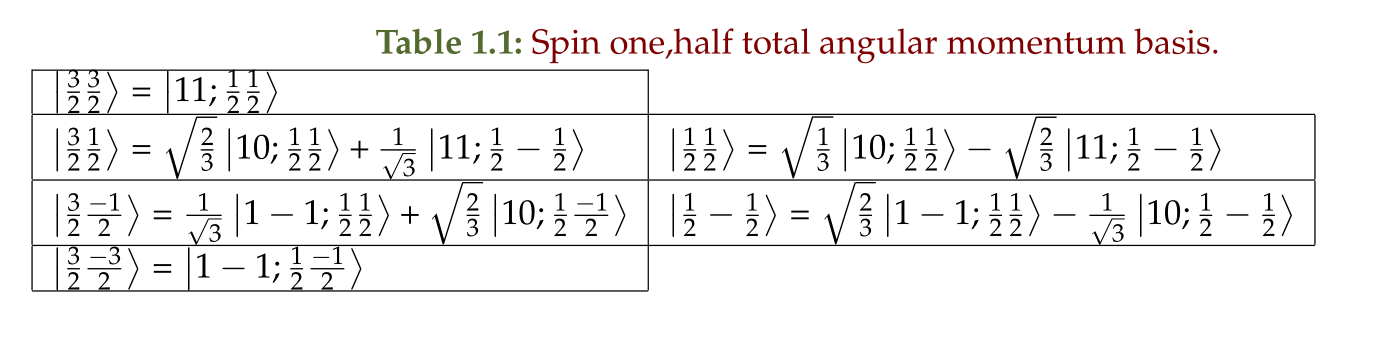
ClebschGordanOneOneHalf

Example. Spin two, spin one.

With \( j_1 = 2 \) and \( j_2 = 1 \), we have \( j \in 1,2,3 \), and can proceed the same way as sketched in fig. 2.
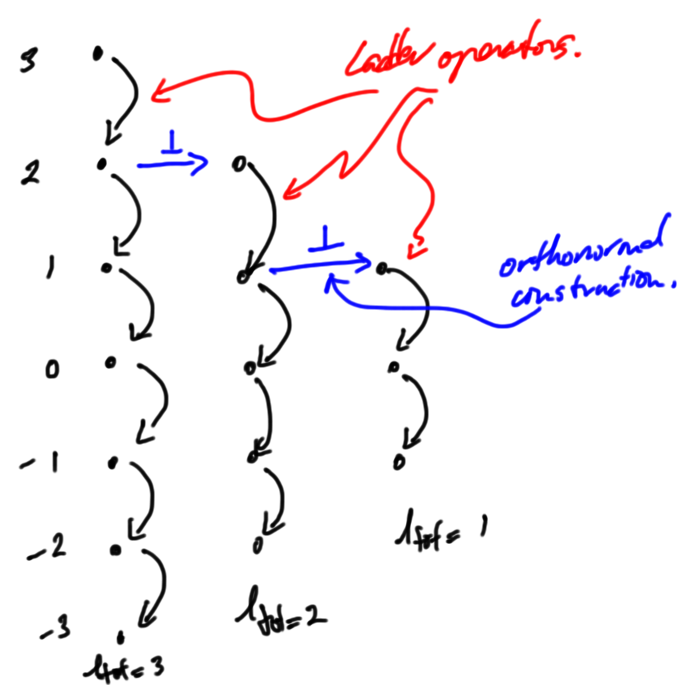
fig. 2. Spin two,one Clebsch-Gordan procedure

fig. 2. Spin two,one Clebsch-Gordan procedure

References

[1] Jun John Sakurai and Jim J Napolitano. Modern quantum mechanics. Pearson Higher Ed, 2014.
Dirac delta function potential

November 19, 2015 phy1520 , ,

[Click here for a PDF of this post with nicer formatting]

Note: there’s an error below (and in the associated PDF).  10 points to anybody that finds it (I’ve fixed it in my working version of phy1520.pdf)

Q:Dirac delta function potential

Problem 2.24/2.25 [1] introduces a Dirac delta function potential

\begin{equation}\label{eqn:diracPotential:20}
H = \frac{p^2}{2m} – V_0 \delta(x),
\end{equation}

which vanishes after \( t = 0 \). Solve for the bound state for \( t < 0 \) and then the time evolution after that.

A:

The first part of this problem was assigned back in phy356, where we solved this for a rectangular potential that had the limiting form of a delta function potential. However, this problem can be solved directly by considering the \( \Abs{x} > 0 \) and \( x = 0 \) regions separately.

For \( \Abs{x} > 0 \) Schrodinger’s equation takes the form

\begin{equation}\label{eqn:diracPotential:40}
E \psi = -\frac{\Hbar^2}{2m} \frac{d^2 \psi}{dx^2}.
\end{equation}

With

\begin{equation}\label{eqn:diracPotential:60}
\kappa =
\frac{\sqrt{-2 m E}}{\Hbar},
\end{equation}

this has solutions

\begin{equation}\label{eqn:diracPotential:80}
\psi = e^{\pm \kappa x}.
\end{equation}

For \( x > 0 \) we must have
\begin{equation}\label{eqn:diracPotential:100}
\psi = a e^{-\kappa x},
\end{equation}

and for \( x < 0 \)
\begin{equation}\label{eqn:diracPotential:120}
\psi = b e^{\kappa x}.
\end{equation}

requiring that \( \psi \) is continuous at \( x = 0 \) means \( a = b \), or

\begin{equation}\label{eqn:diracPotential:140}
\psi = \psi(0) e^{-\kappa \Abs{x}}.
\end{equation}

For the \( x = 0 \) region, consider an interval \( [-\epsilon, \epsilon] \) region around the origin. We must have

\begin{equation}\label{eqn:diracPotential:160}
E \int_{-\epsilon}^\epsilon \psi(x) dx = \frac{-\Hbar^2}{2m} \int_{-\epsilon}^\epsilon \frac{d^2 \psi}{dx^2} dx – V_0 \int_{-\epsilon}^\epsilon \delta(x) \psi(x) dx.
\end{equation}

The RHS is zero

\begin{equation}\label{eqn:diracPotential:180}
E \int_{-\epsilon}^\epsilon \psi(x) dx
=
E \frac{ e^{-\kappa (\epsilon)} – 1}{-\kappa}
-E \frac{ 1 – e^{\kappa (-\epsilon)}}{\kappa}
\rightarrow
0.
\end{equation}

That leaves
\begin{equation}\label{eqn:diracPotential:200}
\begin{aligned}
V_0 \int_{-\epsilon}^\epsilon \delta(x) \psi(x) dx
&=
\frac{-\Hbar^2}{2m} \int_{-\epsilon}^\epsilon \frac{d^2 \psi}{dx^2} dx \\
&=
\frac{-\Hbar^2}{2m} \evalrange{\frac{d \psi}{dx}}{-\epsilon}{\epsilon} \\
&=
\frac{-\Hbar^2}{2m}
\psi(0)
\lr
{
-\kappa e^{-\kappa (\epsilon)}

\kappa e^{\kappa (-\epsilon)}
}.
\end{aligned}
\end{equation}

In the \( \epsilon \rightarrow 0 \) limit this gives

\begin{equation}\label{eqn:diracPotential:220}
V_0 = \frac{\Hbar^2 \kappa}{m}.
\end{equation}

Equating relations for \( \kappa \) we have

\begin{equation}\label{eqn:diracPotential:240}
\kappa = \frac{m V_0}{\Hbar^2} = \frac{\sqrt{-2 m E}}{\Hbar},
\end{equation}

or

\begin{equation}\label{eqn:diracPotential:260}
E = -\inv{2 m} \lr{ \frac{m V_0}{\Hbar} }^2,
\end{equation}

with

\begin{equation}\label{eqn:diracPotential:280}
\psi(x, t < 0) = C \exp\lr{ -i E t/\hbar – \kappa \Abs{x}}.
\end{equation}

The normalization requires

\begin{equation}\label{eqn:diracPotential:300}
1
= 2 \Abs{C}^2 \int_0^\infty e^{- 2 \kappa x} dx
= 2 \Abs{C}^2 \evalrange{\frac{e^{- 2 \kappa x}}{-2 \kappa}}{0}{\infty}
= \frac{\Abs{C}^2}{\kappa},
\end{equation}

so
\begin{equation}\label{eqn:diracPotential:320}
\boxed{
\psi(x, t < 0) = \inv{\sqrt{\kappa}} \exp\lr{ -i E t/\hbar – \kappa \Abs{x}}. } \end{equation} There is only one bound state for such a potential. After turning off the potential, any plane wave \begin{equation}\label{eqn:diracPotential:360} \psi(x, t) = e^{i k x – i E(k) t/\Hbar}, \end{equation} where \begin{equation}\label{eqn:diracPotential:380} k = \frac{\sqrt{2 m E}}{\Hbar}, \end{equation} is a solution. In particular, at \( t = 0 \), the wave packet \begin{equation}\label{eqn:diracPotential:400} \psi(x,0) = \inv{\sqrt{2\pi}} \int_{-\infty}^\infty e^{i k x} A(k) dk, \end{equation} is a solution. To solve for \( A(k) \), we require \begin{equation}\label{eqn:diracPotential:420} \inv{\sqrt{2\pi}} \int_{-\infty}^\infty e^{i k x} A(k) dk = \inv{\sqrt{\kappa}} e^{ – \kappa \Abs{x} }, \end{equation} or \begin{equation}\label{eqn:diracPotential:440} \boxed{ A(k) = \inv{\sqrt{2\pi \kappa}} \int_{-\infty}^\infty e^{-i k x} e^{ – m V_0 \Abs{x}/\Hbar^2 } dx. } \end{equation} The initial time state established by the delta function potential evolves as \begin{equation}\label{eqn:diracPotential:480} \boxed{ \psi(x, t > 0) = \inv{\sqrt{2\pi}} \int_{-\infty}^\infty e^{i k x – i \Hbar k^2 t/2m} A(k) dk.
}
\end{equation}

References

[1] Jun John Sakurai and Jim J Napolitano. Modern quantum mechanics. Pearson Higher Ed, 2014.
PHY1520H Graduate Quantum Mechanics. Lecture 16: Addition of angular momenta. Taught by Prof. Arun Paramekanti

November 17, 2015 phy1520 , , ,

[Click here for a PDF of this post with nicer formatting]

Disclaimer

Peeter’s lecture notes from class. These may be incoherent and rough.

These are notes for the UofT course PHY1520, Graduate Quantum Mechanics, taught by Prof. Paramekanti, covering [1] chap. 3 content.

Addition of angular momenta

  • For orbital angular momentum

    \begin{equation}\label{eqn:qmLecture16:20}
    \begin{aligned}
    \hat{\BL}_1 &= \hat{\Br}_1 \cross \hat{\Bp}_1 \\
    \hat{\BL}_1 &= \hat{\Br}_1 \cross \hat{\Bp}_1,
    \end{aligned}
    \end{equation}

    We can show that it is true that

    \begin{equation}\label{eqn:qmLecture16:40}
    \antisymmetric{L_{1i} + L_{2i}}{L_{1j} + L_{2j}} =
    i \Hbar \epsilon_{i j k} \lr{ L_{1k} + L_{2k} },
    \end{equation}

    because the angular momentum of the independent particles commute. Given this is it fair to consider that the sum

    \begin{equation}\label{eqn:qmLecture16:60}
    \hat{\BL}_1 + \hat{\BL}_2
    \end{equation}

    is also angular momentum.

  • Given \( \ket{l_1, m_1} \) and \( \ket{l_2, m_2} \), if a measurement is made of \( \hat{\BL}_1 + \hat{\BL}_2 \), what do we get?

    Specifically, what do we get for

    \begin{equation}\label{eqn:qmLecture16:80}
    \lr{\hat{\BL}_1 + \hat{\BL}_2}^2,
    \end{equation}

    and for
    \begin{equation}\label{eqn:qmLecture16:100}
    \lr{\hat{L}_{1z} + \hat{L}_{2z}}.
    \end{equation}

    For the latter, we get

    \begin{equation}\label{eqn:qmLecture16:120}
    \lr{\hat{L}_{1z} + \hat{L}_{2z}}\ket{ l_1, m_1 ; l_2, m_2 }
    =
    \lr{ \Hbar m_1 + \Hbar m_2 } \ket{ l_1, m_1 ; l_2, m_2 }
    \end{equation}

    Given
    \begin{equation}\label{eqn:qmLecture16:140}
    \hat{L}_{1z} + \hat{L}_{2z} = \hat{L}_z^{\textrm{tot}},
    \end{equation}

    we find
    \begin{equation}\label{eqn:qmLecture16:160}
    \begin{aligned}
    \antisymmetric{\hat{L}_z^{\textrm{tot}}}{\hat{\BL}_1^2} &= 0 \\
    \antisymmetric{\hat{L}_z^{\textrm{tot}}}{\hat{\BL}_2^2} &= 0 \\
    \antisymmetric{\hat{L}_z^{\textrm{tot}}}{\hat{\BL}_{1z}} &= 0 \\
    \antisymmetric{\hat{L}_z^{\textrm{tot}}}{\hat{\BL}_{1z}} &= 0.
    \end{aligned}
    \end{equation}

    We also find

    \begin{equation}\label{eqn:qmLecture16:180}
    \begin{aligned}
    \antisymmetric{(\hat{\BL}_1 + \hat{\BL}_2)^2}{\BL_1^2}
    &=
    \antisymmetric{\hat{\BL}_1^2 + \hat{\BL}_2^2 + 2 \hat{\BL}_1 \cdot
    \hat{\BL}_2}{\BL_1^2} \\
    &=
    0,
    \end{aligned}
    \end{equation}

    but for
    \begin{equation}\label{eqn:qmLecture16:200}
    \begin{aligned}
    \antisymmetric{(\hat{\BL}_1 + \hat{\BL}_2)^2}{\hat{L}_{1z}}
    &=
    \antisymmetric{\hat{\BL}_1^2 + \hat{\BL}_2^2 + 2 \hat{\BL}_1 \cdot
    \hat{\BL}_2}{\hat{L}_{1z}} \\
    &=
    2 \antisymmetric{\hat{\BL}_1 \cdot \hat{\BL}_2}{\hat{L}_{1z}} \\
    &\ne 0.
    \end{aligned}
    \end{equation}

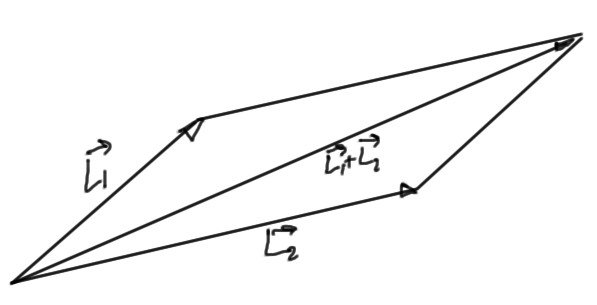
Classically if we have measured \( \hat{\BL}_{1} \) and \( \hat{\BL}_{2} \) then we know the total angular momentum as sketched in fig. 1.

fig. 1.  Classical addition of angular momenta.

fig. 1. Classical addition of angular momenta.

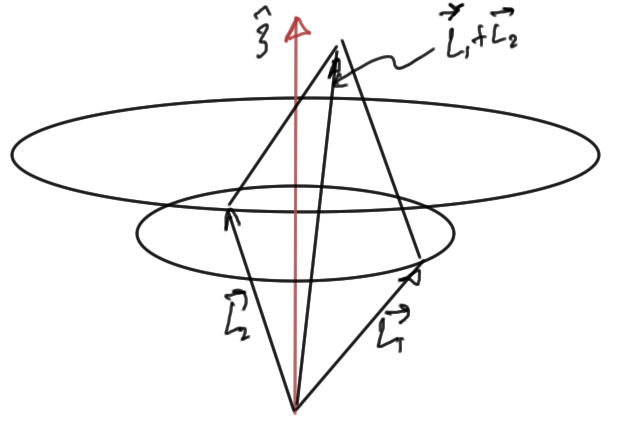
In QM where we don’t know all the components of the angular momenum simultaneously, things get fuzzier. For example, if the \( \hat{L}_{1z} \) and \( \hat{L}_{2z} \) components have been measured, we have the angular momentum defined within a conical region as sketched in fig. 2.

fig. 2.  Addition of angular momenta given measured L_z

fig. 2. Addition of angular momenta given measured L_z

Suppose we know \( \hat{L}_z^{\textrm{tot}} \) precisely, but have impricise information about \( \lr{\hat{\BL}^{\textrm{tot}}}^2 \). Can we determine bounds for this? Let \( \ket{\psi} = \ket{ l_1, m_2 ; l_2, m_2 } \), so

\begin{equation}\label{eqn:qmLecture16:220}
\begin{aligned}
\bra{\psi} \lr{ \hat{\BL}_1 + \hat{\BL}_2 }^2 \ket{\psi}
&=
\bra{\psi} \hat{\BL}_1^2 \ket{\psi}
+ \bra{\psi} \hat{\BL}_2^2 \ket{\psi}
+ 2 \bra{\psi} \hat{\BL}_1 \cdot \hat{\BL}_2 \ket{\psi} \\
&=
l_1 \lr{ l_1 + 1} \Hbar^2
+ l_2 \lr{ l_2 + 1} \Hbar^2
+ 2
\bra{\psi} \hat{\BL}_1 \cdot \hat{\BL}_2 \ket{\psi}.
\end{aligned}
\end{equation}

Using the Cauchy-Schwartz inequality

\begin{equation}\label{eqn:qmLecture16:240}
\Abs{\braket{\phi}{\psi}}^2 \le
\Abs{\braket{\phi}{\phi}}
\Abs{\braket{\psi}{\psi}},
\end{equation}

which is the equivalent of the classical relationship
\begin{equation}\label{eqn:qmLecture16:260}
\lr{ \BA \cdot \BB }^2 \le \BA^2 \BB^2.
\end{equation}

Applying this to the last term, we have

\begin{equation}\label{eqn:qmLecture16:280}
\begin{aligned}
\lr{ \bra{\psi} \hat{\BL}_1 \cdot \hat{\BL}_2 \ket{\psi} }^2
&\le
\bra{ \psi} \hat{\BL}_1 \cdot \hat{\BL}_1 \ket{\psi}
\bra{ \psi} \hat{\BL}_2 \cdot \hat{\BL}_2 \ket{\psi} \\
&=
\Hbar^4
l_1 \lr{ l_1 + 1 }
l_2 \lr{ l_2 + 2 }.
\end{aligned}
\end{equation}

Thus for the max we have

\begin{equation}\label{eqn:qmLecture16:300}
\bra{\psi} \lr{ \hat{\BL}_1 + \hat{\BL}_2 }^2 \ket{\psi}
\le
\Hbar^2 l_1 \lr{ l_1 + 1 }
+\Hbar^2 l_2 \lr{ l_2 + 1 }
+ 2 \Hbar^2 \sqrt{ l_1 \lr{ l_1 + 1 } l_2 \lr{ l_2 + 2 } }
\end{equation}

and for the min
\begin{equation}\label{eqn:qmLecture16:360}
\bra{\psi} \lr{ \hat{\BL}_1 + \hat{\BL}_2 }^2 \ket{\psi}
\ge
\Hbar^2 l_1 \lr{ l_1 + 1 }
+\Hbar^2 l_2 \lr{ l_2 + 1 }
– 2 \Hbar^2 \sqrt{ l_1 \lr{ l_1 + 1 } l_2 \lr{ l_2 + 2 } }.
\end{equation}

To try to pretty up these estimate, starting with the max, note that if we replace a portion of the RHS with something bigger, we are left with a strict less than relationship.

That is

\begin{equation}\label{eqn:qmLecture16:320}
\begin{aligned}
l_1 \lr{ l_1 + 1 } &< \lr{ l_1 + \inv{2} }^2 \\ l_2 \lr{ l_2 + 1 } &< \lr{ l_2 + \inv{2} }^2 \end{aligned} \end{equation} That is \begin{equation}\label{eqn:qmLecture16:340} \begin{aligned} \bra{\psi} \lr{ \hat{\BL}_1 + \hat{\BL}_2 }^2 \ket{\psi} &< \Hbar^2 \lr{ l_1 \lr{ l_1 + 1 } + l_2 \lr{ l_2 + 1 } + 2 \lr{ l_1 + \inv{2} } \lr{ l_2 + \inv{2} } } \\ &= \Hbar^2 \lr{ l_1^2 + l_2^2 + l_1 + l_2 + 2 l_1 l_2 + l_1 + l_2 + \inv{2} } \\ &= \Hbar^2 \lr{ \lr{ l_1 + l_2 + \inv{2} } \lr{ l_1 + l_2 + \frac{3}{2} } - \inv{4} } \end{aligned} \end{equation} or \begin{equation}\label{eqn:qmLecture16:380} l_{\textrm{tot}} \lr{ l_{\textrm{tot}} + 1 } < \lr{ l_1 + l_2 + \inv{2} } \lr{ l_1 + l_2 + \frac{3}{2} } , \end{equation} which, gives \begin{equation}\label{eqn:qmLecture16:400} l_{\textrm{tot}} < l_1 + l_2 + \inv{2}. \end{equation} Finally, given a quantization requirement, that is \begin{equation}\label{eqn:t:1} \boxed{ l_{\textrm{tot}} \le l_1 + l_2. } \end{equation} Similarly, for the min, we find \begin{equation}\label{eqn:qmLecture16:440} \begin{aligned} \bra{\psi} \lr{ \hat{\BL}_1 + \hat{\BL}_2 }^2 \ket{\psi} &>
\Hbar^2
\lr{
l_1 \lr{ l_1 + 1 }
+ l_2 \lr{ l_2 + 1 }
– 2 \lr{ l_1 + \inv{2} } \lr{ l_2 + \inv{2} }
} \\
&=
\Hbar^2
\lr{
l_1^2 + l_2^2 %+ \cancel{l_1 + l_2}
– 2 l_1 l_2
– \inv{2}
}
\end{aligned}
\end{equation}

This will be finished Thursday, but we should get

\begin{equation}\label{eqn:t:2}
\boxed{
\Abs{l_1 – l_2} \le l_{\textrm{tot}} \le l_1 + l_2.
}
\end{equation}

References

[1] Jun John Sakurai and Jim J Napolitano. Modern quantum mechanics. Pearson Higher Ed, 2014.
Two spin time evolution

November 14, 2015 phy1520 , , , ,

[Click here for a PDF of this post with nicer formatting]

Motivation

Our midterm posed a (low mark “quick question”) that I didn’t complete (or at least not properly). This shouldn’t have been a difficult question, but I spend way too much time on it, costing me time that I needed for other questions.

It turns out that there isn’t anything fancy required for this question, just perseverance and careful work.

Guts

The question asked for the time evolution of a two particle state

\begin{equation}\label{eqn:twoSpinHamiltonian:20}
\psi = \inv{\sqrt{2}} \lr{ \ket{\uparrow \downarrow} – \ket{\downarrow \uparrow} }
\end{equation}

under the action of the Hamiltonian

\begin{equation}\label{eqn:twoSpinHamiltonian:40}
H = – B S_{z,1} + 2 B S_{x,2} = \frac{\Hbar B}{2}\lr{ -\sigma_{z,1} + 2 \sigma_{x,2} } .
\end{equation}

We have to know the action of the Hamiltonian on all the states

\begin{equation}\label{eqn:twoSpinHamiltonian:60}
\begin{aligned}
H \ket{\uparrow \uparrow} &= \frac{B \Hbar}{2} \lr{ -\ket{\uparrow \uparrow} + 2 \ket{\uparrow \downarrow} } \\
H \ket{\uparrow \downarrow} &= \frac{B \Hbar}{2} \lr{ -\ket{\uparrow \downarrow} + 2 \ket{\uparrow \uparrow} } \\
H \ket{\downarrow \uparrow} &= \frac{B \Hbar}{2} \lr{ \ket{\downarrow \uparrow} + 2 \ket{\downarrow \downarrow} } \\
H \ket{\downarrow \downarrow} &= \frac{B \Hbar}{2} \lr{ \ket{\downarrow \downarrow} + 2 \ket{\downarrow \uparrow} } \\
\end{aligned}
\end{equation}

With respect to the basis \( \setlr{ \ket{\uparrow \uparrow}, \ket{\uparrow \downarrow}, \ket{\downarrow \uparrow}, \ket{\downarrow \downarrow} } \), the matrix of the Hamiltonian is

\begin{equation}\label{eqn:twoSpinHamiltonian:80}
H =
\frac{ \Hbar B }{2}
\begin{bmatrix}
-1 & 2 & 0 & 0 \\
2 & -1 & 0 & 0 \\
0 & 0 & 1 & 2 \\
0 & 0 & 2 & 1 \\
\end{bmatrix}
\end{equation}

Utilizing the block diagonal form (and ignoring the \( \Hbar B/2 \) factor for now), the characteristic equation is

\begin{equation}\label{eqn:twoSpinHamiltonian:100}
0
=
\begin{vmatrix}
-1 -\lambda & 2 \\
2 & -1 – \lambda
\end{vmatrix}
\begin{vmatrix}
1 -\lambda & 2 \\
2 & 1 – \lambda
\end{vmatrix}
=
\lr{(1 + \lambda)^2 – 4}
\lr{(1 – \lambda)^2 – 4}.
\end{equation}

This has solutions

\begin{equation}\label{eqn:twoSpinHamiltonian:120}
1 \pm \lambda = \pm 2,
\end{equation}

or, with the \( \Hbar B/2 \) factors put back in

\begin{equation}\label{eqn:twoSpinHamiltonian:140}
\lambda = \pm \Hbar B/2 , \pm 3 \Hbar B/2.
\end{equation}

I was thinking that we needed to compute the time evolution operator

\begin{equation}\label{eqn:twoSpinHamiltonian:160}
U = e^{-i H t/\Hbar},
\end{equation}

but we actually only need the eigenvectors, and the inverse relations. We can find the eigenvectors by inspection in each case from

\begin{equation}\label{eqn:twoSpinHamiltonian:180}
\begin{aligned}
H – (1) \frac{ \Hbar B }{2}
&=
\frac{ \Hbar B }{2}
\begin{bmatrix}
-2 & 2 & 0 & 0 \\
2 & -2 & 0 & 0 \\
0 & 0 & 0 & 2 \\
0 & 0 & 2 & 0 \\
\end{bmatrix} \\
H – (-1) \frac{ \Hbar B }{2}
&=
\frac{ \Hbar B }{2}
\begin{bmatrix}
0 & 2 & 0 & 0 \\
2 & 0 & 0 & 0 \\
0 & 0 & 2 & 2 \\
0 & 0 & 2 & 2 \\
\end{bmatrix} \\
H – (3) \frac{ \Hbar B }{2}
&=
\frac{ \Hbar B }{2}
\begin{bmatrix}
-4 & 2 & 0 & 0 \\
2 & -4 & 0 & 0 \\
0 & 0 &-2 & 2 \\
0 & 0 & 2 &-2 \\
\end{bmatrix} \\
H – (-3) \frac{ \Hbar B }{2}
&=
\frac{ \Hbar B }{2}
\begin{bmatrix}
2 & 2 & 0 & 0 \\
2 & 2 & 0 & 0 \\
0 & 0 & 4 & 2 \\
0 & 0 & 2 & 1 \\
\end{bmatrix}.
\end{aligned}
\end{equation}

The eigenkets are

\begin{equation}\label{eqn:twoSpinHamiltonian:280}
\begin{aligned}
\ket{1} &=
\inv{\sqrt{2}}
\begin{bmatrix}
1 \\
1 \\
0 \\
0 \\
\end{bmatrix} \\
\ket{-1} &=
\inv{\sqrt{2}}
\begin{bmatrix}
0 \\
0 \\
1 \\
-1 \\
\end{bmatrix} \\
\ket{3} &=
\inv{\sqrt{2}}
\begin{bmatrix}
0 \\
0 \\
1 \\
1 \\
\end{bmatrix} \\
\ket{-3} &=
\inv{\sqrt{2}}
\begin{bmatrix}
1 \\
-1 \\
0 \\
0 \\
\end{bmatrix},
\end{aligned}
\end{equation}

or

\begin{equation}\label{eqn:twoSpinHamiltonian:300}
\begin{aligned}
\sqrt{2} \ket{1} &= \ket{\uparrow \uparrow} + \ket{\uparrow \downarrow} \\
\sqrt{2} \ket{-1} &= \ket{\downarrow \uparrow} – \ket{\downarrow \downarrow} \\
\sqrt{2} \ket{3} &= \ket{\downarrow \uparrow} + \ket{\downarrow \downarrow} \\
\sqrt{2} \ket{-3} &= \ket{\uparrow \uparrow} – \ket{\uparrow \downarrow}.
\end{aligned}
\end{equation}

We can invert these

\begin{equation}\label{eqn:twoSpinHamiltonian:220}
\begin{aligned}
\ket{\uparrow \uparrow} &= \inv{\sqrt{2}} \lr{ \ket{1} + \ket{-3} } \\
\ket{\uparrow \downarrow} &= \inv{\sqrt{2}} \lr{ \ket{1} – \ket{-3} } \\
\ket{\downarrow \uparrow} &= \inv{\sqrt{2}} \lr{ \ket{3} + \ket{-1} } \\
\ket{\downarrow \downarrow} &= \inv{\sqrt{2}} \lr{ \ket{3} – \ket{-1} } \\
\end{aligned}
\end{equation}

The original state of interest can now be expressed in terms of the eigenkets

\begin{equation}\label{eqn:twoSpinHamiltonian:240}
\psi
=
\inv{2} \lr{
\ket{1} – \ket{-3} –
\ket{3} – \ket{-1}
}
\end{equation}

The time evolution of this ket is

\begin{equation}\label{eqn:twoSpinHamiltonian:260}
\begin{aligned}
\psi(t)
&=
\inv{2}
\lr{
e^{-i B t/2} \ket{1}
– e^{3 i B t/2} \ket{-3}
– e^{-3 i B t/2} \ket{3}
– e^{i B t/2} \ket{-1}
} \\
&=
\inv{2 \sqrt{2}}
\Biglr{
e^{-i B t/2} \lr{ \ket{\uparrow \uparrow} + \ket{\uparrow \downarrow} }
– e^{3 i B t/2} \lr{ \ket{\uparrow \uparrow} – \ket{\uparrow \downarrow} }
– e^{-3 i B t/2} \lr{ \ket{\downarrow \uparrow} + \ket{\downarrow \downarrow} }
– e^{i B t/2} \lr{ \ket{\downarrow \uparrow} – \ket{\downarrow \downarrow} }
} \\
&=
\inv{2 \sqrt{2}}
\Biglr{
\lr{ e^{-i B t/2} – e^{3 i B t/2} } \ket{\uparrow \uparrow}
+ \lr{ e^{-i B t/2} + e^{3 i B t/2} } \ket{\uparrow \downarrow}
– \lr{ e^{-3 i B t/2} + e^{i B t/2} } \ket{\downarrow \uparrow}
+ \lr{ e^{i B t/2} – e^{-3 i B t/2} } \ket{\downarrow \downarrow}
} \\
&=
\inv{2 \sqrt{2}}
\Biglr{
e^{i B t/2} \lr{ e^{-2 i B t/2} – e^{2 i B t/2} } \ket{\uparrow \uparrow}
+ e^{i B t/2} \lr{ e^{-2 i B t/2} + e^{2 i B t/2} } \ket{\uparrow \downarrow}
– e^{- i B t/2} \lr{ e^{-2 i B t/2} + e^{2 i B t/2} } \ket{\downarrow \uparrow}
+ e^{- i B t/2} \lr{ e^{2 i B t/2} – e^{-2 i B t/2} } \ket{\downarrow \downarrow}
} \\
&=
\inv{\sqrt{2}}
\lr{
i \sin( B t )
\lr{
e^{- i B t/2} \ket{\downarrow \downarrow} – e^{i B t/2} \ket{\uparrow \uparrow}
}
+ \cos( B t ) \lr{
e^{i B t/2} \ket{\uparrow \downarrow}
– e^{- i B t/2} \ket{\downarrow \uparrow}
}
}
\end{aligned}
\end{equation}

Note that this returns to the original state when \( t = \frac{2 \pi n}{B}, n \in \mathbb{Z} \). I think I’ve got it right this time (although I got a slightly different answer on paper before typing it up.)

This doesn’t exactly seem like a quick answer question, at least to me. Is there some easier way to do it?

PHY1520H Graduate Quantum Mechanics. Lecture 15: angular momentum rotation representation, and angular momentum addition. Taught by Prof. Arun Paramekanti

November 12, 2015 phy1520 , ,

[Click here for a PDF of this post with nicer formatting]

Disclaimer

Peeter’s lecture notes from class. These may be incoherent and rough.

These are notes for the UofT course PHY1520, Graduate Quantum Mechanics, taught by Prof. Paramekanti, covering chap 3. content from [1].

Angular momentum (wrap up.)

We found

\begin{equation}\label{eqn:qmLecture15:20}
\begin{aligned}
\hat{\BL^2} \ket{j, m} &= j(j+1) \Hbar^2 \ket{j,m} \\
\hat{L}_z \ket{j, m} &= \Hbar m \ket{j,m} \\
\hat{L}_{\pm} \ket{j, m } &= \Hbar \sqrt{(j \mp m)(j \pm m + 1)} \ket{j, m \pm 1 }
\end{aligned}
\end{equation}

or Schwinger

\begin{equation}\label{eqn:qmLecture15:40}
\begin{aligned}
\hat{L}_z &= \inv{2} \lr{ \hat{n}_1 – \hat{n}_2 } \Hbar \\
\hat{L}_{+} &= a_1^\dagger a_2 \Hbar \\
\hat{L}_{-} &= a_1 a_2^\dagger \Hbar \\
j &= \inv{2} \lr{ \hat{n}_1 + \hat{n}_2 },
\end{aligned}
\end{equation}

where each of the \( a_1, a_2 \) operators obey

\begin{equation}\label{eqn:qmLecture15:60}
\begin{aligned}
\antisymmetric{a_1}{a_1^\dagger} &= 1 \\
\antisymmetric{a_2}{a_2^\dagger} &= 1
\end{aligned}
\end{equation}

and any pair of different index \( a \) operators commute, as in

\begin{equation}\label{eqn:qmLecture15:80}
\antisymmetric{a_1}{a_2^\dagger} = 0.
\end{equation}

Representations

It’s possible to compute matrix representations of the rotation operators

\begin{equation}\label{eqn:qmLecture15:100}
\hat{R}_\ncap(\phi) = e^{i \hat{\BL} \cdot \ncap \phi/\Hbar}.
\end{equation}

With respect to a ket it’s possible to find

\begin{equation}\label{eqn:qmLecture15:120}
e^{i \hat{\BL} \cdot \ncap \phi/\Hbar} \ket{j, m}
=
\sum_{m’} d^j_{m m’}(\ncap, \phi) \ket{ j, m’ }.
\end{equation}

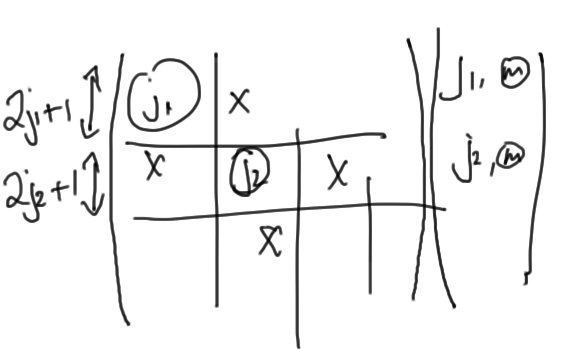
This has a block diagonal form that’s sketched in fig. 1.

fig. 1.  Block diagonal form for angular momentum matrix representation.

fig. 1. Block diagonal form for angular momentum matrix representation.

We can view \( d^j_{m m’}(\ncap, \phi) \) as a matrix, representing the rotation. The problem of determining these matrices can be reduced to that of determining the matrix for \( \hat{\BL} \), because once we have that we can exponentiate that.

Example: spin 1/2

From the eigenvalue relationships, with basis states

\begin{equation}\label{eqn:qmLecture15:160}
\begin{aligned}
\ket{\uparrow} &=
\begin{bmatrix}
1 \\
0
\end{bmatrix} \\
\ket{\downarrow} &=
\begin{bmatrix}
0 \\
1 \\
\end{bmatrix}
\end{aligned}
\end{equation}

we find

\begin{equation}\label{eqn:qmLecture15:180}
\begin{aligned}
\hat{L}_z &= \frac{\Hbar}{2} \begin{bmatrix} 1 & 0 \\ 0 & -1 \\ \end{bmatrix} \\
\hat{L}_{+} &= \frac{\Hbar}{2}
\begin{bmatrix}
0 & 1 \\
0 & 0
\end{bmatrix} \\
\hat{L}_{-} &= \frac{\Hbar}{2}
\begin{bmatrix}
0 & 0 \\
1 & 0
\end{bmatrix}.
\end{aligned}
\end{equation}

Rearranging we find the Pauli matrices

\begin{equation}\label{eqn:qmLecture15:200}
\hat{L}_k = \inv{2} \Hbar \sigma_i.
\end{equation}

Noting that \( \lr{ \Bsigma \cdot \ncap }^2 = 1 \), and \( \lr{\Bsigma \cdot \ncap }^3 = \Bsigma \cdot \ncap \), the rotation matrix is

\begin{equation}\label{eqn:qmLecture15:220}
e^{ i \Bsigma \cdot \ncap \phi/2 } \ket{\inv{2}, m} = \lr{ \cos( \phi/2 ) + i \Bsigma \cdot \ncap \sin(\phi/2) } \ket{\inv{2}, m}.
\end{equation}

The steps are

  1. Enumerate the states.
    \begin{equation}\label{eqn:qmLecture15:140}
    j_1 = \inv{2} \leftrightarrow\, \mbox{2 states (dimension of irrep = 2)}
    \end{equation}

  2. Construct the \( \hat{\BL} \) matrices.
  3. Construct \( d_{m m’}^j(\ncap, \phi) \).

Angular momentum operator in space representation

For \( L = 1 \) it turns out that the rotation matrices turn out to be the 3D rotation matrices. In the space representation

\begin{equation}\label{eqn:qmLecture15:240}
\BL = \Br \cross \Bp,
\end{equation}

the coordinates of the operator are

\begin{equation}\label{eqn:qmLecture15:260}
\hat{L}_k = i \epsilon_{k m n} r_m \lr{ -i \Hbar \PD{r_n}{} }
\end{equation}

We see that scaling \( \Br \rightarrow \alpha \Br \) does not change this operator, allowing for an angular representation \( \hat{L}_k(\theta, \phi) \) that have the form

\begin{equation}\label{eqn:qmLecture15:280}
\begin{aligned}
\hat{L}_z &= -i \Hbar \PD{\phi}{} \\
\hat{L}_{\pm} &= \Hbar \lr{ \pm \PD{\theta}{} + i \cot \theta \PD{\phi}{} }.
\end{aligned}
\end{equation}

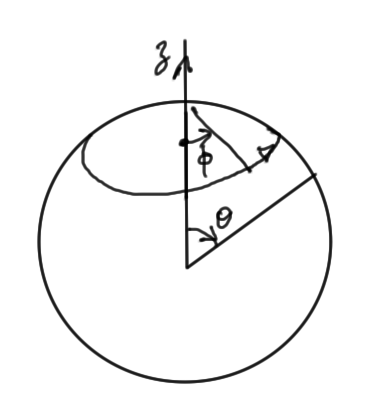
Here \( \theta \) and \( \phi \) are the polar and azimuthal angles respectively as illustrated in fig. 2.

fig. 2.  Spherical coordinate convention.

fig. 2. Spherical coordinate convention.

The equivalent wave function representation of the problem is

\begin{equation}\label{eqn:qmLecture15:300}
\begin{aligned}
\hat{\BL} Y_{lm}(\theta, \phi) &= \Hbar^2 l (l + 1) Y_{lm}(\theta, \phi) \\
\hat{L}_z Y_{lm}(\theta, \phi) &= \Hbar m Y_{lm}(\theta, \phi) \\
\end{aligned}
\end{equation}

One can find these functions

\begin{equation}\label{eqn:qmLecture15:320}
Y_{lm}(\theta, \phi) = P_{l, m}(\cos \theta) e^{i m \phi},
\end{equation}

where \( P_{l, m}(\cos \theta) \) are called the associated Legendre polynomials. This can be applied whenever we have

\begin{equation}\label{eqn:qmLecture15:340}
\antisymmetric{H}{\hat{L}_k} = 0.
\end{equation}

where all the eigenfunctions will have the form

\begin{equation}\label{eqn:qmLecture15:360}
\Psi(r, \theta, \phi) = R(r) Y_{lm}(\theta, \phi).
\end{equation}

Addition of angular momentum

Since \( \hat{\BL} \) is a vector we expect to be able to add angular momentum in some way similar to the addition of classical vectors as illustrated in fig. 3.

fig. 3.  Classical vector addition.

fig. 3. Classical vector addition.

When we have a potential that depends only on the difference in position \( V(\Br_1 – \Br_2) \) then we know from classical problems it is effective to work in center of mass coordinates

\begin{equation}\label{eqn:qmLecture15:380}
\begin{aligned}
\hat{\BR}_{\textrm{cm}} &= \frac{\hat{\Br}_1 + \hat{\Br}_2}{2} \\
\hat{\BP}_{\textrm{cm}} &= \hat{\Bp}_1 + \hat{\Bp}_2
\end{aligned}
\end{equation}

where

\begin{equation}\label{eqn:qmLecture15:400}
\antisymmetric{\hat{R}_i}{\hat{P}_j} = i \Hbar \delta_{ij}.
\end{equation}

Given

\begin{equation}\label{eqn:qmLecture15:420}
\hat{\BL}_1 + \hat{\BL}_2 = \hat{\BL}_{\textrm{tot}},
\end{equation}

do we have
\begin{equation}\label{eqn:qmLecture15:440}
\antisymmetric{
\hat{L}_{\textrm{tot}, i}
}{
\hat{L}_{\textrm{tot}, j}
}
= i \Hbar \epsilon_{i j k} \hat{L}_{\textrm{tot}, k} ?
\end{equation}

That is

\begin{equation}\label{eqn:qmLecture15:460}
\antisymmetric{\hat{L}_{1,i} + \hat{L}_{1,j}}{\hat{L}_{2,i} + \hat{L}_{2,j}} = i \Hbar \epsilon_{i j k} \lr{ \hat{L}_{1,k} + \hat{L}_{1,k} }
\end{equation}

FIXME: Right at the end of the lecture, there was a mention of something about whether or not \( \hat{\BL}_1^2 \) and \( \hat{L}_{1,z} \) were sharply defined, but I missed it. Ask about this if not covered in the next lecture.

References

[1] Jun John Sakurai and Jim J Napolitano. Modern quantum mechanics. Pearson Higher Ed, 2014.