Here are my [lecture notes from last Wednesday’s class], which are posted out of sequence and only in PDF format this time.
November 13, 2018 phy2403 connected and amputated diagrams, decay rate, differential cross section, pair production, S-matrix, scattering, symmetry coefficient, transition amplitude, vacuum fluctuation
Here are my [lecture notes from last Wednesday’s class], which are posted out of sequence and only in PDF format this time.
November 12, 2018 phy2403 cross sections, decay, scalar theory, scattering
[Click here for a PDF of this post with nicer formatting]
These are notes for the UofT course PHY2403H, Quantum Field Theory, taught by Prof. Erich Poppitz, fall 2018.
We defined an \( S-\)matrix
\begin{equation}\label{eqn:qftLecture17:20}
\bra{f} S \ket{i} = S_{fi} = \lr{ 2 \pi }^4 \delta^{(4)} \lr{ \sum \lr{p_i – \sum_{p_f} } } i M_{fi},
\end{equation}
where
\begin{equation}\label{eqn:qftLecture17:40}
i M_{fi} = \sum \text{ all connected amputated Feynman diagrams }.
\end{equation}
The matrix element \( \bra{f} S \ket{i} \) is the amplitude of the transition from the initial to the final state. In general this can get very complicated, as the number of terms grows factorially with the order.
We also talked about decays.
Suppose that we have a scalar theory with a light field \( \Phi, M \) and a heavy field \( \varphi, m \), where \( m > 2 M \). Perhaps we have an interaction with a \( z^2 \) symmetry so that the interaction potential is quadratic in \( \Phi \)
\begin{equation}\label{eqn:qftLecture17:60}
V_{\text{int}} = \mu \varphi \Phi \Phi.
\end{equation}
We may have \( \Phi \Phi \rightarrow \Phi \Phi \) scattering.
We will denote diagrams using a double line for \( \phi \) and a single line for \( \Phi \), as sketched in
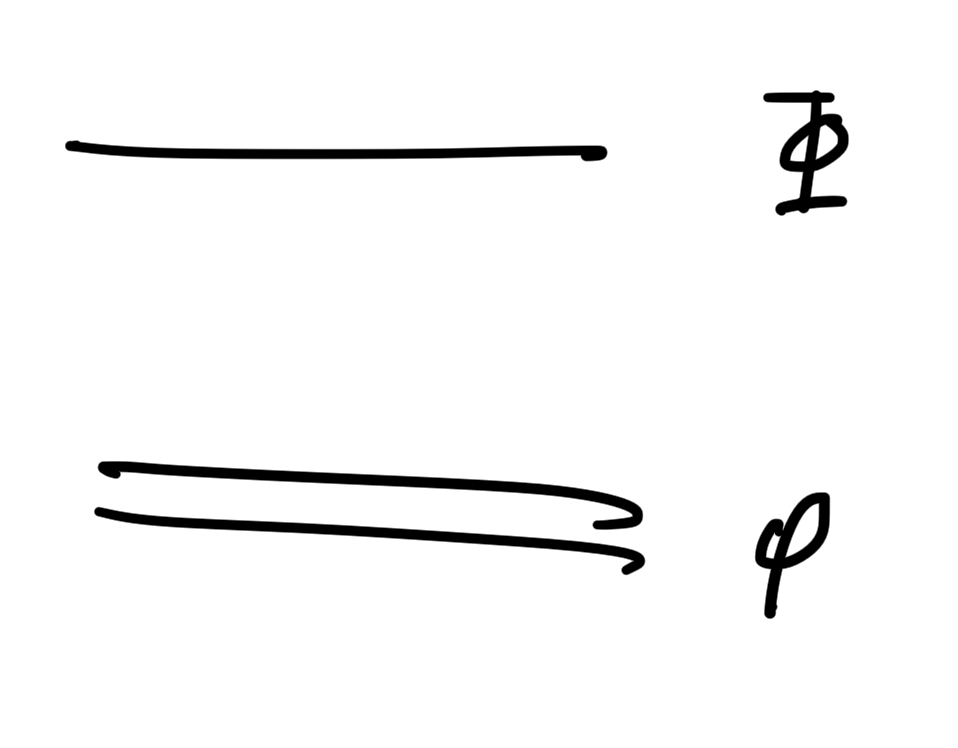
fig. 1. Particle line convention.
There are three possible diagrams:
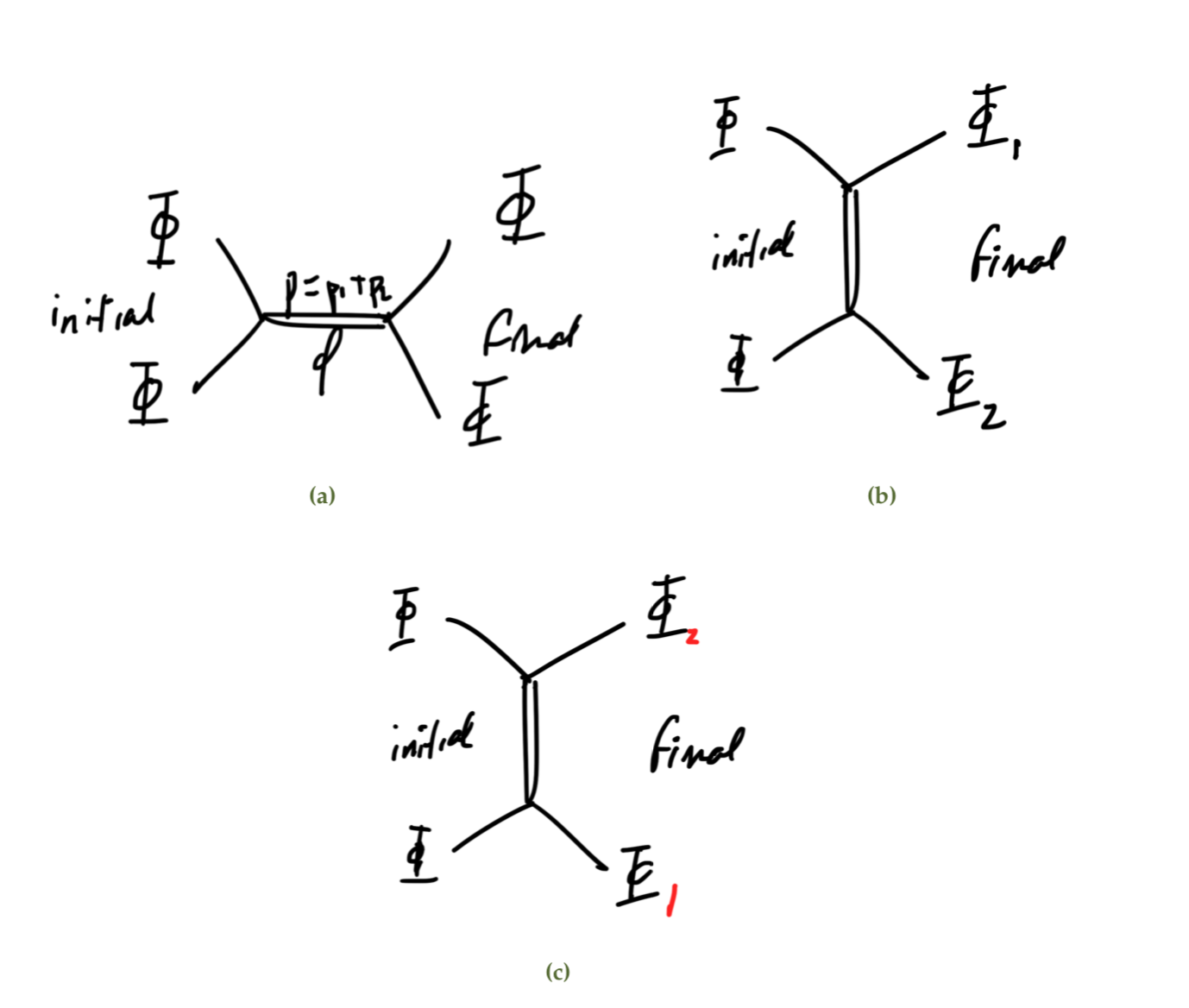
fig 2. Possible diagrams.
The first we will call the s-channel, which has amplitude
\begin{equation}\label{eqn:qftLecture17:80}
A(\text{s-channel}) \sim \frac{i}{p^2 – m^2 + i \epsilon} =
\frac{i}{s – m^2 + i \epsilon}
\end{equation}
\begin{equation}\label{eqn:qftLecture17:100}
(p_1 + p_2)^2 = s
\end{equation}
In the centre of mass frame
\begin{equation}\label{eqn:qftLecture17:120}
\Bp_1 = – \Bp_2,
\end{equation}
so
\begin{equation}\label{eqn:qftLecture17:140}
s = \lr{ p_1^0 + p_2^0 }^2 = E_{\text{cm}}^2.
\end{equation}
To the next order we have a diagram like fig. 3.
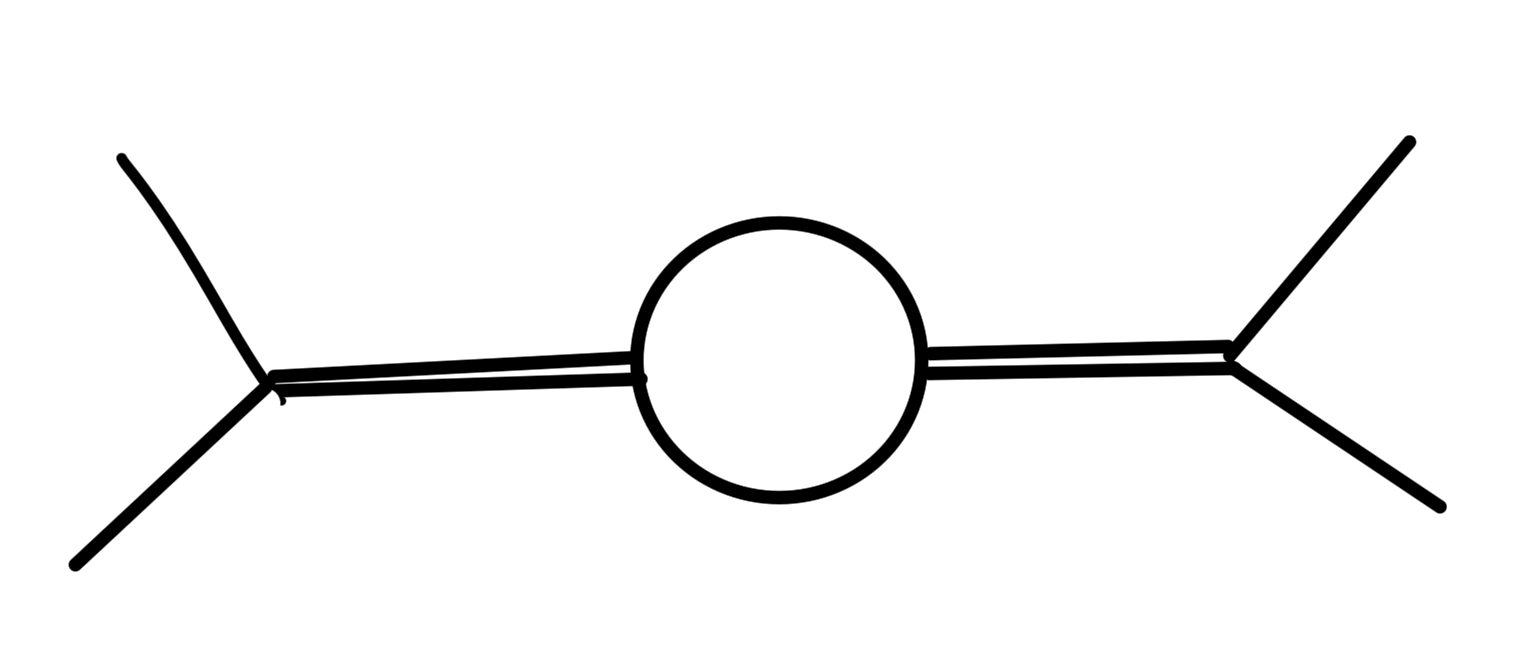
fig. 3. Higher order.
and can have additional virtual particles created, with diagrams like fig. 4.
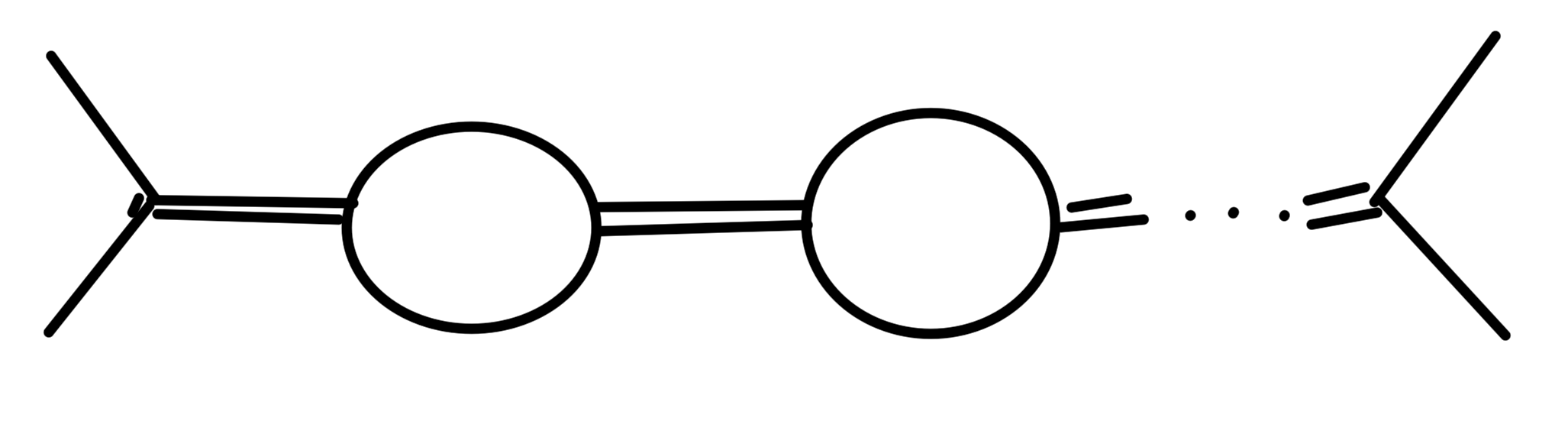
fig. 4. More virtual particles.
We will see (QFT II) that this leads to an addition imaginary \( i \Gamma \) term in the propagator
\begin{equation}\label{eqn:qftLecture17:160}
\frac{i}{s – m^2 + i \epsilon}
\rightarrow
\frac{i}{s – m^2 – i m \Gamma + i \epsilon}.
\end{equation}
If we choose to zoom into the such a figure, as sketched in fig. 5, we find that it contains the interaction of interest for our diagram, so we can (looking forward to currently unknown material) know that our diagram also has such an imaginary \( i \Gamma \) term in its propagator.
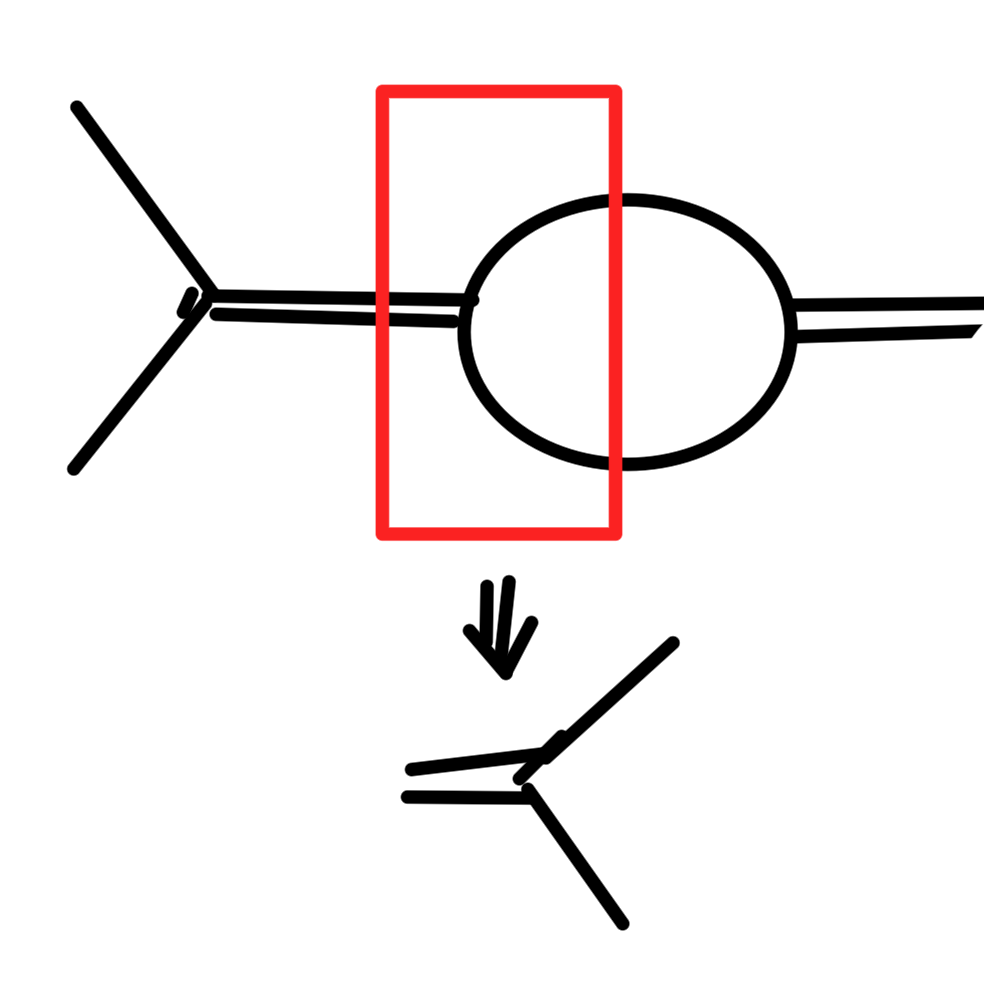
fig. 5. Zooming into the diagram for a higher order virtual particle creation event.
Assuming such a term, the squared amplitude becomes
\begin{equation}\label{eqn:qftLecture17:180}
\evalbar{\sigma}{s \text{near} m^2}
\sim
\Abs{A_s}^2 \sim \inv{(s – m)^2 + m^2 \Gamma^2}
\end{equation}
This is called a resonance (name?), and is sketched in fig. 6.
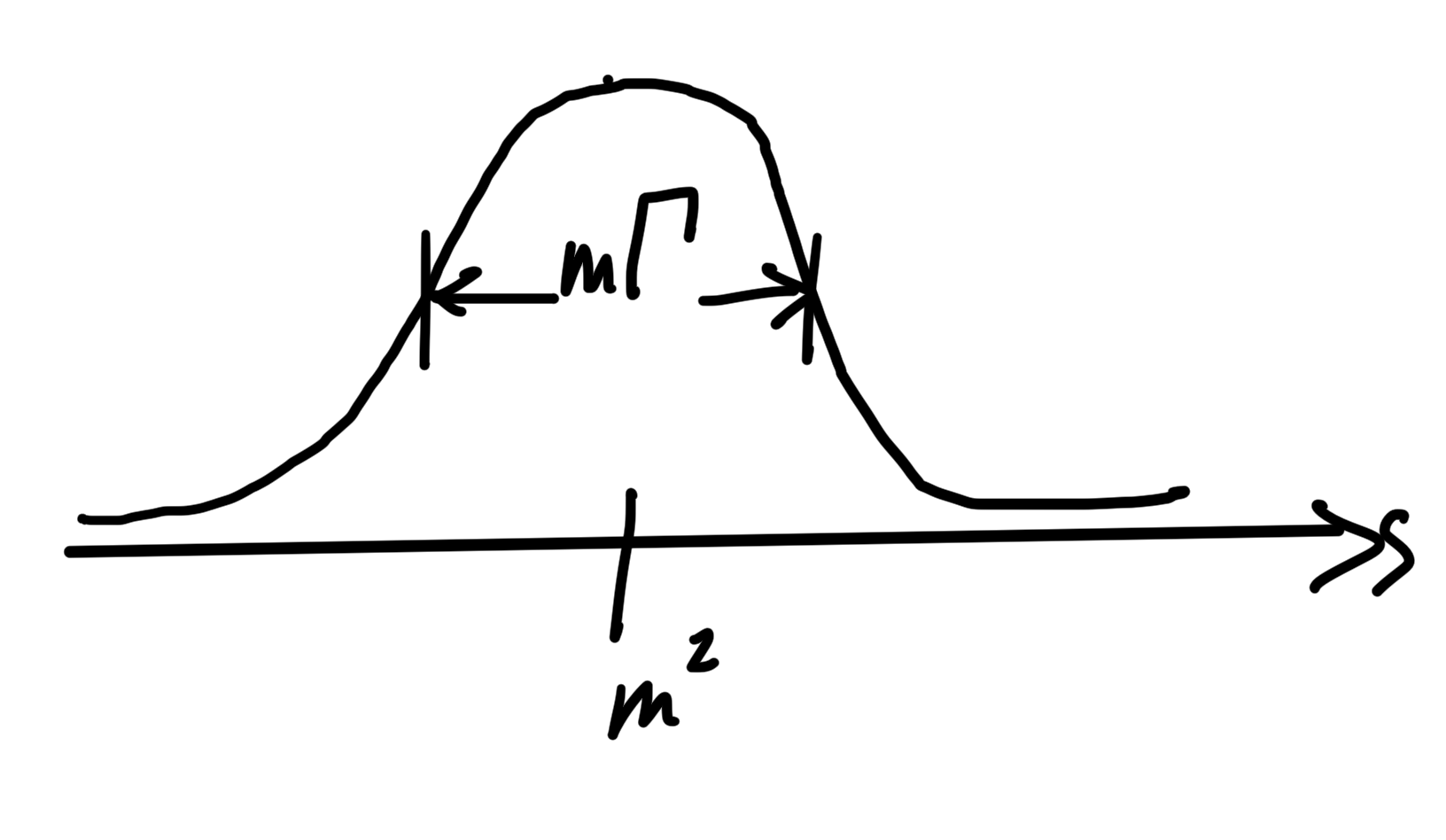
fig. 6. Resonance.
Where are the poles of the modified propagator?
\begin{equation}\label{eqn:qftLecture17:220}
\frac{i}{s – m^2 – i m \Gamma + i \epsilon}
=
\frac{i}{p_0^2 – \Bp^2 – m^2 – i m \Gamma + i \epsilon}
\end{equation}
The pole is found, neglecting \( i \epsilon \), is found at
\begin{equation}\label{eqn:qftLecture17:200}
\begin{aligned}
p_0
&= \sqrt{ \omega_\Bp^2 + i m \Gamma } \\
&= \omega_\Bp \sqrt{ 1 + \frac{i m \Gamma }{\omega_\Bp^2} } \\
&\approx \omega_\Bp + \frac{i m \Gamma }{2 \omega_\Bp}
\end{aligned}
\end{equation}
We have an initial state
\begin{equation}\label{eqn:qftLecture17:240}
\ket{i} = \ket{k},
\end{equation}
and final state
\begin{equation}\label{eqn:qftLecture17:260}
\ket{f} = \ket{p_1^f, p_2^f \cdots p_n^f}.
\end{equation}
We defined decay rate as the ratio of the number of initial particles to the number of final particles.
The probability is
\begin{equation}\label{eqn:qftLecture17:280}
\rho \sim \Abs{\bra{f} S \ket{i}}^2
=
(2 \pi)^4 \delta^{(4)}( p_{\text{in}} – \sum p_f )
(2 \pi)^4 \delta^{(4)}( p_{\text{in}} – \sum p_f )
\times \Abs{ M_{fi} }^2
\end{equation}
Saying that \( \delta(x) f(x) = \delta(x) f(0) \) we can set the argument of one of the delta functions to zero, which gives us a vacuum volume element factor
\begin{equation}\label{eqn:qftLecture17:300}
(2 \pi)^4
\delta^{(4)}( p_{\text{in}} – \sum p_f ) =
(2 \pi)^4
\delta^{(4)}( 0 )
= V_3 T,
\end{equation}
so
\begin{equation}\label{eqn:qftLecture17:320}
\frac{\text{probability for \( i \rightarrow f\)}}{\text{unit time}}
\sim
(2 \pi)^4 \delta^{(4)}( p_{\text{in}} – \sum p_f )
V_3
\times \Abs{ M_{fi} }^2
\end{equation}
\begin{equation}\label{eqn:qftLecture17:340}
\braket{\Bk}{\Bk} = 2 \omega_\Bk V_3
\end{equation}
coming from
\begin{equation}\label{eqn:qftLecture17:360}
\braket{k}{p} = (2 \pi)^3 2 \omega_\Bp \delta^{(3)}(\Bp – \Bk)
\end{equation}
so
\begin{equation}\label{eqn:qftLecture17:380}
\braket{k}{k} = 2 \omega_\Bp V_3
\end{equation}
\begin{equation}\label{eqn:qftLecture17:400}
\frac{\text{probability for \(i \rightarrow f\)}}{\text{unit time}}
\sim
\frac{
(2 \pi)^4 \delta^{(4)}( p_{\text{in}} – \sum p_f )
\Abs{ M_{fi} }^2 V_3
}
{
2 \omega_\Bk V_3
2 \omega_{\Bp_1}
\cdots
2 \omega_{\Bp_n} V_3^n
}
\end{equation}
If we multiply the number of final states with \( p_i^f \in (p_i^f, p_i^f + dp_i^f) \) for a particle in a box
\begin{equation}\label{eqn:qftLecture17:420}
p_x = \frac{ 2 \pi n_x}{L}
\end{equation}
\begin{equation}\label{eqn:qftLecture17:440}
\Delta p_x = \frac{ 2 \pi }{L} \Delta n_x
\end{equation}
\begin{equation}\label{eqn:qftLecture17:460}
\Delta n_x
=
\frac{L}{2 \pi} \Delta p_x
\end{equation}
and
\begin{equation}\label{eqn:qftLecture17:480}
\Delta n_x
\Delta n_y
\Delta n_z
= \frac{V_3}{(2 \pi)^3 }
\Delta p_x
\Delta p_y
\Delta p_z
\end{equation}
\begin{equation}\label{eqn:qftLecture17:500}
\begin{aligned}
\Gamma
&=
\frac{\text{number of events \( i \rightarrow f \)}}{\text{unit time}} \\
&=
\prod_{f} \frac{ d^3 p}{(2 \pi)^3 2 \omega_{\Bp^f} }
\frac{ (2 \pi)^4 \delta^{(4)}( k – \sum_f p^f ) \Abs{M_{fi}}^2 }
{
2 \omega_{\Bk}
}
\end{aligned}
\end{equation}
Note that everything here is Lorentz invariant except for the denominator of the second term ( \(2 \omega_{\Bk}\)). This is a well known result (the decay rate changes in different frames).
For \( 2 \rightarrow \text{many} \) transitions
\begin{equation}\label{eqn:qftLecture17:520}
\frac{\text{probability \( i \rightarrow f \)}}{\text{unit time}}
\times \lr{
\text{ number of final states with \( p_f \in (p_f, p_f + dp_f) \)
}
}
=
\frac{ (2 \pi)^4 \delta^{(4)}( \sum p_i – \sum_f p^f ) \Abs{M_{fi}}^2 {V_3} }
{
2 \omega_{\Bk_1} V_3
2 \omega_{\Bk_2} {V_3 }
}
\prod_{f} \frac{ d^3 p}{(2 \pi)^3 2 \omega_{\Bp^f} }
\end{equation}
We need to divide by the flux.
In the CM frame, as sketched in fig. 7, the current is
\begin{equation}\label{eqn:qftLecture17:540}
\Bj = n \Bv_1 – n \Bv_2,
\end{equation}
so if the density is
\begin{equation}\label{eqn:qftLecture17:560}
n = \inv{V_3},
\end{equation}
(one particle in \(V_3\)), then
\begin{equation}\label{eqn:qftLecture17:580}
\Bj = \frac{\Bv_1 – \Bv_2}{V_3}.
\end{equation}
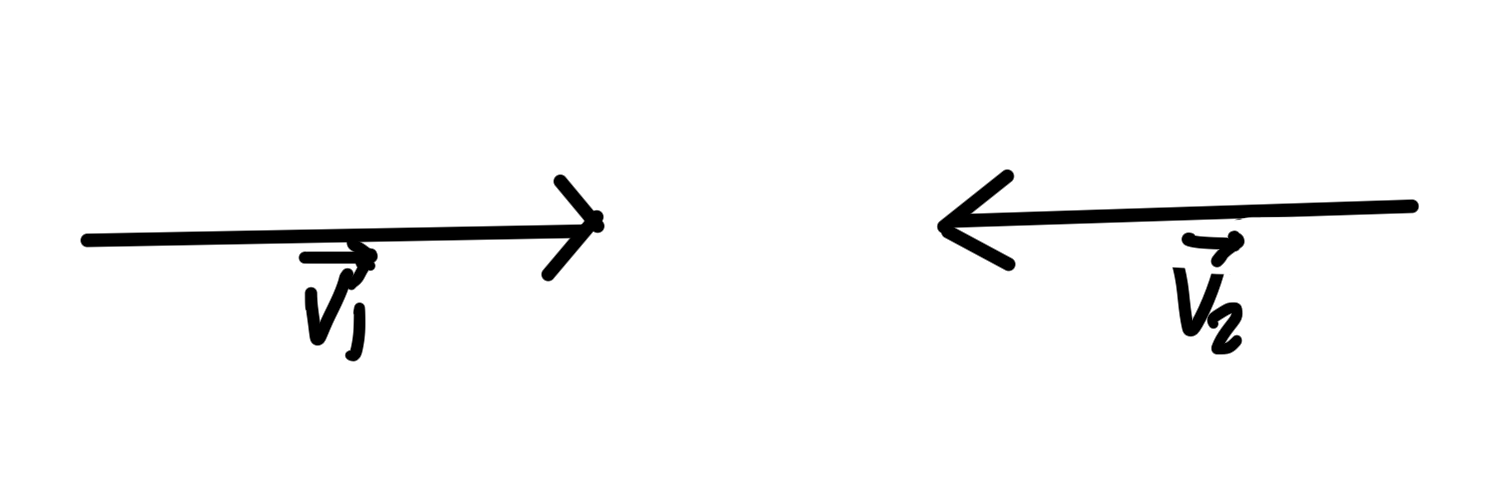
fig. 7. Centre of mass frame.
This is where [1] stops,
\begin{equation}\label{eqn:qftLecture17:640}
\sigma
=
\frac{ (2 \pi)^4 \delta^{(4)}( \sum p_i – \sum_f p^f ) \Abs{M_{fi}}^2 {V_3} }
{
2 \omega_{\Bk_1}
2 \omega_{\Bk_2}
\Abs{\Bv_1 – \Bv_2}
}
\prod_{f} \frac{ d^3 p}{(2 \pi)^3 2 \omega_{\Bp^f} }
\end{equation}
There is, however, a nice Lorentz invariant generalization
\begin{equation}\label{eqn:qftLecture17:600}
j = \inv{ V_3 \omega_{k_A} \omega_{k_B}} \sqrt{ (k_A – k_B)^2 – m_A^2 m_B^2 }
\end{equation}
(Claim: DIY)
\begin{equation}\label{eqn:qftLecture17:620}
\begin{aligned}
\evalbar{j}{CM}
&=
\inv{V_3}
\lr{
\frac{\Abs{\Bk}}{\omega_{k_A}}
+
\frac{\Abs{\Bk}}{\omega_{k_B}}
} \\
&=
\inv{V_3} \lr{ \Abs{\Bv_A} + \Abs{\Bv_B} } \\
&=
\inv{V_3} \Abs{\Bv_1 – \Bv_2 }.
\end{aligned}
\end{equation}
\begin{equation}\label{eqn:qftLecture17:660}
\sigma
=
\frac{ (2 \pi)^4 \delta^{(4)}( \sum p_i – \sum_f p^f ) \Abs{M_{fi}}^2 {V_3} }
{
4 \sqrt{ (k_A – k_B)^2 – m_A^2 m_B^2 }
}
\prod_{f} \frac{ d^3 p}{(2 \pi)^3 2 \omega_{\Bp^f} }.
\end{equation}
[1] Michael E Peskin and Daniel V Schroeder. An introduction to Quantum Field Theory. Westview, 1995.
November 9, 2018 phy2403 beer can spacetime volume, energy momentum tensor, field momentum, Riemann-Lebesque lemma, time dependency
[Click here for a PDF of this post with nicer formatting]
This is a follow up to the unanswered questions I had yesterday related to the apparent time dependent terms in the previous expansion of \( P^i \) for a scalar field.
It turns out that examining the reasons that we can say that the field momentum is conserved also sheds some light on the question. \( P^i \) is not an a-priori conserved quantity, but we may use the charge conservation argument to justify this despite it not having a four-vector nature (i.e. with zero four divergence.)
The momentum \( P^i \) that we have defined is related to the conserved quantity \( T^{0\mu} \), the energy-momentum tensor, which satisfies \( 0 = \partial_\mu T^{0\mu} \) by Noether’s theorem (this was the conserved quantity associated with a spacetime translation.)
That tensor was
\begin{equation}\label{eqn:momentum:120}
T^{\mu\nu} = \partial^\mu \phi \partial^\nu \phi – g^{\mu\nu} \LL,
\end{equation}
and can be used to define the momenta
\begin{equation}\label{eqn:momentum:140}
\begin{aligned}
\int d^3 x T^{0k}
&= \int d^3 x \partial^0 \phi \partial^k \phi \\
&= \int d^3 x \pi \partial^k \phi.
\end{aligned}
\end{equation}
Charge \( Q^i = \int d^3 x j^0 \) was conserved with respect to a limiting surface argument, and we can make a similar “beer can integral” argument for \( P^i \), integrating over a large time interval \( t \in [-T, T] \) as sketched in fig. 1. That is
\begin{equation}\label{eqn:momentum:160}
\begin{aligned}
0
&=
\partial_\mu \int d^4 x T^{0\mu} \\
&=
\partial_0 \int d^4 x T^{00}
+
\partial_k \int d^4 x T^{0k} \\
&=
\partial_0 \int_{-T}^T dt \int d^3 x T^{00}
+
\partial_k \int_{-T}^T dt \int d^3 x T^{0k} \\
&=
\partial_0 \int_{-T}^T dt \int d^3 x T^{00}
+
\partial_k \int_{-T}^T dt
\inv{2} \int \frac{d^3 p }{(2 \pi)^3} p^k
\lr{
a_\Bp^\dagger a_\Bp
+ a_\Bp a_\Bp^\dagger
– a_\Bp a_{-\Bp} e^{- 2 i \omega_\Bp t}
– a_\Bp^\dagger a_{-\Bp}^\dagger e^{2 i \omega_\Bp t}
} \\
&=
\int d^3 x \evalrange{T^{00}}{-T}{T}
+
T \partial_k
\int \frac{d^3 p }{(2 \pi)^3} p^k
\lr{
a_\Bp^\dagger a_\Bp
+ a_\Bp a_\Bp^\dagger
}
-\inv{2}
\partial_k \int_{-T}^T dt
\int \frac{d^3 p }{(2 \pi)^3} p^k
\lr{
a_\Bp a_{-\Bp} e^{- 2 i \omega_\Bp t}
+ a_\Bp^\dagger a_{-\Bp}^\dagger e^{2 i \omega_\Bp t}
}.
\end{aligned}
\end{equation}
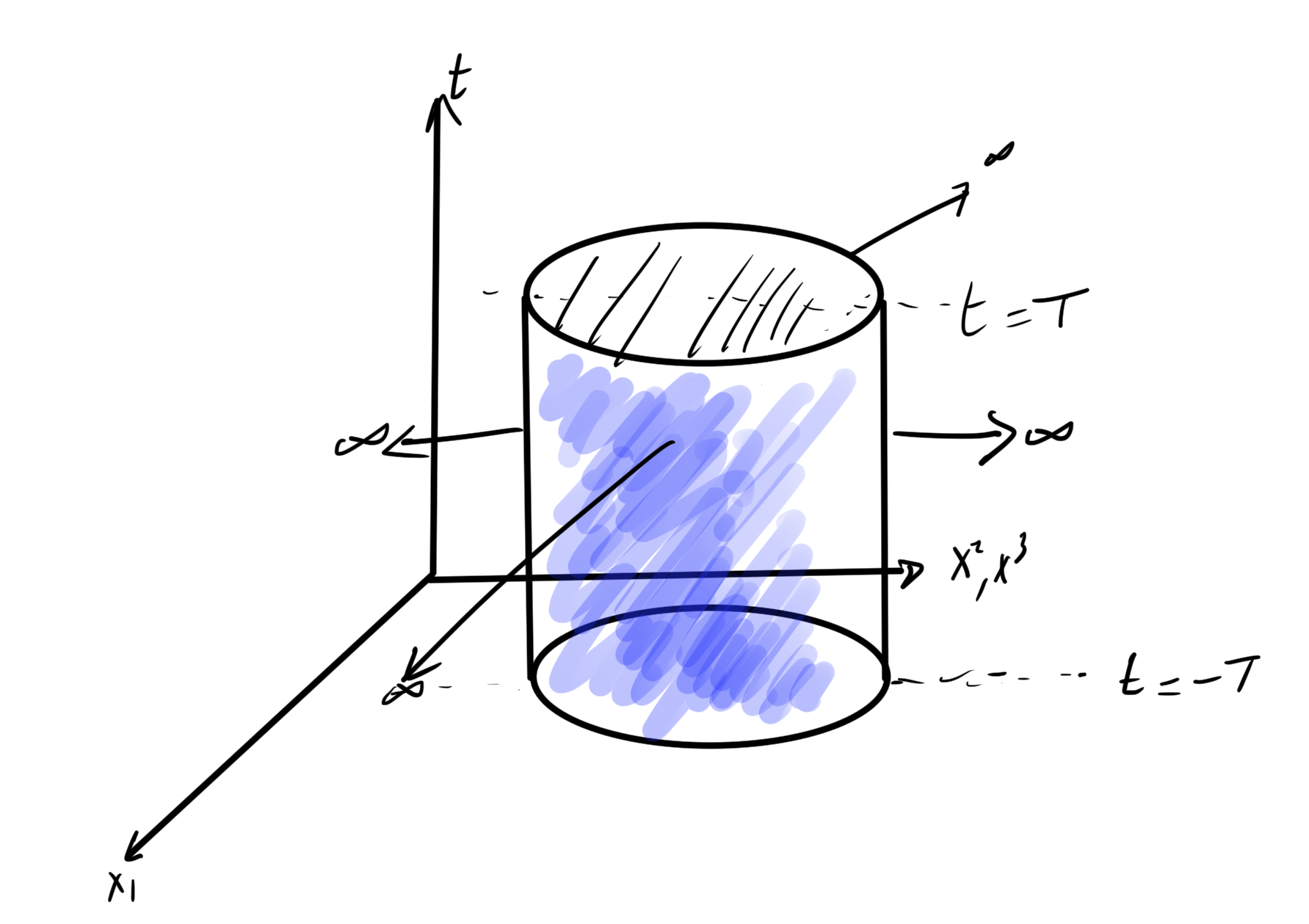
fig. 1. Cylindrical spacetime boundary.
The first integral can be said to vanish if the field energy goes to zero at the time boundaries, and the last integral reduces to
\begin{equation}\label{eqn:momentum:180}
\begin{aligned}
-\inv{2}
\partial_k \int_{-T}^T dt
\int \frac{d^3 p }{(2 \pi)^3} p^k
\lr{
a_\Bp a_{-\Bp} e^{- 2 i \omega_\Bp t}
+ a_\Bp^\dagger a_{-\Bp}^\dagger e^{2 i \omega_\Bp t}
}
&=
-\int \frac{d^3 p }{2 (2 \pi)^3} p^k
\lr{
a_\Bp a_{-\Bp} \frac{\sin( -2 \omega_\Bp T )}{-2 \omega_\Bp}
+ a_\Bp^\dagger a_{-\Bp}^\dagger \frac{\sin( 2 \omega_\Bp T )}{2 \omega_\Bp}
} \\
&=
-\int \frac{d^3 p }{2 (2 \pi)^3} p^k
\lr{
a_\Bp a_{-\Bp} + a_\Bp^\dagger a_{-\Bp}^\dagger
}
\frac{\sin( 2 \omega_\Bp T )}{2 \omega_\Bp}
.
\end{aligned}
\end{equation}
The \( \sin \) term can be interpretted as a sinc like function of \( \omega_\Bp \) which vanishes for large \( \Bp \). It’s not entirely sinc like for a massive field as \( \omega_\Bp = \sqrt{ \Bp^2 + m^2 } \), which never hits zero, as shown in fig. 2.
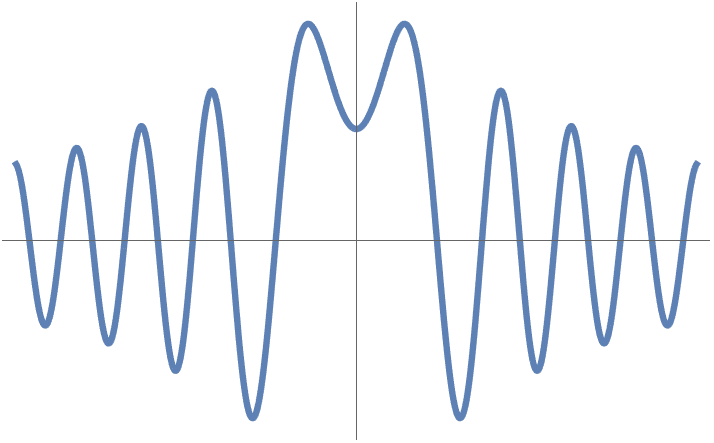
fig 2. sin(2 omega T)/omega
Vanishing for large \( \Bp \) doesn’t help the whole integral vanish, but we can resort to the Riemann-Lebesque lemma [1] instead and interpret this integral as one with a plain old high frequency oscillation that is presumed to vanish (i.e. the rest is well behaved enough that it can be labelled as \( L_1 \) integrable.)
We see that only the non-time dependent portion of \( \mathbf{P} \) matters from a conserved quantity point of view, and having killed off all the time dependent terms, we are left with a conservation relationship for the momenta \( \spacegrad \cdot \BP = 0 \), where \( \BP \) in normal order is just
\begin{equation}\label{eqn:momentum:200}
: \BP : = \int \frac{d^3 p}{(2 \pi)^3} \Bp a_\Bp^\dagger a_\Bp.
\end{equation}
[1] Wikipedia contributors. Riemann-lebesgue lemma — Wikipedia, the free encyclopedia, 2018. URL https://en.wikipedia.org/w/index.php?title=Riemann%E2%80%93Lebesgue_lemma&oldid=856778941. [Online; accessed 29-October-2018].
November 8, 2018 phy2403 anhillation operator, creation operator, momentum of scalar field, normal order
[Click here for a PDF of this post with nicer formatting]
Way back in lecture 8, it was claimed that
\begin{equation}\label{eqn:momentum:20}
P^k = \int d^3 x \hat{\pi} \partial^k \hat{\phi} = \int \frac{d^3 p}{(2\pi)^3} p^k a_\Bp^\dagger a_\Bp.
\end{equation}
If I compute this, I get a normal ordered variation of this operator, but also get some time dependent terms. Here’s the computation (dropping hats)
\begin{equation}\label{eqn:momentum:40}
\begin{aligned}
P^k
&= \int d^3 x \hat{\pi} \partial^k \phi \\
&= \int d^3 x \partial_0 \phi \partial^k \phi \\
&= \int d^3 x \frac{d^3 p d^3 q}{(2 \pi)^6} \inv{\sqrt{2 \omega_p 2 \omega_q} }
\partial_0
\lr{
a_\Bp e^{-i p \cdot x}
+
a_\Bp^\dagger e^{i p \cdot x}
}
\partial^k
\lr{
a_\Bq e^{-i q \cdot x}
+
a_\Bq^\dagger e^{i q \cdot x}
}.
\end{aligned}
\end{equation}
The exponential derivatives are
\begin{equation}\label{eqn:momentum:60}
\begin{aligned}
\partial_0 e^{\pm i p \cdot x}
&=
\partial_0 e^{\pm i p_\mu x^\mu} \\
&=
\pm i p_0
\partial_0 e^{\pm i p \cdot x},
\end{aligned}
\end{equation}
and
\begin{equation}\label{eqn:momentum:80}
\begin{aligned}
\partial^k e^{\pm i p \cdot x}
&=
\partial^k e^{\pm i p^\mu x_\mu} \\
&=
\pm i p^k e^{\pm i p \cdot x},
\end{aligned}
\end{equation}
so
\begin{equation}\label{eqn:momentum:100}
\begin{aligned}
P^k
&=
-\int d^3 x \frac{d^3 p d^3 q}{(2 \pi)^6} \inv{\sqrt{2 \omega_p 2 \omega_q} }
p_0 q^k
\lr{
-a_\Bp e^{-i p \cdot x}
+
a_\Bp^\dagger e^{i p \cdot x}
}
\lr{
-a_\Bq e^{-i q \cdot x}
+
a_\Bq^\dagger e^{i q \cdot x}
} \\
&=
-\inv{2} \int d^3 x \frac{d^3 p d^3 q}{(2 \pi)^6} \sqrt{\frac{\omega_p}{\omega_q}} q^k
\lr{
a_\Bp a_\Bq e^{-i (p + q) \cdot x}
+ a_\Bp^\dagger a_\Bq^\dagger e^{i (p + q) \cdot x}
– a_\Bp a_\Bq^\dagger e^{i (q – p) \cdot x}
– a_\Bp^\dagger a_\Bq e^{i (p – q) \cdot x}
} \\
&=
\inv{2} \int \frac{d^3 p d^3 q}{(2 \pi)^3} \sqrt{\frac{\omega_p}{\omega_q}} q^k
\lr{
– a_\Bp a_\Bq e^{- i(\omega_\Bp + \omega_\Bq) t} \delta^3(\Bp + \Bq)
– a_\Bp^\dagger a_\Bq^\dagger e^{i(\omega_\Bp + \omega_\Bq) t} \delta^3(-\Bp – \Bq)
+ a_\Bp a_\Bq^\dagger e^{i(\omega_\Bq – \omega_\Bp) t} \delta^3(\Bp – \Bq)
+ a_\Bp^\dagger a_\Bq e^{i(\omega_\Bp – \omega_\Bq) t} \delta^3(\Bq – \Bp)
} \\
&=
\inv{2} \int \frac{d^3 p }{(2 \pi)^3} p^k
\lr{
a_\Bp^\dagger a_\Bp
+ a_\Bp a_\Bp^\dagger
– a_\Bp a_{-\Bp} e^{- 2 i \omega_\Bp t}
– a_\Bp^\dagger a_{-\Bp}^\dagger e^{2 i \omega_\Bp t}
}.
\end{aligned}
\end{equation}
What is the rationale for ignoring those time dependent terms? Does normal ordering also implicitly drop any non-paired creation/annihilation operators? If so, why?
November 7, 2018 phy2403 cross section, differential cross section, Feynman diagrams, phi^4 interaction, scattering, tree level diagrams, vacuum expectation, Wick's theorem
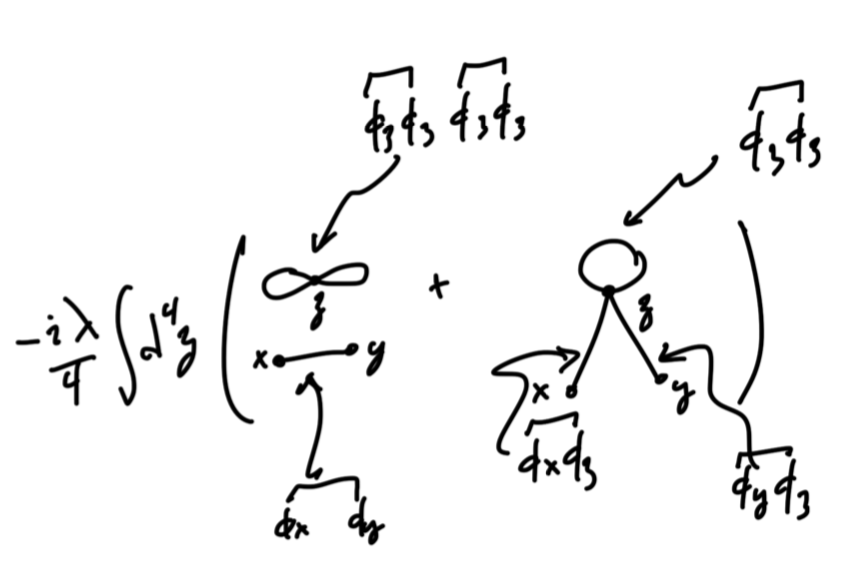
[Here are my notes for the second half of last wednesday’s lecture]. Because the simplewick latex package is required to format these meaningfully, and that’s not available in wordpress latex, I’m not going to attempt to make a web viewable version in addition to the pdf.