pseudoscalar

Corollaries to Stokes and Divergence theorems

October 12, 2016 math and physics play , , , , , , , , ,

[Click here for a PDF of this post with nicer formatting]

In [1] a few problems are set to prove some variations of Stokes theorem. He gives some cool tricks to prove each one using just the classic 3D Stokes and divergence theorems. We can also do them directly from the more general Stokes theorem \( \int d^k \Bx \cdot (\spacegrad \wedge F) = \oint d^{k-1} \Bx \cdot F \).

Question: Stokes theorem on scalar function. ([1] pr. 1.60a)

Prove
\begin{equation}\label{eqn:stokesCorollariesGriffiths:20}
\int \spacegrad T dV = \oint T d\Ba.
\end{equation}

Answer

The direct way to prove this is to apply Stokes theorem

\begin{equation}\label{eqn:stokesCorollariesGriffiths:80}
\int d^3 \Bx \cdot (\spacegrad \wedge T) = \oint d^2 \Bx \cdot T
\end{equation}

Here \( d^3 \Bx = d\Bx_1 \wedge d\Bx_2 \wedge d\Bx_3 \), a pseudoscalar (trivector) volume element, and the wedge and dot products take their most general meanings. For \(k\)-blade \( F \), and \(k’\)-blade \( F’ \), that is

\begin{equation}\label{eqn:stokesCorollariesGriffiths:100}
\begin{aligned}
F \wedge F’ &= \gpgrade{F F’}{k+k’} \\
F \cdot F’ &= \gpgrade{F F’}{\Abs{k-k’}}
\end{aligned}
\end{equation}

With \( d^3\Bx = I dV \), and \( d^2 \Bx = I \ncap dA = I d\Ba \), we have

\begin{equation}\label{eqn:stokesCorollariesGriffiths:120}
\int I dV \spacegrad T = \oint I d\Ba T.
\end{equation}

Cancelling the factors of \( I \) proves the result.

Griffith’s trick to do this was to let \( \Bv = \Bc T \), where \( \Bc \) is a constant. For this, the divergence theorem integral is

\begin{equation}\label{eqn:stokesCorollariesGriffiths:160}
\begin{aligned}
\int dV \spacegrad \cdot (\Bc T)
&=
\int dV \Bc \cdot \spacegrad T \\
&=
\Bc \cdot \int dV \spacegrad T \\
&=
\oint d\Ba \cdot (\Bc T) \\
&=
\Bc \cdot \oint d\Ba T.
\end{aligned}
\end{equation}

This is true for any constant \( \Bc \), so is also true for the unit vectors. This allows for summing projections in each of the unit directions

\begin{equation}\label{eqn:stokesCorollariesGriffiths:180}
\begin{aligned}
\int dV \spacegrad T
&=
\sum \Be_k \lr{ \Be_k \cdot \int dV \spacegrad T } \\
&=
\sum \Be_k \lr{ \Be_k \cdot \oint d\Ba T } \\
&=
\oint d\Ba T.
\end{aligned}
\end{equation}

Question: ([1] pr. 1.60b)

Prove
\begin{equation}\label{eqn:stokesCorollariesGriffiths:40}
\int \spacegrad \cross \Bv dV = -\oint \Bv \cross d\Ba.
\end{equation}

Answer

This also follows directly from the general Stokes theorem

\begin{equation}\label{eqn:stokesCorollariesGriffiths:200}
\int d^3 \Bx \cdot \lr{ \spacegrad \wedge \Bv } = \oint d^2 \Bx \cdot \Bv
\end{equation}

The volume integrand is

\begin{equation}\label{eqn:stokesCorollariesGriffiths:220}
\begin{aligned}
d^3 \Bx \cdot \lr{ \spacegrad \wedge \Bv }
&=
\gpgradeone{ I dV I \spacegrad \cross \Bv } \\
&=
-dV \spacegrad \cross \Bv,
\end{aligned}
\end{equation}

and the surface integrand is
\begin{equation}\label{eqn:stokesCorollariesGriffiths:240}
\begin{aligned}
d^2 \Bx \cdot \Bv
&=
\gpgradeone{ I d\Ba \Bv } \\
&=
\gpgradeone{ I (d\Ba \wedge \Bv) } \\
&=
I^2 (d\Ba \cross \Bv) \\
&=
-d\Ba \cross \Bv \\
&=
\Bv \cross d\Ba.
\end{aligned}
\end{equation}

Plugging these into \ref{eqn:stokesCorollariesGriffiths:200} proves the result.

Griffiths trick for the same is to apply the divergence theorem to \( \Bv \cross \Bc \). Such a volume integral is

\begin{equation}\label{eqn:stokesCorollariesGriffiths:260}
\begin{aligned}
\int dV \spacegrad \cdot (\Bv \cross \Bc)
&=
\int dV \Bc \cdot (\spacegrad \cross \Bv) \\
&=
\Bc \cdot \int dV \spacegrad \cross \Bv.
\end{aligned}
\end{equation}

This must equal
\begin{equation}\label{eqn:stokesCorollariesGriffiths:280}
\begin{aligned}
\oint d\Ba \cdot (\Bv \cross \Bc)
&=
\Bc \cdot \oint d\Ba \cross \Bv \\
&=
-\Bc \cdot \oint \Bv \cross d\Ba
\end{aligned}
\end{equation}

Again, assembling projections, we have
\begin{equation}\label{eqn:stokesCorollariesGriffiths:300}
\begin{aligned}
\int dV \spacegrad \cross \Bv
&=
\sum \Be_k \lr{ \Be_k \cdot \int dV \spacegrad \cross \Bv } \\
&=
-\sum \Be_k \lr{ \Be_k \cdot \oint \Bv \cross d\Ba } \\
&=
-\oint \Bv \cross d\Ba.
\end{aligned}
\end{equation}

Question: ([1] pr. 1.60e)

Prove
\begin{equation}\label{eqn:stokesCorollariesGriffiths:60}
\int \spacegrad T \cross d\Ba = -\oint T d\Bl.
\end{equation}

Answer

This one follows from
\begin{equation}\label{eqn:stokesCorollariesGriffiths:320}
\int d^2 \Bx \cdot \lr{ \spacegrad \wedge T } = \oint d^1 \Bx \cdot T.
\end{equation}

The surface integrand can be written
\begin{equation}\label{eqn:stokesCorollariesGriffiths:340}
\begin{aligned}
d^2 \Bx \cdot \lr{ \spacegrad \wedge T }
&=
\gpgradeone{ I d\Ba \spacegrad T } \\
&=
I (d\Ba \wedge \spacegrad T ) \\
&=
I^2 ( d\Ba \cross \spacegrad T ) \\
&=
-d\Ba \cross \spacegrad T.
\end{aligned}
\end{equation}

The line integrand is

\begin{equation}\label{eqn:stokesCorollariesGriffiths:360}
d^1 \Bx \cdot T = d^1 \Bx T.
\end{equation}

Given a two parameter representation of the surface area element \( d^2 \Bx = d\Bx_1 \wedge d\Bx_2 \), the line element representation is
\begin{equation}\label{eqn:stokesCorollariesGriffiths:380}
\begin{aligned}
d^1 \Bx
&= (\Bx_1 \wedge d\Bx_2) \cdot \Bx^1 + (d\Bx_1 \wedge \Bx_2) \cdot \Bx^2 \\
&= -d\Bx_2 + d\Bx_1,
\end{aligned}
\end{equation}

giving

\begin{equation}\label{eqn:stokesCorollariesGriffiths:400}
\begin{aligned}
-\int d\Ba \cross \spacegrad T
&=
\int
-\evalbar{\lr{ \PD{u_2}{\Bx} T }}{\Delta u_1} du_2
+\evalbar{\lr{ \PD{u_1}{\Bx} T }}{\Delta u_2} du_1 \\
&=
-\oint d\Bl T,
\end{aligned}
\end{equation}

or
\begin{equation}\label{eqn:stokesCorollariesGriffiths:420}
\int \spacegrad T \cross d\Ba
=
-\oint d\Bl T.
\end{equation}

Griffiths trick for the same is to use \( \Bv = \Bc T \) for constant \( \Bc \) in (the usual 3D) Stokes’ theorem. That is

\begin{equation}\label{eqn:stokesCorollariesGriffiths:440}
\begin{aligned}
\int d\Ba \cdot (\spacegrad \cross (\Bc T))
&=
\Bc \cdot \int d\Ba \cross \spacegrad T \\
&=
-\Bc \cdot \int \spacegrad T \cross d\Ba \\
&=
\oint d\Bl \cdot (\Bc T) \\
&=
\Bc \cdot \oint d\Bl T.
\end{aligned}
\end{equation}

Again assembling projections we have
\begin{equation}\label{eqn:stokesCorollariesGriffiths:460}
\begin{aligned}
\int \spacegrad T \cross d\Ba
&=
\sum \Be_k \lr{ \Be_k \cdot \int \spacegrad T \cross d\Ba} \\
&=
-\sum \Be_k \lr{ \Be_k \cdot \oint d\Bl T } \\
&=
-\oint d\Bl T.
\end{aligned}
\end{equation}

References

[1] David Jeffrey Griffiths and Reed College. Introduction to electrodynamics. Prentice hall Upper Saddle River, NJ, 3rd edition, 1999.
Geometric Algebra in a nutshell.

September 29, 2016 math and physics play , , , , , , , , , , , , ,

[Click here for a PDF of this post with nicer formatting]

Motivation

I initially thought that I might submit a problem set solution for ece1228 using Geometric Algebra. In order to justify this, I needed to add an appendix to that problem set that outlined enough of the ideas that such a solution might make sense to the grader.

I ended up changing my mind and reworked the problem entirely, removing any use of GA. Here’s the tutorial I initially considered submitting with that problem.

Geometric Algebra in a nutshell.

Geometric Algebra defines a non-commutative, associative vector product

\begin{equation}\label{eqn:gaTutorial:20}
\begin{aligned}
\Ba \Bb \Bc
&=
(\Ba \Bb) \Bc \\
&=
\Ba (\Bb \Bc),
\end{aligned}
\end{equation}

where the square of a vector equals the squared vector magnitude

\begin{equation}\label{eqn:gaTutorial:40}
\Ba^2 = \Abs{\Ba}^2,
\end{equation}

In Euclidean spaces such a squared vector is always positive, but that is not necessarily the case in the mixed signature spaces used in special relativity.

There are a number of consequences of these two simple vector multiplication rules.

  • Squared unit vectors have a unit magnitude (up to a sign). In a Euclidean space such a product is always positive

    \begin{equation}\label{eqn:gaTutorial:60}
    (\Be_1)^2 = 1.
    \end{equation}

  • Products of perpendicular vectors anticommute.

    \begin{equation}\label{eqn:gaTutorial:80}
    \begin{aligned}
    2
    &=
    (\Be_1 + \Be_2)^2 \\
    &= (\Be_1 + \Be_2)(\Be_1 + \Be_2) \\
    &= \Be_1^2 + \Be_2 \Be_1 + \Be_1 \Be_2 + \Be_2^2 \\
    &= 2 + \Be_2 \Be_1 + \Be_1 \Be_2.
    \end{aligned}
    \end{equation}

    A product of two perpendicular vectors is called a bivector, and can be used to represent an oriented plane. The last line above shows an example of a scalar and bivector sum, called a multivector. In general Geometric Algebra allows sums of scalars, vectors, bivectors, and higher degree analogues (grades) be summed.

    Comparison of the RHS and LHS of \ref{eqn:gaTutorial:80} shows that we must have

    \begin{equation}\label{eqn:gaTutorial:100}
    \Be_2 \Be_1 = -\Be_1 \Be_2.
    \end{equation}

    It is true in general that the product of two perpendicular vectors anticommutes. When, as above, such a product is a product of
    two orthonormal vectors, it behaves like a non-commutative imaginary quantity, as it has an imaginary square in Euclidean spaces

    \begin{equation}\label{eqn:gaTutorial:120}
    \begin{aligned}
    (\Be_1 \Be_2)^2
    &=
    (\Be_1 \Be_2)
    (\Be_1 \Be_2) \\
    &=
    \Be_1 (\Be_2
    \Be_1) \Be_2 \\
    &=
    -\Be_1 (\Be_1
    \Be_2) \Be_2 \\
    &=
    -(\Be_1 \Be_1)
    (\Be_2 \Be_2) \\
    &=-1.
    \end{aligned}
    \end{equation}

    Such “imaginary” (unit bivectors) have important applications describing rotations in Euclidean spaces, and boosts in Minkowski spaces.

  • The product of three perpendicular vectors, such as

    \begin{equation}\label{eqn:gaTutorial:140}
    I = \Be_1 \Be_2 \Be_3,
    \end{equation}

    is called a trivector. In \R{3}, the product of three orthonormal vectors is called a pseudoscalar for the space, and can represent an oriented volume element. The quantity \( I \) above is the typical orientation picked for the \R{3} unit pseudoscalar. This quantity also has characteristics of an imaginary number

    \begin{equation}\label{eqn:gaTutorial:160}
    \begin{aligned}
    I^2
    &=
    (\Be_1 \Be_2 \Be_3)
    (\Be_1 \Be_2 \Be_3) \\
    &=
    \Be_1 \Be_2 (\Be_3
    \Be_1) \Be_2 \Be_3 \\
    &=
    -\Be_1 \Be_2 \Be_1
    \Be_3 \Be_2 \Be_3 \\
    &=
    -\Be_1 (\Be_2 \Be_1)
    (\Be_3 \Be_2) \Be_3 \\
    &=
    -\Be_1 (\Be_1 \Be_2)
    (\Be_2 \Be_3) \Be_3 \\
    &=

    \Be_1^2
    \Be_2^2
    \Be_3^2 \\
    &=
    -1.
    \end{aligned}
    \end{equation}

  • The product of two vectors in \R{3} can be expressed as the sum of a symmetric scalar product and antisymmetric bivector product

    \begin{equation}\label{eqn:gaTutorial:480}
    \begin{aligned}
    \Ba \Bb
    &=
    \sum_{i,j = 1}^n \Be_i \Be_j a_i b_j \\
    &=
    \sum_{i = 1}^n \Be_i^2 a_i b_i
    +
    \sum_{0 < i \ne j \le n} \Be_i \Be_j a_i b_j \\ &= \sum_{i = 1}^n a_i b_i + \sum_{0 < i < j \le n} \Be_i \Be_j (a_i b_j - a_j b_i). \end{aligned} \end{equation} The first (symmetric) term is clearly the dot product. The antisymmetric term is designated the wedge product. In general these are written \begin{equation}\label{eqn:gaTutorial:500} \Ba \Bb = \Ba \cdot \Bb + \Ba \wedge \Bb, \end{equation} where \begin{equation}\label{eqn:gaTutorial:520} \begin{aligned} \Ba \cdot \Bb &\equiv \inv{2} \lr{ \Ba \Bb + \Bb \Ba } \\ \Ba \wedge \Bb &\equiv \inv{2} \lr{ \Ba \Bb - \Bb \Ba }, \end{aligned} \end{equation} The coordinate expansion of both can be seen above, but in \R{3} the wedge can also be written \begin{equation}\label{eqn:gaTutorial:540} \Ba \wedge \Bb = \Be_1 \Be_2 \Be_3 (\Ba \cross \Bb) = I (\Ba \cross \Bb). \end{equation} This allows for an handy dot plus cross product expansion of the vector product \begin{equation}\label{eqn:gaTutorial:180} \Ba \Bb = \Ba \cdot \Bb + I (\Ba \cross \Bb). \end{equation} This result should be familiar to the student of quantum spin states where one writes \begin{equation}\label{eqn:gaTutorial:200} (\Bsigma \cdot \Ba) (\Bsigma \cdot \Bb) = (\Ba \cdot \Bb) + i (\Ba \cross \Bb) \cdot \Bsigma. \end{equation} This correspondence is because the Pauli spin basis is a specific matrix representation of a Geometric Algebra, satisfying the same commutator and anticommutator relationships. A number of other algebra structures, such as complex numbers, and quaterions can also be modelled as Geometric Algebra elements.

  • It is often useful to utilize the grade selection operator
    \( \gpgrade{M}{n} \) and scalar grade selection operator \( \gpgradezero{M} = \gpgrade{M}{0} \)
    to select the scalar, vector, bivector, trivector, or higher grade algebraic elements. For example, operating on vectors \( \Ba, \Bb, \Bc \), we have

    \begin{equation}\label{eqn:gaTutorial:580}
    \begin{aligned}
    \gpgradezero{ \Ba \Bb }
    &= \Ba \cdot \Bb \\
    \gpgradeone{ \Ba \Bb \Bc }
    &=
    \Ba (\Bb \cdot \Bc)
    +
    \Ba \cdot (\Bb \wedge \Bc) \\
    &=
    \Ba (\Bb \cdot \Bc)
    +
    (\Ba \cdot \Bb) \Bc

    (\Ba \cdot \Bc) \Bb \\
    \gpgradetwo{\Ba \Bb} &=
    \Ba \wedge \Bb \\
    \gpgradethree{\Ba \Bb \Bc} &=
    \Ba \wedge \Bb \wedge \Bc.
    \end{aligned}
    \end{equation}

    Note that the wedge product of any number of vectors such as \( \Ba \wedge \Bb \wedge \Bc \) is associative and can be expressed in terms of the complete antisymmetrization of the product of those vectors. A consequence of that is the fact a wedge product that includes any colinear vectors in the product is zero.

Example: Helmholz equations.

As an example of the power of \ref{eqn:gaTutorial:180}, consider the following Helmholtz equation derivation (wave equations for the electric and magnetic fields in the frequency domain.)

Application of \ref{eqn:gaTutorial:180} to
Maxwell equations in the frequency domain for source free simple media gives

\label{eqn:emtProblemSet1Problem6:340}
\begin{equation}\label{eqn:emtProblemSet1Problem6:360}
\spacegrad \BE = -j \omega I \BB
\end{equation}
\begin{equation}\label{eqn:emtProblemSet1Problem6:380}
\spacegrad I \BB = -j \omega \mu \epsilon \BE.
\end{equation}

These equations use the engineering (not physics) sign convention for the phasors where the time domain fields are of the form \( \boldsymbol{\mathcal{E}}(\Br, t) = \textrm{Re}( \BE e^{j\omega t} \).

Operation with the gradient from the left produces the Helmholtz equation for each of the fields using nothing more than multiplication and simple substitution

\label{eqn:emtProblemSet1Problem6:400}
\begin{equation}\label{eqn:emtProblemSet1Problem6:420}
\spacegrad^2 \BE = – \mu \epsilon \omega^2 \BE
\end{equation}
\begin{equation}\label{eqn:emtProblemSet1Problem6:440}
\spacegrad^2 I \BB = – \mu \epsilon \omega^2 I \BB.
\end{equation}

There was no reason to go through the headache of looking up or deriving the expansion of \( \spacegrad \cross (\spacegrad \cross \BA ) \) as is required with the traditional vector algebra demonstration of these identities.

Observe that the usual Helmholtz equation for \( \BB \) doesn’t have a pseudoscalar factor. That result can be obtained by just cancelling the factors \( I \) since the \R{3} Euclidean pseudoscalar commutes with all grades (this isn’t the case in \R{2} nor in Minkowski spaces.)

Example: Factoring the Laplacian.

There are various ways to demonstrate the identity

\begin{equation}\label{eqn:gaTutorial:660}
\spacegrad \cross \lr{ \spacegrad \cross \BA } = \spacegrad \lr{ \spacegrad \cdot \BA } – \spacegrad^2 \BA,
\end{equation}

such as the use of (somewhat obscure) tensor contraction techniques. We can also do this with Geometric Algebra (using a different set of obscure techniques) by factoring the Laplacian action on a vector

\begin{equation}\label{eqn:gaTutorial:700}
\begin{aligned}
\spacegrad^2 \BA
&=
\spacegrad (\spacegrad \BA) \\
&=
\spacegrad (\spacegrad \cdot \BA + \spacegrad \wedge \BA) \\
&=
\spacegrad (\spacegrad \cdot \BA)
+
\spacegrad \cdot (\spacegrad \wedge \BA) \\
%+
%\cancel{\spacegrad \wedge \spacegrad \wedge \BA}
&=
\spacegrad (\spacegrad \cdot \BA)
+
\spacegrad \cdot (\spacegrad \wedge \BA).
\end{aligned}
\end{equation}

Should we wish to express the last term using cross products, a grade one selection operation can be used
\begin{equation}\label{eqn:gaTutorial:680}
\begin{aligned}
\spacegrad \cdot (\spacegrad \wedge \BA)
&=
\gpgradeone{ \spacegrad (\spacegrad \wedge \BA) } \\
&=
\gpgradeone{ \spacegrad I (\spacegrad \cross \BA) } \\
&=
\gpgradeone{ I \spacegrad \wedge (\spacegrad \cross \BA) } \\
&=
\gpgradeone{ I^2 \spacegrad \cross (\spacegrad \cross \BA) } \\
&=
-\spacegrad \cross (\spacegrad \cross \BA).
\end{aligned}
\end{equation}

Here coordinate expansion was not required in any step.

Learning more.

Some references that may be helpful to learn more about Geometric Algebra are [2], [1], [4], and [3].

References

[1] C. Doran and A.N. Lasenby. Geometric algebra for physicists. Cambridge University Press New York, Cambridge, UK, 1st edition, 2003.

[2] L. Dorst, D. Fontijne, and S. Mann. Geometric Algebra for Computer Science. Morgan Kaufmann, San Francisco, 2007.

[3] D. Hestenes. New Foundations for Classical Mechanics. Kluwer Academic Publishers, 1999.

[4] A. Macdonald. Vector and Geometric Calculus. CreateSpace Independent Publishing Platform, 2012.

Green’s function inversion of the magnetostatic equation

September 27, 2016 math and physics play , , , , , , , , ,

[Click here for a PDF of this post with nicer formatting]

A previous example of inverting a gradient equation was the electrostatics equation. We can do the same for the magnetostatics equation, which has the following Geometric Algebra form in linear media

\begin{equation}\label{eqn:biotSavartGreens:20}
\spacegrad I \BB = – \mu \BJ.
\end{equation}

The Green’s inversion of this is
\begin{equation}\label{eqn:biotSavartGreens:40}
\begin{aligned}
I \BB(\Bx)
&= \int_V dV’ G(\Bx, \Bx’) \spacegrad’ I \BB(\Bx’) \\
&= \int_V dV’ G(\Bx, \Bx’) (-\mu \BJ(\Bx’)) \\
&= \inv{4\pi} \int_V dV’ \frac{\Bx – \Bx’}{ \Abs{\Bx – \Bx’}^3 } (-\mu \BJ(\Bx’)).
\end{aligned}
\end{equation}

We expect the LHS to be a bivector, so the scalar component of this should be zero. That can be demonstrated with some of the usual trickery
\begin{equation}\label{eqn:biotSavartGreens:60}
\begin{aligned}
-\frac{\mu}{4\pi} \int_V dV’ \frac{\Bx – \Bx’}{ \Abs{\Bx – \Bx’}^3 } \cdot \BJ(\Bx’)
&= \frac{\mu}{4\pi} \int_V dV’ \lr{ \spacegrad \inv{ \Abs{\Bx – \Bx’} }} \cdot \BJ(\Bx’) \\
&= -\frac{\mu}{4\pi} \int_V dV’ \lr{ \spacegrad’ \inv{ \Abs{\Bx – \Bx’} }} \cdot \BJ(\Bx’) \\
&= -\frac{\mu}{4\pi} \int_V dV’ \lr{
\spacegrad’ \cdot \frac{\BJ(\Bx’)}{ \Abs{\Bx – \Bx’} }

\frac{\spacegrad’ \cdot \BJ(\Bx’)}{ \Abs{\Bx – \Bx’} }
}.
\end{aligned}
\end{equation}

The current \( \BJ \) is not unconstrained. This can be seen by premultiplying \ref{eqn:biotSavartGreens:20} by the gradient

\begin{equation}\label{eqn:biotSavartGreens:80}
\spacegrad^2 I \BB = -\mu \spacegrad \BJ.
\end{equation}

On the LHS we have a bivector so must have \( \spacegrad \BJ = \spacegrad \wedge \BJ \), or \( \spacegrad \cdot \BJ = 0 \). This kills the \( \spacegrad’ \cdot \BJ(\Bx’) \) integrand numerator in \ref{eqn:biotSavartGreens:60}, leaving

\begin{equation}\label{eqn:biotSavartGreens:100}
\begin{aligned}
-\frac{\mu}{4\pi} \int_V dV’ \frac{\Bx – \Bx’}{ \Abs{\Bx – \Bx’}^3 } \cdot \BJ(\Bx’)
&= -\frac{\mu}{4\pi} \int_V dV’ \spacegrad’ \cdot \frac{\BJ(\Bx’)}{ \Abs{\Bx – \Bx’} } \\
&= -\frac{\mu}{4\pi} \int_{\partial V} dA’ \ncap \cdot \frac{\BJ(\Bx’)}{ \Abs{\Bx – \Bx’} }.
\end{aligned}
\end{equation}

This shows that the scalar part of the equation is zero, provided the normal component of \( \BJ/\Abs{\Bx – \Bx’} \) vanishes on the boundary of the infinite sphere. This leaves the Biot-Savart law as a bivector equation

\begin{equation}\label{eqn:biotSavartGreens:120}
I \BB(\Bx)
= \frac{\mu}{4\pi} \int_V dV’ \BJ(\Bx’) \wedge \frac{\Bx – \Bx’}{ \Abs{\Bx – \Bx’}^3 }.
\end{equation}

Observe that the traditional vector form of the Biot-Savart law can be obtained by premultiplying both sides with \( -I \), leaving

\begin{equation}\label{eqn:biotSavartGreens:140}
\BB(\Bx)
= \frac{\mu}{4\pi} \int_V dV’ \BJ(\Bx’) \cross \frac{\Bx – \Bx’}{ \Abs{\Bx – \Bx’}^3 }.
\end{equation}

This checks against a trusted source such as [1] (eq. 5.39).

References

[1] David Jeffrey Griffiths and Reed College. Introduction to electrodynamics. Prentice hall Upper Saddle River, NJ, 3rd edition, 1999.

Maxwell equation boundary conditions in media

September 10, 2016 math and physics play , , , , , , , , ,

[Click here for a PDF of this post with nicer formatting]

Following [1], Maxwell’s equations in media, including both electric and magnetic sources and currents are

\begin{equation}\label{eqn:boundaryConditionsInMedia:40}
\spacegrad \cross \BE = -\BM – \partial_t \BB
\end{equation}
\begin{equation}\label{eqn:boundaryConditionsInMedia:60}
\spacegrad \cross \BH = \BJ + \partial_t \BD
\end{equation}
\begin{equation}\label{eqn:boundaryConditionsInMedia:80}
\spacegrad \cdot \BD = \rho
\end{equation}
\begin{equation}\label{eqn:boundaryConditionsInMedia:100}
\spacegrad \cdot \BB = \rho_{\textrm{m}}
\end{equation}

In general, it is not possible to assemble these into a single Geometric Algebra equation unless specific assumptions about the permeabilities are made, but we can still use Geometric Algebra to examine the boundary condition question. First, these equations can be expressed in a more natural multivector form

\begin{equation}\label{eqn:boundaryConditionsInMedia:140}
\spacegrad \wedge \BE = -I \lr{ \BM + \partial_t \BB }
\end{equation}
\begin{equation}\label{eqn:boundaryConditionsInMedia:160}
\spacegrad \wedge \BH = I \lr{ \BJ + \partial_t \BD }
\end{equation}
\begin{equation}\label{eqn:boundaryConditionsInMedia:180}
\spacegrad \cdot \BD = \rho
\end{equation}
\begin{equation}\label{eqn:boundaryConditionsInMedia:200}
\spacegrad \cdot \BB = \rho_{\textrm{m}}
\end{equation}

Then duality relations can be used on the divergences to write all four equations in their curl form

\begin{equation}\label{eqn:boundaryConditionsInMedia:240}
\spacegrad \wedge \BE = -I \lr{ \BM + \partial_t \BB }
\end{equation}
\begin{equation}\label{eqn:boundaryConditionsInMedia:260}
\spacegrad \wedge \BH = I \lr{ \BJ + \partial_t \BD }
\end{equation}
\begin{equation}\label{eqn:boundaryConditionsInMedia:280}
\spacegrad \wedge (I\BD) = \rho I
\end{equation}
\begin{equation}\label{eqn:boundaryConditionsInMedia:300}
\spacegrad \wedge (I\BB) = \rho_{\textrm{m}} I.
\end{equation}

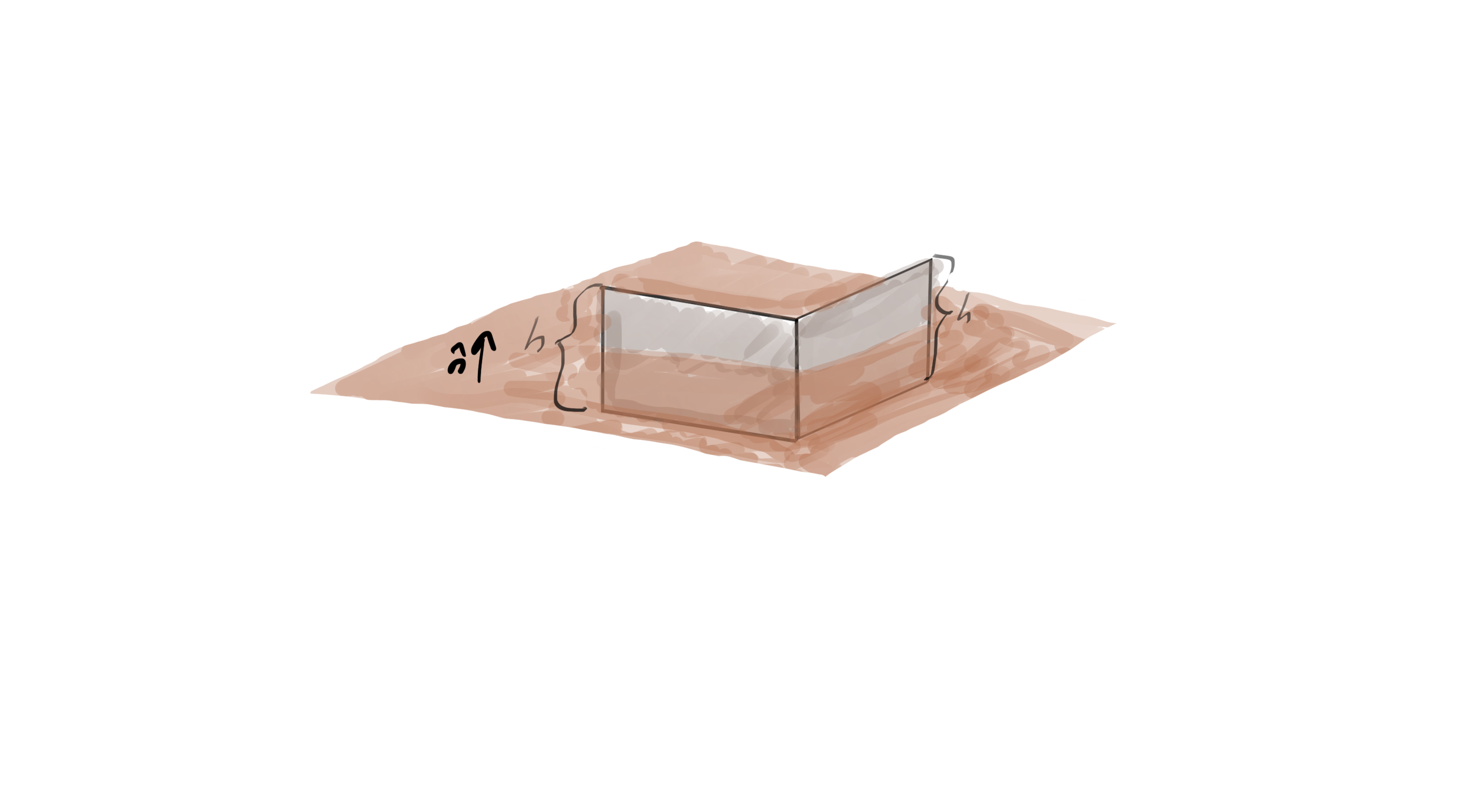
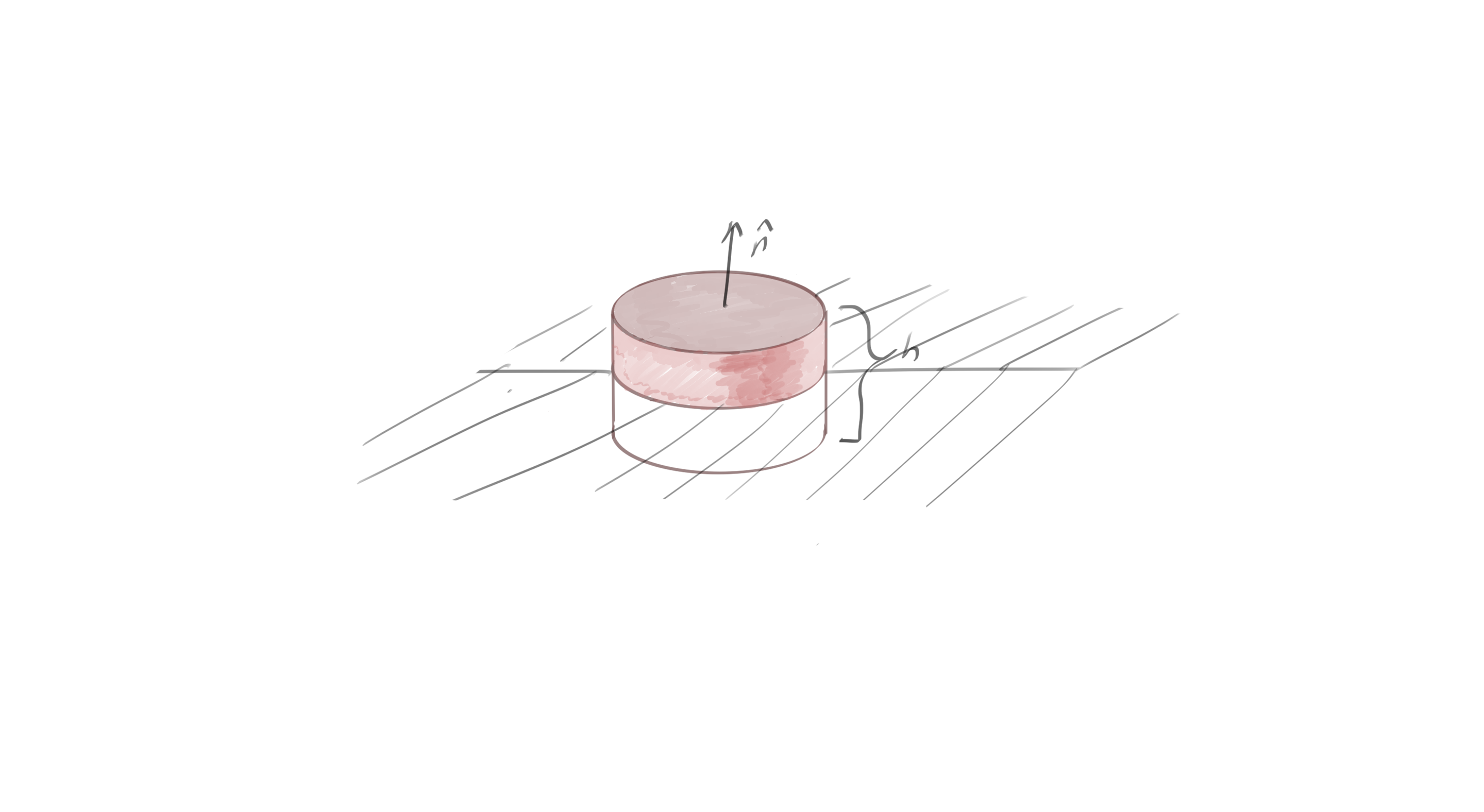
Now it is possible to employ Stokes theorem to each of these. The usual procedure is to both use the loops of fig. 2 and the pillbox of fig. 1, where in both cases the height is made infinitesimal.

boundaryConditionsTwoSurfacesFig1

fig 1. Two surfaces normal to the interface.

boundaryConditionsPillBoxFig2

fig 2. A pillbox volume encompassing the interface.

With all these relations expressed in curl form as above, we can use just the pillbox configuration to evaluate the Stokes integrals.
Let the height \( h \) be measured along the normal axis, and assume that all the charges and currents are localized to the surface

\begin{equation}\label{eqn:boundaryConditionsInMedia:320}
\begin{aligned}
\BM &= \BM_{\textrm{s}} \delta( h ) \\
\BJ &= \BJ_{\textrm{s}} \delta( h ) \\
\rho &= \rho_{\textrm{s}} \delta( h ) \\
\rho_{\textrm{m}} &= \rho_{\textrm{m}\textrm{s}} \delta( h ),
\end{aligned}
\end{equation}

we can enumerate the Stokes integrals \( \int d^3 \Bx \cdot \lr{ \spacegrad \wedge \BX } = \oint_{\partial V} d^2 \Bx \cdot \BX \). The three-volume area element will be written as \( d^3 \Bx = d^2 \Bx \wedge \ncap dh \), giving

\begin{equation}\label{eqn:boundaryConditionsInMedia:360}
\oint_{\partial V} d^2 \Bx \cdot \BE = -\int (d^2 \Bx \wedge \ncap) \cdot \lr{ I \BM_{\textrm{s}} + \partial_t I \BB \Delta h}
\end{equation}
\begin{equation}\label{eqn:boundaryConditionsInMedia:380}
\oint_{\partial V} d^2 \Bx \cdot \BH = \int (d^2 \Bx \wedge \ncap) \cdot \lr{ I \BJ_{\textrm{s}} + \partial_t I \BD \Delta h}
\end{equation}
\begin{equation}\label{eqn:boundaryConditionsInMedia:400}
\oint_{\partial V} d^2 \Bx \cdot (I\BD) = \int (d^2 \Bx \wedge \ncap) \cdot \lr{ \rho_{\textrm{s}} I }
\end{equation}
\begin{equation}\label{eqn:boundaryConditionsInMedia:420}
\oint_{\partial V} d^2 \Bx \cdot (I\BB) = \int (d^2 \Bx \wedge \ncap) \cdot \lr{ \rho_{\textrm{m}\textrm{s}} I }
\end{equation}

In the limit with \( \Delta h \rightarrow 0 \), the LHS integrals are reduced to just the top and bottom surfaces, and the \( \Delta h \) contributions on the RHS are eliminated. With \( i = I \ncap \), and \( d^2 \Bx = dA\, i \) on the top surface, we are left with

\begin{equation}\label{eqn:boundaryConditionsInMedia:460}
0 = \int dA \lr{ i \cdot \Delta \BE + I \cdot \lr{ I \BM_{\textrm{s}} } }
\end{equation}
\begin{equation}\label{eqn:boundaryConditionsInMedia:480}
0 = \int dA \lr{ i \cdot \Delta \BH – I \cdot \lr{ I \BJ_{\textrm{s}} } }
\end{equation}
\begin{equation}\label{eqn:boundaryConditionsInMedia:500}
0 = \int dA \lr{ i \cdot \Delta (I\BD) + \rho_{\textrm{s}} }
\end{equation}
\begin{equation}\label{eqn:boundaryConditionsInMedia:520}
0 = \int dA \lr{ i \cdot \Delta (I\BB) + \rho_{\textrm{m}\textrm{s}} }
\end{equation}

Consider the first integral. Any component of \( \BE \) that is normal to the plane of the pillbox top (or bottom) has no contribution to the integral, so this constraint is one that effects only the tangential components \( \ncap (\ncap \wedge (\Delta \BE)) \). Writing out the vector portion of the integrand, we have

\begin{equation}\label{eqn:boundaryConditionsInMedia:540}
\begin{aligned}
i \cdot \Delta \BE + I \cdot \lr{ I \BM_{\textrm{s}} }
&=
\gpgradeone{ i \Delta \BE + I^2 \BM_{\textrm{s}} } \\
&=
\gpgradeone{ I \ncap \Delta \BE – \BM_{\textrm{s}} } \\
&=
\gpgradeone{ I \ncap \ncap (\ncap \wedge \Delta \BE) – \BM_{\textrm{s}} } \\
&=
\gpgradeone{ I (\ncap \wedge (\Delta \BE)) – \BM_{\textrm{s}} } \\
&=
\gpgradeone{ -\ncap \cross (\Delta \BE) – \BM_{\textrm{s}} }.
\end{aligned}
\end{equation}

The dot product (a scalar) in the two surface charge integrals can also be reduced

\begin{equation}\label{eqn:boundaryConditionsInMedia:560}
\begin{aligned}
i \cdot \Delta (I\BD)
&=
\gpgradezero{ i \Delta (I\BD) } \\
&=
\gpgradezero{ I \ncap \Delta (I\BD) } \\
&=
\gpgradezero{ -\ncap \Delta \BD } \\
&=
-\ncap \cdot \Delta \BD,
\end{aligned}
\end{equation}

so the integral equations are satisfied provided

\begin{equation}\label{eqn:boundaryConditionsInMedia:580}
\boxed{
\begin{aligned}
\ncap \cross (\BE_2 – \BE_1) &= – \BM_{\textrm{s}} \\
\ncap \cross (\BH_2 – \BH_1) &= \BJ_{\textrm{s}} \\
\ncap \cdot (\BD_2 – \BD_1) &= \rho_{\textrm{s}} \\
\ncap \cdot (\BB_2 – \BB_1) &= \rho_{\textrm{m}\textrm{s}}.
\end{aligned}
}
\end{equation}

It is tempting to try to assemble these into a results expressed in terms of a four-vector surface current and composite STA bivector fields like the \( F = \BE + I c \BB \) that we can use for the free space Maxwell’s equation. Dimensionally, we need something with velocity in that mix, but what velocity should be used when the speed of the field propagation in each media is potentially different?

References

[1] Constantine A Balanis. Advanced engineering electromagnetics. Wiley New York, 1989.

Maxwell equation boundary conditions

September 6, 2016 math and physics play , , , , , , , , , , , , , ,

[Click here for a PDF of this post with nicer formatting]

Motivation

boundaryConditionsTwoSurfacesFig1

fig 1. Two surfaces normal to the interface.

Most electrodynamics textbooks either start with or contain a treatment of boundary value conditions. These typically involve evaluating Maxwell’s equations over areas or volumes of decreasing height, such as those illustrated in fig. 1, and fig. 2. These represent surfaces and volumes where the height is allowed to decrease to infinitesimal levels, and are traditionally used to find the boundary value constraints of the normal and tangential components of the electric and magnetic fields.

boundaryConditionsPillBoxFig2

fig 2. A pillbox volume encompassing the interface.

More advanced topics, such as evaluation of the Fresnel reflection and transmission equations, also rely on similar consideration of boundary value constraints. I’ve wondered for a long time how the Fresnel equations could be attacked by looking at the boundary conditions for the combined field \( F = \BE + I c \BB \), instead of the considering them separately.

A unified approach.

The Geometric Algebra (and relativistic tensor) formulations of Maxwell’s equations put the electric and magnetic fields on equal footings. It is in fact possible to specify the boundary value constraints on the fields without first separating Maxwell’s equations into their traditional forms. The starting point in Geometric Algebra is Maxwell’s equation, premultiplied by a stationary observer’s timelike basis vector

\begin{equation}\label{eqn:maxwellBoundaryConditions:20}
\gamma_0 \grad F = \inv{\epsilon_0 c} \gamma_0 J,
\end{equation}

or

\begin{equation}\label{eqn:maxwellBoundaryConditions:40}
\lr{ \partial_0 + \spacegrad} F = \frac{\rho}{\epsilon_0} – \frac{\BJ}{\epsilon_0}.
\end{equation}

The electrodynamic field \(F = \BE + I c \BB\) is a multivector in this spatial domain (whereas it is a bivector in the spacetime algebra domain), and has vector and bivector components. The product of the spatial gradient and the field can still be split into dot and curl components \(\spacegrad M = \spacegrad \cdot M + \spacegrad \wedge M \). If \(M = \sum M_i \), where \(M_i\) is an grade \(i\) blade, then we give this the Hestenes’ [1] definitions

\begin{equation}\label{eqn:maxwellBoundaryConditions:60}
\begin{aligned}
\spacegrad \cdot M &= \sum_i \gpgrade{\spacegrad M_i}{i-1} \\
\spacegrad \wedge M &= \sum_i \gpgrade{\spacegrad M_i}{i+1}.
\end{aligned}
\end{equation}

With that said, Maxwell’s equation can be rearranged into a pair of multivector equations

\begin{equation}\label{eqn:maxwellBoundaryConditions:80}
\begin{aligned}
\spacegrad \cdot F &= \gpgrade{-\partial_0 F + \frac{\rho}{\epsilon_0} – \frac{\BJ}{\epsilon_0 c}}{0,1} \\
\spacegrad \wedge F &= \gpgrade{-\partial_0 F + \frac{\rho}{\epsilon_0} – \frac{\BJ}{\epsilon_0 c}}{2,3},
\end{aligned}
\end{equation}

The latter equation can be integrated with Stokes theorem, but we need to apply a duality transformation to the latter in order to apply Stokes to it

\begin{equation}\label{eqn:maxwellBoundaryConditions:120}
\begin{aligned}
\spacegrad \cdot F
&=
-I^2 \spacegrad \cdot F \\
&=
-I^2 \gpgrade{\spacegrad F}{0,1} \\
&=
-I \gpgrade{I \spacegrad F}{2,3} \\
&=
-I \spacegrad \wedge (IF),
\end{aligned}
\end{equation}

so

\begin{equation}\label{eqn:maxwellBoundaryConditions:100}
\begin{aligned}
\spacegrad \wedge (I F) &= I \lr{ -\inv{c} \partial_t \BE + \frac{\rho}{\epsilon_0} – \frac{\BJ}{\epsilon_0 c} } \\
\spacegrad \wedge F &= -I \partial_t \BB.
\end{aligned}
\end{equation}

Integrating each of these over the pillbox volume gives

\begin{equation}\label{eqn:maxwellBoundaryConditions:140}
\begin{aligned}
\oint_{\partial V} d^2 \Bx \cdot (I F)
&=
\int_{V} d^3 \Bx \cdot \lr{ I \lr{ -\inv{c} \partial_t \BE + \frac{\rho}{\epsilon_0} – \frac{\BJ}{\epsilon_0 c} } } \\
\oint_{\partial V} d^2 \Bx \cdot F
&=
– \partial_t \int_{V} d^3 \Bx \cdot \lr{ I \BB }.
\end{aligned}
\end{equation}

In the absence of charges and currents on the surface, and if the height of the volume is reduced to zero, the volume integrals vanish, and only the upper surfaces of the pillbox contribute to the surface integrals.

\begin{equation}\label{eqn:maxwellBoundaryConditions:200}
\begin{aligned}
\oint_{\partial V} d^2 \Bx \cdot (I F) &= 0 \\
\oint_{\partial V} d^2 \Bx \cdot F &= 0.
\end{aligned}
\end{equation}

With a multivector \(F\) in the mix, the geometric meaning of these integrals is not terribly clear. They do describe the boundary conditions, but to see exactly what those are, we can now resort to the split of \(F\) into its electric and magnetic fields. Let’s look at the non-dual integral to start with

\begin{equation}\label{eqn:maxwellBoundaryConditions:160}
\begin{aligned}
\oint_{\partial V} d^2 \Bx \cdot F
&=
\oint_{\partial V} d^2 \Bx \cdot \lr{ \BE + I c \BB } \\
&=
\oint_{\partial V} d^2 \Bx \cdot \BE + I c d^2 \Bx \wedge \BB \\
&=
0.
\end{aligned}
\end{equation}

No component of \(\BE\) that is normal to the surface contributes to \(d^2 \Bx \cdot \BE \), whereas only components of \(\BB\) that are normal contribute to \(d^2 \Bx \wedge \BB \). That means that we must have tangential components of \(\BE\) and the normal components of \(\BB\) matching on the surfaces

\begin{equation}\label{eqn:maxwellBoundaryConditions:180}
\begin{aligned}
\lr{\BE_2 \wedge \ncap} \ncap – \lr{\BE_1 \wedge (-\ncap)} (-\ncap) &= 0 \\
\lr{\BB_2 \cdot \ncap} \ncap – \lr{\BB_1 \cdot (-\ncap)} (-\ncap) &= 0 .
\end{aligned}
\end{equation}

Similarly, for the dot product of the dual field, this is

\begin{equation}\label{eqn:maxwellBoundaryConditions:220}
\begin{aligned}
\oint_{\partial V} d^2 \Bx \cdot (I F)
&=
\oint_{\partial V} d^2 \Bx \cdot (I \BE – c \BB) \\
&=
\oint_{\partial V} I d^2 \Bx \wedge \BE – c d^2 \Bx \cdot \BB.
\end{aligned}
\end{equation}

For this integral, only the normal components of \(\BE\) contribute, and only the tangential components of \(\BB\) contribute. This means that

\begin{equation}\label{eqn:maxwellBoundaryConditions:240}
\begin{aligned}
\lr{\BE_2 \cdot \ncap} \ncap – \lr{\BE_1 \cdot (-\ncap)} (-\ncap) &= 0 \\
\lr{\BB_2 \wedge \ncap} \ncap – \lr{\BB_1 \wedge (-\ncap)} (-\ncap) &= 0.
\end{aligned}
\end{equation}

This is why we end up with a seemingly strange mix of tangential and normal components of the electric and magnetic fields. These constraints can be summarized as

\begin{equation}\label{eqn:maxwellBoundaryConditions:260}
\begin{aligned}
( \BE_2 – \BE_1 ) \cdot \ncap &= 0 \\
( \BE_2 – \BE_1 ) \wedge \ncap &= 0 \\
( \BB_2 – \BB_1 ) \cdot \ncap &= 0 \\
( \BB_2 – \BB_1 ) \wedge \ncap &= 0
\end{aligned}
\end{equation}

These relationships are usually expressed in terms of all of \(\BE, \BD, \BB\) and \(\BH \). Because I’d started with Maxwell’s equations for free space, I don’t have the \( \epsilon \) and \( \mu \) factors that produce those more general relationships. Those more general boundary value relationships are usually the starting point for the Fresnel interface analysis. It is also possible to further generalize these relationships to include charges and currents on the surface.

References

[1] D. Hestenes. New Foundations for Classical Mechanics. Kluwer Academic Publishers, 1999.