pseudoscalar

Stokes integrals for Maxwell’s equations in Geometric Algebra

September 4, 2016 math and physics play , , , , , , , , , ,

[Click here for a PDF of this post with nicer formatting]

Recall that the relativistic form of Maxwell’s equation in Geometric Algebra is

\begin{equation}\label{eqn:maxwellStokes:20}
\grad F = \inv{c \epsilon_0} J.
\end{equation}

where \( \grad = \gamma^\mu \partial_\mu \) is the spacetime gradient, and \( J = (c\rho, \BJ) = J^\mu \gamma_\mu \) is the four (vector) current density. The pseudoscalar for the space is denoted \( I = \gamma_0 \gamma_1 \gamma_2 \gamma_3 \), where the basis elements satisfy \( \gamma_0^2 = 1 = -\gamma_k^2 \), and a dual basis satisfies \( \gamma_\mu \cdot \gamma^\nu = \delta_\mu^\nu \). The electromagnetic field \( F \) is a composite multivector \( F = \BE + I c \BB \). This is actually a bivector because spatial vectors have a bivector representation in the space time algebra of the form \( \BE = E^k \gamma_k \gamma_0 \).

Previously, I wrote out the Stokes integrals for Maxwell’s equation in GA form using some three parameter spacetime manifold volumes. This time I’m going to use two and three parameter spatial volumes, again with the Geometric Algebra form of Stokes theorem.

Multiplication by a timelike unit vector transforms Maxwell’s equation from their relativistic form. When that vector is the standard basis timelike unit vector \( \gamma_0 \), we obtain Maxwell’s equations from the point of view of a stationary observer

\begin{equation}\label{eqn:stokesMaxwellSpaceTimeSplit:40}
\lr{\partial_0 + \spacegrad} \lr{ \BE + c I \BB } = \inv{\epsilon_0 c} \lr{ c \rho – \BJ },
\end{equation}

Extracting the scalar, vector, bivector, and trivector grades respectively, we have
\begin{equation}\label{eqn:stokesMaxwellSpaceTimeSplit:60}
\begin{aligned}
\spacegrad \cdot \BE &= \frac{\rho}{\epsilon_0} \\
c I \spacegrad \wedge \BB &= -\partial_0 \BE – \inv{\epsilon_0 c} \BJ \\
\spacegrad \wedge \BE &= – I c \partial_0 \BB \\
c I \spacegrad \cdot \BB &= 0.
\end{aligned}
\end{equation}

Each of these can be written as a curl equation

\begin{equation}\label{eqn:stokesMaxwellSpaceTimeSplit:80}
\boxed{
\begin{aligned}
\spacegrad \wedge (I \BE) &= I \frac{\rho}{\epsilon_0} \\
\inv{\mu_0} \spacegrad \wedge \BB &= \epsilon_0 I \partial_t \BE + I \BJ \\
\spacegrad \wedge \BE &= -I \partial_t \BB \\
\spacegrad \wedge (I \BB) &= 0,
\end{aligned}
}
\end{equation}

a form that allows for direct application of Stokes integrals. The first and last of these require a three parameter volume element, whereas the two bivector grade equations can be integrated using either two or three parameter volume elements. Suppose that we have can parameterize the space with parameters \( u, v, w \), for which the gradient has the representation

\begin{equation}\label{eqn:stokesMaxwellSpaceTimeSplit:100}
\spacegrad = \Bx^u \partial_u + \Bx^v \partial_v + \Bx^w \partial_w,
\end{equation}

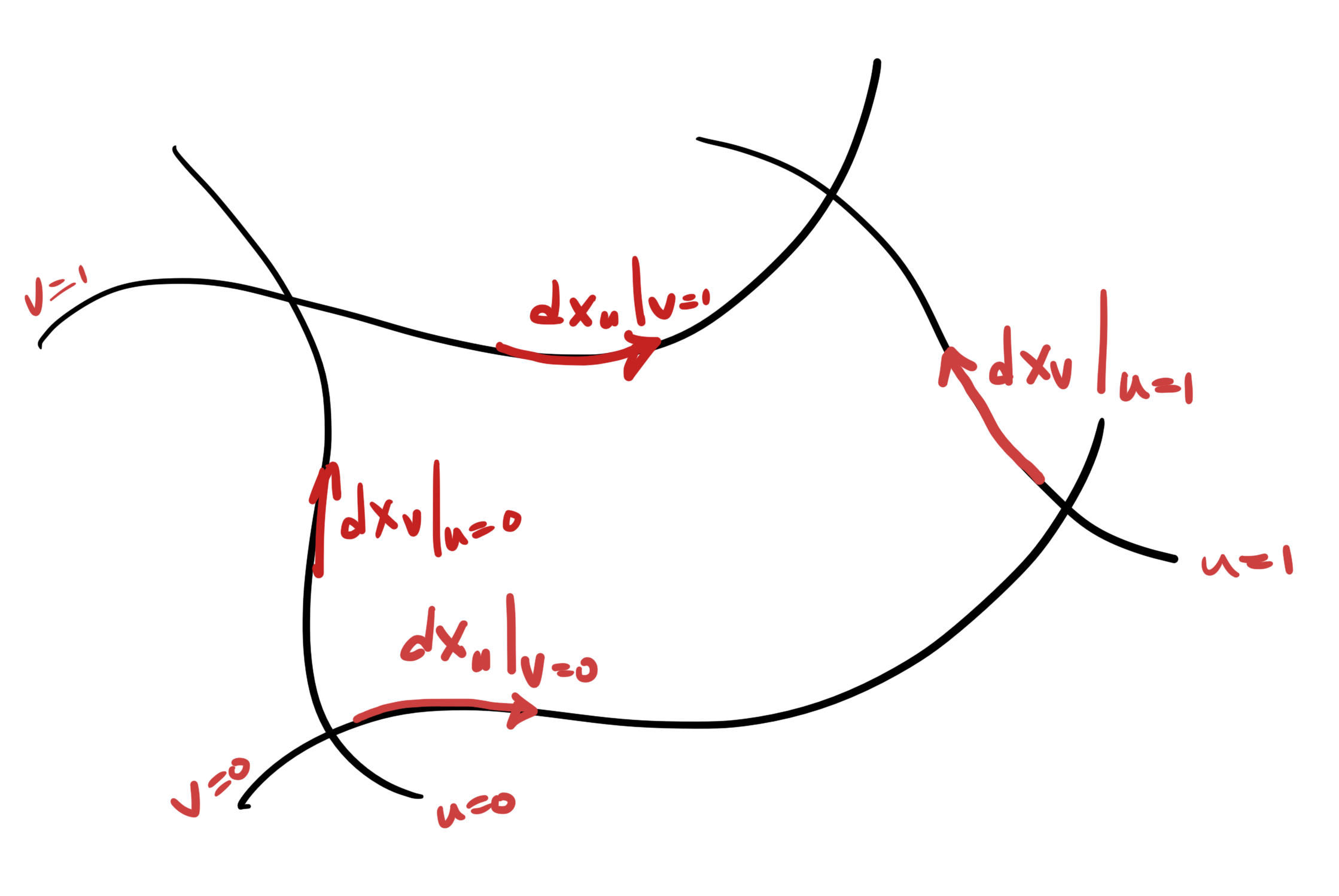
but we integrate over a two parameter subset of this space spanned by \( \Bx(u,v) \), with area element

\begin{equation}\label{eqn:stokesMaxwellSpaceTimeSplit:120}
\begin{aligned}
d^2 \Bx
&= d\Bx_u \wedge d\Bx_v \\
&=
\PD{u}{\Bx}
\wedge
\PD{v}{\Bx}
\,du dv \\
&=
\Bx_u
\wedge
\Bx_v
\,du dv,
\end{aligned}
\end{equation}

as illustrated in fig. 1.
 

twoParameterAreaElementFig1

fig. 1. Two parameter manifold.

Our curvilinear coordinates \( \Bx_u, \Bx_v, \Bx_w \) are dual to the reciprocal basis \( \Bx^u, \Bx^v, \Bx^w \), but we won’t actually have to calculate that reciprocal basis. Instead we need only know that it can be calculated and is defined by the relations \( \Bx_a \cdot \Bx^b = \delta_a^b \). Knowing that we can reduce (say),

\begin{equation}\label{eqn:stokesMaxwellSpaceTimeSplit:140}
\begin{aligned}
d^2 \Bx \cdot ( \spacegrad \wedge \BE )
&=
d^2 \Bx \cdot ( \Bx^a \partial_a \wedge \BE ) \\
&=
(\Bx_u \wedge \Bx_v) \cdot ( \Bx^a \wedge \partial_a \BE ) \,du dv \\
&=
(((\Bx_u \wedge \Bx_v) \cdot \Bx^a) \cdot \partial_a \BE \,du dv \\
&=
d\Bx_u \cdot \partial_v \BE \,dv
-d\Bx_v \cdot \partial_u \BE \,du,
\end{aligned}
\end{equation}

Because each of the differentials, for example \( d\Bx_u = (\PDi{u}{\Bx}) du \), is calculated with the other (i.e.\( v \)) held constant, this is directly integrable, leaving

\begin{equation}\label{eqn:stokesMaxwellSpaceTimeSplit:160}
\begin{aligned}
\int d^2 \Bx \cdot ( \spacegrad \wedge \BE )
&=
\int \evalrange{\lr{d\Bx_u \cdot \BE}}{v=0}{v=1}
-\int \evalrange{\lr{d\Bx_v \cdot \BE}}{u=0}{u=1} \\
&=
\oint d\Bx \cdot \BE.
\end{aligned}
\end{equation}

That direct integration of one of the parameters, while the others are held constant, is the basic idea behind Stokes theorem.

The pseudoscalar grade Maxwell’s equations from \ref{eqn:stokesMaxwellSpaceTimeSplit:80} require a three parameter volume element to apply Stokes theorem to. Again, allowing for curvilinear coordinates such a differential expands as

\begin{equation}\label{eqn:stokesMaxwellSpaceTimeSplit:180}
\begin{aligned}
d^3 \Bx \cdot (\spacegrad \wedge (I\BB))
&=
(( \Bx_u \wedge \Bx_v \wedge \Bx_w ) \cdot \Bx^a ) \cdot \partial_a (I\BB) \,du dv dw \\
&=
(d\Bx_u \wedge d\Bx_v) \cdot \partial_w (I\BB) dw
+(d\Bx_v \wedge d\Bx_w) \cdot \partial_u (I\BB) du
+(d\Bx_w \wedge d\Bx_u) \cdot \partial_v (I\BB) dv.
\end{aligned}
\end{equation}

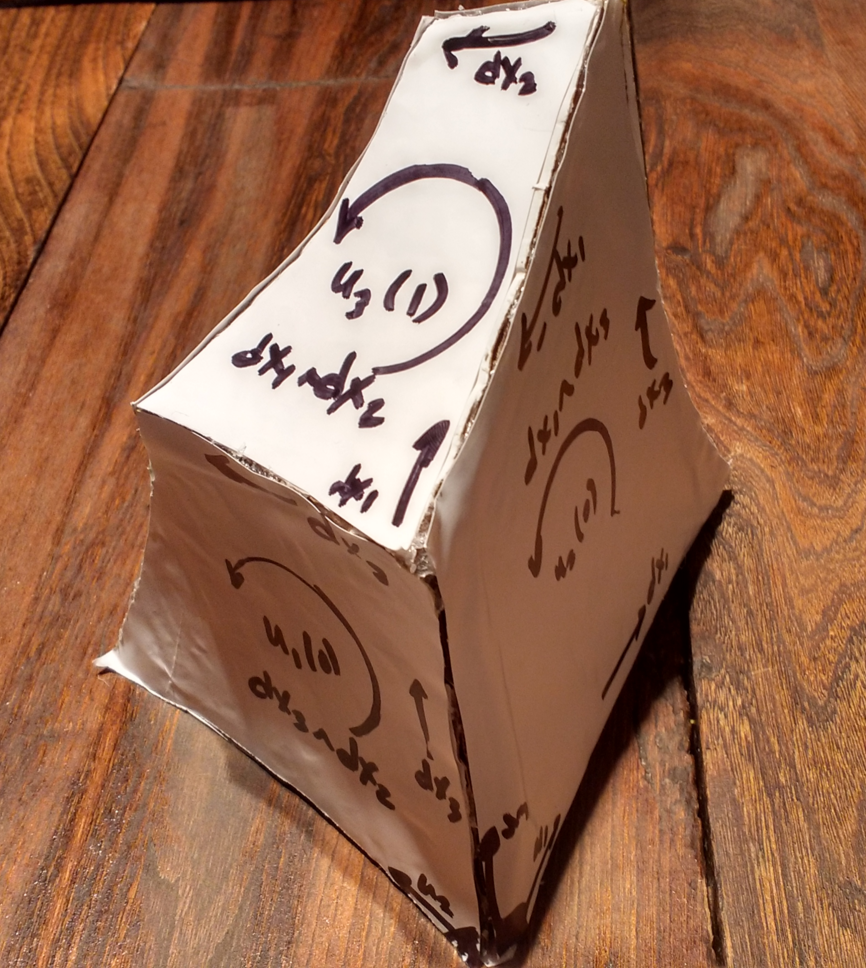
Like the two parameter volume, this is directly integrable

\begin{equation}\label{eqn:stokesMaxwellSpaceTimeSplit:200}
\int
d^3 \Bx \cdot (\spacegrad \wedge (I\BB))
=
\int \evalbar{(d\Bx_u \wedge d\Bx_v) \cdot (I\BB) }{\Delta w}
+\int \evalbar{(d\Bx_v \wedge d\Bx_w) \cdot (I\BB)}{\Delta u}
+\int \evalbar{(d\Bx_w \wedge d\Bx_u) \cdot (I\BB)}{\Delta v}.
\end{equation}

After some thought (or a craft project such as that of fig. 2) is can be observed that this is conceptually an oriented surface integral
threeParameterSurfaceFig2

fig. 2. Oriented three parameter surface.

Noting that

\begin{equation}\label{eqn:stokesMaxwellSpaceTimeSplit:221}
\begin{aligned}
d^2 \Bx \cdot (I\Bf)
&= \gpgradezero{ d^2 \Bx I B } \\
&= I (d^2\Bx \wedge \Bf)
\end{aligned}
\end{equation}

we can now write down the results of application of Stokes theorem to each of Maxwell’s equations in their curl forms

\begin{equation}\label{eqn:stokesMaxwellSpaceTimeSplit:220}
\boxed{
\begin{aligned}
\oint d\Bx \cdot \BE &= -I \partial_t \int d^2 \Bx \wedge \BB \\
\inv{\mu_0} \oint d\Bx \cdot \BB &= \epsilon_0 I \partial_t \int d^2 \Bx \wedge \BE + I \int d^2 \Bx \wedge \BJ \\
\oint d^2 \Bx \wedge \BE &= \inv{\epsilon_0} \int (d^3 \Bx \cdot I) \rho \\
\oint d^2 \Bx \wedge \BB &= 0.
\end{aligned}
}
\end{equation}

In the three parameter surface integrals the specific meaning to apply to \( d^2 \Bx \wedge \Bf \) is
\begin{equation}\label{eqn:stokesMaxwellSpaceTimeSplit:240}
\oint d^2 \Bx \wedge \Bf
=
\int \evalbar{\lr{d\Bx_u \wedge d\Bx_v \wedge \Bf}}{\Delta w}
+\int \evalbar{\lr{d\Bx_v \wedge d\Bx_w \wedge \Bf}}{\Delta u}
+\int \evalbar{\lr{d\Bx_w \wedge d\Bx_u \wedge \Bf}}{\Delta v}.
\end{equation}

Note that in each case only the component of the vector \( \Bf \) that is projected onto the normal to the area element contributes.
Application of Stokes Theorem to the Maxwell equation

September 3, 2016 math and physics play , , , , , , , , , , , ,

[Click here for a PDF of this post with nicer formatting]

The relativistic form of Maxwell’s equation in Geometric Algebra is

\begin{equation}\label{eqn:maxwellStokes:20}
\grad F = \inv{c \epsilon_0} J,
\end{equation}

where \( \grad = \gamma^\mu \partial_\mu \) is the spacetime gradient, and \( J = (c\rho, \BJ) = J^\mu \gamma_\mu \) is the four (vector) current density. The pseudoscalar for the space is denoted \( I = \gamma_0 \gamma_1 \gamma_2 \gamma_3 \), where the basis elements satisfy \( \gamma_0^2 = 1 = -\gamma_k^2 \), and a dual basis satisfies \( \gamma_\mu \cdot \gamma^\nu = \delta_\mu^\nu \). The electromagnetic field \( F \) is a composite multivector \( F = \BE + I c \BB \). This is actually a bivector because spatial vectors have a bivector representation in the space time algebra of the form \( \BE = E^k \gamma_k \gamma_0 \).

A dual representation, with \( F = I G \) is also possible

\begin{equation}\label{eqn:maxwellStokes:60}
\grad G = \frac{I}{c \epsilon_0} J.
\end{equation}

Either form of Maxwell’s equation can be split into grade one and three components. The standard (non-dual) form is

\begin{equation}\label{eqn:maxwellStokes:40}
\begin{aligned}
\grad \cdot F &= \inv{c \epsilon_0} J \\
\grad \wedge F &= 0,
\end{aligned}
\end{equation}

and the dual form is

\begin{equation}\label{eqn:maxwellStokes:41}
\begin{aligned}
\grad \cdot G &= 0 \\
\grad \wedge G &= \frac{I}{c \epsilon_0} J.
\end{aligned}
\end{equation}

In both cases a potential representation \( F = \grad \wedge A \), where \( A \) is a four vector potential can be used to kill off the non-current equation. Such a potential representation reduces Maxwell’s equation to

\begin{equation}\label{eqn:maxwellStokes:80}
\grad \cdot F = \inv{c \epsilon_0} J,
\end{equation}

or
\begin{equation}\label{eqn:maxwellStokes:100}
\grad \wedge G = \frac{I}{c \epsilon_0} J.
\end{equation}

In both cases, these reduce to
\begin{equation}\label{eqn:maxwellStokes:120}
\grad^2 A – \grad \lr{ \grad \cdot A } = \inv{c \epsilon_0} J.
\end{equation}

This can clearly be further simplified by using the Lorentz gauge, where \( \grad \cdot A = 0 \). However, the aim for now is to try applying Stokes theorem to Maxwell’s equation. The dual form \ref{eqn:maxwellStokes:100} has the curl structure required for the application of Stokes. Suppose that we evaluate this curl over the three parameter volume element \( d^3 x = i\, dx^0 dx^1 dx^2 \), where \( i = \gamma_0 \gamma_1 \gamma_2 \) is the unit pseudoscalar for the spacetime volume element.

\begin{equation}\label{eqn:maxwellStokes:101}
\begin{aligned}
\int_V d^3 x \cdot \lr{ \grad \wedge G }
&=
\int_V d^3 x \cdot \lr{ \gamma^\mu \wedge \partial_\mu G } \\
&=
\int_V \lr{ d^3 x \cdot \gamma^\mu } \cdot \partial_\mu G \\
&=
\sum_{\mu \ne 3} \int_V \lr{ d^3 x \cdot \gamma^\mu } \cdot \partial_\mu G.
\end{aligned}
\end{equation}

This uses the distibution identity \( A_s \cdot (a \wedge A_r) = (A_s \cdot a) \cdot A_r \) which holds for blades \( A_s, A_r \) provided \( s > r > 0 \). Observe that only the component of the gradient that lies in the tangent space of the three volume manifold contributes to the integral, allowing the gradient to be used in the Stokes integral instead of the vector derivative (see: [1]).
Defining the the surface area element

\begin{equation}\label{eqn:maxwellStokes:140}
\begin{aligned}
d^2 x
&= \sum_{\mu \ne 3} i \cdot \gamma^\mu \inv{dx^\mu} d^3 x \\
&= \gamma_1 \gamma_2 dx dy
+ c \gamma_2 \gamma_0 dt dy
+ c \gamma_0 \gamma_1 dt dx,
\end{aligned}
\end{equation}

Stokes theorem for this volume element is now completely specified

\begin{equation}\label{eqn:maxwellStokes:200}
\int_V d^3 x \cdot \lr{ \grad \wedge G }
=
\int_{\partial V} d^2 \cdot G.
\end{equation}

Application to the dual Maxwell equation gives

\begin{equation}\label{eqn:maxwellStokes:160}
\int_{\partial V} d^2 x \cdot G
= \inv{c \epsilon_0} \int_V d^3 x \cdot (I J).
\end{equation}

After some manipulation, this can be restated in the non-dual form

\begin{equation}\label{eqn:maxwellStokes:180}
\boxed{
\int_{\partial V} \inv{I} d^2 x \wedge F
= \frac{1}{c \epsilon_0 I} \int_V d^3 x \wedge J.
}
\end{equation}

It can be demonstrated that using this with each of the standard basis spacetime 3-volume elements recovers Gauss’s law and the Ampere-Maxwell equation. So, what happened to Faraday’s law and Gauss’s law for magnetism? With application of Stokes to the curl equation from \ref{eqn:maxwellStokes:40}, those equations take the form

\begin{equation}\label{eqn:maxwellStokes:240}
\boxed{
\int_{\partial V} d^2 x \cdot F = 0.
}
\end{equation}

Problem 1:

Demonstrate that the Ampere-Maxwell equation and Gauss’s law can be recovered from the trivector (curl) equation \ref{eqn:maxwellStokes:100}.

Answer

The curl equation is a trivector on each side, so dotting it with each of the four possible trivectors \( \gamma_0 \gamma_1 \gamma_2, \gamma_0 \gamma_2 \gamma_3, \gamma_0 \gamma_1 \gamma_3, \gamma_1 \gamma_2 \gamma_3 \) will give four different scalar equations. For example, dotting with \( \gamma_0 \gamma_1 \gamma_2 \), we have for the curl side

\begin{equation}\label{eqn:maxwellStokes:460}
\begin{aligned}
\lr{ \gamma_0 \gamma_1 \gamma_2 } \cdot \lr{ \gamma^\mu \wedge \partial_\mu G }
&=
\lr{ \lr{ \gamma_0 \gamma_1 \gamma_2 } \cdot \gamma^\mu } \cdot \partial_\mu G \\
&=
(\gamma_0 \gamma_1) \cdot \partial_2 G
+(\gamma_2 \gamma_0) \cdot \partial_1 G
+(\gamma_1 \gamma_2) \cdot \partial_0 G,
\end{aligned}
\end{equation}

and for the current side, we have

\begin{equation}\label{eqn:maxwellStokes:480}
\begin{aligned}
\inv{\epsilon_0 c} \lr{ \gamma_0 \gamma_1 \gamma_2 } \cdot \lr{ I J }
&=
\inv{\epsilon_0 c} \gpgradezero{ \gamma_0 \gamma_1 \gamma_2 (\gamma_0 \gamma_1 \gamma_2 \gamma_3) J } \\
&=
\inv{\epsilon_0 c} \gpgradezero{ -\gamma_3 J } \\
&=
\inv{\epsilon_0 c} \gamma^3 \cdot J \\
&=
\inv{\epsilon_0 c} J^3,
\end{aligned}
\end{equation}

so we have
\begin{equation}\label{eqn:maxwellStokes:500}
(\gamma_0 \gamma_1) \cdot \partial_2 G
+(\gamma_2 \gamma_0) \cdot \partial_1 G
+(\gamma_1 \gamma_2) \cdot \partial_0 G
=
\inv{\epsilon_0 c} J^3.
\end{equation}

Similarily, dotting with \( \gamma_{013}, \gamma_{023}, and \gamma_{123} \) respectively yields
\begin{equation}\label{eqn:maxwellStokes:620}
\begin{aligned}
\gamma_{01} \cdot \partial_3 G + \gamma_{30} \partial_1 G + \gamma_{13} \partial_0 G &= – \inv{\epsilon_0 c} J^2 \\
\gamma_{02} \cdot \partial_3 G + \gamma_{30} \partial_2 G + \gamma_{23} \partial_0 G &= \inv{\epsilon_0 c} J^1 \\
\gamma_{12} \cdot \partial_3 G + \gamma_{31} \partial_2 G + \gamma_{23} \partial_1 G &= -\inv{\epsilon_0} \rho.
\end{aligned}
\end{equation}

Expanding the dual electromagnetic field, first in terms of the spatial vectors, and then in the space time basis, we have
\begin{equation}\label{eqn:maxwellStokes:520}
\begin{aligned}
G
&= -I F \\
&= -I \lr{ \BE + I c \BB } \\
&= -I \BE + c \BB. \\
&= -I \BE + c B^k \gamma_k \gamma_0 \\
&= \inv{2} \epsilon^{r s t} \gamma_r \gamma_s E^t + c B^k \gamma_k \gamma_0.
\end{aligned}
\end{equation}

So, dotting with a spatial vector will pick up a component of \( \BB \), we have
\begin{equation}\label{eqn:maxwellStokes:540}
\begin{aligned}
\lr{ \gamma_m \wedge \gamma_0 } \cdot \partial_\mu G
&=
\lr{ \gamma_m \wedge \gamma_0 } \cdot \partial_\mu \lr{
\inv{2} \epsilon^{r s t} \gamma_r \gamma_s E^t + c B^k \gamma_k \gamma_0
} \\
&=
c \partial_\mu B^k
\gpgradezero{
\gamma_m \gamma_0 \gamma_k \gamma_0
} \\
&=
c \partial_\mu B^k
\gpgradezero{
\gamma_m \gamma_0 \gamma_0 \gamma^k
} \\
&=
c \partial_\mu B^k
\delta_m^k \\
&=
c \partial_\mu B^m.
\end{aligned}
\end{equation}

Written out explicitly the electric field contributions to \( G \) are

\begin{equation}\label{eqn:maxwellStokes:560}
\begin{aligned}
-I \BE
&=
-\gamma_{0123k0} E^k \\
&=
-\gamma_{123k} E^k \\
&=
\left\{
\begin{array}{l l}
\gamma_{12} E^3 & \quad \mbox{\( k = 3 \)} \\
\gamma_{31} E^2 & \quad \mbox{\( k = 2 \)} \\
\gamma_{23} E^1 & \quad \mbox{\( k = 1 \)} \\
\end{array}
\right.,
\end{aligned}
\end{equation}

so
\begin{equation}\label{eqn:maxwellStokes:580}
\begin{aligned}
\gamma_{23} \cdot G &= -E^1 \\
\gamma_{31} \cdot G &= -E^2 \\
\gamma_{12} \cdot G &= -E^3.
\end{aligned}
\end{equation}

We now have the pieces required to expand \ref{eqn:maxwellStokes:500} and \ref{eqn:maxwellStokes:620}, which are respectively

\begin{equation}\label{eqn:maxwellStokes:501}
\begin{aligned}
– c \partial_2 B^1 + c \partial_1 B^2 – \partial_0 E^3 &= \inv{\epsilon_0 c} J^3 \\
– c \partial_3 B^1 + c \partial_1 B^3 + \partial_0 E^2 &= -\inv{\epsilon_0 c} J^2 \\
– c \partial_3 B^2 + c \partial_2 B^3 – \partial_0 E^1 &= \inv{\epsilon_0 c} J^1 \\
– \partial_3 E^3 – \partial_2 E^2 – \partial_1 E^1 &= – \inv{\epsilon_0} \rho
\end{aligned}
\end{equation}

which are the components of the Ampere-Maxwell equation, and Gauss’s law

\begin{equation}\label{eqn:maxwellStokes:600}
\begin{aligned}
\inv{\mu_0} \spacegrad \cross \BB – \epsilon_0 \PD{t}{\BE} &= \BJ \\
\spacegrad \cdot \BE &= \frac{\rho}{\epsilon_0}.
\end{aligned}
\end{equation}

Problem 2:

Prove \ref{eqn:maxwellStokes:180}.

Answer

The proof just requires the expansion of the dot products using scalar selection

\begin{equation}\label{eqn:maxwellStokes:260}
\begin{aligned}
d^2 x \cdot G
&=
\gpgradezero{ d^2 x (-I) F } \\
&=
-\gpgradezero{ I d^2 x F } \\
&=
-I \lr{ d^2 x \wedge F },
\end{aligned}
\end{equation}

and
for the three volume dot product

\begin{equation}\label{eqn:maxwellStokes:280}
\begin{aligned}
d^3 x \cdot (I J)
&=
\gpgradezero{
d^3 x\, I J
} \\
&=
-\gpgradezero{
I d^3 x\, J
} \\
&=
-I \lr{ d^3 x \wedge J }.
\end{aligned}
\end{equation}

Problem 3:

Using each of the four possible spacetime volume elements, write out the components of the Stokes integral
\ref{eqn:maxwellStokes:180}.

Answer

The four possible volume and associated area elements are
\begin{equation}\label{eqn:maxwellStokes:220}
\begin{aligned}
d^3 x = c \gamma_0 \gamma_1 \gamma_2 dt dx dy & \qquad d^2 x = \gamma_1 \gamma_2 dx dy + c \gamma_2 \gamma_0 dy dt + c \gamma_0 \gamma_1 dt dx \\
d^3 x = c \gamma_0 \gamma_1 \gamma_3 dt dx dz & \qquad d^2 x = \gamma_1 \gamma_3 dx dz + c \gamma_3 \gamma_0 dz dt + c \gamma_0 \gamma_1 dt dx \\
d^3 x = c \gamma_0 \gamma_2 \gamma_3 dt dy dz & \qquad d^2 x = \gamma_2 \gamma_3 dy dz + c \gamma_3 \gamma_0 dz dt + c \gamma_0 \gamma_2 dt dy \\
d^3 x = \gamma_1 \gamma_2 \gamma_3 dx dy dz & \qquad d^2 x = \gamma_1 \gamma_2 dx dy + \gamma_2 \gamma_3 dy dz + c \gamma_3 \gamma_1 dz dx \\
\end{aligned}
\end{equation}

Wedging the area element with \( F \) will produce pseudoscalar multiples of the various \( \BE \) and \( \BB \) components, but a recipe for these components is required.

First note that for \( k \ne 0 \), the wedge \( \gamma_k \wedge \gamma_0 \wedge F \) will just select components of \( \BB \). This can be seen first by simplifying

\begin{equation}\label{eqn:maxwellStokes:300}
\begin{aligned}
I \BB
&=
\gamma_{0 1 2 3} B^m \gamma_{m 0} \\
&=
\left\{
\begin{array}{l l}
\gamma_{3 2} B^1 & \quad \mbox{\( m = 1 \)} \\
\gamma_{1 3} B^2 & \quad \mbox{\( m = 2 \)} \\
\gamma_{2 1} B^3 & \quad \mbox{\( m = 3 \)}
\end{array}
\right.,
\end{aligned}
\end{equation}

or

\begin{equation}\label{eqn:maxwellStokes:320}
I \BB = – \epsilon_{a b c} \gamma_{a b} B^c.
\end{equation}

From this it follows that

\begin{equation}\label{eqn:maxwellStokes:340}
\gamma_k \wedge \gamma_0 \wedge F = I c B^k.
\end{equation}

The electric field components are easier to pick out. Those are selected by

\begin{equation}\label{eqn:maxwellStokes:360}
\begin{aligned}
\gamma_m \wedge \gamma_n \wedge F
&= \gamma_m \wedge \gamma_n \wedge \gamma_k \wedge \gamma_0 E^k \\
&= -I E^k \epsilon_{m n k}.
\end{aligned}
\end{equation}

The respective volume element wedge products with \( J \) are

\begin{equation}\label{eqn:maxwellStokes:400}
\begin{aligned}
\inv{I} d^3 x \wedge J = \inv{c \epsilon_0} J^3
\inv{I} d^3 x \wedge J = \inv{c \epsilon_0} J^2
\inv{I} d^3 x \wedge J = \inv{c \epsilon_0} J^1,
\end{aligned}
\end{equation}

and the respective sum of surface area elements wedged with the electromagnetic field are

\begin{equation}\label{eqn:maxwellStokes:380}
\begin{aligned}
\inv{I} d^2 x \wedge F &= – \evalbar{E^3}{c \Delta t} dx dy + c \lr{ \evalbar{B^2}{\Delta x} dy – \evalbar{B^1}{\Delta y} dx } dt \\
\inv{I} d^2 x \wedge F &= \evalbar{E^2}{c \Delta t} dx dz + c \lr{ \evalbar{B^3}{\Delta x} dz – \evalbar{B^1}{\Delta z} dx } dt \\
\inv{I} d^2 x \wedge F &= – \evalbar{E^1}{c \Delta t} dy dz + c \lr{ \evalbar{B^3}{\Delta y} dz – \evalbar{B^2}{\Delta z} dy } dt \\
\inv{I} d^2 x \wedge F &= – \evalbar{E^3}{\Delta z} dy dx – \evalbar{E^2}{\Delta y} dx dz – \evalbar{E^1}{\Delta x} dz dy,
\end{aligned}
\end{equation}

so
\begin{equation}\label{eqn:maxwellStokes:381}
\begin{aligned}
\int_{\partial V} – \evalbar{E^3}{c \Delta t} dx dy + c \lr{ \evalbar{B^2}{\Delta x} dy – \evalbar{B^1}{\Delta y} dx } dt &=
c \int_V dx dy dt \inv{c \epsilon_0} J^3 \\
\int_{\partial V} \evalbar{E^2}{c \Delta t} dx dz + c \lr{ \evalbar{B^3}{\Delta x} dz – \evalbar{B^1}{\Delta z} dx } dt &=
-c \int_V dx dy dt \inv{c \epsilon_0} J^2 \\
\int_{\partial V} – \evalbar{E^1}{c \Delta t} dy dz + c \lr{ \evalbar{B^3}{\Delta y} dz – \evalbar{B^2}{\Delta z} dy } dt &=
c \int_V dx dy dt \inv{c \epsilon_0} J^1 \\
\int_{\partial V} – \evalbar{E^3}{\Delta z} dy dx – \evalbar{E^2}{\Delta y} dx dz – \evalbar{E^1}{\Delta x} dz dy &=
-\int_V dx dy dz \inv{\epsilon_0} \rho.
\end{aligned}
\end{equation}

Observe that if the volume elements are taken to their infinesimal limits, we recover the traditional differential forms of the Ampere-Maxwell and Gauss’s law equations.

References

[1] A. Macdonald. Vector and Geometric Calculus. CreateSpace Independent Publishing Platform, 2012.

Updated notes for ece1229 antenna theory

March 16, 2015 ece1229 , , , , , , , , , , , , , , , , , , , , , , , , , , , , , , , , , , , , , , , , , , , , , , , , , , , , , , , , , , , , , , , , , , , , , , , , , , , , , , , , , , , , , , , , , , , , , , , , , , , , , , , , , , , , , , , , , , , , , , , , , , , , , , , , , , , , , , , , , , , , , , , , , , , , ,

I’ve now posted a first update of my notes for the antenna theory course that I am taking this term at UofT.

Unlike most of the other classes I have taken, I am not attempting to take comprehensive notes for this class. The class is taught on slides which go by faster than I can easily take notes for (and some of which match the textbook closely). In class I have annotated my copy of textbook with little details instead. This set of notes contains musings of details that were unclear, or in some cases, details that were provided in class, but are not in the text (and too long to pencil into my book), as well as some notes Geometric Algebra formalism for Maxwell’s equations with magnetic sources (something I’ve encountered for the first time in any real detail in this class).

The notes compilation linked above includes all of the following separate notes, some of which have been posted separately on this blog:

Maxwell’s equations in tensor form with magnetic sources

February 22, 2015 ece1229 , , , , , , , , , , , , , , , , , , , , , , , , ,

[Click here for a PDF of this post with nicer formatting]

Following the principle that one should always relate new formalisms to things previously learned, I’d like to know what Maxwell’s equations look like in tensor form when magnetic sources are included. As a verification that the previous Geometric Algebra form of Maxwell’s equation that includes magnetic sources is correct, I’ll start with the GA form of Maxwell’s equation, find the tensor form, and then verify that the vector form of Maxwell’s equations can be recovered from the tensor form.

Tensor form

With four-vector potential \( A \), and bivector electromagnetic field \( F = \grad \wedge A \), the GA form of Maxwell’s equation is

\begin{equation}\label{eqn:gaMagneticSourcesToTensorToVector:20}
\grad F = \frac{J}{\epsilon_0 c} + M I.
\end{equation}

The left hand side can be unpacked into vector and trivector terms \( \grad F = \grad \cdot F + \grad \wedge F \), which happens to also separate the sources nicely as a side effect

\begin{equation}\label{eqn:gaMagneticSourcesToTensorToVector:60}
\grad \cdot F = \frac{J}{\epsilon_0 c}
\end{equation}
\begin{equation}\label{eqn:gaMagneticSourcesToTensorToVector:80}
\grad \wedge F = M I.
\end{equation}

The electric source equation can be unpacked into tensor form by dotting with the four vector basis vectors. With the usual definition \( F^{\alpha \beta} = \partial^\alpha A^\beta – \partial^\beta A^\alpha \), that is

\begin{equation}\label{eqn:gaMagneticSourcesToTensorToVector:100}
\begin{aligned}
\gamma^\mu \cdot \lr{ \grad \cdot F }
&=
\gamma^\mu \cdot \lr{ \grad \cdot \lr{ \grad \wedge A } } \\
&=
\gamma^\mu \cdot \lr{ \gamma^\nu \partial_\nu \cdot
\lr{ \gamma_\alpha \partial^\alpha \wedge \gamma_\beta A^\beta } } \\
&=
\gamma^\mu \cdot \lr{ \gamma^\nu \cdot \lr{ \gamma_\alpha \wedge \gamma_\beta
} } \partial_\nu \partial^\alpha A^\beta \\
&=
\inv{2}
\gamma^\mu \cdot \lr{ \gamma^\nu \cdot \lr{ \gamma_\alpha \wedge \gamma_\beta } }
\partial_\nu F^{\alpha \beta} \\
&=
\inv{2} \delta^{\nu \mu}_{[\alpha \beta]} \partial_\nu F^{\alpha \beta} \\
&=
\inv{2} \partial_\nu F^{\nu \mu}

\inv{2} \partial_\nu F^{\mu \nu} \\
&=
\partial_\nu F^{\nu \mu}.
\end{aligned}
\end{equation}

So the first tensor equation is

\begin{equation}\label{eqn:gaMagneticSourcesToTensorToVector:120}
\boxed{
\partial_\nu F^{\nu \mu} = \inv{c \epsilon_0} J^\mu.
}
\end{equation}

To unpack the magnetic source portion of Maxwell’s equation, put it first into dual form, so that it has four vectors on each side

\begin{equation}\label{eqn:gaMagneticSourcesToTensorToVector:140}
\begin{aligned}
M
&= – \lr{ \grad \wedge F} I \\
&= -\frac{1}{2} \lr{ \grad F + F \grad } I \\
&= -\frac{1}{2} \lr{ \grad F I – F I \grad } \\
&= – \grad \cdot \lr{ F I }.
\end{aligned}
\end{equation}

Dotting with \( \gamma^\mu \) gives

\begin{equation}\label{eqn:gaMagneticSourcesToTensorToVector:160}
\begin{aligned}
M^\mu
&= \gamma^\mu \cdot \lr{ \grad \cdot \lr{ – F I } } \\
&= \gamma^\mu \cdot \lr{ \gamma^\nu \partial_\nu \cdot \lr{ -\frac{1}{2}
\gamma^\alpha \wedge \gamma^\beta I F_{\alpha \beta} } } \\
&= -\inv{2}
\gpgradezero{
\gamma^\mu \cdot \lr{ \gamma^\nu \cdot \lr{ \gamma^\alpha \wedge \gamma^\beta I } }
}
\partial_\nu F_{\alpha \beta}.
\end{aligned}
\end{equation}

This scalar grade selection is a complete antisymmetrization of the indexes

\begin{equation}\label{eqn:gaMagneticSourcesToTensorToVector:180}
\begin{aligned}
\gpgradezero{
\gamma^\mu \cdot \lr{ \gamma^\nu \cdot \lr{ \gamma^\alpha \wedge \gamma^\beta I } }
}
&=
\gpgradezero{
\gamma^\mu \cdot \lr{ \gamma^\nu \cdot \lr{
\gamma^\alpha \gamma^\beta
\gamma_0 \gamma_1 \gamma_2 \gamma_3
} }
} \\
&=
\gpgradezero{
\gamma_0 \gamma_1 \gamma_2 \gamma_3
\gamma^\mu \gamma^\nu \gamma^\alpha \gamma^\beta
} \\
&=
\delta^{\mu \nu \alpha \beta}_{3 2 1 0} \\
&=
\epsilon^{\mu \nu \alpha \beta },
\end{aligned}
\end{equation}

so the magnetic source portion of Maxwell’s equation, in tensor form, is

\begin{equation}\label{eqn:gaMagneticSourcesToTensorToVector:200}
\boxed{
\inv{2} \epsilon^{\nu \alpha \beta \mu}
\partial_\nu F_{\alpha \beta}
=
M^\mu.
}
\end{equation}

Relating the tensor to the fields

The electromagnetic field has been identified with the electric and magnetic fields by

\begin{equation}\label{eqn:gaMagneticSourcesToTensorToVector:220}
F = \boldsymbol{\mathcal{E}} + c \mu_0 \boldsymbol{\mathcal{H}} I ,
\end{equation}

or in coordinates

\begin{equation}\label{eqn:gaMagneticSourcesToTensorToVector:240}
\inv{2} \gamma_\mu \wedge \gamma_\nu F^{\mu \nu}
= E^a \gamma_a \gamma_0 + c \mu_0 H^a \gamma_a \gamma_0 I.
\end{equation}

By forming the dot product sequence \( F^{\alpha \beta} = \gamma^\beta \cdot \lr{ \gamma^\alpha \cdot F } \), the electric and magnetic field components can be related to the tensor components. The electric field components follow by inspection and are

\begin{equation}\label{eqn:gaMagneticSourcesToTensorToVector:260}
E^b = \gamma^0 \cdot \lr{ \gamma^b \cdot F } = F^{b 0}.
\end{equation}

The magnetic field relation to the tensor components follow from

\begin{equation}\label{eqn:gaMagneticSourcesToTensorToVector:280}
\begin{aligned}
F^{r s}
&= F_{r s} \\
&= \gamma_s \cdot \lr{ \gamma_r \cdot \lr{ c \mu_0 H^a \gamma_a \gamma_0 I
} } \\
&=
c \mu_0 H^a \gpgradezero{ \gamma_s \gamma_r \gamma_a \gamma_0 I } \\
&=
c \mu_0 H^a \gpgradezero{ -\gamma^0 \gamma^1 \gamma^2 \gamma^3
\gamma_s \gamma_r \gamma_a \gamma_0 } \\
&=
c \mu_0 H^a \gpgradezero{ -\gamma^1 \gamma^2 \gamma^3
\gamma_s \gamma_r \gamma_a } \\
&=
– c \mu_0 H^a \delta^{[3 2 1]}_{s r a} \\
&=
c \mu_0 H^a \epsilon_{ s r a }.
\end{aligned}
\end{equation}

Expanding this for each pair of spacelike coordinates gives

\begin{equation}\label{eqn:gaMagneticSourcesToTensorToVector:320}
F^{1 2} = c \mu_0 H^3 \epsilon_{ 2 1 3 } = – c \mu_0 H^3
\end{equation}
\begin{equation}\label{eqn:gaMagneticSourcesToTensorToVector:340}
F^{2 3} = c \mu_0 H^1 \epsilon_{ 3 2 1 } = – c \mu_0 H^1
\end{equation}
\begin{equation}\label{eqn:gaMagneticSourcesToTensorToVector:360}
F^{3 1} = c \mu_0 H^2 \epsilon_{ 1 3 2 } = – c \mu_0 H^2,
\end{equation}

or

\begin{equation}\label{eqn:gaMagneticSourcesToTensorToVector:380}
\boxed{
\begin{aligned}
E^1 &= F^{1 0} \\
E^2 &= F^{2 0} \\
E^3 &= F^{3 0} \\
H^1 &= -\inv{c \mu_0} F^{2 3} \\
H^2 &= -\inv{c \mu_0} F^{3 1} \\
H^3 &= -\inv{c \mu_0} F^{1 2}.
\end{aligned}
}
\end{equation}

Recover the vector equations from the tensor equations

Starting with the non-dual Maxwell tensor equation, expanding the timelike index gives

\begin{equation}\label{eqn:gaMagneticSourcesToTensorToVector:480}
\begin{aligned}
\inv{c \epsilon_0} J^0
&= \inv{\epsilon_0} \rho \\
&=
\partial_\nu F^{\nu 0} \\
&=
\partial_1 F^{1 0}
+\partial_2 F^{2 0}
+\partial_3 F^{3 0}
\end{aligned}
\end{equation}

This is Gauss’s law

\begin{equation}\label{eqn:gaMagneticSourcesToTensorToVector:500}
\boxed{
\spacegrad \cdot \boldsymbol{\mathcal{E}}
=
\rho/\epsilon_0.
}
\end{equation}

For a spacelike index, any one is representive. Expanding index 1 gives

\begin{equation}\label{eqn:gaMagneticSourcesToTensorToVector:520}
\begin{aligned}
\inv{c \epsilon_0} J^1
&= \partial_\nu F^{\nu 1} \\
&= \inv{c} \partial_t F^{0 1}
+ \partial_2 F^{2 1}
+ \partial_3 F^{3 1} \\
&= -\inv{c} E^1
+ \partial_2 (c \mu_0 H^3)
+ \partial_3 (-c \mu_0 H^2) \\
&=
\lr{ -\inv{c} \PD{t}{\boldsymbol{\mathcal{E}}} + c \mu_0 \spacegrad \cross \boldsymbol{\mathcal{H}} } \cdot \Be_1.
\end{aligned}
\end{equation}

Extending this to the other indexes and multiplying through by \( \epsilon_0 c \) recovers the Ampere-Maxwell equation (assuming linear media)

\begin{equation}\label{eqn:gaMagneticSourcesToTensorToVector:540}
\boxed{
\spacegrad \cross \boldsymbol{\mathcal{H}} = \boldsymbol{\mathcal{J}} + \PD{t}{\boldsymbol{\mathcal{D}}}.
}
\end{equation}

The expansion of the 0th free (timelike) index of the dual Maxwell tensor equation is

\begin{equation}\label{eqn:gaMagneticSourcesToTensorToVector:400}
\begin{aligned}
M^0
&=
\inv{2} \epsilon^{\nu \alpha \beta 0}
\partial_\nu F_{\alpha \beta} \\
&=
-\inv{2} \epsilon^{0 \nu \alpha \beta}
\partial_\nu F_{\alpha \beta} \\
&=
-\inv{2}
\lr{
\partial_1 (F_{2 3} – F_{3 2})
+\partial_2 (F_{3 1} – F_{1 3})
+\partial_3 (F_{1 2} – F_{2 1})
} \\
&=

\lr{
\partial_1 F_{2 3}
+\partial_2 F_{3 1}
+\partial_3 F_{1 2}
} \\
&=

\lr{
\partial_1 (- c \mu_0 H^1 ) +
\partial_2 (- c \mu_0 H^2 ) +
\partial_3 (- c \mu_0 H^3 )
},
\end{aligned}
\end{equation}

but \( M^0 = c \rho_m \), giving us Gauss’s law for magnetism (with magnetic charge density included)

\begin{equation}\label{eqn:gaMagneticSourcesToTensorToVector:420}
\boxed{
\spacegrad \cdot \boldsymbol{\mathcal{H}} = \rho_m/\mu_0.
}
\end{equation}

For the spacelike indexes of the dual Maxwell equation, only one need be computed (say 1), and cyclic permutation will provide the rest. That is

\begin{equation}\label{eqn:gaMagneticSourcesToTensorToVector:440}
\begin{aligned}
M^1
&= \inv{2} \epsilon^{\nu \alpha \beta 1} \partial_\nu F_{\alpha \beta} \\
&=
\inv{2} \lr{ \partial_2 \lr{F_{3 0} – F_{0 3}} }
+\inv{2} \lr{ \partial_3 \lr{F_{0 2} – F_{0 2}} }
+\inv{2} \lr{ \partial_0 \lr{F_{2 3} – F_{3 2}} } \\
&=
– \partial_2 F^{3 0}
+ \partial_3 F^{2 0}
+ \partial_0 F_{2 3} \\
&=
-\partial_2 E^3 + \partial_3 E^2 + \inv{c} \PD{t}{} \lr{ – c \mu_0 H^1 } \\
&= – \lr{ \spacegrad \cross \boldsymbol{\mathcal{E}} + \mu_0 \PD{t}{\boldsymbol{\mathcal{H}}} } \cdot \Be_1.
\end{aligned}
\end{equation}

Extending this to the rest of the coordinates gives the Maxwell-Faraday equation (as extended to include magnetic current density sources)

\begin{equation}\label{eqn:gaMagneticSourcesToTensorToVector:460}
\boxed{
\spacegrad \cross \boldsymbol{\mathcal{E}} = -\boldsymbol{\mathcal{M}} – \mu_0 \PD{t}{\boldsymbol{\mathcal{H}}}.
}
\end{equation}

This takes things full circle, going from the vector differential Maxwell’s equations, to the Geometric Algebra form of Maxwell’s equation, to Maxwell’s equations in tensor form, and back to the vector form. Not only is the tensor form of Maxwell’s equations with magnetic sources now known, the translation from the tensor and vector formalism has also been verified, and miraculously no signs or factors of 2 were lost or gained in the process.

Notes for ece1229 antenna theory

February 4, 2015 ece1229 , , , , , , , , , , , , , , , , , , , , , , , , , , , , , , , , , , , , , , , , , , , , , , , , , , , , , , , , , , , , , , , , , , , , , , , , , , , , , , , , , , , ,

I’ve now posted a first set of notes for the antenna theory course that I am taking this term at UofT.

Unlike most of the other classes I have taken, I am not attempting to take comprehensive notes for this class. The class is taught on slides that match the textbook so closely, there is little value to me taking notes that just replicate the text. Instead, I am annotating my copy of textbook with little details instead. My usual notes collection for the class will contain musings of details that were unclear, or in some cases, details that were provided in class, but are not in the text (and too long to pencil into my book.)

The notes linked above include:

  • Reading notes for chapter 2 (Fundamental Parameters of Antennas) and chapter 3 (Radiation Integrals and Auxiliary Potential Functions) of the class text.
  • Geometric Algebra musings.  How to do formulate Maxwell’s equations when magnetic sources are also included (those modeling magnetic dipoles).
  • Some problems for chapter 2 content.