math and physics play

Green’s function inversion of the magnetostatic equation

September 27, 2016 math and physics play , , , , , , , , ,

[Click here for a PDF of this post with nicer formatting]

A previous example of inverting a gradient equation was the electrostatics equation. We can do the same for the magnetostatics equation, which has the following Geometric Algebra form in linear media

\begin{equation}\label{eqn:biotSavartGreens:20}
\spacegrad I \BB = – \mu \BJ.
\end{equation}

The Green’s inversion of this is
\begin{equation}\label{eqn:biotSavartGreens:40}
\begin{aligned}
I \BB(\Bx)
&= \int_V dV’ G(\Bx, \Bx’) \spacegrad’ I \BB(\Bx’) \\
&= \int_V dV’ G(\Bx, \Bx’) (-\mu \BJ(\Bx’)) \\
&= \inv{4\pi} \int_V dV’ \frac{\Bx – \Bx’}{ \Abs{\Bx – \Bx’}^3 } (-\mu \BJ(\Bx’)).
\end{aligned}
\end{equation}

We expect the LHS to be a bivector, so the scalar component of this should be zero. That can be demonstrated with some of the usual trickery
\begin{equation}\label{eqn:biotSavartGreens:60}
\begin{aligned}
-\frac{\mu}{4\pi} \int_V dV’ \frac{\Bx – \Bx’}{ \Abs{\Bx – \Bx’}^3 } \cdot \BJ(\Bx’)
&= \frac{\mu}{4\pi} \int_V dV’ \lr{ \spacegrad \inv{ \Abs{\Bx – \Bx’} }} \cdot \BJ(\Bx’) \\
&= -\frac{\mu}{4\pi} \int_V dV’ \lr{ \spacegrad’ \inv{ \Abs{\Bx – \Bx’} }} \cdot \BJ(\Bx’) \\
&= -\frac{\mu}{4\pi} \int_V dV’ \lr{
\spacegrad’ \cdot \frac{\BJ(\Bx’)}{ \Abs{\Bx – \Bx’} }

\frac{\spacegrad’ \cdot \BJ(\Bx’)}{ \Abs{\Bx – \Bx’} }
}.
\end{aligned}
\end{equation}

The current \( \BJ \) is not unconstrained. This can be seen by premultiplying \ref{eqn:biotSavartGreens:20} by the gradient

\begin{equation}\label{eqn:biotSavartGreens:80}
\spacegrad^2 I \BB = -\mu \spacegrad \BJ.
\end{equation}

On the LHS we have a bivector so must have \( \spacegrad \BJ = \spacegrad \wedge \BJ \), or \( \spacegrad \cdot \BJ = 0 \). This kills the \( \spacegrad’ \cdot \BJ(\Bx’) \) integrand numerator in \ref{eqn:biotSavartGreens:60}, leaving

\begin{equation}\label{eqn:biotSavartGreens:100}
\begin{aligned}
-\frac{\mu}{4\pi} \int_V dV’ \frac{\Bx – \Bx’}{ \Abs{\Bx – \Bx’}^3 } \cdot \BJ(\Bx’)
&= -\frac{\mu}{4\pi} \int_V dV’ \spacegrad’ \cdot \frac{\BJ(\Bx’)}{ \Abs{\Bx – \Bx’} } \\
&= -\frac{\mu}{4\pi} \int_{\partial V} dA’ \ncap \cdot \frac{\BJ(\Bx’)}{ \Abs{\Bx – \Bx’} }.
\end{aligned}
\end{equation}

This shows that the scalar part of the equation is zero, provided the normal component of \( \BJ/\Abs{\Bx – \Bx’} \) vanishes on the boundary of the infinite sphere. This leaves the Biot-Savart law as a bivector equation

\begin{equation}\label{eqn:biotSavartGreens:120}
I \BB(\Bx)
= \frac{\mu}{4\pi} \int_V dV’ \BJ(\Bx’) \wedge \frac{\Bx – \Bx’}{ \Abs{\Bx – \Bx’}^3 }.
\end{equation}

Observe that the traditional vector form of the Biot-Savart law can be obtained by premultiplying both sides with \( -I \), leaving

\begin{equation}\label{eqn:biotSavartGreens:140}
\BB(\Bx)
= \frac{\mu}{4\pi} \int_V dV’ \BJ(\Bx’) \cross \frac{\Bx – \Bx’}{ \Abs{\Bx – \Bx’}^3 }.
\end{equation}

This checks against a trusted source such as [1] (eq. 5.39).

References

[1] David Jeffrey Griffiths and Reed College. Introduction to electrodynamics. Prentice hall Upper Saddle River, NJ, 3rd edition, 1999.

Green’s function for the gradient in Euclidean spaces.

September 26, 2016 math and physics play , , , , , , , , , , ,

[Click here for a PDF of this post with nicer formatting]

In [1] it is stated that the Green’s function for the gradient is

\begin{equation}\label{eqn:gradientGreensFunction:20}
G(x, x’) = \inv{S_n} \frac{x – x’}{\Abs{x-x’}^n},
\end{equation}

where \( n \) is the dimension of the space, \( S_n \) is the area of the unit sphere, and
\begin{equation}\label{eqn:gradientGreensFunction:40}
\grad G = \grad \cdot G = \delta(x – x’).
\end{equation}

What I’d like to do here is verify that this Green’s function operates as asserted. Here, as in some parts of the text, I am following a convention where vectors are written without boldface.

Let’s start with checking that the gradient of the Green’s function is zero everywhere that \( x \ne x’ \)

\begin{equation}\label{eqn:gradientGreensFunction:100}
\begin{aligned}
\spacegrad \inv{\Abs{x – x’}^n}
&=
-\frac{n}{2} \frac{e^\nu \partial_\nu (x_\mu – x_\mu’)(x^\mu – {x^\mu}’)}{\Abs{x – x’}^{n+2}} \\
&=
-\frac{n}{2} 2 \frac{e^\nu (x_\mu – x_\mu’) \delta_\nu^\mu }{\Abs{x – x’}^{n+2}} \\
&=
-n \frac{ x – x’}{\Abs{x – x’}^{n+2}}.
\end{aligned}
\end{equation}

This means that we have, everywhere that \( x \ne x’ \)

\begin{equation}\label{eqn:gradientGreensFunction:120}
\begin{aligned}
\spacegrad \cdot G
&=
\inv{S_n} \lr{ \frac{\spacegrad \cdot \lr{x – x’}}{\Abs{x – x’}^{n}} + \lr{ \spacegrad \inv{\Abs{x – x’}^{n}} } \cdot \lr{ x – x’} } \\
&=
\inv{S_n} \lr{ \frac{n}{\Abs{x – x’}^{n}} + \lr{ -n \frac{x – x’}{\Abs{x – x’}^{n+2} } \cdot \lr{ x – x’} } } \\
= 0.
\end{aligned}
\end{equation}

Next, consider the curl of the Green’s function. Zero curl will mean that we have \( \grad G = \grad \cdot G = G \lgrad \).

\begin{equation}\label{eqn:gradientGreensFunction:140}
\begin{aligned}
S_n (\grad \wedge G)
&=
\frac{\grad \wedge (x-x’)}{\Abs{x – x’}^{n}}
+
\grad \inv{\Abs{x – x’}^{n}} \wedge (x-x’) \\
&=
\frac{\grad \wedge (x-x’)}{\Abs{x – x’}^{n}}
– n
\frac{x – x’}{\Abs{x – x’}^{n}} \wedge (x-x’) \\
&=
\frac{\grad \wedge (x-x’)}{\Abs{x – x’}^{n}}.
\end{aligned}
\end{equation}

However,

\begin{equation}\label{eqn:gradientGreensFunction:160}
\begin{aligned}
\grad \wedge (x-x’)
&=
\grad \wedge x \\
&=
e^\mu \wedge e_\nu \partial_\mu x^\nu \\
&=
e^\mu \wedge e_\nu \delta_\mu^\nu \\
&=
e^\mu \wedge e_\mu.
\end{aligned}
\end{equation}

For any metric where \( e_\mu \propto e^\mu \), which is the case in all the ones with physical interest (i.e. \R{3} and Minkowski space), \( \grad \wedge G \) is zero.

Having shown that the gradient of the (presumed) Green’s function is zero everywhere that \( x \ne x’ \), the guts of the
demonstration can now proceed. We wish to evaluate the gradient weighted convolution of the Green’s function using the Fundamental Theorem of (Geometric) Calculus. Here the gradient acts bidirectionally on both the gradient and the test function. Working in primed coordinates so that the final result is in terms of the unprimed, we have

\begin{equation}\label{eqn:gradientGreensFunction:60}
\int_V G(x,x’) d^n x’ \lrgrad’ F(x’)
= \int_{\partial V} G(x,x’) d^{n-1} x’ F(x’).
\end{equation}

Let \( d^n x’ = dV’ I \), \( d^{n-1} x’ n = dA’ I \), where \( n = n(x’) \) is the outward normal to the area element \( d^{n-1} x’ \). From this point on, lets restrict attention to Euclidean spaces, where \( n^2 = 1 \). In that case

\begin{equation}\label{eqn:gradientGreensFunction:80}
\begin{aligned}
\int_V dV’ G(x,x’) \lrgrad’ F(x’)
&=
\int_V dV’ \lr{G(x,x’) \lgrad’} F(x’)
+
\int_V dV’ G(x,x’) \lr{ \rgrad’ F(x’) } \\
&= \int_{\partial V} dA’ G(x,x’) n F(x’).
\end{aligned}
\end{equation}

Here, the pseudoscalar \( I \) has been factored out by commuting it with \( G \), using \( G I = (-1)^{n-1} I G \), and then pre-multiplication with \( 1/((-1)^{n-1} I ) \).

Each of these integrals can be considered in sequence. A convergence bound is required of the multivector test function \( F(x’) \) on the infinite surface \( \partial V \). Since it’s true that

\begin{equation}\label{eqn:gradientGreensFunction:180}
\Abs{ \int_{\partial V} dA’ G(x,x’) n F(x’) }
\ge
\int_{\partial V} dA’ \Abs{ G(x,x’) n F(x’) },
\end{equation}

then it is sufficient to require that

\begin{equation}\label{eqn:gradientGreensFunction:200}
\lim_{x’ \rightarrow \infty} \Abs{ \frac{x -x’}{\Abs{x – x’}^n} n(x’) F(x’) } \rightarrow 0,
\end{equation}

in order to kill off the surface integral. Evaluating the integral on a hypersphere centred on \( x \) where \( x’ – x = n \Abs{x – x’} \), that is

\begin{equation}\label{eqn:gradientGreensFunction:260}
\lim_{x’ \rightarrow \infty} \frac{ \Abs{F(x’)}}{\Abs{x – x’}^{n-1}} \rightarrow 0.
\end{equation}

Given such a constraint, that leaves

\begin{equation}\label{eqn:gradientGreensFunction:220}
\int_V dV’ \lr{G(x,x’) \lgrad’} F(x’)
=
-\int_V dV’ G(x,x’) \lr{ \rgrad’ F(x’) }.
\end{equation}

The LHS is zero everywhere that \( x \ne x’ \) so it can be restricted to a spherical ball around \( x \), which allows the test function \( F \) to be pulled out of the integral, and a second application of the Fundamental Theorem to be applied.

\begin{equation}\label{eqn:gradientGreensFunction:240}
\begin{aligned}
\int_V dV’ \lr{G(x,x’) \lgrad’} F(x’)
&=
\lim_{\epsilon \rightarrow 0}
\int_{\Abs{x – x’} < \epsilon} dV' \lr{G(x,x') \lgrad'} F(x') \\ &= \lr{ \lim_{\epsilon \rightarrow 0} I^{-1} \int_{\Abs{x - x'} < \epsilon} I dV' \lr{G(x,x') \lgrad'} } F(x) \\ &= \lr{ \lim_{\epsilon \rightarrow 0} (-1)^{n-1} I^{-1} \int_{\Abs{x - x'} < \epsilon} G(x,x') d^n x' \lgrad' } F(x) \\ &= \lr{ \lim_{\epsilon \rightarrow 0} (-1)^{n-1} I^{-1} \int_{\Abs{x - x'} = \epsilon} G(x,x') d^{n-1} x' } F(x) \\ &= \lr{ \lim_{\epsilon \rightarrow 0} (-1)^{n-1} I^{-1} \int_{\Abs{x - x'} = \epsilon} G(x,x') dA' I n } F(x) \\ &= \lr{ \lim_{\epsilon \rightarrow 0} \int_{\Abs{x - x'} = \epsilon} dA' G(x,x') n } F(x) \\ &= \lr{ \lim_{\epsilon \rightarrow 0} \int_{\Abs{x - x'} = \epsilon} dA' \frac{\epsilon (-n)}{S_n \epsilon^n} n } F(x) \\ &= -\lim_{\epsilon \rightarrow 0} \frac{F(x)}{S_n \epsilon^{n-1}} \int_{\Abs{x - x'} = \epsilon} dA' \\ &= -\lim_{\epsilon \rightarrow 0} \frac{F(x)}{S_n \epsilon^{n-1}} S_n \epsilon^{n-1} \\ &= -F(x). \end{aligned} \end{equation} This essentially calculates the divergence integral around an infinitesimal hypersphere, without assuming that the gradient commutes with the gradient in this infinitesimal region. So, provided the test function is constrained by \ref{eqn:gradientGreensFunction:260}, we have \begin{equation}\label{eqn:gradientGreensFunction:280} F(x) = \int_V dV' G(x,x') \lr{ \grad' F(x') }. \end{equation} In particular, should we have a first order gradient equation \begin{equation}\label{eqn:gradientGreensFunction:300} \spacegrad' F(x') = M(x'), \end{equation} the inverse of this equation is given by \begin{equation}\label{eqn:gradientGreensFunction:320} \boxed{ F(x) = \int_V dV' G(x,x') M(x'). } \end{equation} Note that the sign of the Green's function is explicitly tied to the definition of the convolution integral that is used. This is important since since the conventions for the sign of the Green's function or the parameters in the convolution integral often vary. What's cool about this result is that it applies not only to gradient equations in Euclidean spaces, but also to multivector (or even just vector) fields \( F \), instead of the usual scalar functions that we usually apply Green's functions to.

Example: Electrostatics

As a check of the sign consider the electrostatics equation

\begin{equation}\label{eqn:gradientGreensFunction:380}
\spacegrad \BE = \frac{\rho}{\epsilon_0},
\end{equation}

for which we have after substitution into \ref{eqn:gradientGreensFunction:320}
\begin{equation}\label{eqn:gradientGreensFunction:400}
\BE(\Bx) = \inv{4 \pi \epsilon_0} \int_V dV’ \frac{\Bx – \Bx’}{\Abs{\Bx – \Bx’}^3} \rho(\Bx’).
\end{equation}

This matches the sign found in a trusted reference such as [2].

Future thought.

Does this Green’s function also work for mixed metric spaces? If so, in such a metric, what does it mean to
calculate the surface area of a unit sphere in a mixed signature space?

References

[1] C. Doran and A.N. Lasenby. Geometric algebra for physicists. Cambridge University Press New York, Cambridge, UK, 1st edition, 2003.

[2] JD Jackson. Classical Electrodynamics. John Wiley and Sons, 2nd edition, 1975.

Fundamental Theorem of Geometric Calculus

September 20, 2016 math and physics play , , , , , , , , , , , , , , , ,

[Click here for a PDF of this post with nicer formatting]

Stokes Theorem

The Fundamental Theorem of (Geometric) Calculus is a generalization of Stokes theorem to multivector integrals. Notationally, it looks like Stokes theorem with all the dot and wedge products removed. It is worth restating Stokes theorem and all the definitions associated with it for reference

Stokes’ Theorem

For blades \(F \in \bigwedge^{s}\), and \(m\) volume element \(d^k \Bx, s < k\), \begin{equation*} \int_V d^k \Bx \cdot (\boldpartial \wedge F) = \oint_{\partial V} d^{k-1} \Bx \cdot F. \end{equation*} This is a loaded and abstract statement, and requires many definitions to make it useful

  • The volume integral is over a \(m\) dimensional surface (manifold).
  • Integration over the boundary of the manifold \(V\) is indicated by \( \partial V \).
  • This manifold is assumed to be spanned by a parameterized vector \( \Bx(u^1, u^2, \cdots, u^k) \).
  • A curvilinear coordinate basis \( \setlr{ \Bx_i } \) can be defined on the manifold by
    \begin{equation}\label{eqn:fundamentalTheoremOfCalculus:40}
    \Bx_i \equiv \PD{u^i}{\Bx} \equiv \partial_i \Bx.
    \end{equation}

  • A dual basis \( \setlr{\Bx^i} \) reciprocal to the tangent vector basis \( \Bx_i \) can be calculated subject to the requirement \( \Bx_i \cdot \Bx^j = \delta_i^j \).
  • The vector derivative \(\boldpartial\), the projection of the gradient onto the tangent space of the manifold, is defined by
    \begin{equation}\label{eqn:fundamentalTheoremOfCalculus:100}
    \boldpartial = \Bx^i \partial_i = \sum_{i=1}^k \Bx_i \PD{u^i}{}.
    \end{equation}

  • The volume element is defined by
    \begin{equation}\label{eqn:fundamentalTheoremOfCalculus:60}
    d^k \Bx = d\Bx_1 \wedge d\Bx_2 \cdots \wedge d\Bx_k,
    \end{equation}

    where

    \begin{equation}\label{eqn:fundamentalTheoremOfCalculus:80}
    d\Bx_k = \Bx_k du^k,\qquad \text{(no sum)}.
    \end{equation}

  • The volume element is non-zero on the manifold, or \( \Bx_1 \wedge \cdots \wedge \Bx_k \ne 0 \).
  • The surface area element \( d^{k-1} \Bx \), is defined by
    \begin{equation}\label{eqn:fundamentalTheoremOfCalculus:120}
    d^{k-1} \Bx = \sum_{i = 1}^k (-1)^{k-i} d\Bx_1 \wedge d\Bx_2 \cdots \widehat{d\Bx_i} \cdots \wedge d\Bx_k,
    \end{equation}

    where \( \widehat{d\Bx_i} \) indicates the omission of \( d\Bx_i \).

  • My proof for this theorem was restricted to a simple “rectangular” volume parameterized by the ranges
    \(
    [u^1(0), u^1(1) ] \otimes
    [u^2(0), u^2(1) ] \otimes \cdots \otimes
    [u^k(0), u^k(1) ] \)

  • The precise meaning that should be given to oriented area integral is
    \begin{equation}\label{eqn:fundamentalTheoremOfCalculus:140}
    \oint_{\partial V} d^{k-1} \Bx \cdot F
    =
    \sum_{i = 1}^k (-1)^{k-i} \int \evalrange{
    \lr{ \lr{ d\Bx_1 \wedge d\Bx_2 \cdots \widehat{d\Bx_i} \cdots \wedge d\Bx_k } \cdot F }
    }{u^i = u^i(0)}{u^i(1)},
    \end{equation}

    where both the a area form and the blade \( F \) are evaluated at the end points of the parameterization range.

After the work of stating exactly what is meant by this theorem, most of the proof follows from the fact that for \( s < k \) the volume curl dot product can be expanded as \begin{equation}\label{eqn:fundamentalTheoremOfCalculus:160} \int_V d^k \Bx \cdot (\boldpartial \wedge F) = \int_V d^k \Bx \cdot (\Bx^i \wedge \partial_i F) = \int_V \lr{ d^k \Bx \cdot \Bx^i } \cdot \partial_i F. \end{equation} Each of the \(du^i\) integrals can be evaluated directly, since each of the remaining \(d\Bx_j = du^j \PDi{u^j}{}, i \ne j \) is calculated with \( u^i \) held fixed. This allows for the integration over a ``rectangular'' parameterization region, proving the theorem for such a volume parameterization. A more general proof requires a triangulation of the volume and surface, but the basic principle of the theorem is evident, without that additional work.

Fundamental Theorem of Calculus

There is a Geometric Algebra generalization of Stokes theorem that does not have the blade grade restriction of Stokes theorem. In [2] this is stated as

\begin{equation}\label{eqn:fundamentalTheoremOfCalculus:180}
\int_V d^k \Bx \boldpartial F = \oint_{\partial V} d^{k-1} \Bx F.
\end{equation}

A similar expression is used in [1] where it is also pointed out there is a variant with the vector derivative acting to the left

\begin{equation}\label{eqn:fundamentalTheoremOfCalculus:200}
\int_V F d^k \Bx \boldpartial = \oint_{\partial V} F d^{k-1} \Bx.
\end{equation}

In [3] it is pointed out that a bidirectional formulation is possible, providing the most general expression of the Fundamental Theorem of (Geometric) Calculus

\begin{equation}\label{eqn:fundamentalTheoremOfCalculus:220}
\boxed{
\int_V F d^k \Bx \boldpartial G = \oint_{\partial V} F d^{k-1} \Bx G.
}
\end{equation}

Here the vector derivative acts both to the left and right on \( F \) and \( G \). The specific action of this operator is
\begin{equation}\label{eqn:fundamentalTheoremOfCalculus:240}
\begin{aligned}
F \boldpartial G
&=
(F \boldpartial) G
+
F (\boldpartial G) \\
&=
(\partial_i F) \Bx^i G
+
F \Bx^i (\partial_i G).
\end{aligned}
\end{equation}

The fundamental theorem can be demonstrated by direct expansion. With the vector derivative \( \boldpartial \) and its partials \( \partial_i \) acting bidirectionally, that is

\begin{equation}\label{eqn:fundamentalTheoremOfCalculus:260}
\begin{aligned}
\int_V F d^k \Bx \boldpartial G
&=
\int_V F d^k \Bx \Bx^i \partial_i G \\
&=
\int_V F \lr{ d^k \Bx \cdot \Bx^i + d^k \Bx \wedge \Bx^i } \partial_i G.
\end{aligned}
\end{equation}

Both the reciprocal frame vectors and the curvilinear basis span the tangent space of the manifold, since we can write any reciprocal frame vector as a set of projections in the curvilinear basis

\begin{equation}\label{eqn:fundamentalTheoremOfCalculus:280}
\Bx^i = \sum_j \lr{ \Bx^i \cdot \Bx^j } \Bx_j,
\end{equation}

so \( \Bx^i \in sectionpan \setlr{ \Bx_j, j \in [1,k] } \).
This means that \( d^k \Bx \wedge \Bx^i = 0 \), and

\begin{equation}\label{eqn:fundamentalTheoremOfCalculus:300}
\begin{aligned}
\int_V F d^k \Bx \boldpartial G
&=
\int_V F \lr{ d^k \Bx \cdot \Bx^i } \partial_i G \\
&=
\sum_{i = 1}^{k}
\int_V
du^1 du^2 \cdots \widehat{ du^i} \cdots du^k
F \lr{
(-1)^{k-i}
\Bx_1 \wedge \Bx_2 \cdots \widehat{\Bx_i} \cdots \wedge \Bx_k } \partial_i G du^i \\
&=
\sum_{i = 1}^{k}
(-1)^{k-i}
\int_{u^1}
\int_{u^2}
\cdots
\int_{u^{i-1}}
\int_{u^{i+1}}
\cdots
\int_{u^k}
\evalrange{ \lr{
F d\Bx_1 \wedge d\Bx_2 \cdots \widehat{d\Bx_i} \cdots \wedge d\Bx_k G
}
}{u^i = u^i(0)}{u^i(1)}.
\end{aligned}
\end{equation}

Adding in the same notational sugar that we used in Stokes theorem, this proves the Fundamental theorem \ref{eqn:fundamentalTheoremOfCalculus:220} for “rectangular” parameterizations. Note that such a parameterization need not actually be rectangular.

Example: Application to Maxwell’s equation

{example:fundamentalTheoremOfCalculus:1}

Maxwell’s equation is an example of a first order gradient equation

\begin{equation}\label{eqn:fundamentalTheoremOfCalculus:320}
\grad F = \inv{\epsilon_0 c} J.
\end{equation}

Integrating over a four-volume (where the vector derivative equals the gradient), and applying the Fundamental theorem, we have

\begin{equation}\label{eqn:fundamentalTheoremOfCalculus:340}
\inv{\epsilon_0 c} \int d^4 x J = \oint d^3 x F.
\end{equation}

Observe that the surface area element product with \( F \) has both vector and trivector terms. This can be demonstrated by considering some examples

\begin{equation}\label{eqn:fundamentalTheoremOfCalculus:360}
\begin{aligned}
\gamma_{012} \gamma_{01} &\propto \gamma_2 \\
\gamma_{012} \gamma_{23} &\propto \gamma_{023}.
\end{aligned}
\end{equation}

On the other hand, the four volume integral of \( J \) has only trivector parts. This means that the integral can be split into a pair of same-grade equations

\begin{equation}\label{eqn:fundamentalTheoremOfCalculus:380}
\begin{aligned}
\inv{\epsilon_0 c} \int d^4 x \cdot J &=
\oint \gpgradethree{ d^3 x F} \\
0 &=
\oint d^3 x \cdot F.
\end{aligned}
\end{equation}

The first can be put into a slightly tidier form using a duality transformation
\begin{equation}\label{eqn:fundamentalTheoremOfCalculus:400}
\begin{aligned}
\gpgradethree{ d^3 x F}
&=
-\gpgradethree{ d^3 x I^2 F} \\
&=
\gpgradethree{ I d^3 x I F} \\
&=
(I d^3 x) \wedge (I F).
\end{aligned}
\end{equation}

Letting \( n \Abs{d^3 x} = I d^3 x \), this gives

\begin{equation}\label{eqn:fundamentalTheoremOfCalculus:420}
\oint \Abs{d^3 x} n \wedge (I F) = \inv{\epsilon_0 c} \int d^4 x \cdot J.
\end{equation}

Note that this normal is normal to a three-volume subspace of the spacetime volume. For example, if one component of that spacetime surface area element is \( \gamma_{012} c dt dx dy \), then the normal to that area component is \( \gamma_3 \).

A second set of duality transformations

\begin{equation}\label{eqn:fundamentalTheoremOfCalculus:440}
\begin{aligned}
n \wedge (IF)
&=
\gpgradethree{ n I F} \\
&=
-\gpgradethree{ I n F} \\
&=
-\gpgradethree{ I (n \cdot F)} \\
&=
-I (n \cdot F),
\end{aligned}
\end{equation}

and
\begin{equation}\label{eqn:fundamentalTheoremOfCalculus:460}
\begin{aligned}
I d^4 x \cdot J
&=
\gpgradeone{ I d^4 x \cdot J } \\
&=
\gpgradeone{ I d^4 x J } \\
&=
\gpgradeone{ (I d^4 x) J } \\
&=
(I d^4 x) J,
\end{aligned}
\end{equation}

can further tidy things up, leaving us with

\begin{equation}\label{eqn:fundamentalTheoremOfCalculus:500}
\boxed{
\begin{aligned}
\oint \Abs{d^3 x} n \cdot F &= \inv{\epsilon_0 c} \int (I d^4 x) J \\
\oint d^3 x \cdot F &= 0.
\end{aligned}
}
\end{equation}

The Fundamental theorem of calculus immediately provides relations between the Faraday bivector \( F \) and the four-current \( J \).

References

[1] C. Doran and A.N. Lasenby. Geometric algebra for physicists. Cambridge University Press New York, Cambridge, UK, 1st edition, 2003.

[2] A. Macdonald. Vector and Geometric Calculus. CreateSpace Independent Publishing Platform, 2012.

[3] Garret Sobczyk and Omar Le\’on S\’anchez. Fundamental theorem of calculus. Advances in Applied Clifford Algebras, 21\penalty0 (1):\penalty0 221–231, 2011. URL https://arxiv.org/abs/0809.4526.

Maxwell equation boundary conditions in media

September 10, 2016 math and physics play , , , , , , , , ,

[Click here for a PDF of this post with nicer formatting]

Following [1], Maxwell’s equations in media, including both electric and magnetic sources and currents are

\begin{equation}\label{eqn:boundaryConditionsInMedia:40}
\spacegrad \cross \BE = -\BM – \partial_t \BB
\end{equation}
\begin{equation}\label{eqn:boundaryConditionsInMedia:60}
\spacegrad \cross \BH = \BJ + \partial_t \BD
\end{equation}
\begin{equation}\label{eqn:boundaryConditionsInMedia:80}
\spacegrad \cdot \BD = \rho
\end{equation}
\begin{equation}\label{eqn:boundaryConditionsInMedia:100}
\spacegrad \cdot \BB = \rho_{\textrm{m}}
\end{equation}

In general, it is not possible to assemble these into a single Geometric Algebra equation unless specific assumptions about the permeabilities are made, but we can still use Geometric Algebra to examine the boundary condition question. First, these equations can be expressed in a more natural multivector form

\begin{equation}\label{eqn:boundaryConditionsInMedia:140}
\spacegrad \wedge \BE = -I \lr{ \BM + \partial_t \BB }
\end{equation}
\begin{equation}\label{eqn:boundaryConditionsInMedia:160}
\spacegrad \wedge \BH = I \lr{ \BJ + \partial_t \BD }
\end{equation}
\begin{equation}\label{eqn:boundaryConditionsInMedia:180}
\spacegrad \cdot \BD = \rho
\end{equation}
\begin{equation}\label{eqn:boundaryConditionsInMedia:200}
\spacegrad \cdot \BB = \rho_{\textrm{m}}
\end{equation}

Then duality relations can be used on the divergences to write all four equations in their curl form

\begin{equation}\label{eqn:boundaryConditionsInMedia:240}
\spacegrad \wedge \BE = -I \lr{ \BM + \partial_t \BB }
\end{equation}
\begin{equation}\label{eqn:boundaryConditionsInMedia:260}
\spacegrad \wedge \BH = I \lr{ \BJ + \partial_t \BD }
\end{equation}
\begin{equation}\label{eqn:boundaryConditionsInMedia:280}
\spacegrad \wedge (I\BD) = \rho I
\end{equation}
\begin{equation}\label{eqn:boundaryConditionsInMedia:300}
\spacegrad \wedge (I\BB) = \rho_{\textrm{m}} I.
\end{equation}

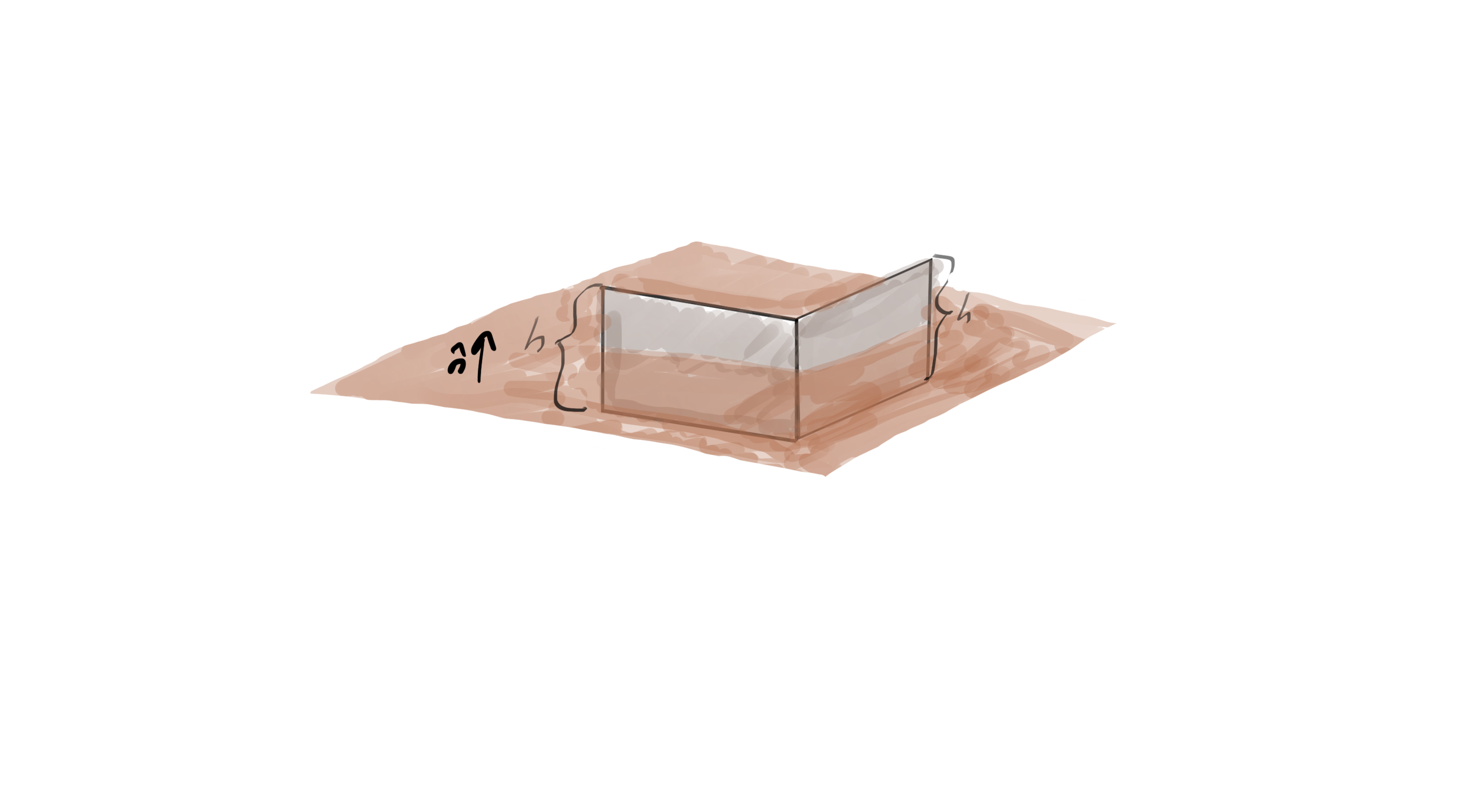
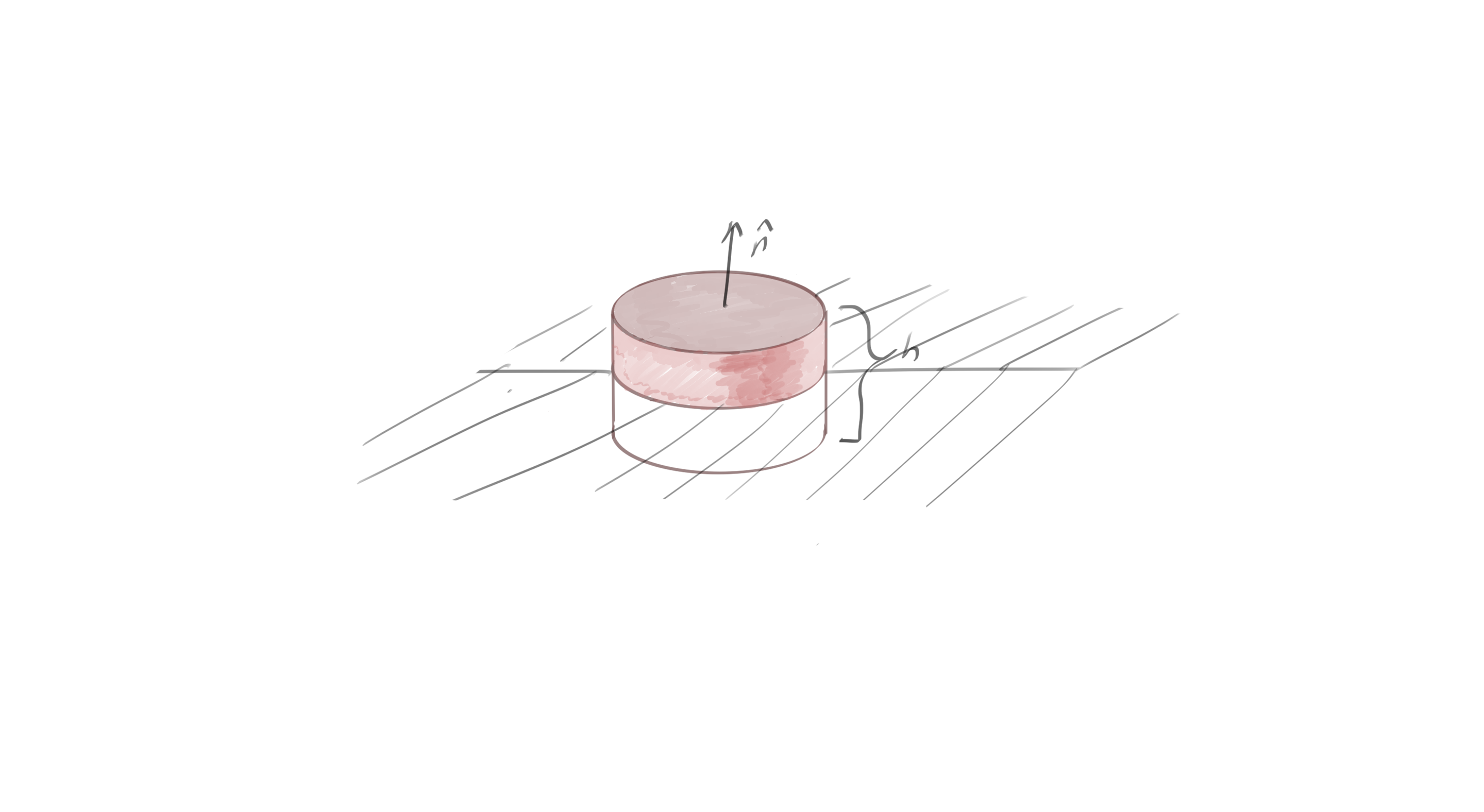
Now it is possible to employ Stokes theorem to each of these. The usual procedure is to both use the loops of fig. 2 and the pillbox of fig. 1, where in both cases the height is made infinitesimal.

boundaryConditionsTwoSurfacesFig1

fig 1. Two surfaces normal to the interface.

boundaryConditionsPillBoxFig2

fig 2. A pillbox volume encompassing the interface.

With all these relations expressed in curl form as above, we can use just the pillbox configuration to evaluate the Stokes integrals.
Let the height \( h \) be measured along the normal axis, and assume that all the charges and currents are localized to the surface

\begin{equation}\label{eqn:boundaryConditionsInMedia:320}
\begin{aligned}
\BM &= \BM_{\textrm{s}} \delta( h ) \\
\BJ &= \BJ_{\textrm{s}} \delta( h ) \\
\rho &= \rho_{\textrm{s}} \delta( h ) \\
\rho_{\textrm{m}} &= \rho_{\textrm{m}\textrm{s}} \delta( h ),
\end{aligned}
\end{equation}

we can enumerate the Stokes integrals \( \int d^3 \Bx \cdot \lr{ \spacegrad \wedge \BX } = \oint_{\partial V} d^2 \Bx \cdot \BX \). The three-volume area element will be written as \( d^3 \Bx = d^2 \Bx \wedge \ncap dh \), giving

\begin{equation}\label{eqn:boundaryConditionsInMedia:360}
\oint_{\partial V} d^2 \Bx \cdot \BE = -\int (d^2 \Bx \wedge \ncap) \cdot \lr{ I \BM_{\textrm{s}} + \partial_t I \BB \Delta h}
\end{equation}
\begin{equation}\label{eqn:boundaryConditionsInMedia:380}
\oint_{\partial V} d^2 \Bx \cdot \BH = \int (d^2 \Bx \wedge \ncap) \cdot \lr{ I \BJ_{\textrm{s}} + \partial_t I \BD \Delta h}
\end{equation}
\begin{equation}\label{eqn:boundaryConditionsInMedia:400}
\oint_{\partial V} d^2 \Bx \cdot (I\BD) = \int (d^2 \Bx \wedge \ncap) \cdot \lr{ \rho_{\textrm{s}} I }
\end{equation}
\begin{equation}\label{eqn:boundaryConditionsInMedia:420}
\oint_{\partial V} d^2 \Bx \cdot (I\BB) = \int (d^2 \Bx \wedge \ncap) \cdot \lr{ \rho_{\textrm{m}\textrm{s}} I }
\end{equation}

In the limit with \( \Delta h \rightarrow 0 \), the LHS integrals are reduced to just the top and bottom surfaces, and the \( \Delta h \) contributions on the RHS are eliminated. With \( i = I \ncap \), and \( d^2 \Bx = dA\, i \) on the top surface, we are left with

\begin{equation}\label{eqn:boundaryConditionsInMedia:460}
0 = \int dA \lr{ i \cdot \Delta \BE + I \cdot \lr{ I \BM_{\textrm{s}} } }
\end{equation}
\begin{equation}\label{eqn:boundaryConditionsInMedia:480}
0 = \int dA \lr{ i \cdot \Delta \BH – I \cdot \lr{ I \BJ_{\textrm{s}} } }
\end{equation}
\begin{equation}\label{eqn:boundaryConditionsInMedia:500}
0 = \int dA \lr{ i \cdot \Delta (I\BD) + \rho_{\textrm{s}} }
\end{equation}
\begin{equation}\label{eqn:boundaryConditionsInMedia:520}
0 = \int dA \lr{ i \cdot \Delta (I\BB) + \rho_{\textrm{m}\textrm{s}} }
\end{equation}

Consider the first integral. Any component of \( \BE \) that is normal to the plane of the pillbox top (or bottom) has no contribution to the integral, so this constraint is one that effects only the tangential components \( \ncap (\ncap \wedge (\Delta \BE)) \). Writing out the vector portion of the integrand, we have

\begin{equation}\label{eqn:boundaryConditionsInMedia:540}
\begin{aligned}
i \cdot \Delta \BE + I \cdot \lr{ I \BM_{\textrm{s}} }
&=
\gpgradeone{ i \Delta \BE + I^2 \BM_{\textrm{s}} } \\
&=
\gpgradeone{ I \ncap \Delta \BE – \BM_{\textrm{s}} } \\
&=
\gpgradeone{ I \ncap \ncap (\ncap \wedge \Delta \BE) – \BM_{\textrm{s}} } \\
&=
\gpgradeone{ I (\ncap \wedge (\Delta \BE)) – \BM_{\textrm{s}} } \\
&=
\gpgradeone{ -\ncap \cross (\Delta \BE) – \BM_{\textrm{s}} }.
\end{aligned}
\end{equation}

The dot product (a scalar) in the two surface charge integrals can also be reduced

\begin{equation}\label{eqn:boundaryConditionsInMedia:560}
\begin{aligned}
i \cdot \Delta (I\BD)
&=
\gpgradezero{ i \Delta (I\BD) } \\
&=
\gpgradezero{ I \ncap \Delta (I\BD) } \\
&=
\gpgradezero{ -\ncap \Delta \BD } \\
&=
-\ncap \cdot \Delta \BD,
\end{aligned}
\end{equation}

so the integral equations are satisfied provided

\begin{equation}\label{eqn:boundaryConditionsInMedia:580}
\boxed{
\begin{aligned}
\ncap \cross (\BE_2 – \BE_1) &= – \BM_{\textrm{s}} \\
\ncap \cross (\BH_2 – \BH_1) &= \BJ_{\textrm{s}} \\
\ncap \cdot (\BD_2 – \BD_1) &= \rho_{\textrm{s}} \\
\ncap \cdot (\BB_2 – \BB_1) &= \rho_{\textrm{m}\textrm{s}}.
\end{aligned}
}
\end{equation}

It is tempting to try to assemble these into a results expressed in terms of a four-vector surface current and composite STA bivector fields like the \( F = \BE + I c \BB \) that we can use for the free space Maxwell’s equation. Dimensionally, we need something with velocity in that mix, but what velocity should be used when the speed of the field propagation in each media is potentially different?

References

[1] Constantine A Balanis. Advanced engineering electromagnetics. Wiley New York, 1989.

Maxwell equation boundary conditions

September 6, 2016 math and physics play , , , , , , , , , , , , , ,

[Click here for a PDF of this post with nicer formatting]

Motivation

boundaryConditionsTwoSurfacesFig1

fig 1. Two surfaces normal to the interface.

Most electrodynamics textbooks either start with or contain a treatment of boundary value conditions. These typically involve evaluating Maxwell’s equations over areas or volumes of decreasing height, such as those illustrated in fig. 1, and fig. 2. These represent surfaces and volumes where the height is allowed to decrease to infinitesimal levels, and are traditionally used to find the boundary value constraints of the normal and tangential components of the electric and magnetic fields.

boundaryConditionsPillBoxFig2

fig 2. A pillbox volume encompassing the interface.

More advanced topics, such as evaluation of the Fresnel reflection and transmission equations, also rely on similar consideration of boundary value constraints. I’ve wondered for a long time how the Fresnel equations could be attacked by looking at the boundary conditions for the combined field \( F = \BE + I c \BB \), instead of the considering them separately.

A unified approach.

The Geometric Algebra (and relativistic tensor) formulations of Maxwell’s equations put the electric and magnetic fields on equal footings. It is in fact possible to specify the boundary value constraints on the fields without first separating Maxwell’s equations into their traditional forms. The starting point in Geometric Algebra is Maxwell’s equation, premultiplied by a stationary observer’s timelike basis vector

\begin{equation}\label{eqn:maxwellBoundaryConditions:20}
\gamma_0 \grad F = \inv{\epsilon_0 c} \gamma_0 J,
\end{equation}

or

\begin{equation}\label{eqn:maxwellBoundaryConditions:40}
\lr{ \partial_0 + \spacegrad} F = \frac{\rho}{\epsilon_0} – \frac{\BJ}{\epsilon_0}.
\end{equation}

The electrodynamic field \(F = \BE + I c \BB\) is a multivector in this spatial domain (whereas it is a bivector in the spacetime algebra domain), and has vector and bivector components. The product of the spatial gradient and the field can still be split into dot and curl components \(\spacegrad M = \spacegrad \cdot M + \spacegrad \wedge M \). If \(M = \sum M_i \), where \(M_i\) is an grade \(i\) blade, then we give this the Hestenes’ [1] definitions

\begin{equation}\label{eqn:maxwellBoundaryConditions:60}
\begin{aligned}
\spacegrad \cdot M &= \sum_i \gpgrade{\spacegrad M_i}{i-1} \\
\spacegrad \wedge M &= \sum_i \gpgrade{\spacegrad M_i}{i+1}.
\end{aligned}
\end{equation}

With that said, Maxwell’s equation can be rearranged into a pair of multivector equations

\begin{equation}\label{eqn:maxwellBoundaryConditions:80}
\begin{aligned}
\spacegrad \cdot F &= \gpgrade{-\partial_0 F + \frac{\rho}{\epsilon_0} – \frac{\BJ}{\epsilon_0 c}}{0,1} \\
\spacegrad \wedge F &= \gpgrade{-\partial_0 F + \frac{\rho}{\epsilon_0} – \frac{\BJ}{\epsilon_0 c}}{2,3},
\end{aligned}
\end{equation}

The latter equation can be integrated with Stokes theorem, but we need to apply a duality transformation to the latter in order to apply Stokes to it

\begin{equation}\label{eqn:maxwellBoundaryConditions:120}
\begin{aligned}
\spacegrad \cdot F
&=
-I^2 \spacegrad \cdot F \\
&=
-I^2 \gpgrade{\spacegrad F}{0,1} \\
&=
-I \gpgrade{I \spacegrad F}{2,3} \\
&=
-I \spacegrad \wedge (IF),
\end{aligned}
\end{equation}

so

\begin{equation}\label{eqn:maxwellBoundaryConditions:100}
\begin{aligned}
\spacegrad \wedge (I F) &= I \lr{ -\inv{c} \partial_t \BE + \frac{\rho}{\epsilon_0} – \frac{\BJ}{\epsilon_0 c} } \\
\spacegrad \wedge F &= -I \partial_t \BB.
\end{aligned}
\end{equation}

Integrating each of these over the pillbox volume gives

\begin{equation}\label{eqn:maxwellBoundaryConditions:140}
\begin{aligned}
\oint_{\partial V} d^2 \Bx \cdot (I F)
&=
\int_{V} d^3 \Bx \cdot \lr{ I \lr{ -\inv{c} \partial_t \BE + \frac{\rho}{\epsilon_0} – \frac{\BJ}{\epsilon_0 c} } } \\
\oint_{\partial V} d^2 \Bx \cdot F
&=
– \partial_t \int_{V} d^3 \Bx \cdot \lr{ I \BB }.
\end{aligned}
\end{equation}

In the absence of charges and currents on the surface, and if the height of the volume is reduced to zero, the volume integrals vanish, and only the upper surfaces of the pillbox contribute to the surface integrals.

\begin{equation}\label{eqn:maxwellBoundaryConditions:200}
\begin{aligned}
\oint_{\partial V} d^2 \Bx \cdot (I F) &= 0 \\
\oint_{\partial V} d^2 \Bx \cdot F &= 0.
\end{aligned}
\end{equation}

With a multivector \(F\) in the mix, the geometric meaning of these integrals is not terribly clear. They do describe the boundary conditions, but to see exactly what those are, we can now resort to the split of \(F\) into its electric and magnetic fields. Let’s look at the non-dual integral to start with

\begin{equation}\label{eqn:maxwellBoundaryConditions:160}
\begin{aligned}
\oint_{\partial V} d^2 \Bx \cdot F
&=
\oint_{\partial V} d^2 \Bx \cdot \lr{ \BE + I c \BB } \\
&=
\oint_{\partial V} d^2 \Bx \cdot \BE + I c d^2 \Bx \wedge \BB \\
&=
0.
\end{aligned}
\end{equation}

No component of \(\BE\) that is normal to the surface contributes to \(d^2 \Bx \cdot \BE \), whereas only components of \(\BB\) that are normal contribute to \(d^2 \Bx \wedge \BB \). That means that we must have tangential components of \(\BE\) and the normal components of \(\BB\) matching on the surfaces

\begin{equation}\label{eqn:maxwellBoundaryConditions:180}
\begin{aligned}
\lr{\BE_2 \wedge \ncap} \ncap – \lr{\BE_1 \wedge (-\ncap)} (-\ncap) &= 0 \\
\lr{\BB_2 \cdot \ncap} \ncap – \lr{\BB_1 \cdot (-\ncap)} (-\ncap) &= 0 .
\end{aligned}
\end{equation}

Similarly, for the dot product of the dual field, this is

\begin{equation}\label{eqn:maxwellBoundaryConditions:220}
\begin{aligned}
\oint_{\partial V} d^2 \Bx \cdot (I F)
&=
\oint_{\partial V} d^2 \Bx \cdot (I \BE – c \BB) \\
&=
\oint_{\partial V} I d^2 \Bx \wedge \BE – c d^2 \Bx \cdot \BB.
\end{aligned}
\end{equation}

For this integral, only the normal components of \(\BE\) contribute, and only the tangential components of \(\BB\) contribute. This means that

\begin{equation}\label{eqn:maxwellBoundaryConditions:240}
\begin{aligned}
\lr{\BE_2 \cdot \ncap} \ncap – \lr{\BE_1 \cdot (-\ncap)} (-\ncap) &= 0 \\
\lr{\BB_2 \wedge \ncap} \ncap – \lr{\BB_1 \wedge (-\ncap)} (-\ncap) &= 0.
\end{aligned}
\end{equation}

This is why we end up with a seemingly strange mix of tangential and normal components of the electric and magnetic fields. These constraints can be summarized as

\begin{equation}\label{eqn:maxwellBoundaryConditions:260}
\begin{aligned}
( \BE_2 – \BE_1 ) \cdot \ncap &= 0 \\
( \BE_2 – \BE_1 ) \wedge \ncap &= 0 \\
( \BB_2 – \BB_1 ) \cdot \ncap &= 0 \\
( \BB_2 – \BB_1 ) \wedge \ncap &= 0
\end{aligned}
\end{equation}

These relationships are usually expressed in terms of all of \(\BE, \BD, \BB\) and \(\BH \). Because I’d started with Maxwell’s equations for free space, I don’t have the \( \epsilon \) and \( \mu \) factors that produce those more general relationships. Those more general boundary value relationships are usually the starting point for the Fresnel interface analysis. It is also possible to further generalize these relationships to include charges and currents on the surface.

References

[1] D. Hestenes. New Foundations for Classical Mechanics. Kluwer Academic Publishers, 1999.