magnetic field

Electric and magnetic fields at an interface

October 9, 2016 math and physics play , , ,

[Click here for a PDF of this post with nicer formatting]

As pointed out in [1] the fields at an interface that is not a perfect conductor on either side are related by

\begin{equation}\label{eqn:fieldsAtInterface:20}
\begin{aligned}
\ncap \cdot \lr{ \BD_2 – \BD_1 } &= \rho_{es} \\
\ncap \cross \lr{ \BE_2 – \BE_1 } &= -\BM_s \\
\ncap \cdot \lr{ \BB_2 – \BB_1 } &= \rho_{ms} \\
\ncap \cross \lr{ \BH_2 – \BH_1 } &= \BJ_s.
\end{aligned}
\end{equation}

Given the fields in medium 1, assuming that boths sets of media are linear, we can use these relationships to determine the fields in the other medium.

\begin{equation}\label{eqn:fieldsAtInterface:40}
\begin{aligned}
\ncap \cdot \BE_2 &= \inv{\epsilon_2} \lr{ \epsilon_1 \ncap \cdot \BE_1 + \rho_{es} } \\
\ncap \wedge \BE_2 &= \ncap \wedge \BE_1 -I \BM_s \\
\ncap \cdot \BB_2 &= \ncap \cdot \BB_1 + \rho_{ms} \\
\ncap \wedge \BB_2 &= \mu_2 \lr{ \inv{\mu_1} \ncap \wedge \BB_1 + I \BJ_s}.
\end{aligned}
\end{equation}

Now the fields in interface 2 can be obtained by adding the normal and tangential projections. For the electric field

\begin{equation}\label{eqn:fieldsAtInterface:60}
\begin{aligned}
\BE_2
&=
\ncap (\ncap \cdot \BE_2 )
+ \ncap \cdot (\ncap \wedge \BE_2) \\
&=
\inv{\epsilon_2} \ncap \lr{ \epsilon_1 \ncap \cdot \BE_1 + \rho_{es} }
+
\ncap \cdot (\ncap \wedge \BE_1 -I \BM_s).
\end{aligned}
\end{equation}

Note that this manipulation can also be done without Geometric Algebra by writing \( \BE_2 = \ncap (\ncap \cdot \BE_2 ) – \ncap \cross (\ncap \cross \BE_2) \)).
Expanding \( \ncap \cdot (\ncap \wedge \BE_1) = \BE_1 – \ncap (\ncap \cdot \BE_1) \), and \( \ncap \cdot (I \BM_s) = -\ncap \cross \BM_s \), that is

\begin{equation}\label{eqn:fieldsAtInterface:80}
\boxed{
\BE_2
=
\BE_1
+ \ncap (\ncap \cdot \BE_1) \lr{ \frac{\epsilon_1}{\epsilon_2} – 1 }
+ \frac{\rho_{es}}{\epsilon_2}
+ \ncap \cross \BM_s.
}
\end{equation}

For the magnetic field

\begin{equation}\label{eqn:fieldsAtInterface:100}
\begin{aligned}
\BB_2
&=
\ncap (\ncap \cdot \BB_2 )
+
\ncap \cdot (\ncap \wedge \BB_2) \\
&=
\ncap \lr{ \ncap \cdot \BB_1 + \rho_{ms} }
+
\mu_2 \ncap \cdot \lr{ \lr{ \inv{\mu_1} \ncap \wedge \BB_1 + I \BJ_s} },
\end{aligned}
\end{equation}

which is

\begin{equation}\label{eqn:fieldsAtInterface:120}
\boxed{
\BB_2
=
\frac{\mu_2}{\mu_1} \BB_1
+
\ncap (\ncap \cdot \BB_1) \lr{ 1 – \frac{\mu_2}{\mu_1} }
+ \ncap \rho_{ms}
– \ncap \cross \BJ_s.
}
\end{equation}

These are kind of pretty results, having none of the explicit angle dependence that we see in the Fresnel relationships. In this analysis, it is assumed there is only a transmitted component of the ray in question, and no reflected component. Can we do a purely vectoral treatment of the Fresnel equations along these same lines?

References

[1] Constantine A Balanis. Advanced engineering electromagnetics. Wiley New York, 1989.
Green’s function inversion of the magnetostatic equation

September 27, 2016 math and physics play , , , , , , , , ,

[Click here for a PDF of this post with nicer formatting]

A previous example of inverting a gradient equation was the electrostatics equation. We can do the same for the magnetostatics equation, which has the following Geometric Algebra form in linear media

\begin{equation}\label{eqn:biotSavartGreens:20}
\spacegrad I \BB = – \mu \BJ.
\end{equation}

The Green’s inversion of this is
\begin{equation}\label{eqn:biotSavartGreens:40}
\begin{aligned}
I \BB(\Bx)
&= \int_V dV’ G(\Bx, \Bx’) \spacegrad’ I \BB(\Bx’) \\
&= \int_V dV’ G(\Bx, \Bx’) (-\mu \BJ(\Bx’)) \\
&= \inv{4\pi} \int_V dV’ \frac{\Bx – \Bx’}{ \Abs{\Bx – \Bx’}^3 } (-\mu \BJ(\Bx’)).
\end{aligned}
\end{equation}

We expect the LHS to be a bivector, so the scalar component of this should be zero. That can be demonstrated with some of the usual trickery
\begin{equation}\label{eqn:biotSavartGreens:60}
\begin{aligned}
-\frac{\mu}{4\pi} \int_V dV’ \frac{\Bx – \Bx’}{ \Abs{\Bx – \Bx’}^3 } \cdot \BJ(\Bx’)
&= \frac{\mu}{4\pi} \int_V dV’ \lr{ \spacegrad \inv{ \Abs{\Bx – \Bx’} }} \cdot \BJ(\Bx’) \\
&= -\frac{\mu}{4\pi} \int_V dV’ \lr{ \spacegrad’ \inv{ \Abs{\Bx – \Bx’} }} \cdot \BJ(\Bx’) \\
&= -\frac{\mu}{4\pi} \int_V dV’ \lr{
\spacegrad’ \cdot \frac{\BJ(\Bx’)}{ \Abs{\Bx – \Bx’} }

\frac{\spacegrad’ \cdot \BJ(\Bx’)}{ \Abs{\Bx – \Bx’} }
}.
\end{aligned}
\end{equation}

The current \( \BJ \) is not unconstrained. This can be seen by premultiplying \ref{eqn:biotSavartGreens:20} by the gradient

\begin{equation}\label{eqn:biotSavartGreens:80}
\spacegrad^2 I \BB = -\mu \spacegrad \BJ.
\end{equation}

On the LHS we have a bivector so must have \( \spacegrad \BJ = \spacegrad \wedge \BJ \), or \( \spacegrad \cdot \BJ = 0 \). This kills the \( \spacegrad’ \cdot \BJ(\Bx’) \) integrand numerator in \ref{eqn:biotSavartGreens:60}, leaving

\begin{equation}\label{eqn:biotSavartGreens:100}
\begin{aligned}
-\frac{\mu}{4\pi} \int_V dV’ \frac{\Bx – \Bx’}{ \Abs{\Bx – \Bx’}^3 } \cdot \BJ(\Bx’)
&= -\frac{\mu}{4\pi} \int_V dV’ \spacegrad’ \cdot \frac{\BJ(\Bx’)}{ \Abs{\Bx – \Bx’} } \\
&= -\frac{\mu}{4\pi} \int_{\partial V} dA’ \ncap \cdot \frac{\BJ(\Bx’)}{ \Abs{\Bx – \Bx’} }.
\end{aligned}
\end{equation}

This shows that the scalar part of the equation is zero, provided the normal component of \( \BJ/\Abs{\Bx – \Bx’} \) vanishes on the boundary of the infinite sphere. This leaves the Biot-Savart law as a bivector equation

\begin{equation}\label{eqn:biotSavartGreens:120}
I \BB(\Bx)
= \frac{\mu}{4\pi} \int_V dV’ \BJ(\Bx’) \wedge \frac{\Bx – \Bx’}{ \Abs{\Bx – \Bx’}^3 }.
\end{equation}

Observe that the traditional vector form of the Biot-Savart law can be obtained by premultiplying both sides with \( -I \), leaving

\begin{equation}\label{eqn:biotSavartGreens:140}
\BB(\Bx)
= \frac{\mu}{4\pi} \int_V dV’ \BJ(\Bx’) \cross \frac{\Bx – \Bx’}{ \Abs{\Bx – \Bx’}^3 }.
\end{equation}

This checks against a trusted source such as [1] (eq. 5.39).

References

[1] David Jeffrey Griffiths and Reed College. Introduction to electrodynamics. Prentice hall Upper Saddle River, NJ, 3rd edition, 1999.

Constant magnetic solenoid field

September 24, 2015 phy1520 , , , , ,

[Click here for a PDF of this post with nicer formatting]

In [2] the following vector potential

\begin{equation}\label{eqn:solenoidConstantField:20}
\BA = \frac{B \rho_a^2}{2 \rho} \phicap,
\end{equation}

is introduced in a discussion on the Aharonov-Bohm effect, for configurations where the interior field of a solenoid is either a constant \( \BB \) or zero.

I wasn’t able to make sense of this since the field I was calculating was zero for all \( \rho \ne 0 \)

\begin{equation}\label{eqn:solenoidConstantField:40}
\begin{aligned}
\BB
&= \spacegrad \cross \BA \\
&= \lr{ \rhocap \partial_\rho + \zcap \partial_z + \frac{\phicap}{\rho}
\partial_\phi } \cross \frac{B \rho_a^2}{2 \rho} \phicap \\
&= \lr{ \rhocap \partial_\rho + \frac{\phicap}{\rho} \partial_\phi } \cross
\frac{B \rho_a^2}{2 \rho} \phicap \\
&=
\frac{B \rho_a^2}{2}
\rhocap \cross \phicap \partial_\rho \lr{ \inv{\rho} }
+
\frac{B \rho_a^2}{2 \rho}
\frac{\phicap}{\rho} \cross \partial_\phi \phicap \\
&=
\frac{B \rho_a^2}{2 \rho^2} \lr{ -\zcap + \phicap \cross \partial_\phi \phicap}.
\end{aligned}
\end{equation}

Note that the \( \rho \) partial requires that \( \rho \ne 0 \). To expand the cross product in the second term let \( j = \Be_1 \Be_2 \), and expand using a Geometric Algebra representation of the unit vector

\begin{equation}\label{eqn:solenoidConstantField:60}
\begin{aligned}
\phicap \cross \partial_\phi \phicap
&=
\Be_2 e^{j \phi} \cross \lr{ \Be_2 \Be_1 \Be_2 e^{j \phi} } \\
&=
– \Be_1 \Be_2 \Be_3
\gpgradetwo{
\Be_2 e^{j \phi} (-\Be_1) e^{j \phi}
} \\
&=
\Be_1 \Be_2 \Be_3 \Be_2 \Be_1 \\
&= \Be_3 \\
&= \zcap.
\end{aligned}
\end{equation}

So, provided \( \rho \ne 0 \), \( \BB = 0 \).

The errata [1] provides the clarification, showing that a \( \rho > \rho_a \) constraint is required for this potential to produce the desired results. Continuity at \( \rho = \rho_a \) means that in the interior (or at least on the boundary) we must have one of

\begin{equation}\label{eqn:solenoidConstantField:80}
\BA = \frac{B \rho_a}{2} \phicap,
\end{equation}

or

\begin{equation}\label{eqn:solenoidConstantField:100}
\BA = \frac{B \rho}{2} \phicap.
\end{equation}

The first doesn’t work, but the second does

\begin{equation}\label{eqn:solenoidConstantField:120}
\begin{aligned}
\BB
&= \spacegrad \cross \BA \\
&= \lr{ \rhocap \partial_\rho + \zcap \partial_z + \frac{\phicap}{\rho}
\partial_\phi } \cross \frac{B \rho}{2 } \phicap \\
&=
\frac{B }{2 } \rhocap \cross \phicap
+
\frac{B \rho}{2 }
\frac{\phicap}{\rho} \cross \partial_\phi \phicap \\
&= B \zcap.
\end{aligned}
\end{equation}

So the vector potential that we want for a constant \( B \zcap \) field in the interior \( \rho < \rho_a \) of a cylindrical space, we need

\begin{equation}\label{eqn:solenoidConstantField:140}
\BA =
\left\{
\begin{array}{l l}
\frac{B \rho_a^2}{2 \rho} \phicap & \quad \mbox{if \( \rho \ge \rho_a \) } \\
\frac{B \rho}{2} \phicap & \quad \mbox{if \( \rho \le \rho_a \).}
\end{array}
\right.
\end{equation}

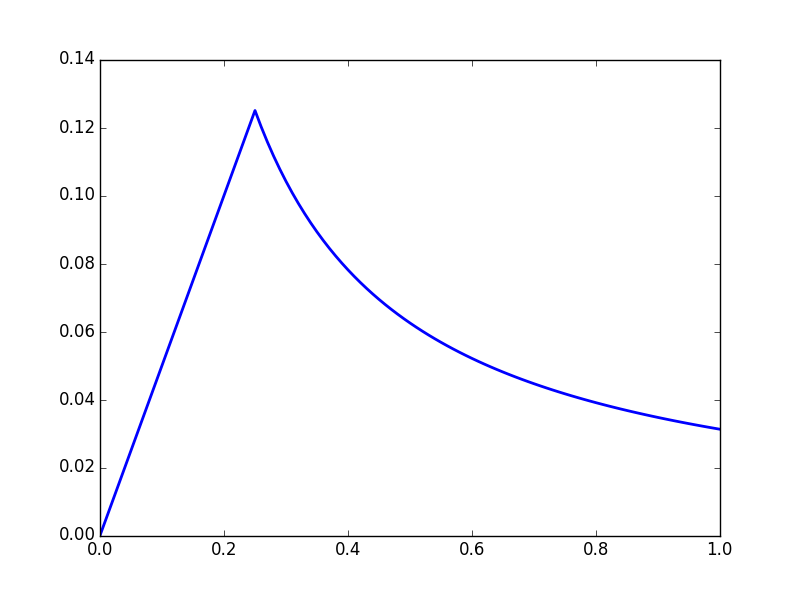
An example of the magnitude of potential is graphed in fig. 1.

solenoidPotentialFig1

fig. 1. Vector potential for constant field in cylindrical region.


References

[1] Jun John Sakurai and Jim J Napolitano. \emph{Errata: Typographical Errors, Mistakes, and Comments, Modern Quantum Mechanics, 2nd Edition}, 2013. URL http://www.rpi.edu/dept/phys/Courses/PHYS6520/Spring2015/ErrataMQM.pdf.

[2] Jun John Sakurai and Jim J Napolitano. Modern quantum mechanics. Pearson Higher Ed, 2014.

Plane wave solution directly from Maxwell’s equations

May 6, 2015 math and physics play , , , ,

[Click here for a PDF of this post with nicer formatting]

Here’s a problem that I thought was fun, an exercise for the reader to show that the plane wave solution to Maxwell’s equations can be found with ease directly from Maxwell’s equations. This is in contrast to the what seems like the usual method of first showing that Maxwell’s equations imply wave equations for the fields, and then solving those wave equations.

Problem. \( \xcap \) oriented plane wave electric field ([1] ex. 4.1)

A uniform plane wave having only an \( x \) component of the electric field is traveling in the \( + z \) direction in an unbounded lossless, source-0free region. Using Maxwell’s equations write expressions for the electric and corresponding magnetic field intensities.

Answer

The phasor form of Maxwell’s equations for a source free region are

\begin{equation}\label{eqn:ExPlaneWave:40}
\spacegrad \cross \BE = -j \omega \BB
\end{equation}
\begin{equation}\label{eqn:ExPlaneWave:60}
\spacegrad \cross \BH = j \omega \BD
\end{equation}
\begin{equation}\label{eqn:ExPlaneWave:80}
\spacegrad \cdot \BD = 0
\end{equation}
\begin{equation}\label{eqn:ExPlaneWave:100}
\spacegrad \cdot \BB = 0.
\end{equation}

Since \( \BE = \xcap E(z) \), the magnetic field follows from \ref{eqn:ExPlaneWave:40}

\begin{equation}\label{eqn:ExPlaneWave:120}
-j \omega \BB
= \spacegrad \cross \BE
=
\begin{vmatrix}
\xcap & \ycap & \zcap \\
\partial_x & \partial_y & \partial_z \\
E & 0 & 0
\end{vmatrix}
=
\ycap \partial_z E(z)
– \zcap \partial_y E(z),
\end{equation}

or

\begin{equation}\label{eqn:ExPlaneWave:140}
\BB =
-\inv{j \omega} \partial_z E.
\end{equation}

This is constrained by \ref{eqn:ExPlaneWave:60}

\begin{equation}\label{eqn:ExPlaneWave:160}
j \omega \epsilon \xcap E
=
\inv{\mu} \spacegrad \cross \BB
=
-\inv{\mu j \omega}
\begin{vmatrix}
\xcap & \ycap & \zcap \\
\partial_x & \partial_y & \partial_z \\
0 & \partial_z E & 0
\end{vmatrix}
=
-\inv{\mu j \omega}
\lr{
-\xcap \partial_{z z} E
+ \zcap \partial_x \partial_z E
}
\end{equation}

Since \( \partial_x \partial_z E = \partial_z \lr{ \partial_x E } = \partial_z \inv{\epsilon} \spacegrad \cdot \BD = \partial_z 0 \), this means

\begin{equation}\label{eqn:ExPlaneWave:180}
\partial_{zz} E = -\omega^2 \epsilon\mu E = -k^2 E.
\end{equation}

This is the usual starting place that we use to show that the plane wave has an exponential form

\begin{equation}\label{eqn:ExPlaneWave:200}
\BE(z) =
\xcap
\lr{
E_{+} e^{-j k z}
+
E_{-} e^{j k z}
}.
\end{equation}

The magnetic field from \ref{eqn:ExPlaneWave:140} is

\begin{equation}\label{eqn:ExPlaneWave:220}
\BB
= \frac{j}{\omega} \lr{ -j k E_{+} e^{-j k z} + j k E_{-} e^{j k z} }
= \inv{c} \lr{ E_{+} e^{-j k z} – E_{-} e^{j k z} },
\end{equation}

or

\begin{equation}\label{eqn:ExPlaneWave:240}
\BH
= \inv{\mu c} \lr{ E_{+} e^{-j k z} – E_{-} e^{j k z} }
= \inv{\eta} \lr{ E_{+} e^{-j k z} – E_{-} e^{j k z} }.
\end{equation}

A solution requires zero divergence for the magnetic field, but that can be seen to be the case by inspection.

References

[1] Constantine A Balanis. Advanced engineering electromagnetics. Wiley New York, 1989.
Updated notes for ece1229 antenna theory

March 16, 2015 ece1229 , , , , , , , , , , , , , , , , , , , , , , , , , , , , , , , , , , , , , , , , , , , , , , , , , , , , , , , , , , , , , , , , , , , , , , , , , , , , , , , , , , , , , , , , , , , , , , , , , , , , , , , , , , , , , , , , , , , , , , , , , , , , , , , , , , , , , , , , , , , , , , , , , , , , ,

I’ve now posted a first update of my notes for the antenna theory course that I am taking this term at UofT.

Unlike most of the other classes I have taken, I am not attempting to take comprehensive notes for this class. The class is taught on slides which go by faster than I can easily take notes for (and some of which match the textbook closely). In class I have annotated my copy of textbook with little details instead. This set of notes contains musings of details that were unclear, or in some cases, details that were provided in class, but are not in the text (and too long to pencil into my book), as well as some notes Geometric Algebra formalism for Maxwell’s equations with magnetic sources (something I’ve encountered for the first time in any real detail in this class).

The notes compilation linked above includes all of the following separate notes, some of which have been posted separately on this blog: